
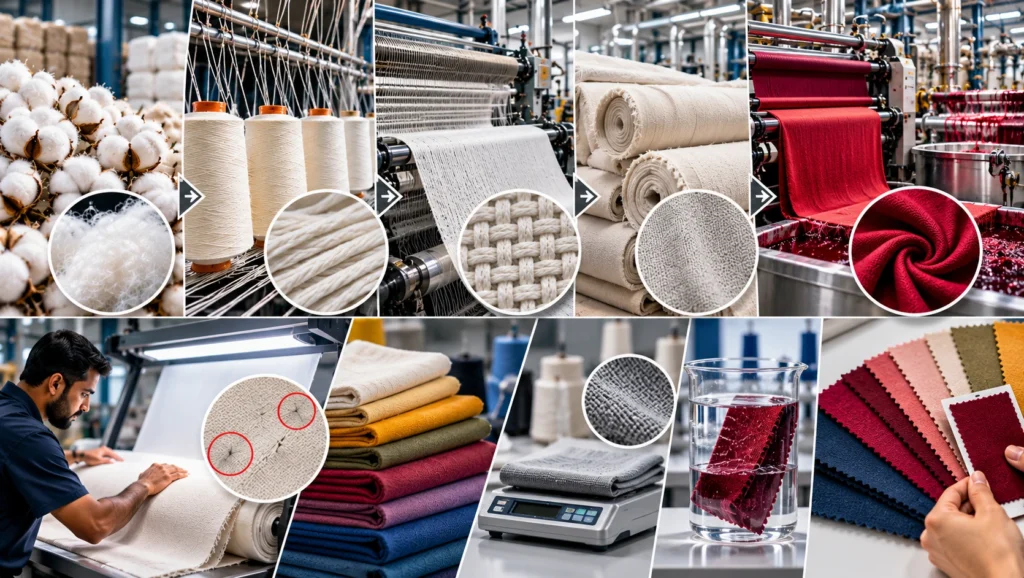
Every fabric starts as fibre, and the fibre choice sets limits on everything downstream: how the yarn spins, how the fabric drapes, how it dyes, and how it performs on a customer’s body. The first fork in the road is natural versus synthetic.
Natural fibres come from plants, animals, or (rarely) minerals. Cotton, the most widely used natural fibre in apparel, is harvested from the cotton plant’s seed pod, then separated from the seeds in a process called ginning before it’s cleaned and baled for shipping to a spinning mill. Wool is sheared from sheep and washed to remove lanolin and dirt before spinning. Linen comes from the flax plant’s stem fibres. Natural fibres generally breathe well and take dye readily, but they vary batch to batch depending on the harvest, which is why mills blend cotton from different bales to keep yarn quality consistent.
Synthetic fibres are manufactured, not grown. Polyester and nylon are made by forcing molten polymer through a spinneret, a device with tiny holes, to form continuous filaments, which are then either used as filament yarn directly or cut into shorter staple lengths and spun like a natural fibre if they need to blend with cotton. Synthetics are engineered for consistency, moisture-wicking, and stretch recovery, which is why most performance and activewear fabric leans synthetic or blended.
Neither category is inherently better. A brand ordering combed cotton jersey for a premium T-shirt needs natural fibre for hand feel and breathability. A brand ordering compression-fit activewear needs a synthetic or synthetic-heavy blend for stretch recovery and moisture management. The fibre decision should follow from what the garment needs to do, not from habit. If the question is which fabric type fits a specific garment category, our guide to denim fabric types covers that decision in more depth for one common case.
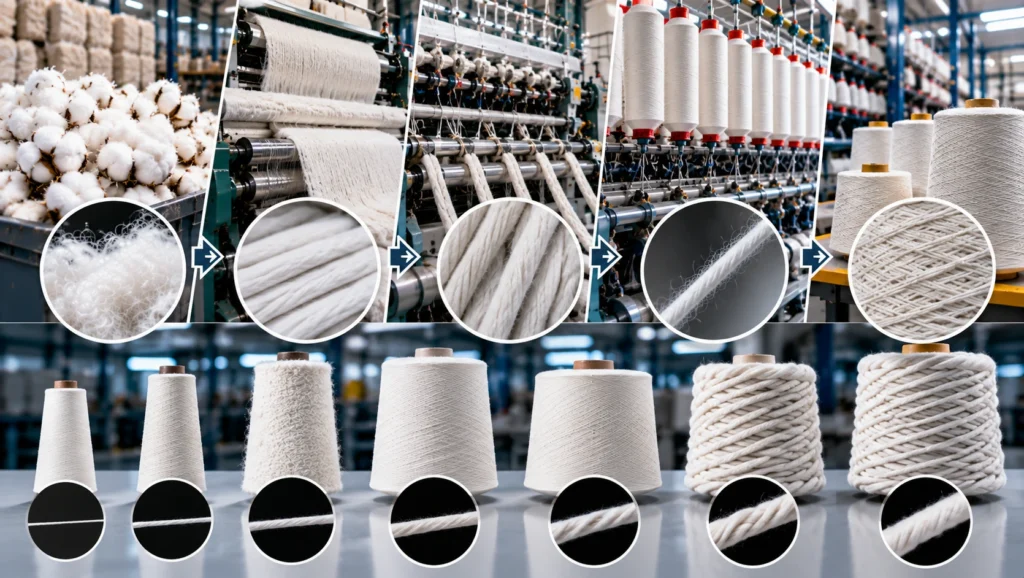
Loose fibre can’t be woven or knitted on its own. It first has to become yarn, a continuous, twisted strand strong enough to survive a loom or knitting machine.
Raw fibre goes through carding, which passes it through fine wire teeth to remove impurities and align the fibres roughly parallel, producing a loose rope called a sliver. Higher-quality yarns add combing after carding, which pulls out the shortest fibres and leaves only longer ones aligned in parallel; this is why combed cotton feels smoother and pills less than carded-only cotton. The sliver is then drawn out and twisted into yarn, a process called spinning. Twist direction (S-twist or Z-twist) and twist level both affect strength and hand feel; more twist generally means a stronger but firmer yarn.
Yarn fineness is described by yarn count, and the two common systems measure opposite things. Direct systems like tex (grams per kilometre of yarn) and denier (grams per 9,000 metres, mostly used for synthetic filament) get a bigger number for a thicker yarn. The indirect system, cotton count (Ne), does the opposite: it counts how many 840-yard hanks make up one pound of yarn, so a higher Ne number means a finer, thinner yarn. A buyer comparing two yarn quotes needs to know which system a mill is quoting in, since “30” means a coarse yarn in tex and a relatively fine one in cotton count.
Ring spinning and open-end (rotor) spinning are the two dominant industrial methods, and they don’t just differ in cost. Ring-spun yarn is pulled through a slower process that produces a stronger, slightly uneven yarn prized for premium and fade-sensitive fabrics like denim. Open-end spinning is faster and cheaper, producing a more uniform yarn suited to high-volume, value-tier goods. Neither is a defect; they’re a tradeoff a buyer should choose on purpose, since the ring-spun versus open-end decision has a direct, visible effect on how the finished garment fades, a point covered in more depth in our guide to denim fabric types.
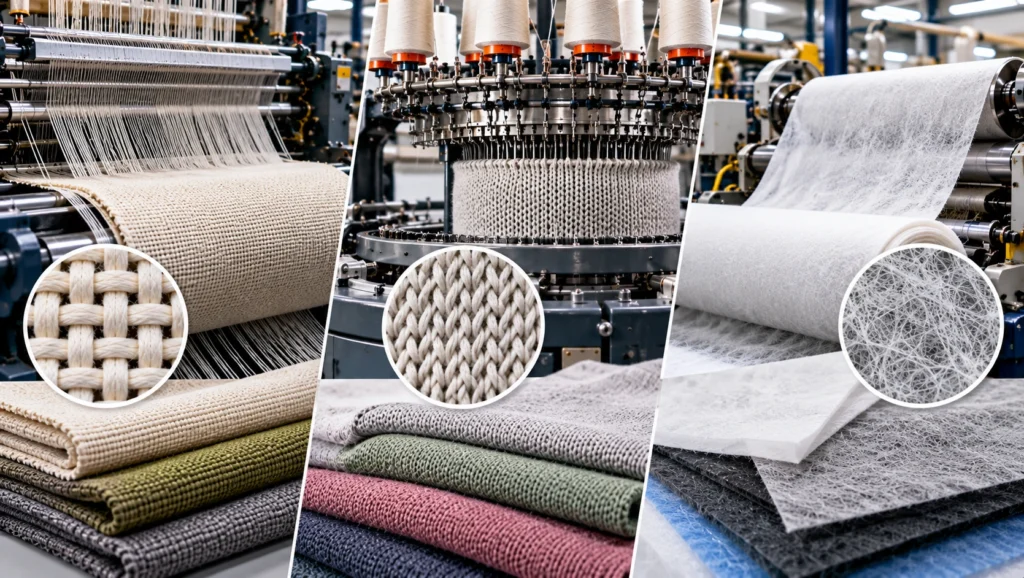
Once yarn exists, it has to become fabric, and there are three structurally different ways to do that, each producing cloth with different stretch, drape, and fraying behaviour.
Weaving interlaces two sets of yarn, the lengthwise warp and the crosswise weft, at right angles on a loom. Warp yarns are wound onto a beam under tension (warping), often coated with a protective starch or resin (sizing) to survive the friction of weaving, then threaded through the loom’s heddles and reed (drawing-in). The loom then repeats five motions: shedding (raising and lowering warp yarns to form a gap), picking (passing the weft yarn through that gap), beat-up (pushing the new weft yarn tight against the fell of the cloth), let-off (releasing more warp from the beam), and take-up (winding the finished fabric onto a cloth beam). Woven fabric generally has less inherent stretch than knit, holds a crease well, and doesn’t run or ladder if cut, which is why it’s the default for structured garments like jackets and trousers.
Knitting interlocks loops of yarn instead of interlacing two yarn sets. Weft knitting forms loops across the fabric’s width from one continuous yarn, the structure behind jersey and most T-shirt fabric. Warp knitting forms loops along the fabric’s length from multiple yarns simultaneously, producing more run-resistant structures like tricot. Knit fabric stretches more than woven by nature of its loop structure, which is why it’s the default for T-shirts, activewear, and anything that needs to move with the body.
Nonwoven fabric skips yarn entirely. According to INDA, the Association of the Nonwoven Fabrics Industry, nonwoven fabrics are sheet or web structures made directly from fibres or filaments, bonded together by mechanical, thermal, or chemical means rather than by weaving or knitting. Felt, interlining, and many technical or single-use materials fall into this category. For a typical apparel brand, nonwovens usually show up as interlining, labels, or packaging components rather than as the visible outer fabric, but it’s worth knowing the category exists as a third structural option distinct from woven and knit.
Choosing between these three isn’t a style preference, it’s a structural decision that determines how the finished garment will fit, move, and hold its shape.
Fabric straight off a loom or knitting machine is called greige (pronounced “gray”) goods, sometimes written grey goods or grey cloth. It’s raw and undyed, usually the pale or off-white colour of the fibre itself, and it still carries natural oils, waxes, dirt, and whatever sizing was applied to the warp yarn before weaving.
Greige fabric isn’t ready to dye or sell as-is. Singeing burns off short surface fibres with a gas flame or hot plate so the fabric surface is smooth and doesn’t pill excessively. Desizing removes the sizing added before weaving, using dilute acid, enzymes, or plain washing, since sizing left in place blocks even dye absorption. Scouring washes out remaining oils, waxes, and natural impurities. Bleaching, where needed, removes the fabric’s natural colour so a pale or bright dye shade can come through clean rather than muddy. Mercerizing, used mainly on cotton, treats the fabric with concentrated caustic soda under tension to increase strength, lustre, and dye uptake.
This is also the point in the process where a mill can hold undyed inventory and dye it to order once a brand confirms a colour, which is exactly why piece-dyed greige stock shortens lead time compared to yarn that’s already been dyed before weaving.
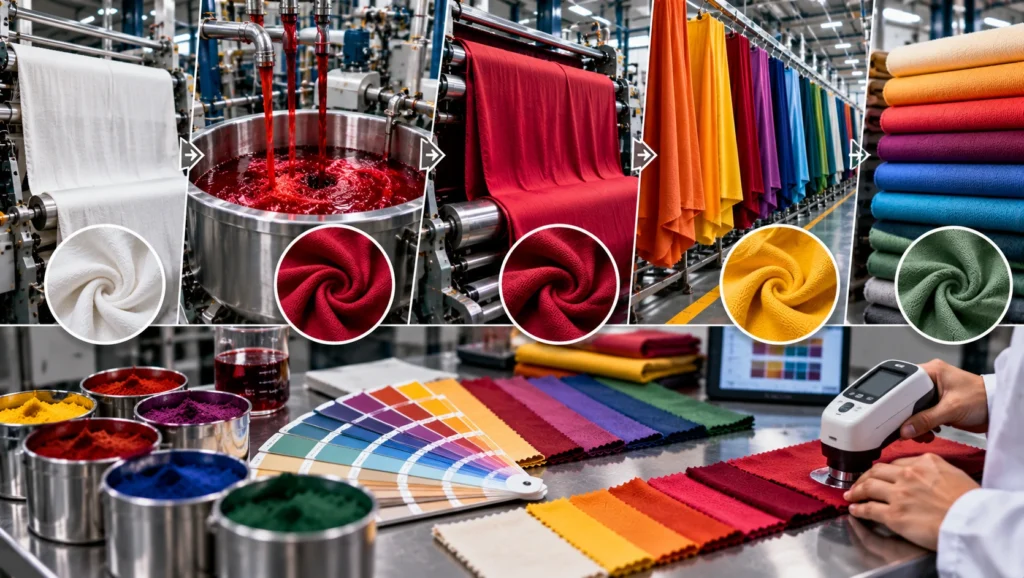
Once greige fabric is prepared, it’s ready for colour. Colour can be added at the fibre, yarn, piece (fabric), or garment stage, and the choice affects cost, consistency, and how a reorder will be checked against the original approval. The dye chemistry itself, which dye class suits which fibre, how a lab dip gets approved, and what colour fastness testing actually measures, is enough of a subject on its own that we’ve covered it separately in our guide to the fabric dyeing process. This guide focuses on how the base fabric itself gets built; that one covers what happens to it once colour enters the picture.
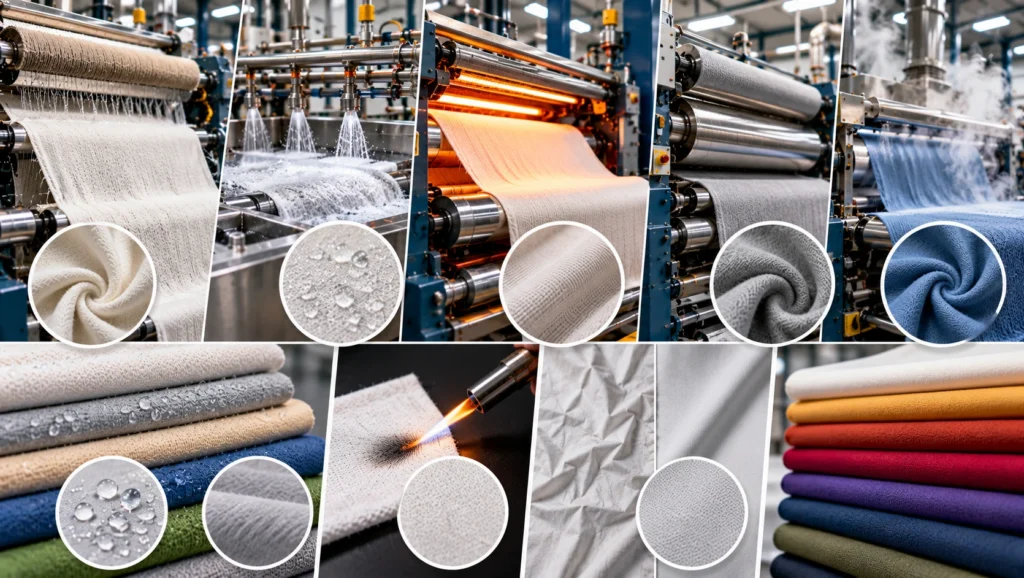
Finishing is the last stage before fabric is graded and shipped, and it splits into two categories that solve different problems.
Mechanical finishes change the fabric’s surface or structure through physical processes, no chemicals reacting with the fibre. Calendering passes fabric between heated rollers under pressure for a smooth, slightly lustrous surface. Brushing or napping raises a soft surface fibre, the process behind fleece and flannel’s hand feel. Compaction and tentering control the fabric’s final width and correct distortion like skew or bow before it ships, often the last chance to fix a dimensional problem before the fabric leaves the mill.
Chemical finishes apply a treatment that bonds to or coats the fibre to add a specific performance property. Softening finishes improve hand feel. Durable water repellent (DWR) coatings are common on jacket shells and outerwear. Anti-microbial finishes reduce odour retention on activewear. Wrinkle-resistant and soil-release finishes are common on shirting and workwear.
A tech pack that just says “soft finish” or “water resistant” doesn’t tell a mill which of these to apply or how durable the effect needs to be through washing. Naming the specific finish, and whether it needs to survive a stated number of wash cycles, is worth the extra line on a spec sheet.
Before finished fabric reaches a cutting table, it gets graded, and the apparel industry’s default method is the 4-point system, formalised under ASTM D5430, the standard test methods for visually inspecting and grading fabrics.
The system assigns penalty points to each visible defect based on its length, not its severity in a subjective sense: a defect up to 3 inches long scores 1 point, 3.1 to 6 inches scores 2 points, 6.1 to 9 inches scores 3 points, and anything longer than 9 inches scores the maximum 4 points, regardless of how long it actually runs. Points are then totalled and compared against a tolerance expressed as points per 100 square yards. A roll that stays within the buyer’s agreed tolerance passes as first quality; a roll that exceeds it gets downgraded to second quality or rejected outright.
The value of a named, numbered standard here is that it removes the argument. “The fabric looked fine to us” isn’t a defensible position when a buyer can point to a specific points-per-hundred-yards tolerance and a rejected roll that exceeded it. Specifying “graded to the 4-point system, maximum X points per 100 square yards” on a fabric order gives a mill and an inspector the same number to check against, which is the same discipline covered in more depth in our guide to apparel quality control and AQL inspection for the garment level.
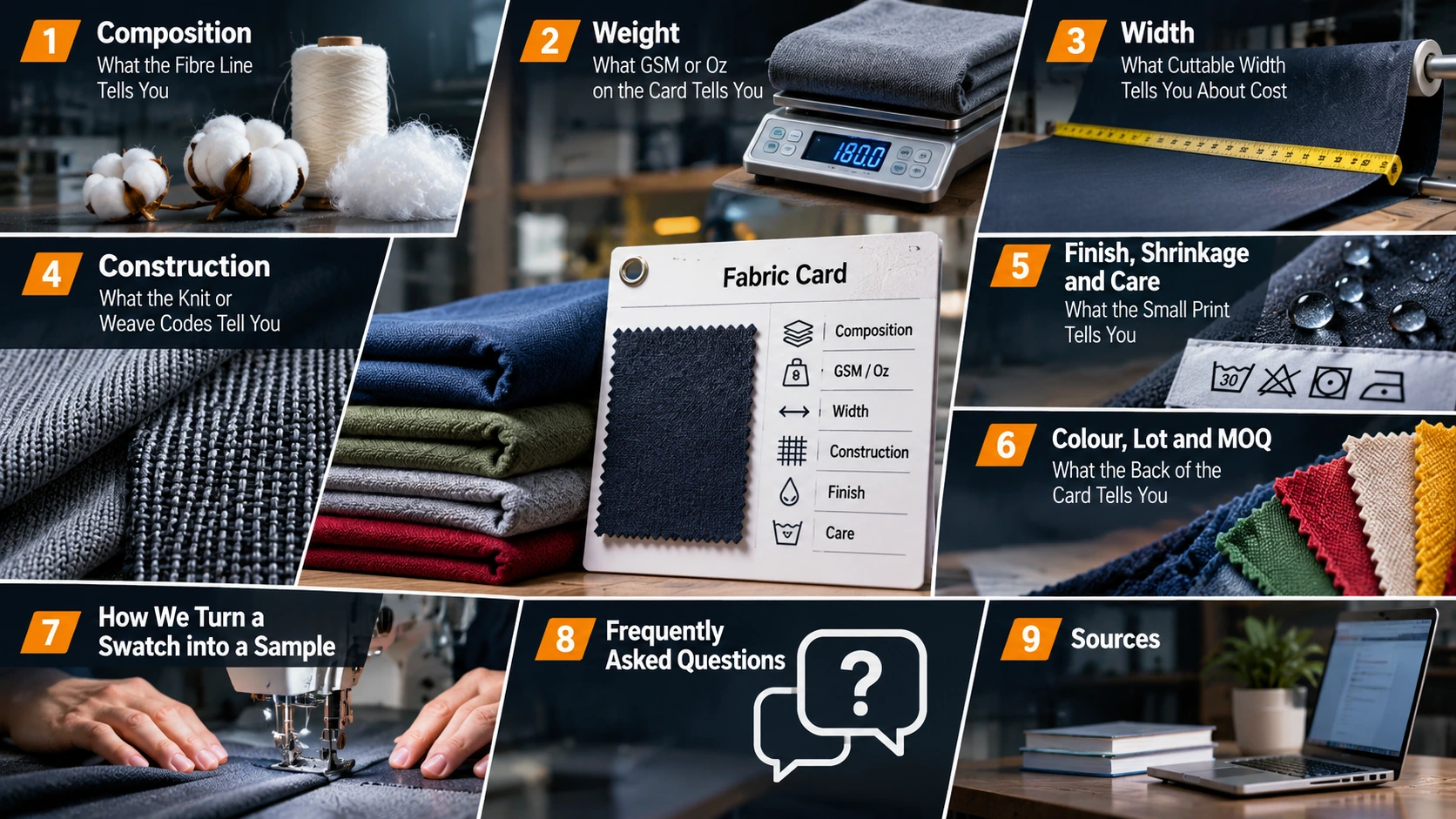
Most fabric requests we see specify a fibre and a colour and stop there, which leaves a mill guessing at exactly the details that cause disputes later. Four numbers belong on every fabric spec, whether it’s going into a tech pack or a standalone fabric order:
GSM (grams per square metre). This is the fabric’s weight, and it dictates drape, warmth, and how premium the finished garment feels. A hoodie built on 200 GSM fleece and one built on 450 GSM fleece are not interchangeable products, even if both are called “fleece.”
Composition. Not just “cotton” or “cotton blend,” but the actual percentage breakdown (for example, 95% cotton, 5% elastane), since even a small elastane percentage changes stretch recovery and shrinkage behaviour.
Construction. Whether the fabric is woven or knitted, and if knitted, which structure (jersey, interlock, rib, French terry, and so on). Two fabrics with identical GSM and composition can behave completely differently depending on construction.
Shrinkage tolerance. A stated maximum percentage after a standard wash cycle, tested and confirmed on a physical sample rather than assumed from the fabric type. This is the single most commonly missing number on the fabric specs we review, and it’s the one most likely to cause a fit dispute after bulk production.
None of these four additions make a spec sheet longer for its own sake. Each one closes a gap that otherwise surfaces after the fabric is already cut, which is the most expensive point to discover it.
This is the part that’s ours specifically, not general textile theory. When a brand comes to us without an existing fabric locked in, our fabric sourcing service starts with technical translation: turning a description like “heavy and soft” into an industrial spec, for example 400 GSM combed cotton French terry with a silicone finish. From there we work with mill partners to source or commission the greige goods, whether that means pulling from stock or having a mill custom-knit or weave from scratch to hit an exact GSM and construction target.
We prioritise long-staple, combed, and ring-spun yarn for premium cotton programs specifically because carded, open-end yarn pills and degrades faster, and we manage both knit construction (interlock, rib, jersey, pique) and woven construction (twill, canvas, poplin) depending on what the design calls for. Once a fabric is dyed and finished, we don’t take a mill’s word for it: we cut a 50x50cm sample from the bulk roll, run it through industrial wash and dry cycles, and measure shrinkage and skewing against a stated tolerance, typically 3 to 5%, before the roll is accepted onto our cutting floor. Colourfastness gets checked the same way, with a crocking test against a white cloth under wet and dry conditions.
If you’re working from a fabric idea rather than a locked spec, our team can translate it into the GSM, composition, and construction numbers a mill can actually quote against, get in touch and we’ll walk through what your specific design needs.
Fibre is spun into yarn, yarn is turned into cloth by weaving, knitting, or bonding into a nonwoven, and the raw (greige) cloth is then pretreated, coloured, and finished before it's graded and shipped as sellable fabric.
Greige, or grey goods, is fabric straight off a loom or knitting machine before it's dyed or finished. It's usually pale or off-white and still carries natural oils, sizing, and impurities that need to be removed before dyeing.
Woven fabric interlaces two yarn sets, warp and weft, at right angles on a loom. Knitted fabric interlocks loops of one or more yarns. Woven fabric generally holds a crease and doesn't stretch much; knit fabric stretches more and drapes differently because of its loop structure.
It's a genuine third category, made by bonding fibres directly (mechanically, thermally, or chemically) without spinning yarn or weaving/knitting it. In apparel it most often shows up as interlining, labels, or packaging components rather than the visible outer fabric, but technical and single-use nonwovens are a real, growing category on their own.
It describes yarn fineness. Direct systems like tex and denier give a bigger number for a thicker yarn. The indirect cotton count (Ne) system does the opposite, a higher number means a finer yarn. Knowing which system a mill quotes in avoids comparing numbers that aren't measuring the same thing.
Yes. Ring-spun yarn is stronger and produces more pronounced, higher-contrast fading, which is why premium and fade-sensitive fabrics use it. Open-end (rotor) yarn is faster and cheaper to produce and suits high-volume, value-tier goods where uniform appearance matters more than fade character.
A grading method under ASTM D5430 that assigns penalty points to fabric defects based on their length (1 to 4 points per defect), totalled and compared against a tolerance expressed as points per 100 square yards. Fabric within tolerance passes as first quality; fabric exceeding it is downgraded or rejected.
Mechanical finishes change a fabric's surface or dimensions through physical processes like calendering or brushing, without chemicals reacting with the fibre. Chemical finishes bond a treatment to the fibre for a specific property, like water repellency, softening, or anti-microbial protection.
GSM (weight), composition (the actual fibre percentage breakdown, not just a fibre name), construction (woven or knit, and which structure), and a shrinkage tolerance figure confirmed on a physical sample.
Both are possible, and the difference matters. Yarn dyeing colours the yarn before weaving or knitting, which is how stripes and structural colour like denim's warp dye get built in. Piece dyeing colours the finished greige fabric after weaving or knitting, which is the more common approach for solid colours since a mill can hold undyed stock and dye to order. The mechanics of dye classes and colour approval are covered separately in our fabric dyeing process guide.
We can do both. For a fabric that already exists at a mill in the GSM and construction a design needs, we source directly from stock. For a fabric that doesn't exist yet, we commission the mill to custom-knit or weave the greige goods from scratch to the exact specification the design calls for.
* * *

FOUNDER & CEO AT RIJIZ