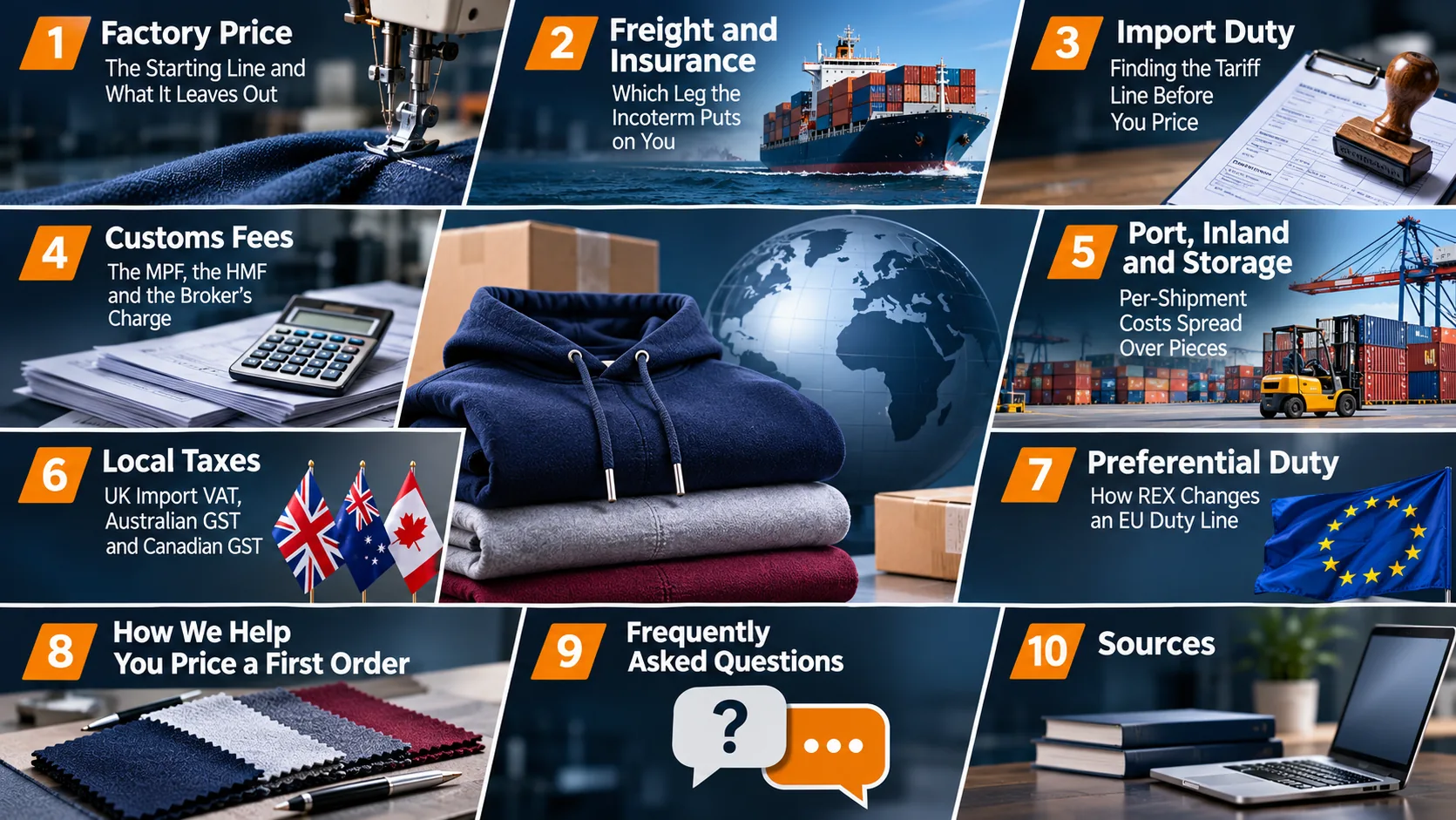


You calculate landed cost by adding every cost of bringing your clothing to your warehouse onto the factory price, then dividing by the number of pieces. Picture a 30-piece order that looked right at the factory price until the customs broker’s invoice arrived with fees, port charges and a duty bill nobody had written down. If you buy through private label production or a custom build, the factory price is only the first line. Each cost line below has its own source document, so you can check the total before you set a retail price.
Table 1 lists the seven cost lines, their example figures and where each number should come from.
|
Cost line
|
What it covers
|
Example total, 30 pieces (example figures, not a quote)
|
Per piece
|
Where the number comes from
|
|---|---|---|---|---|
|
Factory price
|
Your order at the agreed price
|
300.00
|
10.00
|
Factory quote
|
|
Freight
|
Carriage from the factory to the port or airport, and onward
|
45.00
|
1.50
|
Carrier invoice
|
|
Insurance
|
Cover for the goods in transit
|
3.00
|
0.10
|
Insurance or forwarder invoice
|
|
Import duty
|
Rate applied to the customs value
|
30.00
|
1.00
|
Broker's entry summary, from your tariff code
|
|
Customs fees
|
Merchandise processing fee, harbor maintenance fee and broker charge
|
41.42
|
1.38
|
CBP notice and broker invoice
|
|
Port, inland and storage
|
Terminal, trucking to the warehouse and any storage
|
25.00
|
0.83
|
Port, trucker and warehouse invoices
|
|
Local taxes
|
VAT or GST on the taxable value
|
Not in this example
|
Not in this example
|
Rules of the country you import into
|
The factory price is the first line of every landed-cost sum, and it should be one number per piece in the currency printed on the invoice. Keep that invoice with your entry paperwork. The Canada Border Services Agency (CBSA) says your declared value for duty should be supported by a receipt or sales invoice from the vendor. The invoice value is also where each country’s valuation rules start, and we come back to that under duty.
Convert currency at the rate the rules specify, not the rate you see on the day you pay. Canada is the clearest example: the CBSA says the value for duty is declared in Canadian dollars, using the exchange rate from the date the goods began their direct and continuous journey to Canada. Ask your broker which date and rate your market uses before you fix a budget.
Anything the quote leaves out goes on the unit line too. Fabric bought from a separate supplier and packaging such as custom packaging are per-piece costs, so they sit beside the garment price rather than on the freight line. If your fabric comes through our fabric sourcing service, ask us to show it as its own line. Our MOQ guide explains how the minimum order size moves the unit price, so this post uses MOQ only as an input and does not repeat that reasoning.

Incoterms 2020 is a set of standard trade terms that goes into your sales contract. Each term says which party pays for which part of the journey, so the same factory price can produce a different landed cost under each term you choose.
Read the term on your order as a list of legs and tick off who pays each one. Ask your forwarder what the freight is billed on, whether that is weight, volume or a minimum charge, so you can check the invoice when it arrives.
Insurance is a line of its own, and the level of cover depends on the Incoterm and what the contract says. Ask which level your quote includes, then write it into the contract rather than assuming it.

Import duty is a rate applied to a customs value, and the customs value is not always the price printed on your invoice. The rate depends on the tariff code of the garment, so a cotton T-shirt, a hoodie and a dress can each attract a different rate. A single blended rate across a whole shipment is a guess, and a guess is what makes a landed cost look right until the entry arrives.
Find the code by working from the fibre, the knit or woven construction and the garment type, then matching it to the tariff schedule of the country you import into. The first six digits of a tariff number, the HS code, are shared across countries that use the Harmonized System, and the later digits are set by each country. Your broker should confirm the final code, and you should keep that code on the same sheet as the invoice.
For goods entering the United States, look the code up in the Harmonized Tariff Schedule of the United States (HTS) and confirm the rate with a licensed customs broker. This guide does not print a duty rate for any code, because rates change and a figure here would read as a quote. US tariff surcharges have changed several times since 2025; confirm the current rate for your HTS code with your broker before you price.
The EU starts from a different place. Under Article 70(1) of the Union Customs Code, the primary basis for the customs value is the transaction value, “the price actually paid or payable for the goods when sold for export to the customs territory of the Union”, according to the European Commission’s customs valuation guidance. Two points follow for a buyer. A purchase order is not enough, because the guidance says a purchase order cannot serve as the basis for the customs value. And where the importer cannot access the invoice for that sale, the guidance says the transaction value method does not apply, so keep the commercial invoice on file.
The US merchandise processing fee (MPF) is 0.3464 percent ad valorem, according to CBP’s fee notice for fiscal 2027, which keeps that rate unchanged. CBP also sets a minimum and a maximum amount for the fee, and the same notice says CBP must determine each year whether those limits need adjusting for inflation. This guide does not print the dollar limits, because they change with the fiscal year. A small shipment can meet the minimum and pay more than the rate alone would suggest, so price the minimum in before you commit.
The harbor maintenance fee (HMF) is 0.125 percent ad valorem of the merchandise on cargo that arrives by sea, according to CBP’s user fee table. Check that rate on CBP’s current fee pages before you use it in a budget.
The broker’s charge comes from your broker’s invoice, so ask for it in writing and ask whether it applies per entry. On a small order a fixed charge spreads over fewer pieces, so it weighs more on each unit than it does on a large run.
Do not assume a small sample shipment enters the US duty free under the old low-value de minimis rule. US treatment of low-value shipments has changed since 2025, so ask your broker how your shipment will be entered before you leave duty out of the sum.

Terminal charges, trucking to the warehouse and any storage or demurrage are per-shipment costs. A 30-piece order therefore carries a bigger share per unit than a 1,000-piece order paying the same port charges.
Worked example with example figures, not a quote. Take 30 pieces at an example factory price of 10.00 each, so 30 x 10.00 = 300.00 of goods. Add example freight of 45.00 and example insurance of 3.00. Duty uses an example rate of 10 percent, which is not the rate for any product: 10 percent of 300.00 is 30.00. The customs fees are the MPF at 0.3464 percent of 300.00, which is 1.04 rounded, plus the HMF at 0.125 percent of 300.00, which is 0.38 rounded, plus an example broker charge of 40.00, so 1.04 + 0.38 + 40.00 = 41.42. Port, inland and storage at an example 25.00 closes the list. The total is 300.00 + 45.00 + 3.00 + 30.00 + 41.42 + 25.00 = 444.42, and dividing by 30 pieces gives 444.42 / 30 = 14.81 per piece.
The example treats the factory price as the customs value, a simplification. The MPF line uses the rate alone, so if CBP’s minimum fee applies to your entry, the real total will be higher than this example. Local taxes are left out because they depend on the country, and the next section covers them. Each new shipment needs its own calculation, because the per-shipment lines change with every booking.

Each destination adds its own local tax on top of the duty, and the taxable base is set by that country’s rules. For the UK, GOV.UK says you work out the base by adding the charges payable on importation, such as customs duty and excise duty, and the cost of any incidental expenses, to the customs value, and it says the VAT itself is not included. This guide gives no UK VAT rate.
For Australia, the Australian Border Force guidance says GST on taxable importations is 10 percent of the value of the taxable importation. That value is the customs value, plus any duty payable, plus the amount paid to transport the goods to Australia and to insure them for that transport. Example figures: a customs value of 300.00, transport and insurance of 48.00 and an example duty of 30.00 give 300.00 + 48.00 + 30.00 = 378.00, and 10 percent of 378.00 is 37.80 of GST.
For Canada, the CBSA works in sequence. It sets the value for duty in Canadian dollars, calculates customs duty on that value, then charges GST on the value for duty plus the duty. GST is 5 percent on most goods. In the CBSA’s own example, US$100 at an exchange rate of 1.15 gives CAN$115.00 for duty, 4 percent duty is $4.60, and 5 percent GST on $119.60 is $5.98, a total of $10.58.
Whether any of these taxes is a cost to your business or is recovered depends on your registration and your accounts, so take that question to your accountant. This guide gives no EU import VAT rate.
In the EU, a REX statement on origin can change which duty line applies, because it lets a registered exporter certify preferential origin on the invoice itself. The European Commission’s REX guidance describes REX as a system of self-certification, and the registration is a one-off formality, so the exporter does not apply for a separate certificate of origin on every shipment.
The registration number must appear in the statement when the originating products in the consignment are above a value threshold: EUR 6,000 under the GSP and free trade agreements, and EUR 10,000 under the rules for overseas countries and territories. The guidance says the validity of a registration number is not limited in time. The statement goes on the invoice or another commercial document, and a transport document such as a bill of lading or an airway bill cannot be treated as that other document, because the carrier or forwarder issues it.
When preference is claimed under the GSP, the importer declares a statement code, U164, U165 or U166, together with C100 and the REX number on the import declaration. The guidance says importers should check a registration on the public DG TAXUD register before relying on it. Whether your factory holds a REX number, and whether your product qualifies, is a question for the factory and your broker, not something this guide can confirm.
We hold ISO 9001 certification and REX registration, and we run at MOQ 30 per design. Sampling takes about 12 days and bulk production about 18 days after you approve the sample. We quote the factory price per design, and we help you gather the inputs for each landed line before you commit.
Send us the destination, the Incoterm you plan to use, the HS code you expect and the name of your broker with your tech pack, so the inputs for each line arrive in one message. Our tech pack guide explains what the spec needs to hold, and our apparel prototyping and sampling page sets out how the sample is built before bulk starts, so the garment you cost is the one the sample proves.
We stand behind the finished order with a full refund or a free remake if the order does not match what was agreed. To start, send your enquiry through our contact page, and we will reply with the factory price per design and the list of inputs we need from you.
It depends on the quote and on the Incoterm written on your order, so the factory price alone does not tell you. Ask the factory to state in writing which lines sit inside its price and which sit outside it. Then add every line outside the quote to your landed sum.
The answer depends on the country you import into, because each country sets its own valuation rule. The EU starts from the price actually paid or payable for the goods when sold for export to the EU, so the invoice is the anchor. Ask your broker which valuation basis applies to your entry before you price.
Start from the fibre, the knit or woven construction and the garment type, then find the matching heading in the tariff schedule of the country you import into. The first six digits of an HS code are shared across countries that use the Harmonized System, so the work is in the later digits. Have your broker confirm the final code before you rely on it.
The merchandise processing fee (MPF) is a US customs fee of 0.3464 percent ad valorem, and CBP's fiscal 2027 notice keeps that rate unchanged. CBP also sets a minimum and a maximum amount and reviews those limits each year. Check CBP's current notice for the limits in force on your entry date.
Usually yes, because per-shipment costs such as broker charges, port fees and trucking spread across fewer pieces. A fixed minimum on a fee also weighs more on a small shipment than a percentage rate does. The worked example in this guide shows the effect with example figures.
Often yes, but the base and the rule depend on the country. Australian GST is 10 percent of the value of the taxable importation, which includes duty and the transport and insurance to Australia. Canada calculates GST on the value that includes customs duty, and the UK adds duty and incidental costs to the base before import VAT.
Whether import VAT becomes part of your cost depends on whether your business can recover it, and that depends on your registration and accounts. This guide does not decide that question. Put it to your accountant before you set the cost in your books.
A REX number identifies a registered exporter who makes a statement on origin. The number matters when you claim preferential duty under the GSP, because the import declaration then needs the statement code and the REX number. Confirm with your factory and your broker whether that applies to your product.
Work out duty line by line, since each style or colour carries its own value and tariff code. Share freight and insurance by volume or weight, because a bulky size takes more space than a small one of the same value. Add each line's share to its unit cost so every size and colour carries its own landed figure.

FOUNDER & CEO AT RIJIZ