
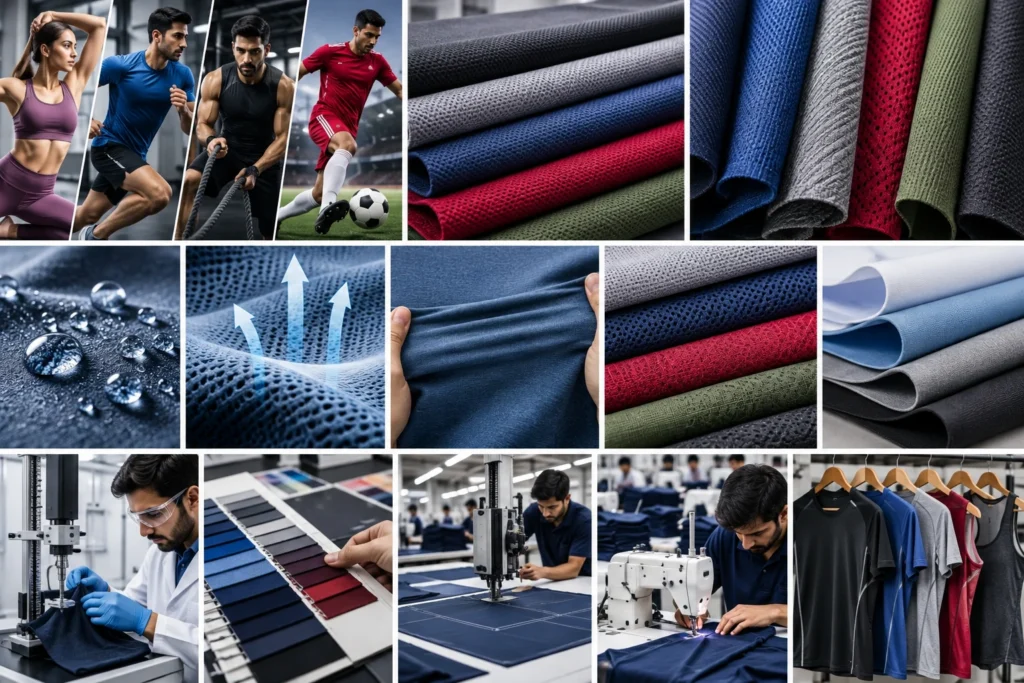
Activewear fabric specs shift meaningfully depending on what the garment is actually built to do, and starting from activity type produces a more useful spec than starting from a fiber blend in isolation.
|
Activity
|
Fiber blend
|
GSM range
|
|---|---|---|
|
Yoga / studio
|
Nylon-spandex or poly-spandex, 8-20% spandex
|
180-240
|
|
Running / HIIT
|
Polyester-spandex, lower spandex share
|
150-200
|
|
Team sports / training
|
Polyester-spandex, sublimation-compatible
|
160-220
|
|
Gym / weight training
|
Nylon-spandex or poly-spandex, firmer hand
|
200-260
|
|
Outdoor recreation
|
Polyester or nylon blend, sometimes brushed
|
220-280
|
|
Key priority
|
|---|
|
Four-way stretch, soft hand, opacity under stretch
|
|
Moisture management, low weight, breathability
|
|
Durability, print compatibility, colorfastness
|
|
Abrasion resistance, compression, shape retention
|
|
Durability, weather resistance, layering compatibility
|
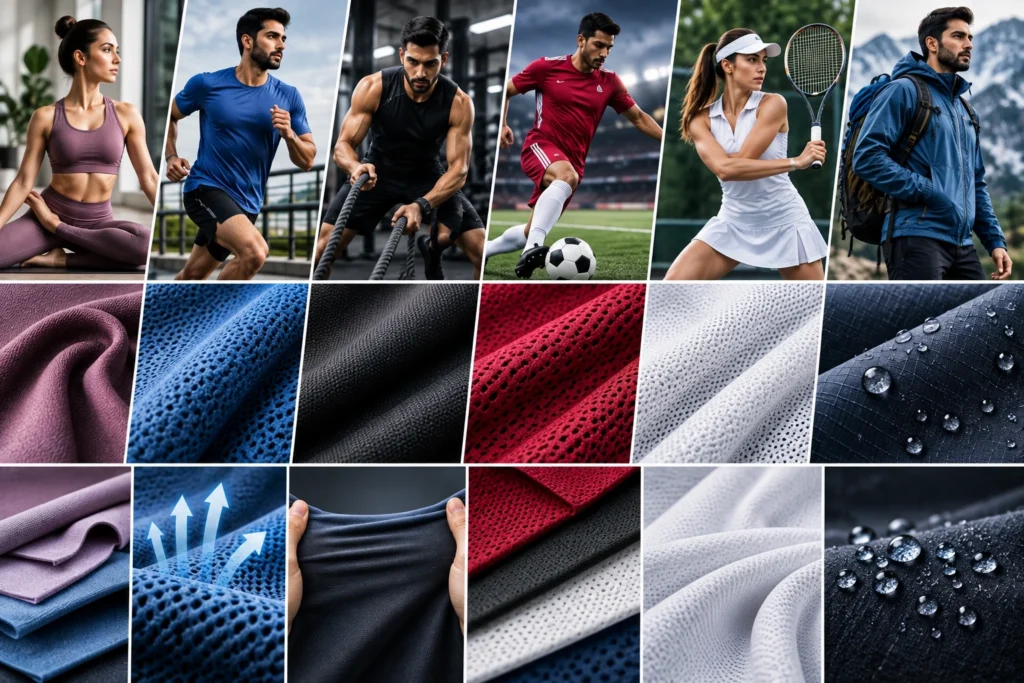
Yoga and studio fabric needs the highest spandex share in this table, since opacity under a deep stretch (bending, squatting) is a real, specific failure mode buyers test for, a fabric that goes see-through under stretch fails regardless of how it performs on every other spec. Running and HIIT fabric trades some of that stretch range for lower weight and better airflow, since the priority shifts to keeping the wearer cool and dry over a sustained effort rather than accommodating extreme range of motion. Team sports fabric adds sublimation compatibility as a hard requirement, since most team programs need printed graphics, numbers, or sponsor logos, which narrows the fiber choice toward polyester specifically.
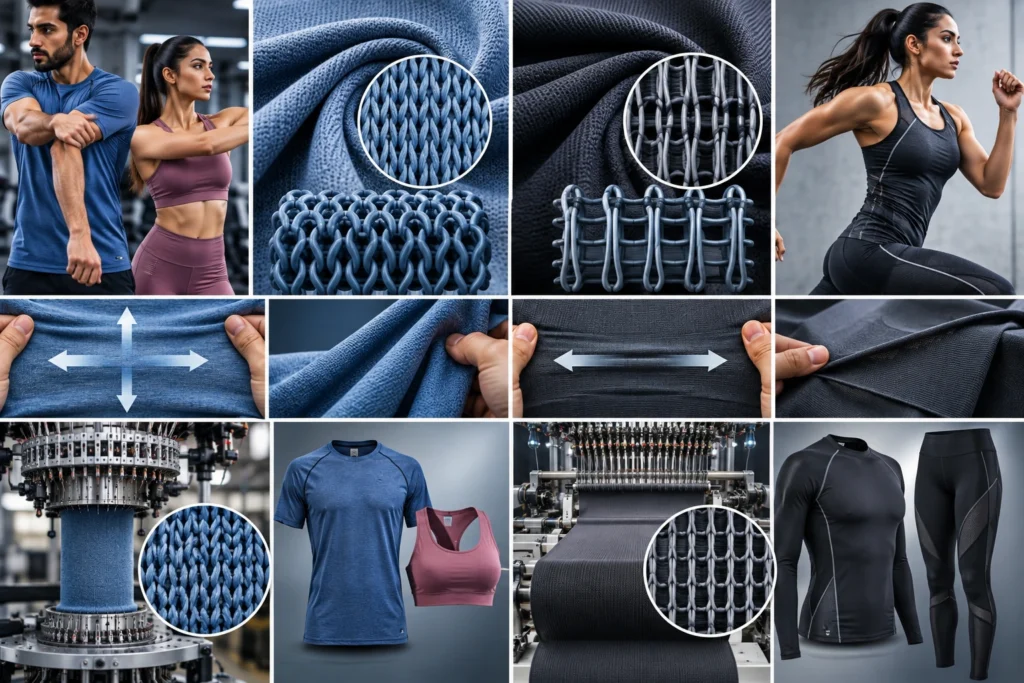
Fiber blend gets most of the attention in activewear sourcing conversations, but knit construction is what actually determines whether a fabric moves the way an activewear garment needs to.
Circular knitting produces fabric on a rotating cylindrical needle bed, building the fabric as a continuous tube through weft knitting, where a single yarn loops horizontally, row by row. This construction is what gives most activewear its characteristic omni-directional stretch and recovery, and it’s the dominant construction for leggings, sports bras, and compression tops.
Warp knitting works differently: multiple parallel yarns loop vertically at the same time on a flat-bed machine, producing flat yardage rather than a tube. Warp knit fabric is more resistant to runs and can incorporate multiple yarns or colors more easily, but it doesn’t reproduce the fine tactile quality or the full-range omni-directional stretch that circular knit delivers, which is why it shows up less often in the highest-stretch activewear categories and more often in structured or lower-stretch applications.
A brand specifying “4-way stretch performance knit” on a tech pack without naming the knit construction is leaving a real variable open. Two fabrics can carry an identical fiber blend and spandex percentage and still behave differently in the finished garment depending on which construction produced them.
“Anti-odor” and “antimicrobial” on an activewear hangtag can mean genuinely different underlying treatments, and they don’t all work the same way or last the same length of time.
Silver-ion treatment is moisture-activated: sweat, humidity, or any liquid contact triggers the silver ions to penetrate bacterial cell walls and disrupt protein synthesis and DNA replication, a mechanism that’s broad-spectrum, effective against bacteria, fungi, mold, and mildew . It’s durable through repeated washing at low concentrations, since the mechanism needs very little active silver to keep working.
Natural or plant-based antimicrobial finishes work through different active compounds entirely, and durability through washing varies more by specific treatment than silver-ion treatment does, which is worth confirming with a supplier rather than assuming parity between “natural antimicrobial” and “silver-ion antimicrobial” as if they were the same claim with a different marketing spin.
Neither claim means much without a test standard behind it, AATCC 100 is the real antimicrobial test standard, and asking a supplier for verified test data at the quality-control stage rather than accepting the hangtag claim alone is what actually confirms it.
Activewear sourcing content leans on “eco” and “sustainable” more than almost any other apparel category, and two real, checkable certifications are worth knowing by name rather than accepting the adjective alone.
bluesign audits the manufacturing process itself: resource use, chemical inputs, air and water emissions, and worker health and safety at the factory and mill level. A bluesign-approved fabric or bluesign system partner has been vetted at the production-process level, not just tested as a finished piece of fabric.
OEKO-TEX Standard 100 works differently: it tests the finished textile itself for harmful substances above defined limits, covering everything from the fabric to trims and threads depending on the product class. It’s a finished-product safety certification, not a manufacturing-process audit.
These two certifications answer different questions and aren’t substitutes for each other. A fabric can carry one, both, or neither, and a brand asking a supplier for “sustainable certification” without specifying which one risks getting whichever certification the supplier already has on hand rather than the one that actually matters for the brand’s specific claim.

No. Above a certain point, added spandex increases cost and can change hand feel and durability without adding meaningful performance benefit for a given activity. Yoga and studio wear justify a higher spandex share because of the opacity-under-stretch requirement; running and team sports fabric usually don't need to go nearly as high.
No. Inherent wicking is engineered into the fiber or yarn cross-section and is permanent. A topical wicking finish is applied after the fact and typically degrades over repeated washing. The real test standard behind a genuine wicking claim, AATCC 195, is covered in more depth elsewhere in this series.
No, they're two distinct construction methods produced on different machines. A finished garment can combine panels of each (a circular-knit body with a warp-knit structured panel, for example), but a single piece of fabric is one or the other, not both.
It's widely used in activewear and generally considered safe at the low concentrations used for textile treatment, though a brand with specific safety claims to make should ask a supplier for the treatment's actual test data and compliance documentation rather than relying on general industry reputation.
Because most team programs require printed graphics, numbers, or sponsor branding, and polyester is the fiber that accepts sublimation ink directly through heat conversion. A fabric blend that isn't majority polyester won't take sublimation printing the same way, which narrows the practical fiber choice for this category specifically.
bluesign audits the manufacturing process and chemical inputs at the factory level. OEKO-TEX Standard 100 tests the finished textile itself for harmful substances. One is a process certification, the other is a finished-product certification, and they're not interchangeable.
Yes, particularly for outdoor recreation and cooler-weather training pieces, where a brushed interior face adds a soft, slightly insulating hand without the bulk of a full fleece backing. It's less common in high-intensity categories like running or HIIT, where the priority is airflow rather than warmth.
No. GSM tells you weight, not stretch percentage, knit construction, or moisture-management performance. Two fabrics at the same GSM can perform completely differently depending on fiber blend, spandex share, and whether they're circular or warp knit.
It depends on what claim the brand wants to make. A brand focused on manufacturing-process sustainability should ask about bluesign specifically; a brand focused on finished-product safety should ask about OEKO-TEX Standard 100. Some suppliers carry both, but assuming one implies the other is a mistake.
* * *

FOUNDER & CEO AT RIJIZ