
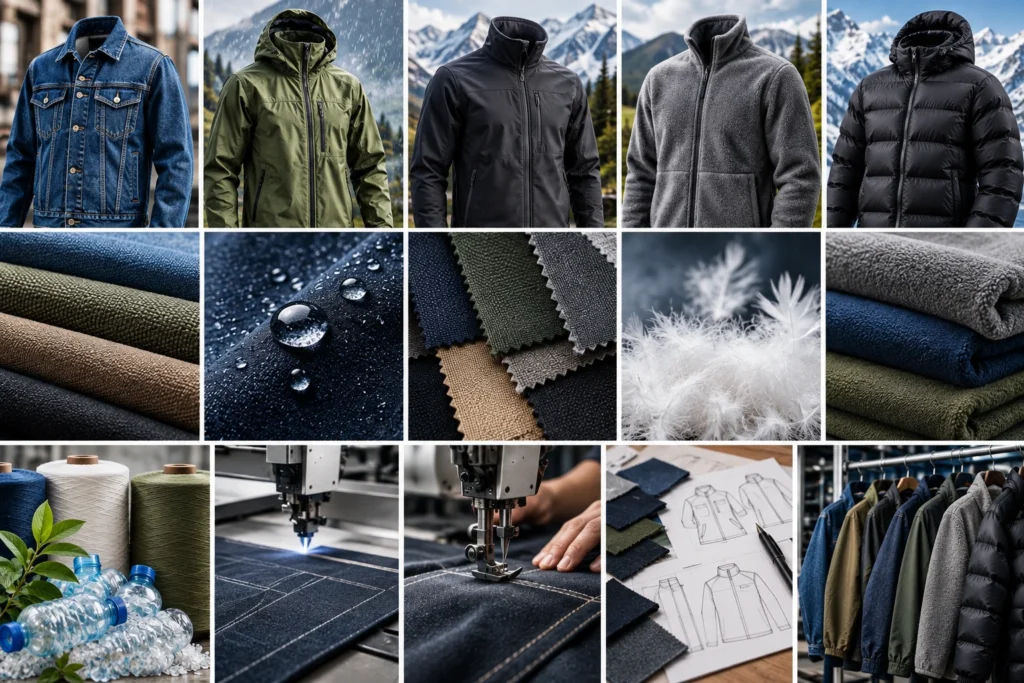
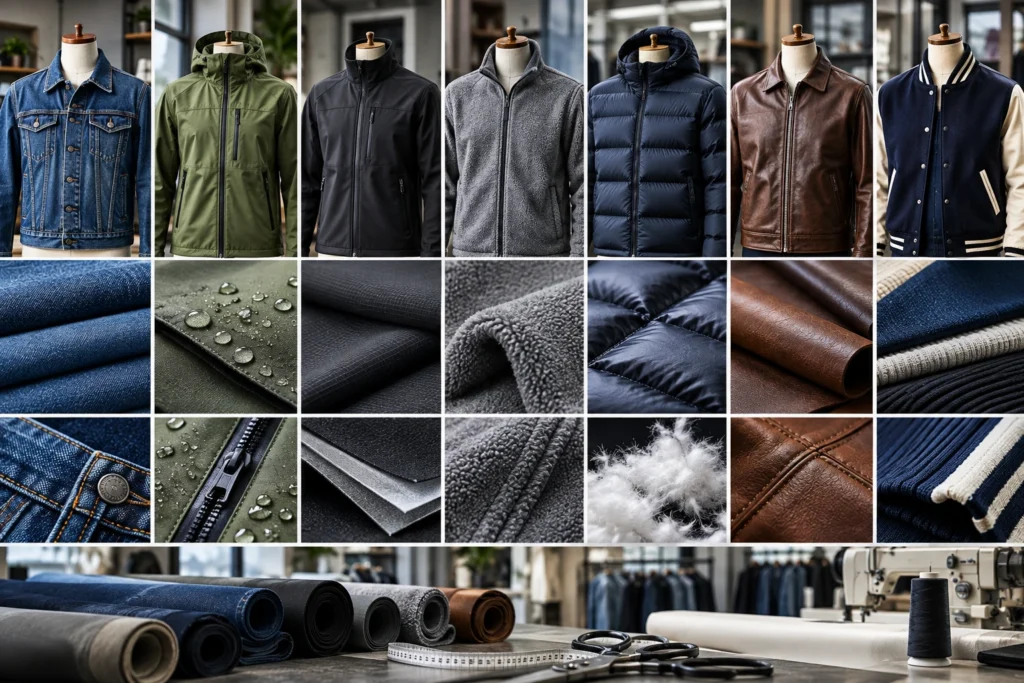
Ten jacket categories, one page, spanning Rijiz’s full jackets lineup . This table is the fastest way to see how differently “jacket fabric” behaves depending on what the finished garment actually has to do, from holding a crease on a denim trucker jacket to keeping rain out at 20,000mm on a technical shell.
|
Jacket type
|
Fabric family
|
Key spec
|
Typical range
|
|---|---|---|---|
|
Denim jacket
|
Cotton twill
|
Weight (oz/GSM)
|
10-16 oz (340-540 GSM)
|
|
Windbreaker
|
Nylon or polyester ripstop/taffeta
|
Denier
|
20-150D, average 70-80D
|
|
Rain jacket
|
Nylon/polyester with PU or membrane
|
Hydrostatic head
|
5,000-28,000mm+
|
|
Ski/snowboard jacket
|
2L/2.5L/3L technical shell
|
Waterproof + breathability
|
10,000-20,000mm+ / 10,000-20,000 g/m²/24hr
|
|
Fleece jacket
|
Polyester fleece knit
|
Weight (GSM)
|
150-450 GSM
|
|
Softshell jacket
|
Bonded 2-3 layer laminate
|
Construction
|
DWR face + membrane + fleece backing
|
|
Puffer jacket
|
Shell + down or synthetic fill
|
Fill power / fill weight
|
500-800 fill power; g/m² for synthetic
|
|
Bomber jacket
|
Nylon or poly shell, often quilted
|
Weight/denier
|
Varies by lining, 100-300 GSM shell
|
|
Satin jacket
|
100% polyester satin
|
Weight (GSM)
|
Lightweight, sublimation-compatible
|
|
Leather / faux leather
|
Genuine hide or PU microfiber
|
Thickness/finish
|
Varies by hide or PU grade
|
|
Varsity jacket
|
Wool-blend body, leather/PU sleeves
|
Weight (GSM)
|
250-300+ GSM wool blend body
|
The rest of this guide walks through where each of those numbers comes from, and what actually changes when you move up or down the range.
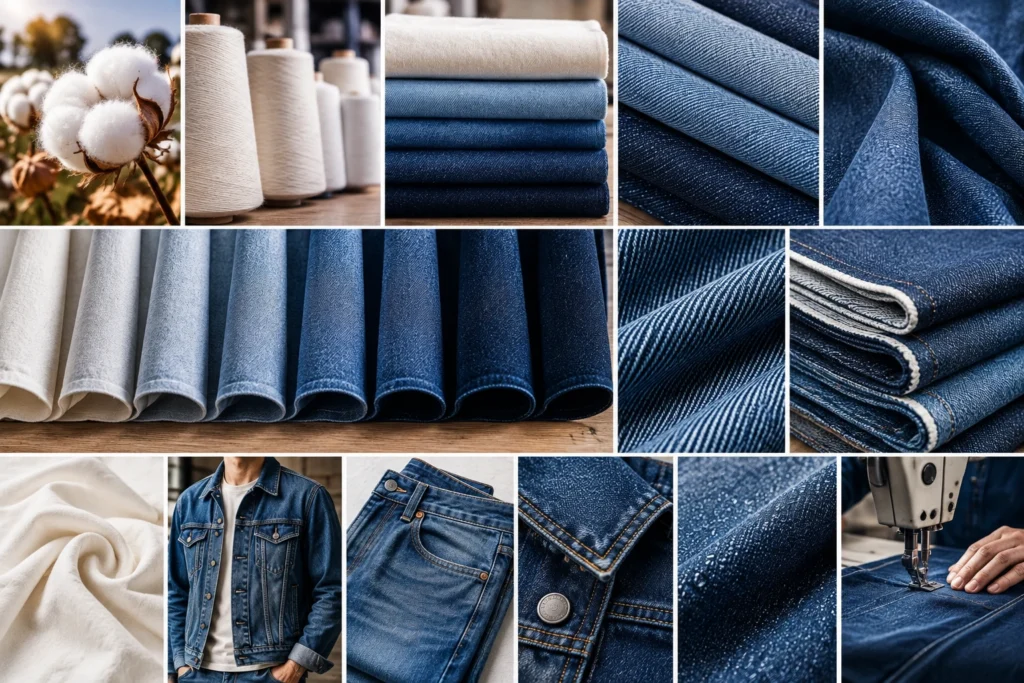
Denim jackets run lighter or heavier depending on climate and structure needs. Mainstream retail denim jackets typically sit at 10-13 oz (roughly 340-440 GSM), with the custom range extending from 9 to 14.5 oz. Winter-weight denim moves up to 14-16 oz (475-540 GSM); lightweight summer denim drops to 6-8 oz (200-270 GSM). Standard construction is 100% cotton, sometimes with 1-2% elastane for stretch, woven in a 3/1 twill.
Canvas, used for utility and trucker-style jackets, runs a similar 10-12 oz range as mid-weight denim, but with a plain or basket weave instead of a twill, giving it a flatter, more rigid hand. A denim jacket built to this spec is worth a look for the full range of weight and wash options available at production scale.
Windbreakers and rain jackets live and die on two specs: denier (the shell fabric’s density) and waterproof rating (how much water pressure the fabric resists before it leaks).
Denier measures the mass, in grams, of a 9,000-meter length of yarn. General outerwear shells run 30D-150D, with 70-80D the average for a standard resort-grade jacket. Ultralight packable windbreakers drop to 20D taffeta; high-abrasion zones like cuffs and pack panels sometimes use ballistic-weight fabric at 300-1,200D. Ripstop’s reinforcement grid (thicker threads woven at intervals into a thinner base) resists tear propagation better than plain taffeta at the same denier, which is why ripstop dominates technical shells while taffeta, softer and slightly glossier, remains common on lighter down jacket linings.
Waterproof rating is expressed in millimeters of hydrostatic head , the water pressure a fabric can resist before leaking. As a rough guide: 5,000mm handles light rain, 10,000mm is adequate for hiking and general outdoor use, 20,000mm and up covers skiing and heavy snow, and 28,000mm or more is mountaineering-grade. Two regional test standards measure this differently: ISO 811, compared against JIS L1092 and AATCC 127 , common across Europe and much of the global outdoor industry, applies pressure at a standard rate; JIS L1092, common in Japan and across Asia, applies pressure roughly 17 times faster. Because the two standards test at such different rates, a supplier’s mm number only means something once you know which standard produced it, a detail worth confirming before comparing two suppliers’ spec sheets from different regions as if the numbers were on the same scale.
Coating and membrane are two different waterproofing approaches. A PU (polyurethane) coating is a liquid film applied or laminated onto the fabric. A membrane, typically PTFE/ePTFE or PE, is manufactured separately and bonded to the face fabric, generally the higher-performance, higher-cost route used in premium technical shells. Airflow through the shell fabric itself, tested via ASTM D737 or ISO 9237 air permeability methods , is the tradeoff that comes with any waterproof membrane, since blocking water passage also limits how much air moves through. PTFE membranes are being phased out industry-wide, including by the brands most associated with the technology, over environmental concerns tied to PFAS chemistry. That phase-out reached a hard regulatory line in California and New York starting January 1, 2025, closing out the C8-to-C6-to-C0 fluorocarbon progression the industry had been working through for years, though a “severe wet condition” carve-out for outdoor apparel in California runs until 2028.
Construction tier is the other real differentiator: 2-layer (face fabric plus membrane, with a separate hanging liner) is the bulkiest and cheapest; 2.5-layer (face fabric plus membrane plus a printed protective layer instead of a liner) is the lightest and most packable, common in rain shells; 3-layer (face fabric, membrane, and a bonded interior backer) is the most durable and expensive, standard on premium hardshells.
Insulated jackets, like Rijiz’s puffer and bubble jacket lines, are specced on a completely different axis than shells: fill power for down, fill weight in grams per square meter for synthetic insulation.
Fill power measures loft, how much space an ounce of down expands to fill, and higher numbers mean more warmth per ounce of weight. The range commonly used in outdoor and fashion outerwear runs 500-800: budget-tier jackets sit around 600-650 fill, premium jackets around 800 fill, with true extreme cold-weather gear pushing past 800.
Synthetic insulation doesn’t have a fill-power equivalent; it’s specced by weight in grams per square meter (gsm), and better-built jackets vary that weight by body zone, heavier fill in the torso, lighter in the arms and hood, a practice called body mapping. A real example of that spec in practice: 80 grams in the body, 60 grams in the arms and hood.
Down sourcing carries its own certification question. The Responsible Down Standard (RDS) , developed and administered by Textile Exchange, prohibits live-plucking and force-feeding and requires third-party audit and chain-of-custody documentation at every stage from farm onward. “Ethically sourced down” without RDS behind it is an unverified claim, the same way “moisture-wicking” without a test standard is.
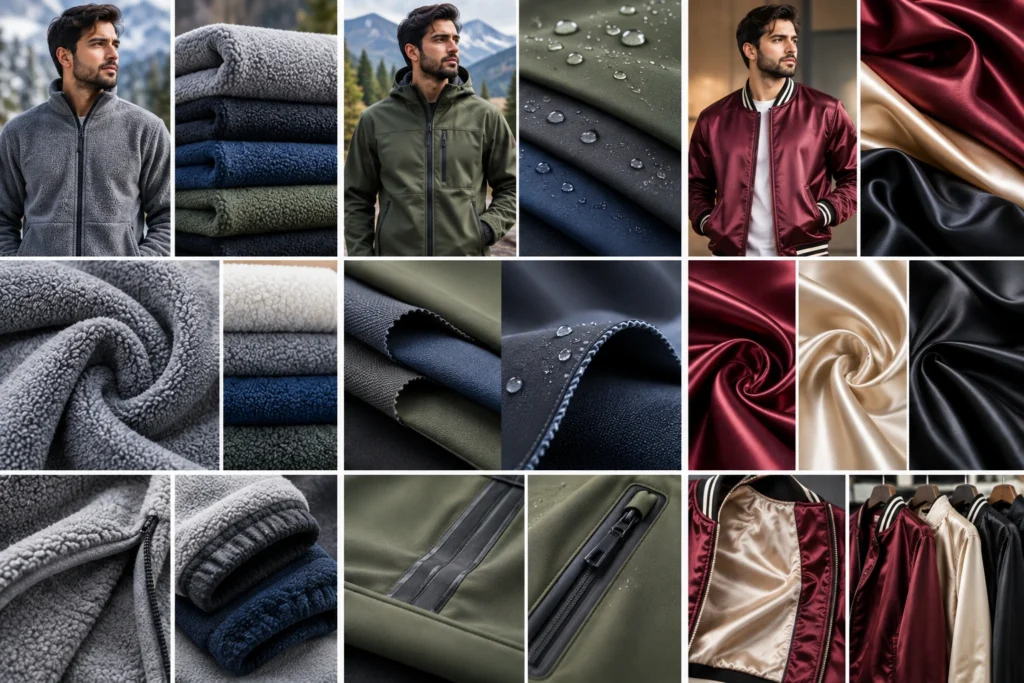
Fleece runs a wide GSM band depending on weight class: microfleece for lightweight layering sits at 150-200 GSM, midweight fleece (the most common weight for branded or embroidered jackets) runs 240-300 GSM, and heavyweight or sherpa-style fleece for cold-climate outerwear runs 320-450 GSM. Anti-pill treatment is a yarn or finishing-level engineering choice, not a wash, and it’s what separates commercial-grade fleece from the kind that balls up after a few washes.
Softshell construction is a bonded laminate, not a single fabric: a DWR-treated woven or knit face fabric, a breathable membrane (commonly TPU-bonded), and a fleece or brushed backing, all bonded together rather than sewn as separate layers. That construction eliminates the need for a separate lining, which is a real production-cost consideration, not just a technical detail, since it reduces the number of components a factory has to source and assemble.
Satin jacket shells are almost always 100% polyester satin, occasionally a silk-touch polyester blend, with a polyester lining. The fiber choice isn’t accidental: polyester accepts dye-sublimation printing directly, since the heat-conversion process bonds ink into the fiber itself rather than sitting on the surface the way screen print does, which is why satin bomber-style jackets are the default canvas for sublimated team and varsity graphics.
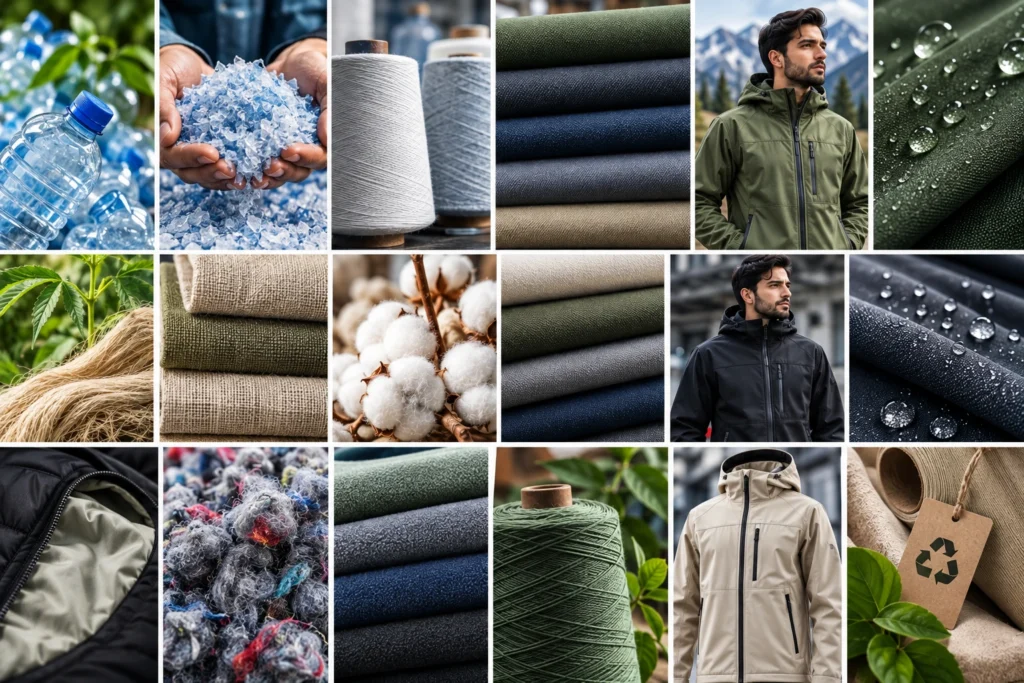
Three named materials come up often enough in jacket sourcing that they’re worth knowing by name rather than accepting a generic “recycled” or “eco” label.
ECONYL, manufactured by the Italian company Aquafil, is regenerated nylon made from fishing nets, fabric scraps, carpet flooring, and industrial plastic waste, processed to virgin-equivalent quality. It shows up across technical streetwear and heavy-duty bomber and MA-1 style shells.
The Global Recycled Standard (GRS) , also managed by Textile Exchange, requires a minimum 20% recycled content for a product to fall under its scope, plus chain-of-custody, social, and environmental criteria for full certification.
Recycled polyester more broadly is a real, functional material, but the honest picture is more nuanced than most marketing suggests: recycled polyester volume grew from 8.9 to roughly 9.3 million tonnes between 2023 and 2024, yet its market share actually declined slightly, from 12.5% to 12%, because virgin polyester production grew even faster over the same period. Recycled polyester is also still overwhelmingly bottle-based, about 98% of supply, with true textile-to-textile recycling still under 1% of the global fiber market. None of that makes a recycled-content claim meaningless, it means it’s worth asking for the certification and percentage behind it rather than the adjective alone.
There isn't one that applies everywhere, since the categories are specced on different axes: weight for denim and fleece, denier and hydrostatic head for shells, fill power or fill weight for insulation. The right question is which axis applies to the category you're sourcing.
Not necessarily for the application. A 5,000-10,000mm rating is genuinely sufficient for urban and light-rain use; paying for 28,000mm mountaineering-grade waterproofing on a commuter jacket adds cost without adding real-world benefit for that use case.
Denier governs abrasion resistance and durability, separately from waterproofness. A low-denier waterproof shell can still tear easily against branches, gear straps, or repeated pack friction, which is why high-wear zones sometimes use a heavier denier fabric even on an otherwise lightweight jacket.
C0 (zero-fluorocarbon) DWR formulations, which don't use the long-chain PFAS chemistry linked to environmental persistence concerns. Performance has generally improved as the technology has matured, but it's worth asking a supplier directly which generation of DWR they're currently running, since the ban is currently state-level rather than a blanket nationwide restriction.
Higher fill power means more warmth per ounce of weight, not simply more warmth outright. A jacket with a lower fill power but more total down fill weight can be just as warm as a higher-fill-power jacket with less total fill, just heavier for the same warmth.
Yes, particularly for wet-climate use, since most synthetic insulation retains more of its loft and warmth when damp than down does, and it's typically more budget-friendly at a given warmth level, though it doesn't compress as small for packing.
Construction. Softshell bonds face fabric, membrane, and backing into one laminate; a traditional build sews separate shell and liner pieces together. Softshell reduces component count and often improves stretch and mobility at some cost to raw waterproofness compared to a dedicated hardshell.
Yes, hybrid construction (a denim body with a technical panel at high-wear or high-exposure zones) is a real, sourceable option, though it requires the tech pack to spec both fabrics and their seam interface clearly rather than treating the jacket as one uniform material.
Because polyester, satin's fiber base, accepts sublimation ink directly through heat conversion, bonding color into the fiber rather than sitting on the surface. Cotton and most natural fibers don't accept sublimation ink the same way, which is why sublimated graphics are almost always on a polyester-based fabric.
It's worth asking regardless, since RDS certification also covers chain-of-custody documentation that protects a brand from an unverifiable sourcing claim later, not just from a marketing-copy standpoint.
* * *

FOUNDER & CEO AT RIJIZ