There is no universal shrinkage limit for clothing. Your spec sets the acceptable figure for one fabric, one wash, one drying method and one test method. You will see figures such as about 3 percent for woven and about 5 percent for knit in blogs and retailer guides, but those sources disagree and most cite nothing. A customer emails to say the tee shrank a size after the first wash. The fix starts before bulk, with a test you can name and a limit you can write down. Our quality control and inspection page covers what we check on the floor, and this guide covers what to ask for on the report.
A shrinkage limit means something only when it is a percentage for each direction, measured after one named wash, drying method and cycle count. The sign convention has to be stated too, because a bare figure can be read two ways. The garment spec sheet post covers the rest of the spec, so this section covers only the shrinkage line.
Who sets the number. No standard sets one shrinkage limit for all clothing. ISO 6330:2021 procedures define washing and drying procedures for textile testing, and the abstract sets no shrinkage limit. The CottonWorks shrinking and skewing guide, from Cotton Incorporated, says that “rigid and arbitrary fabric shrinkage specifications are not the answer”, and its page gives no numeric limit. In practice the buyer writes the number into the spec for that fabric and garment, and the factory works to it.
Length and width. Write length and width as separate figures. Knit fabrics are typically more open and loose than wovens, so the two directions can move by different amounts. A single blended figure can hide a failure in one direction, so the spec should name both.
Sign convention. Shrinkage can be reported with a minus sign or a plus sign, and the sources do not agree. CottonWorks calls a negative change shrinkage and a positive change growth. One lab blog we read says shrinkage is reported with a minus sign, while a software vendor’s guide we read says a positive result means the piece got smaller. Each result is a percent change against the marked length or width before washing, so the direction of the subtraction decides the sign. Ask the lab which convention it uses, and read every figure against it.
The spec line itself can be short, and it belongs on your tech pack. Write the test method and its year, the wash and drying procedure, the length and width limits as separate figures, the sign convention, and who set the limit.
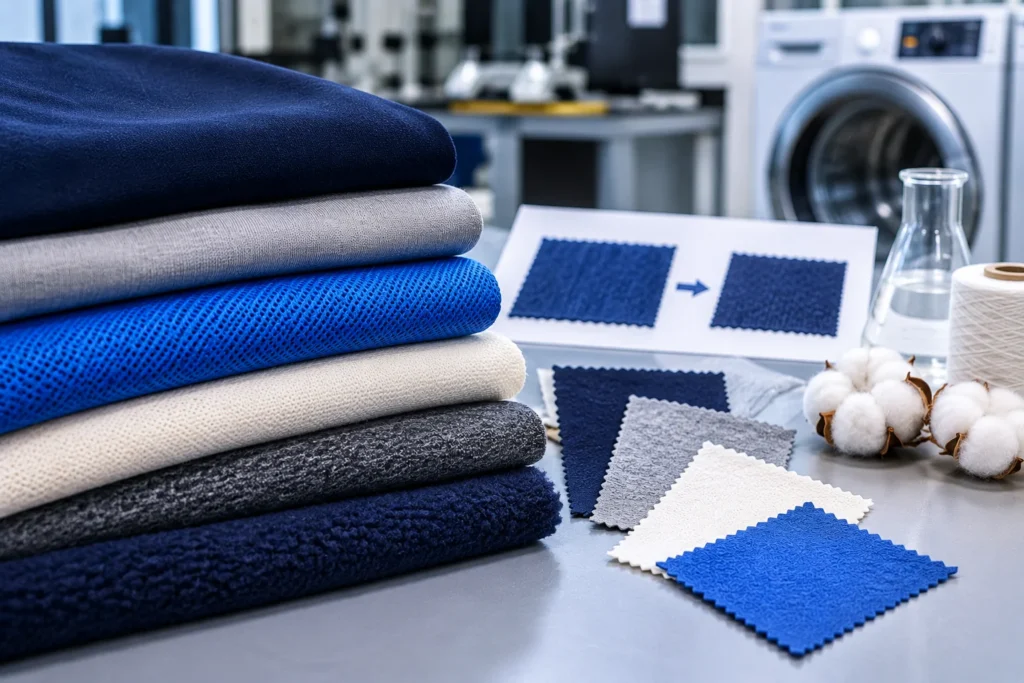
Fibre and construction set the starting point. CottonWorks says knitted fabrics are inherently more prone to shrinkage than wovens, and it lists fibre, yarn, construction, wet processing, finishing, cut-and-sew technique and garment care as the main factors. A fibre name alone therefore never settles the figure. Weight is a separate question, covered in our hoodie GSM guide. The table sets out the figures in circulation, with the source and a status label for each row.
|
Fibre or fabric
|
Figure in circulation and source
|
Status
|
What to ask for
|
|---|---|---|---|
|
Cotton, first wash
|
3% to 5% (instrument maker's guide); up to 20% in the first wash and dry (retailer guide)
|
CONFLICTING, no source givenCONFLICTING, no source given
|
A length and width result on your fabric, in the wash the label states
|
|
Cotton knit t-shirt, length
|
Roughly 5% to 8% (software vendor's guide)
|
UNVERIFIED, no source given
|
Both directions measured, not length alone
|
|
Woven cotton shirting
|
Around 3% or less (software vendor's guide)
|
UNVERIFIED, no source given
|
A fabric test before cutting
|
|
Wool
|
10% to 20% (instrument maker's guide); around 3% to 5% for wool-blend outerwear (software vendor's guide)
|
CONFLICTING, no source given
|
A test on your wool, with felting reported separately
|
|
Polyester
|
Less than 1% (instrument maker's guide); less than 2% (retailer guide)
|
CONFLICTING, no source given
|
A tested result, not a rule of thumb
|
|
Bulk roll, Rijiz fabric sourcing page
|
"typically 3-5%" as the acceptable tolerance
|
Rijiz process figure, not a standard
|
The tolerance agreed for that fabric, written in your spec
|
The cotton row shows the problem. One guide puts first-wash shrinkage at 3% to 5%, another at up to 20% in the first wash and dry, and neither cites a source. Treat any row without a source as a question for your lab, not as a limit. Our own figure is of a different kind: our fabric sourcing page gives “typically 3-5%” as the acceptable tolerance for a bulk roll, which is a process figure for that roll, and your order should state the tolerance agreed for its fabric.
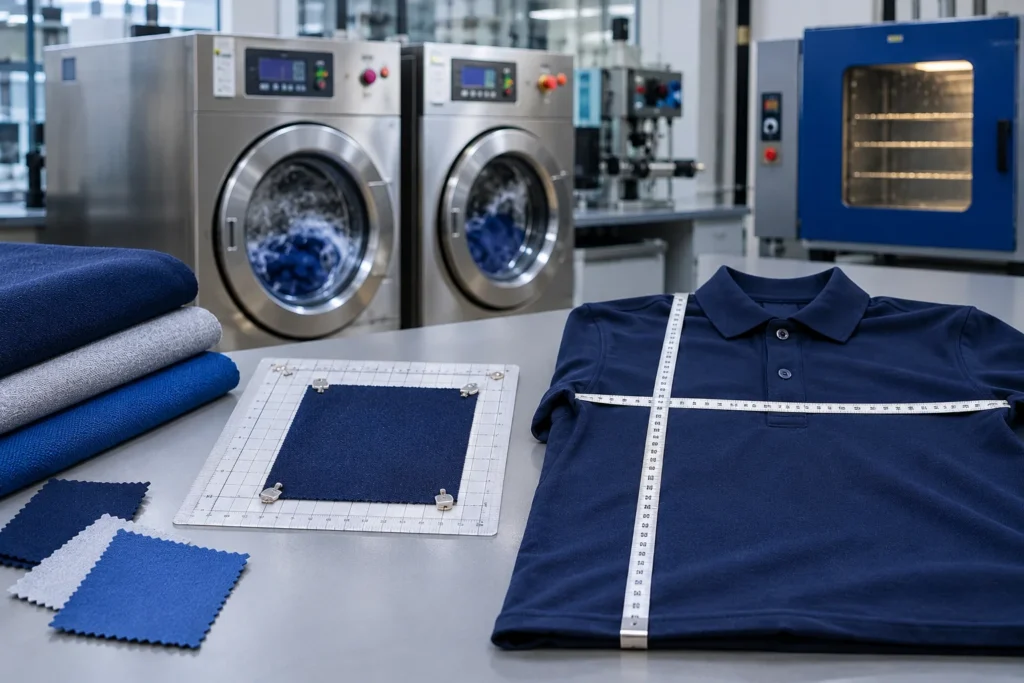
Choose the stage first. The AATCC TM135 store summary covers fabric, and its scope is “the determination of dimensional (length and width) changes of fabrics when subjected to home laundering procedures”. Run it on a swatch before cutting, while the fabric choice can still change. The AATCC TM150 store summary applies the same idea to finished garments, and it warns that the method “may not be applicable to garments made of certain stretch fabrics”.
Both summaries describe four washing temperatures, three agitation cycles and four drying procedures as standard parameters for common home care options. ISO 6330:2021 defines the domestic washing and drying procedures for textile testing: 16 washing procedures on reference Type A machines, 12 on Type B and 7 on Type C, plus six drying procedures. Each washing procedure represents a single domestic wash, so a report that covers several washes must say how many it ran. The standard also notes that machine type, detergent and tumble dryer can change the result.
AATCC lists TM135 as related to ISO 3759, the standard for preparing, marking and measuring fabric specimens and garments for dimensional change tests.
Some practical checks follow. Ask for TM135 on the fabric before you cut, and ask for a garment result on your first finished sample. If the garment is a stretch knit, ask the lab whether TM150 applies at all, because its summary says it may not. Ask which benchmark distances the lab marked too, because the result is a percent change against those marks.
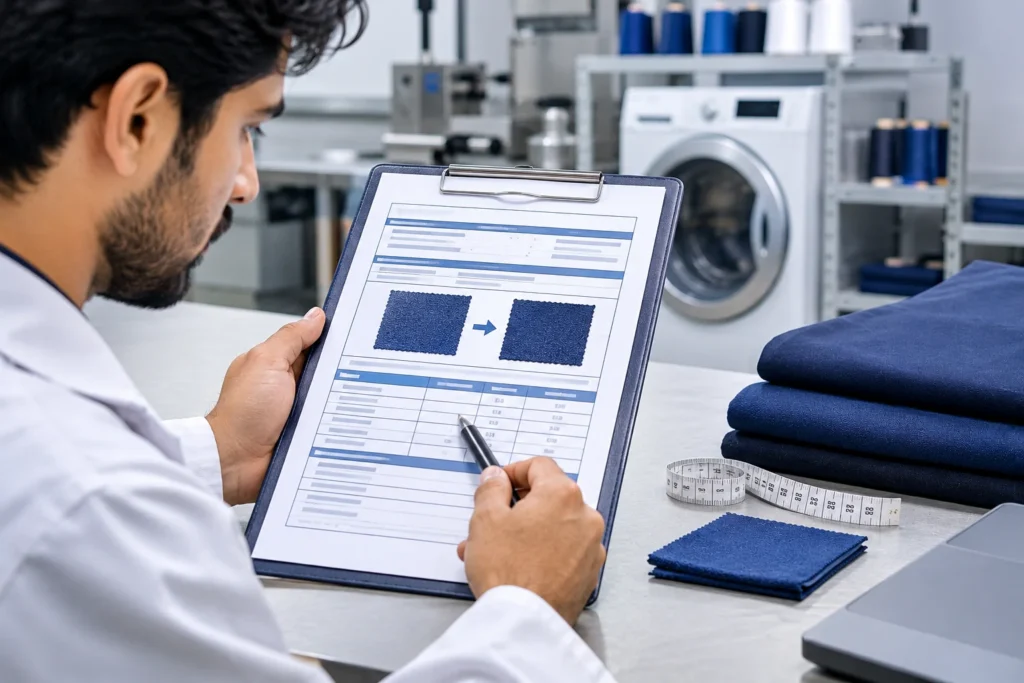
The table lists the fields a report should carry, what each one tells you, and whether to pass it or ask the lab for it.
|
Report field
|
What it tells you
|
Pass, or ask for it
|
|---|---|---|
|
Method and edition
|
Whether the test was TM135 (fabric) or TM150 (garment), and which year
|
Pass if it names the method and year; ask for the year if it does not
|
|
Wash and dry procedure
|
The temperature, agitation and drying used
|
Ask for it, and check it matches the care label you will print
|
|
Length and width
|
Each direction as its own percent change
|
Ask for both as separate figures, not one average
|
|
Sign convention
|
Whether shrinkage is shown as minus or plus
|
Ask the lab to write it on the report
|
|
Benchmarks and specimen
|
How the sample was marked before washing
|
Ask for the benchmark size and the marked specimen
|
|
Number of specimens
|
How many pieces were measured
|
Ask how many, and whether each one was measured before and after washing
|
|
Garment features
|
Twist, skew, seam puckering or trim movement, if measured
|
Ask for them on garments with side seams, a lining or separate trims
|
|
Pass limit and who set it
|
The figure the result is compared with
|
Ask for the limit and the party that set it
|
The AATCC store currently lists TM135-2025 and TM150-2025, so a report that names an older year is a question to put to the lab. Length and width carry the most risk. One lab blog we read gives an absolute average of both directions as the overall change, but an average can pass while one direction fails. Ask for each direction separately, even when the lab also gives an average. Once the report is in, log each result against the spec in our quality control forms.
Garment movement needs its own question. CottonWorks lists seam puckering, skew and changed relationships between body cloth and trim as garment shrinkage changes, which a length and width figure does not capture. If the garment has a lining or a different trim, ask whether the report measures it separately.
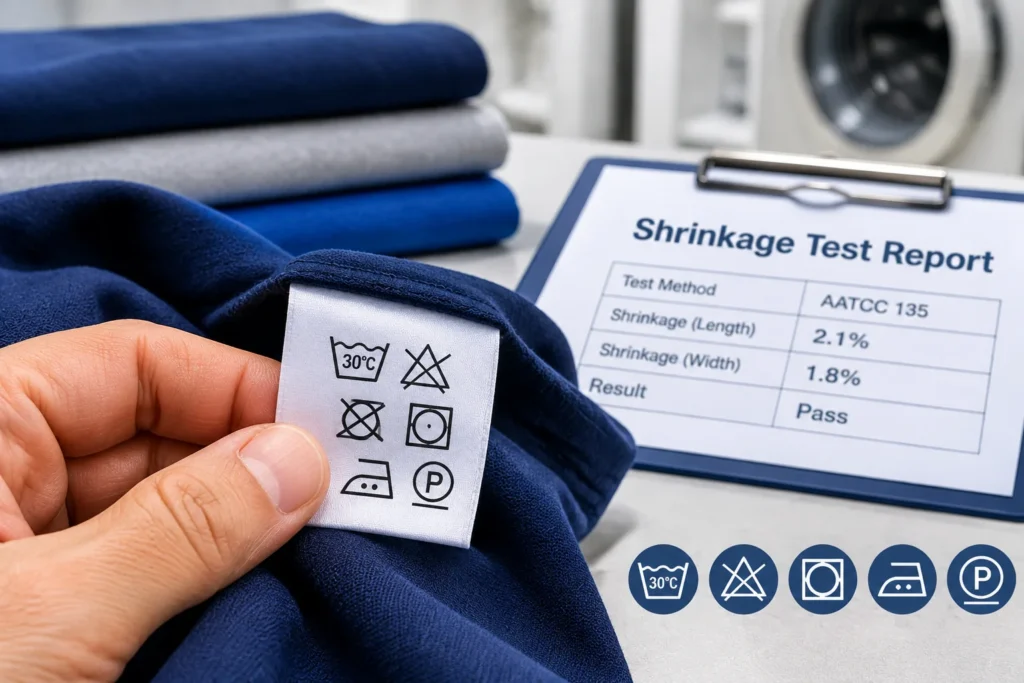
A test protects you only when the care label says what the test did. Under the US care labelling rule, 16 CFR 423.6, a label must say whether the product is washed by hand or machine, and it must give a water temperature unless hot water up to 145 degrees F will not harm the product. The rule also requires a warning where a consumer could reasonably use a washing step that would harm the product. Check your label against four points:
The reasonable basis sits with the maker. A manufacturer or importer must establish a reasonable basis for care information before sale, and a successful test is one form of that evidence. If the product is packaged or folded so the label cannot be seen at sale, the care information must also appear on the package or on a hang tag. A test run on a different wash and dry cycle from the one you print does not support the label you sell with.
Real customers wash more than once. One apparel business guide we read advises remeasuring the same fabric after repeated home laundering, adding a column for each wash, so ask whether your report covers one wash or several.
Part of the figure is set before the garment exists. CottonWorks says relaxation dryers, compactors or crosslinking agents can reduce the residual shrinkage left after wet processing, and that without these measures there is little or no reduction. Finishes such as enzyme or stone wash change the starting point too, and our streetwear fabric guide covers those finishes. Ask your mill which steps the fabric went through, and read the test result against the answer.
Pre-washing. Many guides suggest washing fabric before it is cut. A pre-wash changes the fabric once, but it gives you no result to check against a limit, so it does not replace a test.
Pattern compensation. The pattern can be adjusted for the shrinkage the factory measures on the fabric. Our cut and sew page explains how we build that adjustment into the pattern, so the method is not repeated here.
Roll acceptance. The roll is the earliest point where a bad lot can be stopped. Ask whether your factory tests the roll before the first panel is cut, and what happens to a roll that fails.
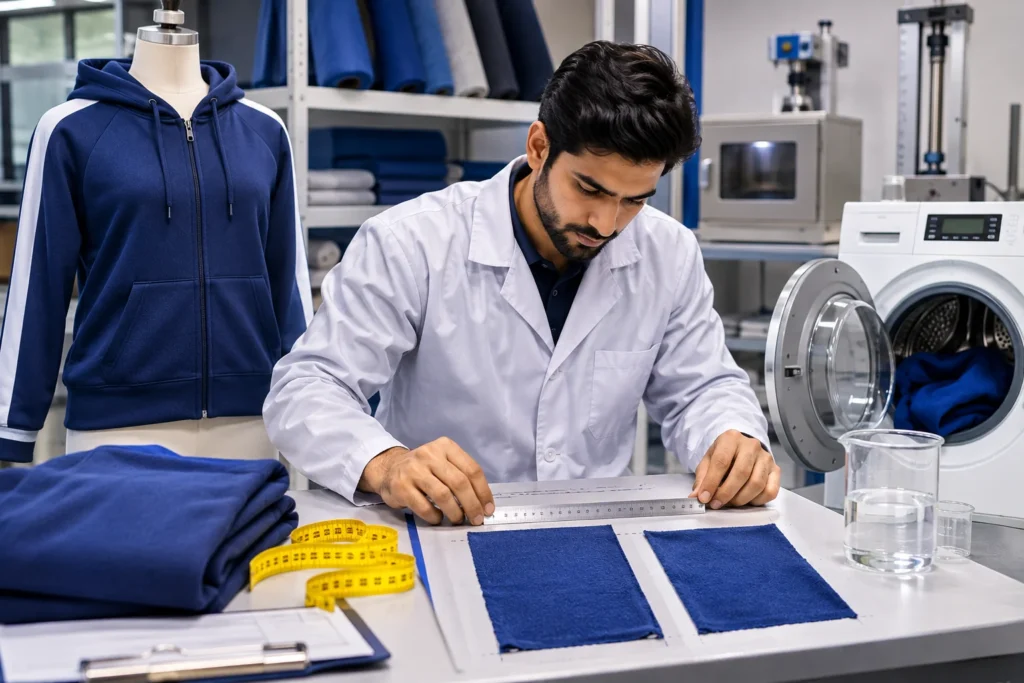
We test bulk fabric before it reaches our cutting room. Our fabric sourcing service page describes the method: “We cut a 50x50cm square of the bulk fabric, mark it, and run it through industrial washers and dryers.” We measure warp and weft shrinkage, and we do not accept fabric onto our cutting floor until it passes strict compliance checks. The page says a roll is rejected if it shrinks beyond the acceptable tolerance, which it gives as typically 3-5%. Our quality control page describes the inbound audit that runs before fabric reaches the cutting tables.
Once the fabric passes, the fit sample is built from it. Our apparel prototyping and sampling page explains that build, and it advises clients to wash the fit sample in a standard home washing machine, because that shows how the garment will behave when your customer owns it.
Sampling takes 12 days, bulk production takes 18 days and shipping takes 6 days, and our minimum is 30 pieces per design. If the finished order does not match what was agreed, we give you a full refund or a free remake. Send us your tech pack and fabric details when you are ready to start a sample.
No. A pre-wash changes the fabric once, but it does not tell you the length and width change against a limit. A shrinkage test names the method, the wash and drying procedure and each direction's change, so you can check it against your spec. Ask for the test even when the fabric has already been washed.
Ask for AATCC 135 on the fabric before cutting, and AATCC 150 on the first finished garment. TM135 is the fabric method and TM150 is the garment method, and TM150 may not apply to certain stretch fabrics. If your tee is a stretch knit, ask the lab to confirm that TM150 applies before you rely on it.
A report should cover the number of washes its test used, and that number should match the care label you will print. ISO 6330:2021 treats each washing procedure as a single domestic wash, so a report with several washes must say how many it ran. If your customers wash often, ask whether the report covers one wash or several.
A swatch is measured before the fabric is cut and sewn, while a garment also goes through cutting, sewing and finishing. CottonWorks lists cut-and-sew technique and garment care among the factors that affect shrinkage, and it includes seam puckering, skew and changed trim relationships in garment shrinkage. A fabric result is a useful first check, but the finished garment is the piece your customer buys.
Ask for length and width separately. A single average can pass while one direction fails, and TM135 is written as a test of dimensional (length and width) changes. One lab blog we read gives the absolute average of both directions as the overall change, so ask for both figures if your lab also reports an average.
Use the convention the report states, and make the lab write it on the result. CottonWorks calls a negative change shrinkage and a positive change growth, but the guides we read disagree, with one saying shrinkage is reported with a minus sign and another saying a positive result means the piece got smaller. A figure of 3 with no sign can mean shrinkage or growth, so the sign is part of the number.
Write the test method and its year, the wash and drying procedure, the length and width limits as separate figures, the sign convention, and who set the limit. Do not write one shrinkage figure for every fabric, because the limit depends on the fabric and its construction.
Yes, if the label makes a care claim, because the maker needs a reasonable basis for that care information. Test the dry cleaning instruction with a method that simulates dry cleaning, since the rule allows tests that simulate the care on the label. A home laundering result does not cover a label that says dry clean only.
Wool can shrink and felt, and the sources give conflicting figures, so do not write a quoted percentage into a spec. One guide gives 10% to 20% for wool, and a software guide gives around 3% to 5% for wool-blend outerwear, and neither cites a source. Test your own wool fabric and garment in the wash the label states, and ask the lab to report felting or distortion separately from the length and width change.
Choose the stage first. The AATCC TM135 store summary covers fabric, and its scope is “the determination of dimensional (length and width) changes of fabrics when subjected to home laundering procedures”. Run it on a swatch before cutting, while the fabric choice can still change. The AATCC TM150 store summary applies the same idea to finished garments, and it warns that the method “may not be applicable to garments made of certain stretch fabrics”.
Both summaries describe four washing temperatures, three agitation cycles and four drying procedures as standard parameters for common home care options. ISO 6330:2021 defines the domestic washing and drying procedures for textile testing: 16 washing procedures on reference Type A machines, 12 on Type B and 7 on Type C, plus six drying procedures. Each washing procedure represents a single domestic wash, so a report that covers several washes must say how many it ran. The standard also notes that machine type, detergent and tumble dryer can change the result.
AATCC lists TM135 as related to ISO 3759, the standard for preparing, marking and measuring fabric specimens and garments for dimensional change tests.
Some practical checks follow. Ask for TM135 on the fabric before you cut, and ask for a garment result on your first finished sample. If the garment is a stretch knit, ask the lab whether TM150 applies at all, because its summary says it may not. Ask which benchmark distances the lab marked too, because the result is a percent change against those marks.

FOUNDER & CEO AT RIJIZ