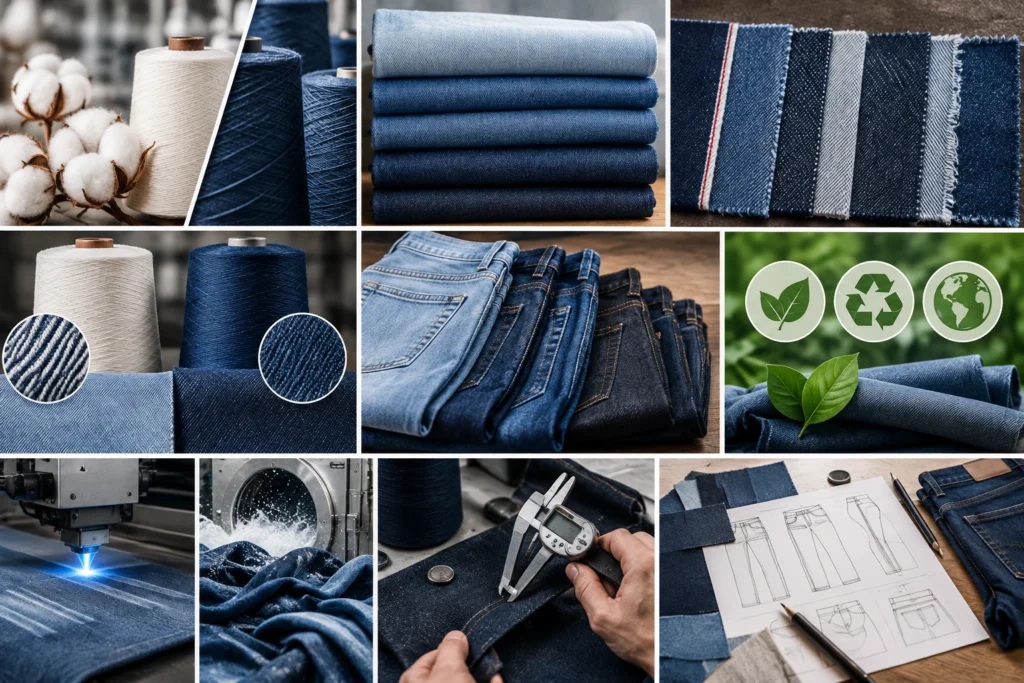
Denim Fabric Types: A Sourcing Guide for Apparel Brands
Table of Contents
What Makes a Fabric Denim, Not Just Blue Cotton
Most buyers describe denim by weight and color, and that’s not wrong, but it isn’t what makes the fabric denim in the first place. Denim is a warp-faced twill weave: only the lengthwise (warp) yarn is dyed, almost always with indigo, and the crosswise (weft) yarn is left undyed. That’s why the face of the fabric is blue and the back is pale, and it’s why denim fades the way it does as the surface wears down toward the undyed core.
The fabric’s name traces back to serge de Nîmes, a twill originally made in Nîmes, France, and the word “jeans” traces separately to Genoa, Italy, once the largest producer of the cloth. Neither history lesson changes how a mill quotes an order, but it explains why two unrelated European place names ended up describing the same American workwear fabric.
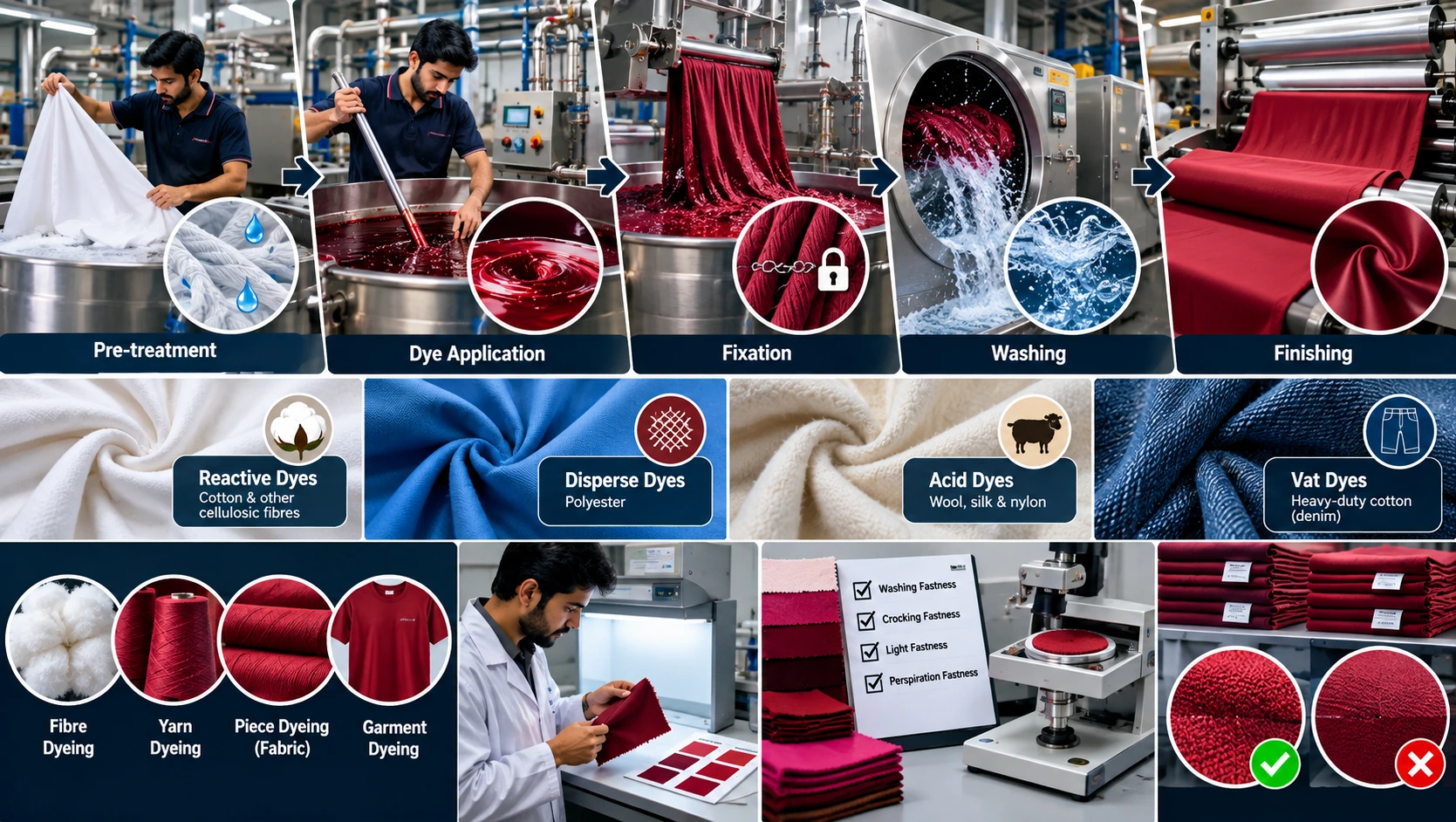
Traditional indigo dyeing uses a rope-dyeing process. Bundles of yarn are twisted into ropes and dipped repeatedly into a reduced indigo bath, then oxidized in air between dips. Because each dip only penetrates the outer layers of the yarn, the result is ring-dyed yarn: a white core wrapped in a thin indigo shell. That structure is the mechanism behind raw denim’s fading pattern, not a marketing description of it. As the surface abrades through wear, the white core shows through in exactly the places that see the most friction, which is why two people can wear the same jeans differently and end up with completely different fade lines.
This construction detail is also why chambray gets mistaken for denim constantly, including in some competitor buying guides. Chambray is a lightweight plain weave, not a twill, and both its warp and weft are dyed to a similar shade instead of one dyed and one left white. It can look close to a light denim at a glance. It isn’t one, and a mill quoting “chambray” against a “light denim” line item on a tech pack is quoting a different fabric.
That weave-and-dye structure is also what separates denim from the fabrics we use on other jacket builds. A puffer jacket shell or a softshell jacket face fabric is usually a technical woven or knit synthetic with a membrane or fill behind it, not a twill, and neither one fades or wears the way denim does. Knowing which category a brief actually falls into (woven cotton twill versus technical synthetic) is the first fork in the road before any weight or construction spec matters.
The Real Difference Between Light, Mid, and Heavy Denim
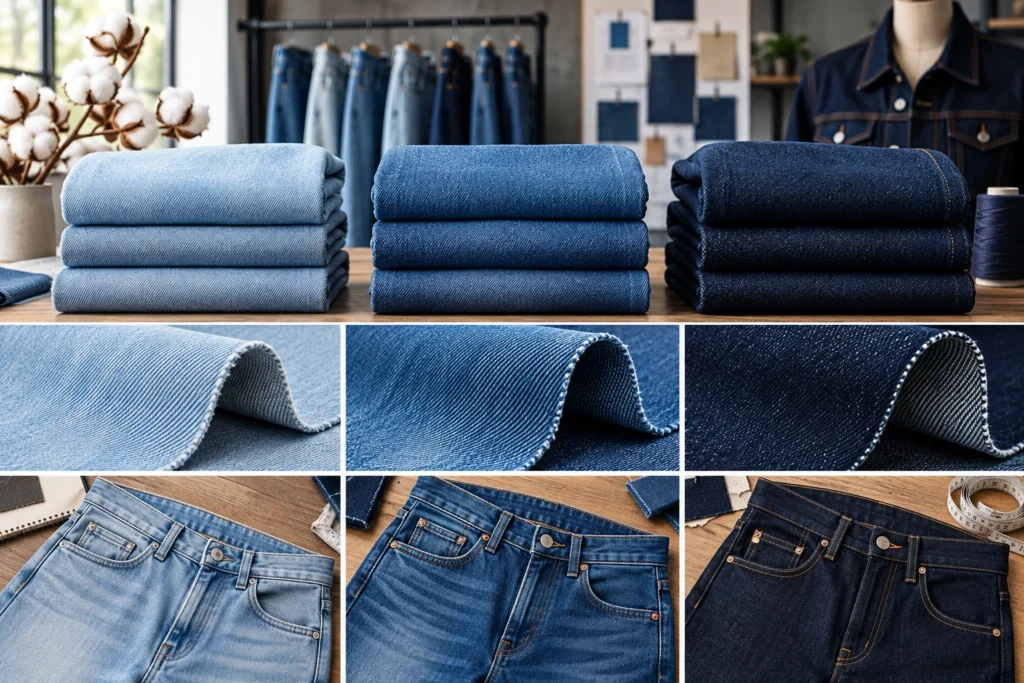
Denim weight is the single most-asked spec question we get, and it’s usually asked the wrong way: “what weight is best” instead of “what weight does this garment need.” Weight is measured in ounces per square yard (oz/yd²) or grams per square meter (GSM), and the two convert directly: 1oz/yd² is approximately 33.9 GSM. The test method mills use to verify weight, ASTM D3776, weighs a conditioned fabric sample under controlled humidity and temperature, which is why two “12oz” bolts from different mills can still read slightly differently on a scale if one wasn’t conditioned the same way before testing.
|
Weight class
|
Range (oz/yd²)
|
Range (GSM)
|
|---|---|---|
|
Light
|
5 to 9oz
|
~170 to 270 GSM
|
|
Mid
|
10 to 14oz
|
~340 to 475 GSM
|
|
Heavy
|
14 to 16oz+
|
~475 to 540+ GSM
|
|
Typical use
|
|---|
|
Shirts, dresses, warm-weather bottoms, layering pieces
|
|
Standard jeans, chinos-style pants, lighter jackets
|
|
Structured jackets, workwear, raw and selvedge denim
|
There isn’t a single global regulatory body that legally defines these three bands. They’re a consistent commercial convention used across mills and buyers, not a codified standard, which is worth knowing before a spec sheet cites “industry-standard mid-weight” as though it’s an enforceable number. What is standardized is the test method behind the number you’re quoted, so when a mill gives you a weight figure, it’s worth asking directly whether it was tested to ASTM D3776 or an equivalent, and under what conditioning.
For outerwear specifically, most jacket-weight denim brands source lands in the 12 to 16oz range, heavy enough to hold structure at the shoulder and collar without a heavy interlining. Our own denim jacket program runs in that band, and the construction and stitching details that go with a heavier substrate are covered in more depth on that page, alongside the rest of our jackets lineup.
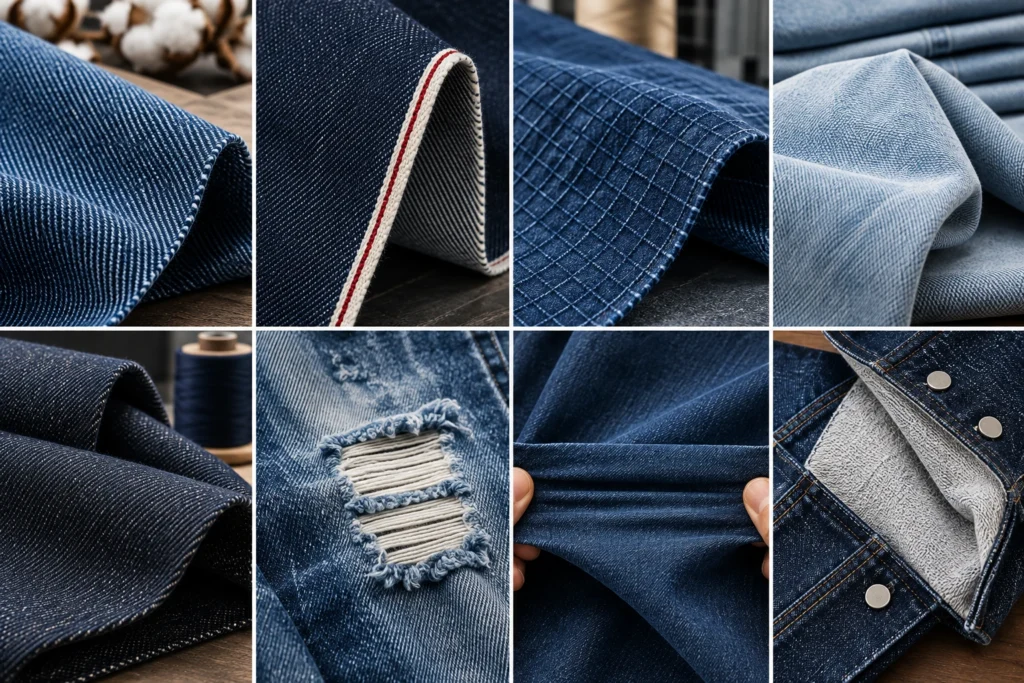
Eight Denim Constructions Worth Knowing Before You Brief a Mill
“Types of denim” gets used loosely to mean weight, wash, weave, and yarn spin all at once, which is part of why briefs get miscommunicated. These eight terms describe genuinely different things about how the fabric is built, not just how it’s finished. Knowing which category a term falls into is what keeps a tech pack from asking a mill for something that doesn’t exist.
Construction and weave
Raw (dry) denim: unwashed and untreated after dyeing and weaving. Stiff hand, deep indigo, develops fades entirely through wear. Usually 12 to 16oz.
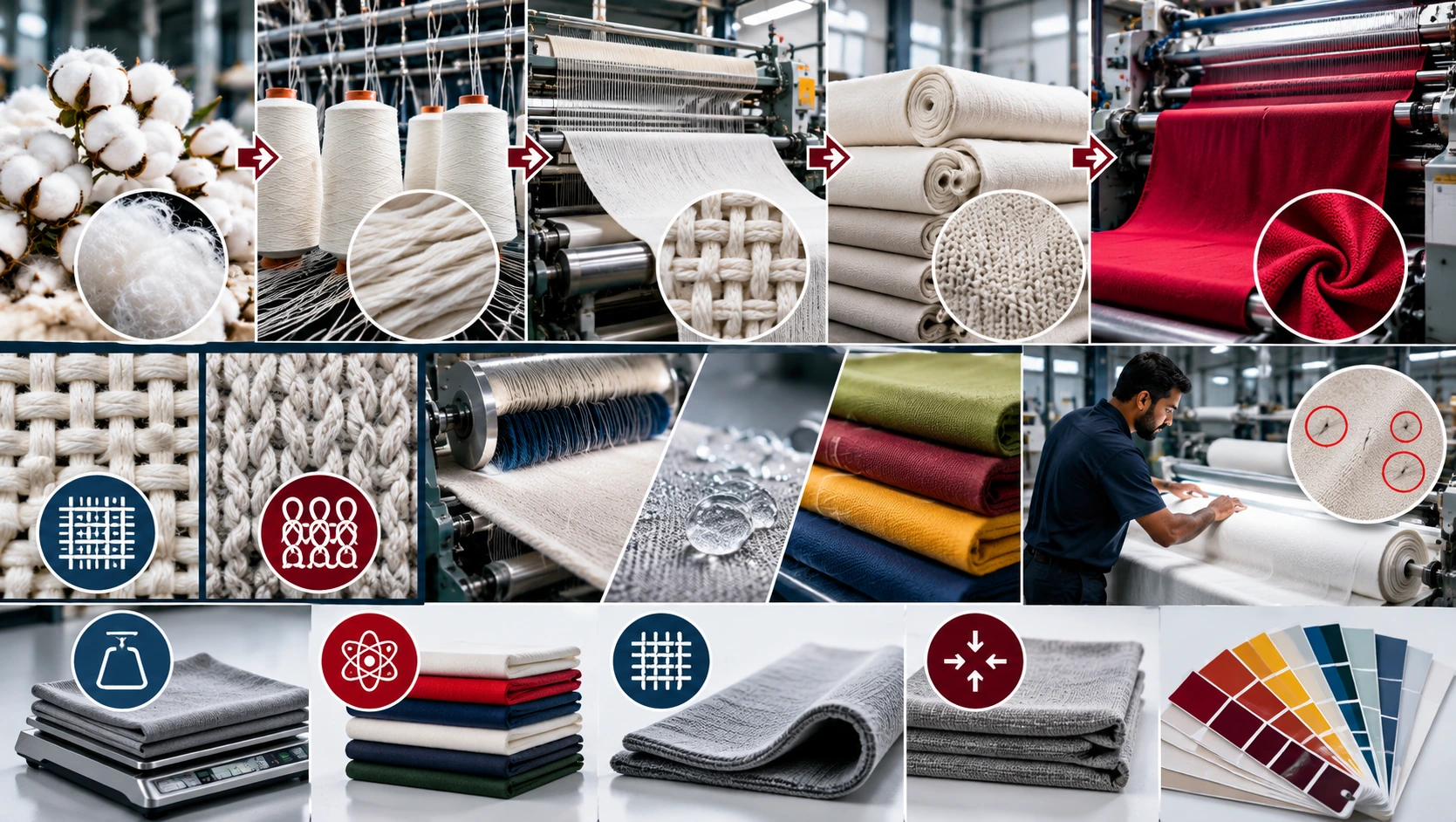
Sanforized denim: mechanically pre-shrunk (compressive shrinkage) to control residual shrinkage to roughly 3% or less. This is the default for most mass-market denim today, typically 10 to 14oz. Unsanforized denim skips this step, and that shrinkage shifts onto the buyer’s first wash instead.
Selvedge denim: woven on narrow, slower shuttle looms (historically around 28 to 32 inches wide, versus 60+ inches for modern projectile or air-jet looms), producing a tightly woven, self-finished edge that won’t fray without overlocking, often marked with a colored ID thread. Typically 12 to 16oz.
Rigid denim: the term for denim with no stretch fiber at all, 100% cotton, the counterpart to stretch denim below.
Slub denim: woven with yarn deliberately spun to an irregular thickness, giving the surface a textured, slightly uneven look. Usually 8 to 12oz.
Bull denim: a heavier, tightly woven, canvas-like twill, typically 12 to 21oz, built for abrasion and tear resistance rather than fashion fading. Common in workwear and uniforms, not always indigo-dyed.
Chambray: a lightweight plain weave (not a twill), both yarns dyed a similar shade, usually under 8oz. Visually close to light denim, technically not denim, as covered above.
Stretch (comfort) denim: cotton blended with elastane or spandex, commonly in the 1 to 3% range, sometimes higher depending on the mill, typically 8 to 13oz.
A separate, common point of confusion: stonewash, acid wash, crushed, and enzyme wash are finishes applied to a woven fabric, not fabric types in their own right. Acid wash uses pumice stones plus an oxidizing agent for a high-contrast, marbled fade. Crushed denim goes through a similar random-crease treatment for a permanently rumpled look. Enzyme wash uses cellulase enzymes to soften and lightly fade the fabric with far less mechanical abrasion than pumice stonewashing. A tech pack asking for “acid wash, 12oz raw denim” is specifying a finish applied to a base fabric, and both halves of that instruction need to be correct for the mill to quote it properly.
Ring-Spun or Open-End: The Yarn Decision Most Spec Sheets Skip
Every one of the constructions above still has to be woven from yarn, and how that yarn was spun changes the finished fabric more than most buyers expect, which is exactly why it rarely makes it onto a spec sheet.
Ring-spun yarn is spun on a slower, more labor-intensive process, roughly five times longer than the alternative below. It produces a stronger yarn with a slightly uneven, “slubby” texture that absorbs indigo less uniformly along its length. That unevenness is what gives ring-spun denim its more pronounced, higher-contrast fading, which is why premium and selvedge denim runs are almost always ring-spun.
Open-end (OE) yarn is spun faster and more cheaply, producing a more uniform yarn at higher volume. It’s the more common choice for bulk and value denim. The tradeoff is real and measurable: open-end yarn has been documented at 10 to 30% weaker than ring-spun yarn of comparable weight. For a garment that needs to survive repeated heavy wear and washing at volume, that strength difference is worth knowing before it shows up as a return rate.
Neither is “better” outright. Ring-spun costs more and fades better. Open-end costs less and holds up more consistently at scale with a plainer fade. The point is that a brand choosing between them should be choosing on purpose, not discovering the difference after the first bulk run comes back.
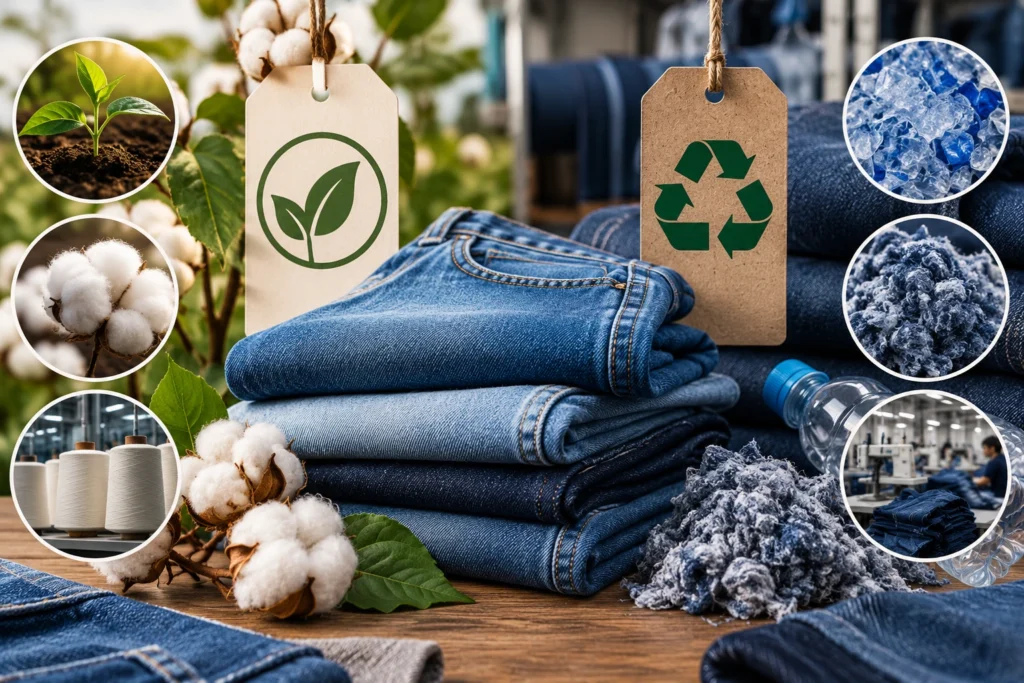
GOTS and GRS Certify Different Things, Not the Same Sustainability Claim
Sustainability claims on denim get grouped together loosely, but the two certifications behind them cover genuinely different things, and a compliance or buying team asking for one won’t accept proof of the other.
The Global Organic Textile Standard (GOTS) certifies organic fiber content and the environmental and social conditions of processing across the entire supply chain, from fiber to finished garment. To sell a product as GOTS-certified, every company that touches it along the way, not just the mill, has to be independently certified. GOTS covers chemical inputs, wastewater treatment, and labor conditions alongside the organic-fiber claim itself.
The Global Recycled Standard (GRS), managed by Textile Exchange, certifies recycled content and chain of custody instead of organic origin. A product needs a minimum of 20% recycled material to fall under GRS scope at all, but needs at least 50% recycled content to carry the GRS product label itself. A denim fabric blended from 30% recycled cotton, for instance, can be GRS-scoped but isn’t eligible for the on-product GRS mark until it clears that 50% threshold.
In practice: ask for GOTS when the requirement is organic fiber origin. Ask for GRS when the requirement is recycled content, and ask specifically what percentage the buyer needs the label to reflect, since 20% and 50% recycled denim are both real, certifiable products, but only one of them can carry the GRS mark on the swing tag.
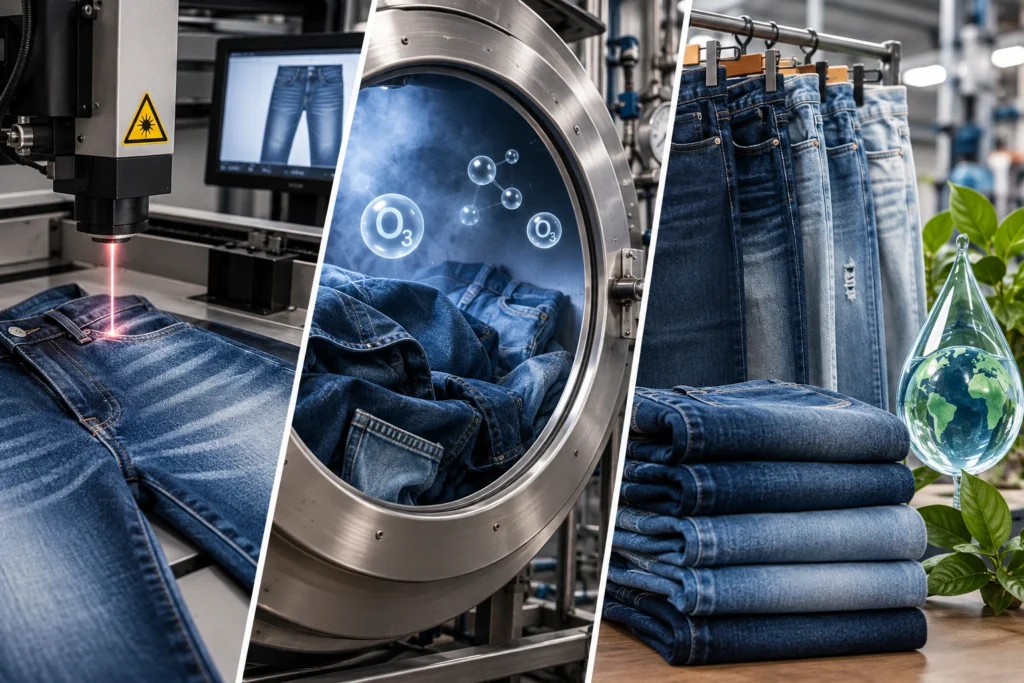
Laser Fading and Ozone Washing Are Reducing Denim's Water Footprint
Denim finishing, not weaving or dyeing, is where most of a pair of jeans’ water and chemical footprint has traditionally sat: stonewashing, bleaching, and rinsing all happen after the garment is already sewn. Two technologies have moved into mainstream use specifically to cut that footprint.
Laser fading uses a computer-controlled laser to burn localized fade patterns, whiskers, and distressing directly onto the garment surface, replicating what stonewashing or hand-sanding used to do without water, stones, or bleaching chemicals in that step. Ozone washing replaces or reduces the stonewashing stage by using ozone gas to fade and soften denim, cutting the chemical load that traditional stone-and-chemical washing required.
Industry reporting from equipment manufacturers and textile trade press consistently describes both technologies as significantly reducing water and chemical use in the finishing stage compared to conventional stonewashing, though the exact percentage reductions cited vary by source and by the specific finish being replicated, so we’re not going to repeat a single number here as though it’s settled. What’s consistent across sources is the direction: brands specifying laser or ozone finishing at the mill level are asking for a real, verifiable reduction in finishing-stage water and chemical use, not a marketing claim with nothing behind it.
The Three Numbers Most Denim Tech Packs Are Missing
Weight and color make it onto almost every denim spec sheet we receive. Three numbers that matter just as much for how the finished garment performs usually don’t, and their absence is where most reorder disputes actually start.
Shrinkage tolerance. Sanforizing controls this, but “sanforized” alone isn’t a number a QC team can check a finished garment against. Ask for a maximum shrinkage percentage after a standard wash cycle, and hold the bulk shipment to that figure specifically, not just to “sanforized, so it should be fine.”
Colorfastness rating. Indigo denim rubs off, that’s expected, but how much is supposed to be a specified, tested number, not a surprise a retail buyer finds after the garment’s been on a shelf next to lighter fabric. Colorfastness to rubbing (crocking) is a standard textile test; ask for the rating your buyer’s own QC standard requires and get it confirmed on the pre-production sample, not assumed from the fabric type alone. This is exactly the kind of check that belongs in a pre-shipment inspection, not discovered after the container’s already loaded.
Stretch recovery percentage. On stretch/comfort denim specifically, elastane content alone doesn’t tell you how well the fabric returns to shape after wear. Two fabrics can both be “2% spandex” and behave completely differently after 20 wears depending on the recovery spec behind that number. Ask for it, especially on fitted styles where sag over time is a real customer complaint.
How We Read a Denim Spec Before It Reaches the Cutting Table
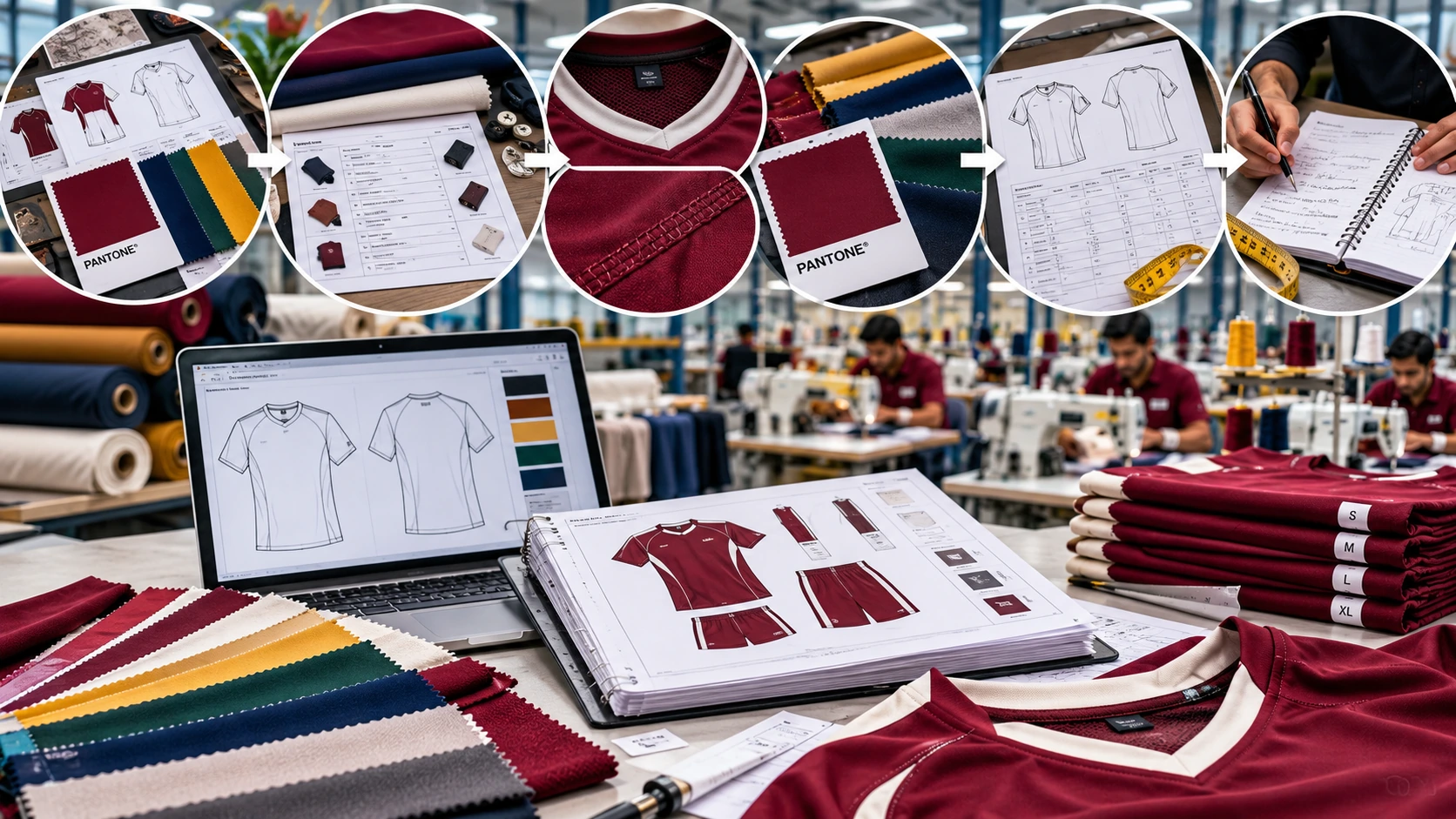
This is the part of the process that’s ours specifically, not general denim knowledge. Every denim order that comes through our factory goes through the same check before it’s cut: weight verified against the tech pack, shrinkage and colorfastness confirmed on a physical pre-production sample rather than assumed from the fabric description, and construction details (weave, sanforizing, stretch percentage) matched to what the garment needs to do, not just what was written down first. If a design also carries branding, whether that’s a woven patch or embroidery on a pocket or yoke, that gets tested on the same sample for how it sits against the denim’s weight and stretch, not added on afterward.
We run at MOQ 30 per design, with sampling typically taking around 12 days and bulk production around 18 days once the sample is approved, so a spec gap caught at the sample stage costs days, not a full production cycle. That’s why we push for the three numbers in the section above before a sample even gets cut: it’s cheaper to fix a shrinkage tolerance on a tech pack than to fix it on 500 finished units. If you’re working from a tech pack already, our team can review it and confirm those numbers before quoting, get in touch and we’ll walk through it together.
Frequently Asked Questions
No. Chambray is a lightweight plain weave with both yarns dyed a similar shade. Denim is a twill weave with only the warp yarn dyed. They can look alike from a distance, but they're different constructions and a mill will quote them as different fabrics.
Raw denim hasn't been washed or treated after dyeing and weaving, so it's stiffer and develops all of its fading through wear. Washed denim has already been through a finishing process (stonewash, enzyme wash, or another treatment) before it reaches the customer, so it's softer out of the box and fades less dramatically from that point on.
Not inherently. What determines durability is the base fabric's weight and yarn strength, plus the stretch recovery percentage of the elastane blend. A well-specified stretch denim with a documented recovery rate can outlast a poorly specified rigid denim. The elastane content number alone doesn't answer the durability question on its own.
It guarantees the fabric has gone through a compressive pre-shrinking process, which typically holds residual shrinkage to around 3% or less. It doesn't guarantee zero shrinkage, and the exact tolerance should still be requested and confirmed on a sample, not assumed from the word "sanforized" alone.
Yes, in two measurable ways: fade appearance and tensile strength. Open-end yarn has been documented at 10 to 30% weaker than ring-spun. For a fashion-forward, fade-driven product, ring-spun is usually worth the added cost. For a high-volume, value-tier product where uniform appearance matters more than fade character, open-end is often the more practical choice.
Jean-weight denim typically runs 10 to 14oz (roughly 340 to 475 GSM). Jacket-weight denim, especially for structured outerwear that needs to hold shape at the collar and shoulder without heavy interlining, usually runs heavier, 12 to 16oz (roughly 405 to 540 GSM).
It depends on the certification tier and the fiber mix, and it varies by mill and by season, so we're not going to quote a blanket percentage here. What we can say is that GOTS and GRS certification carry real compliance and audit costs across the supply chain, which is typically reflected in the fabric price, and it's worth getting a direct quote for the specific percentage and certification level you need rather than assuming a flat markup.
All three are finishes, not fabric types. Stonewash uses pumice stones for mechanical abrasion. Acid wash adds an oxidizing agent to pumice stonewashing for a high-contrast, marbled effect. Enzyme wash uses cellulase enzymes instead of stones, producing a softer, more even fade with less mechanical wear on the fabric itself.
At minimum: shrinkage tolerance after a standard wash cycle, a colorfastness (crocking) rating, stretch recovery percentage on any elastane blend, twill direction if it matters to the design, and whether sanforizing is required. These are the details covered in the sections above that most tech packs leave off.
Yes, that's a standard construction on a lot of fitted styles, and it's worth specifying exactly where each fabric applies on the tech pack, since the two fabrics can behave differently in wash and shrinkage and that needs to be accounted for at the pattern stage, not discovered after the first sample.
Right-hand twill, left-hand twill, and broken twill all use the same weave family but change the diagonal direction (or reverse it periodically, in the case of broken twill) of the surface line. It affects hand feel and how the fabric drapes and hangs, and it's a detail worth specifying on a tech pack for any design where drape matters, rather than leaving it to whatever the mill defaults to.

FOUNDER & CEO AT RIJIZ
Send us a message
Latest Post