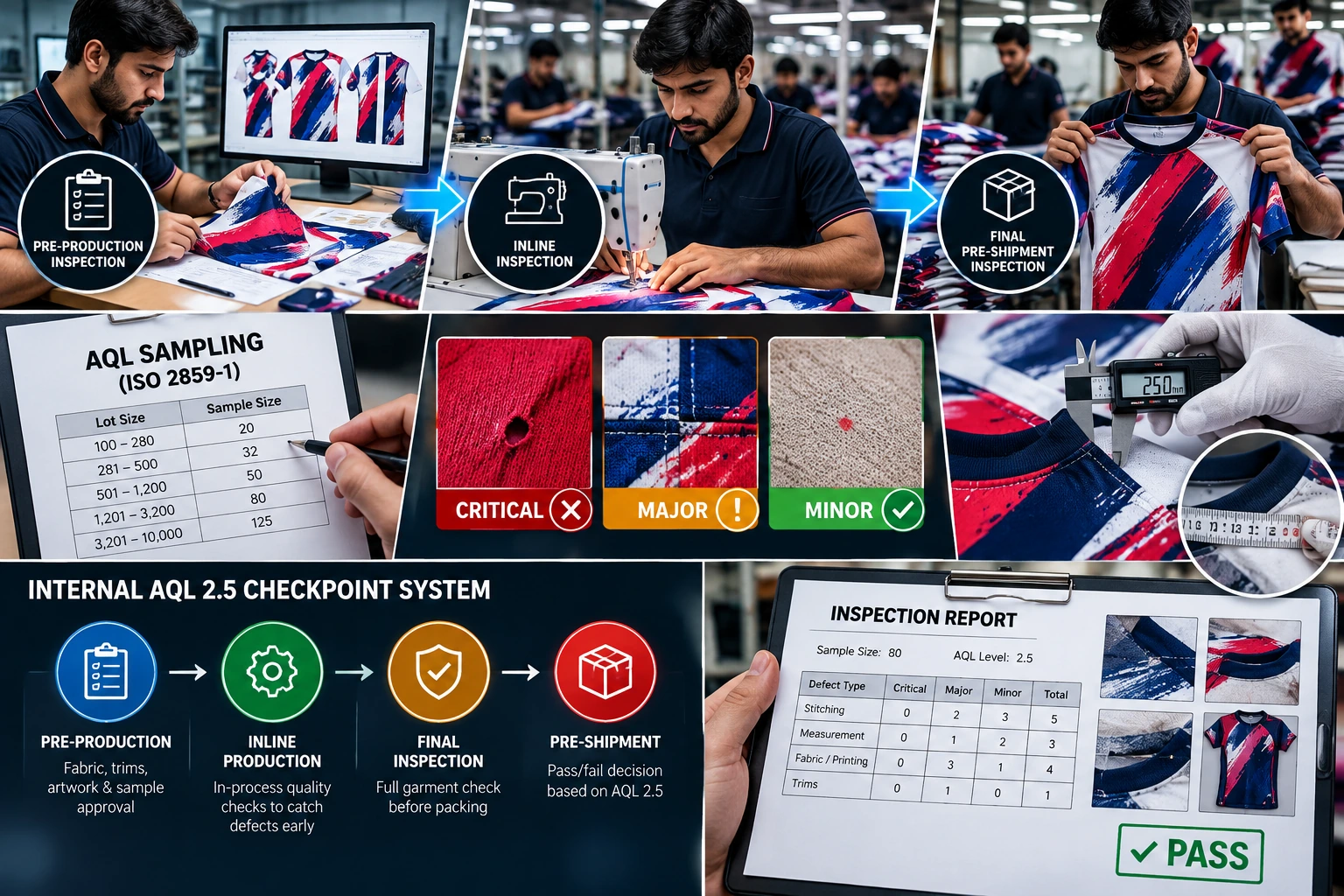

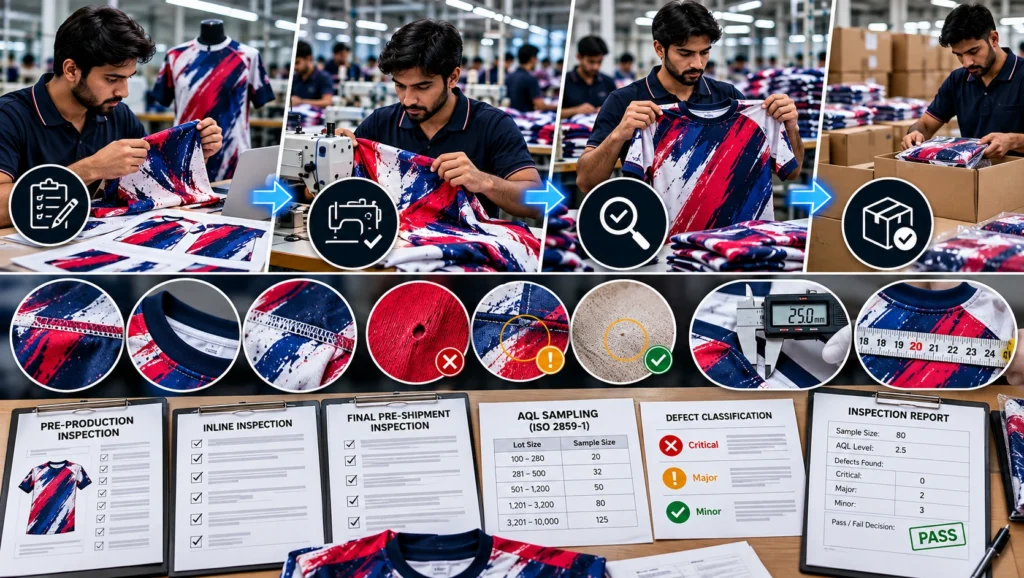
A brand sourcing production for the first time often pictures quality control as one inspection at the very end, a person checking finished garments before they ship. In practice, a working QC program produces several different forms at several different points, because a defect caught in raw fabric costs almost nothing to fix, while the same defect caught in a sealed carton on a loading dock costs a full remake or a customer return. Rijiz’s own quality control and inspection process is built around this logic: catch a problem at the earliest checkpoint where it’s visible, not the last one where it’s expensive.
Each form exists to answer one specific question. A raw material form asks whether the fabric roll is within its defect-point allowance before it reaches the cutting table. An inline form asks whether stitch tension and construction are holding up while the line is still running. A final inspection form asks whether the finished, packed shipment matches the approved sample within its stated tolerance. A brand that only asks for the last of these three is asking a factory to prove quality after the point where anything can still be corrected cheaply.
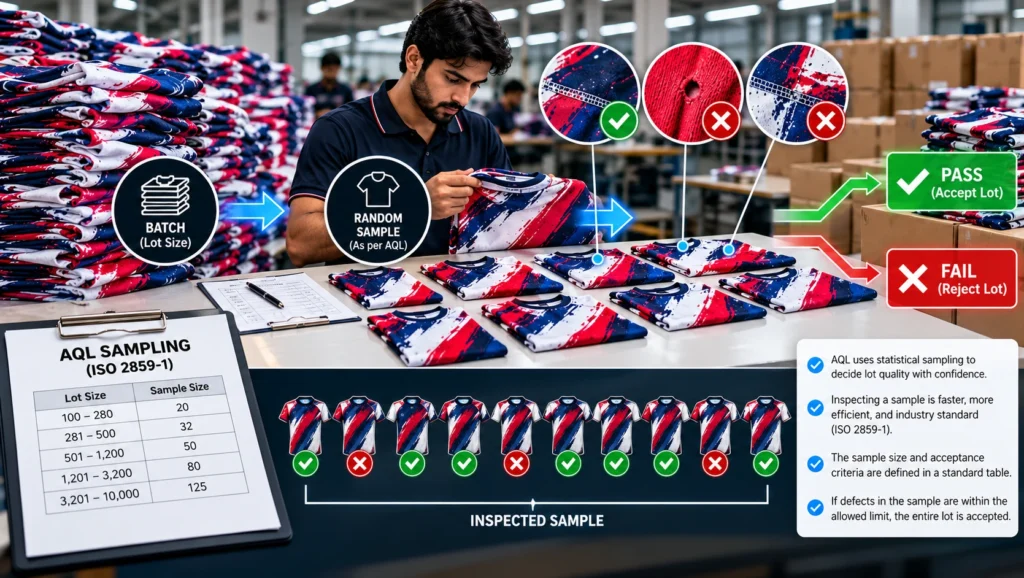
AQL stands for Acceptable Quality Limit, and it’s the statistical basis almost every apparel inspection form is built on. Instead of examining every unit in an order, an inspector pulls a sample sized to the total lot, counts the defects found in that sample, and compares the count against a pre-agreed limit. If the defect count stays under the limit, the lot passes. If it exceeds the limit, the lot fails, even if most of the units in it are actually fine.
The sample sizes and pass/fail thresholds aren’t arbitrary. They come from published sampling tables, most widely ISO 2859-1, the international standard for sampling schemes indexed by acceptance quality limit, and its North American counterpart, ANSI/ASQ Z1.4. Both work the same way: a lot size and an inspection level determine a code letter, and that code letter plus the chosen AQL determine exactly how many units to pull and how many defects are allowed at each severity tier before the lot is rejected. A form that cites “AQL 2.5” without stating the lot size and sample size behind it is only giving half the number.
This is also why AQL sampling isn’t a quality target to aim for. A lot sitting exactly at its AQL is designed to have a high, but not perfect, chance of passing, meaning some defective units can still be present in an accepted shipment. AQL sampling manages statistical risk across a large batch efficiently; it doesn’t promise zero defects, which is part of why the earlier checkpoints matter as much as the final one.
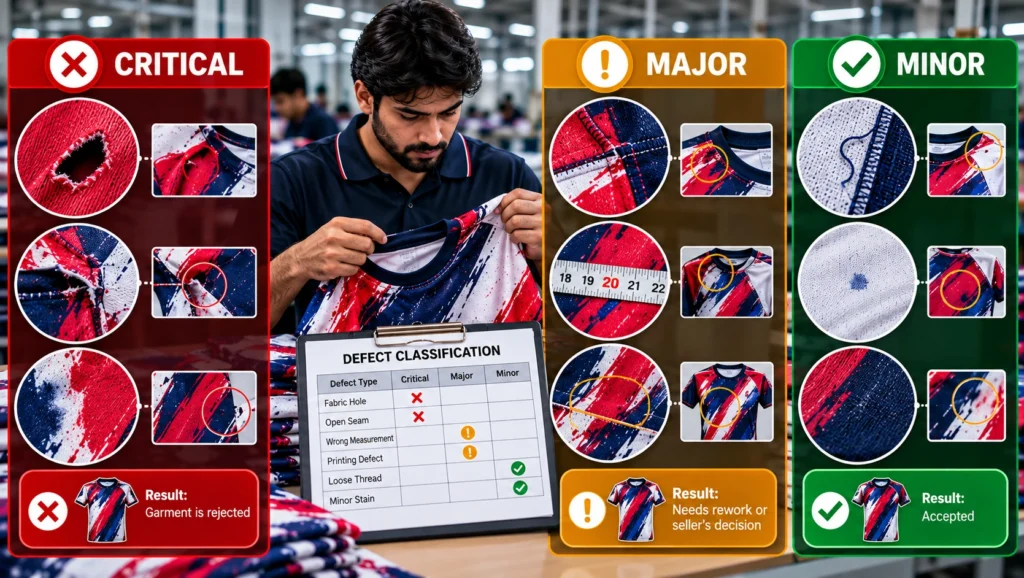
Every defect found during inspection gets sorted into one of three tiers, and a usable QC form records the tier alongside the defect itself, not just a tally.
Critical defects make a garment unsafe or unsellable outright: an exposed needle fragment, a missing safety label where one is required, a component that could pose a choking hazard. Critical defects are typically held to zero tolerance in the sampling plan, meaning even one found in the sample can fail the entire lot.
Major defects don’t create a safety issue but would likely get the garment returned: a seam that’s visibly puckered, a measurement outside its stated tolerance, a color mismatch between panels. Major defects get a wider allowance than critical ones, but the allowance is still tight.
Minor defects are cosmetic issues a typical customer wouldn’t notice or return the item over: a slightly uneven thread trim, a small mark that will come out in the first wash. Minor defects carry the most generous allowance of the three tiers.
A form that logs “12 defects found” without separating them into these tiers is far less useful than one that logs “0 critical, 2 major, 10 minor,” because the second version tells a brand whether the shipment is actually at risk or just cosmetically imperfect.
Pre-production inspection happens before bulk cutting starts, usually against the approved pre-production sample. This is where a brand confirms the factory is working from the right fabric, the right trims, and the right construction, before those choices get multiplied across an entire run. A fit and pre-production sample that hasn’t been formally approved yet is the wrong thing to be inspecting against; the sample has to be locked first.
Inline (during production) inspection happens while the line is actively sewing, at a set interval rather than once. Pulling garments straight from operators’ hands catches a tension or construction drift early, while it’s still a quick fix on the current batch rather than a defect baked into several hundred finished units.
Final, or pre-shipment, inspection happens after garments are finished, packed, and ready to ship, and it’s the checkpoint most brands are familiar with because it’s the one a third-party inspection company usually performs. It checks the finished, packed shipment as a whole: garment measurements, construction, labeling, and carton contents, against the approved Golden Sample and the order’s paperwork.
Treating these as three separate forms, not one, is what actually catches problems early. A brand that only reviews a final inspection report is seeing the outcome of a process it never actually checked in on.
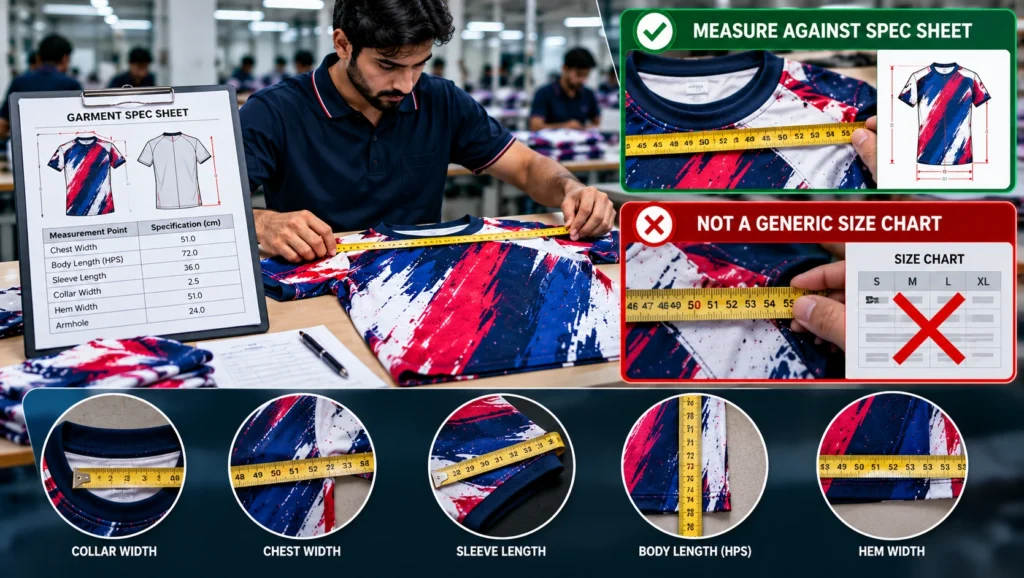
The measurement section of a final inspection form is only as good as the document it’s checked against. An inspector measuring a finished garment against a generic size chart is confirming the garment is roughly the right size. An inspector measuring against the brand’s own garment spec sheet is confirming the garment matches the specific point of measure and tolerance values the brand actually approved, which is a different and much more useful check. Those point of measure values start as body measurements taken from a fit model or a published sizing standard before they’re ever written onto a spec sheet, which is why an inspector who doesn’t know how a measurement was derived has a harder time judging whether an out-of-tolerance reading is a construction problem or a spec problem.
This matters because tolerance varies by point of measure, not by garment. A chest measurement commonly tolerates roughly half an inch either way, since fabric behavior and cutting variance naturally produce more spread across a wider span, while a sleeve length or neck drop needs a much tighter allowance to still read as correctly fitted. A QC form that applies one blanket tolerance to every measurement will pass garments that are visibly off in the places that matter most, and fail garments that are actually fine.
A finished-garment measurement check should record, per point of measure: the spec sheet’s target value, the tolerance, and the actual measurement taken, not just a pass or fail checkbox. That’s the level of detail that lets a brand see exactly where a batch is drifting, rather than just learning that something, somewhere, didn’t match.
A usable QC form doesn’t need to be complicated, but it does need to separate what’s being checked, at which checkpoint, from how severely a failure on that line counts. A simple structure looks like this:
|
Check Category
|
Example Item
|
Checkpoint
|
Defect Tier if Failed
|
|---|---|---|---|
|
Fabric
|
Roll defect points within limit (4-point system)
|
Pre-production
|
Major
|
|
Construction
|
Stitches per inch matches tech pack
|
Inline
|
Major
|
|
Construction
|
Bobbin thread color matches face thread
|
Inline
|
Minor
|
|
Measurement
|
Point of measure within stated tolerance
|
Final
|
Major
|
|
Symmetry
|
Garment folds evenly on the center axis (no off-grain twist)
|
Final
|
Major
|
|
Hardware
|
Zipper, snap, or drawstring survives a pull test
|
Final
|
Critical if it detaches
|
|
Colorfastness
|
No dye transfer under a crocking test (dry and wet)
|
Final
|
Major
|
|
Safety
|
No embedded metal (needle fragment) detected
|
Final
|
Critical
|
|
Packaging
|
Carton weight matches the tech pack's calculated weight
|
Final
|
Minor
|
This structure is a starting template, not a finished form. A real QC form for a specific order should reference the exact spec sheet and sample size for that order, since the AQL tables in ISO 2859-1 tie the actual sample size to the shipment’s own lot size, not to a fixed number every brand can reuse.
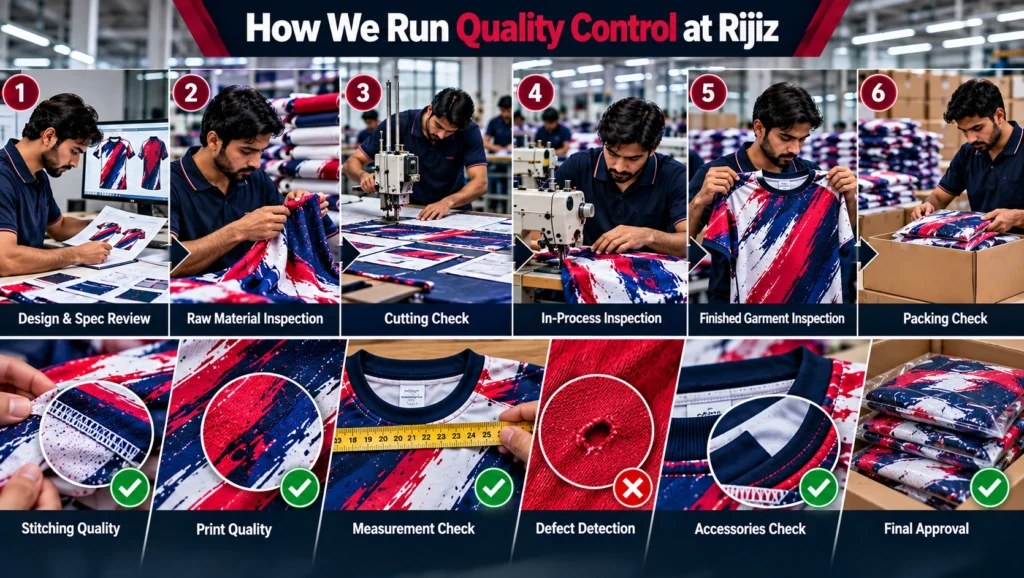
We run internal AQL 2.5 inspection because a single end-of-line check misses too much, and by the time a defect surfaces there, it’s already been sewn into every unit ahead of it in the batch. Fabric gets graded on the 4-point system before it reaches a cutting table, since a garment built from a flawed roll can’t be fixed by better sewing downstream. Every two hours, a floor manager pulls garments straight off the sewing line to check stitches-per-inch and thread color against the tech pack, and a tension problem halts that line immediately rather than running through the rest of the batch. Finished, packed garments go through a Final Random Inspection against your approved Golden Sample, checking dimensional tolerance against your points of measure, symmetry, hardware pull strength, and colorfastness, and every sealed carton passes through a needle detector before it leaves our facility.
We’re ISO 9001 certified, and every inspection report we send documents the sample size, the AQL level, and defects found by tier with photos, not a one-line summary. If a finished order doesn’t match what was approved, we stand behind it with a full refund or a free remake. You’re also welcome to bring in your own third-party inspector for a final random inspection before authorizing shipment; we run a transparent floor and that request doesn’t change how we operate. If you’d like to see how this fits your own production run, get in touch about your quality control and inspection needs and we’ll walk through it together.
AQL stands for Acceptable Quality Limit, the statistical basis for sampling inspection. Instead of checking every unit, an inspector checks a sample sized to the lot and compares the defects found against a pre-agreed limit set by tables like ISO 2859-1.
Critical defects make a garment unsafe or unsellable and are typically held to zero tolerance. Major defects would likely get a garment returned, like an out-of-tolerance measurement or visible seam pucker. Minor defects are small cosmetic issues most customers wouldn't notice.
No. AQL sampling manages statistical risk across a batch efficiently; a lot at its AQL level is designed to have a high chance of passing, not a guarantee of zero defects. That's part of why earlier checkpoints, not just final inspection, matter.
Inline inspection happens while the line is actively sewing, at a set interval, catching construction or tension problems early. Final inspection happens after garments are finished and packed, checking the completed shipment against the approved sample before it ships.
Because tolerance varies by point of measure, not by garment. A spec sheet gives the exact target value and allowed tolerance for each specific measurement, which a generic size chart doesn't provide.
Rijiz states it runs internal AQL 2.5 quality control on its own live quality control page.
Garments with minor or major defects typically go to a rework line for correction. Garments with critical defects are usually destroyed and replaced rather than reworked.
Yes, a factory running a transparent process should welcome an independent inspector conducting a final random inspection before shipment is authorized.
The sample size used, the AQL level applied, defects found broken out by tier with supporting photos, and a clear pass or fail decision, not just a general statement that the order passed.
The structure (fabric, construction, measurement, symmetry, hardware, colorfastness, safety, packaging) stays consistent, but the specific values, especially measurement tolerances and sample size, need to reference that order's own spec sheet and lot size.
* * *

FOUNDER & CEO AT RIJIZ