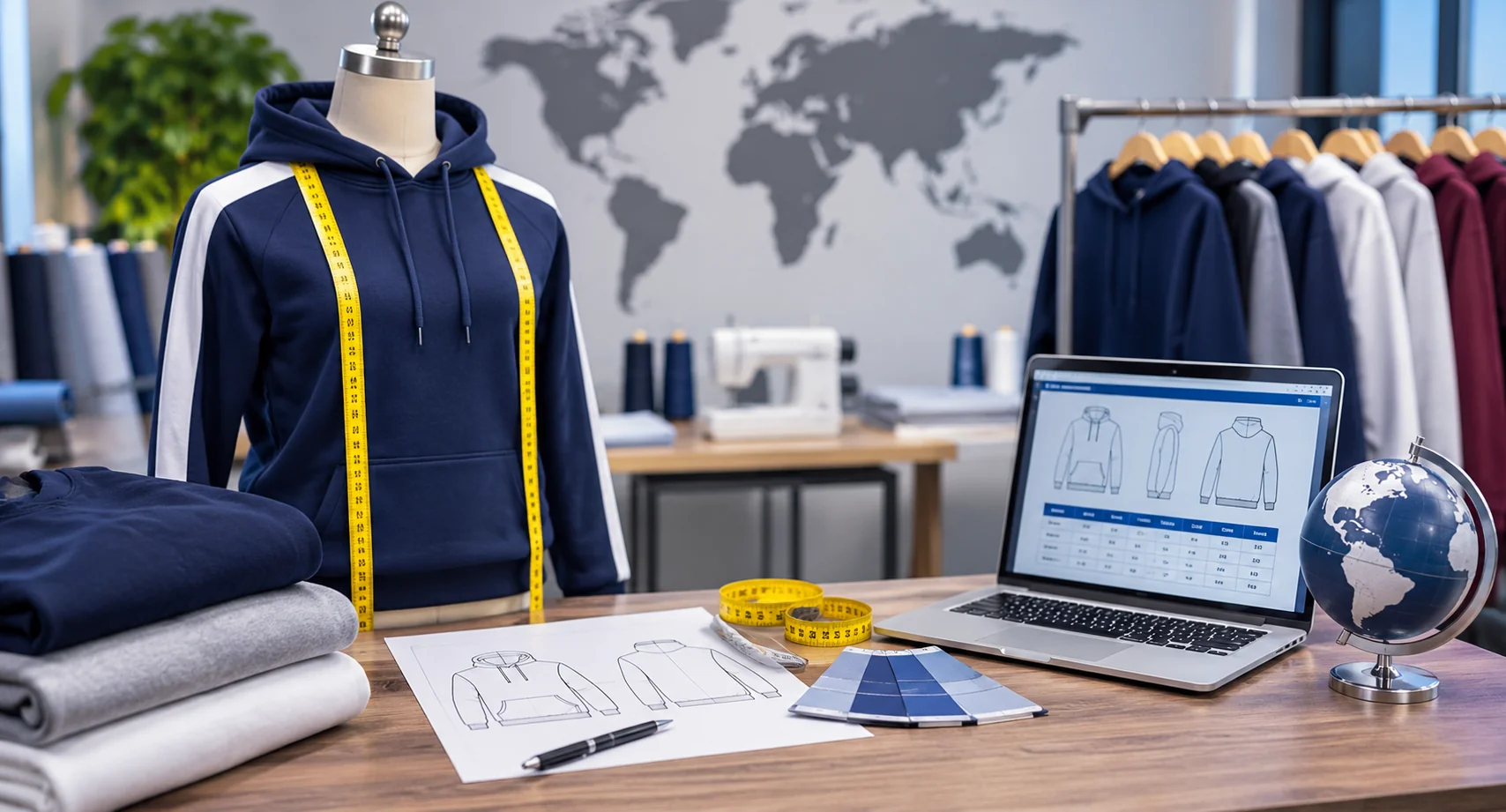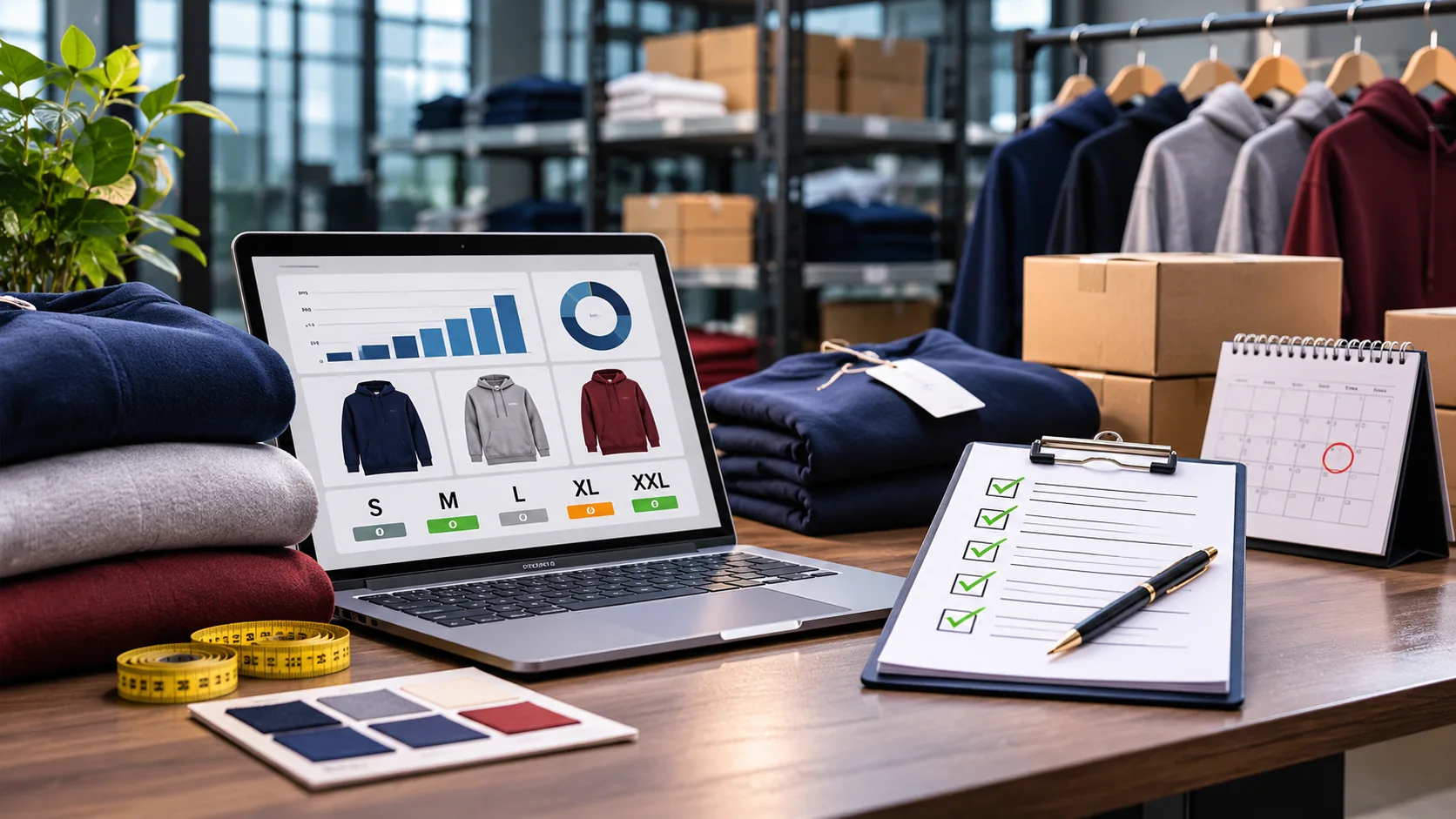
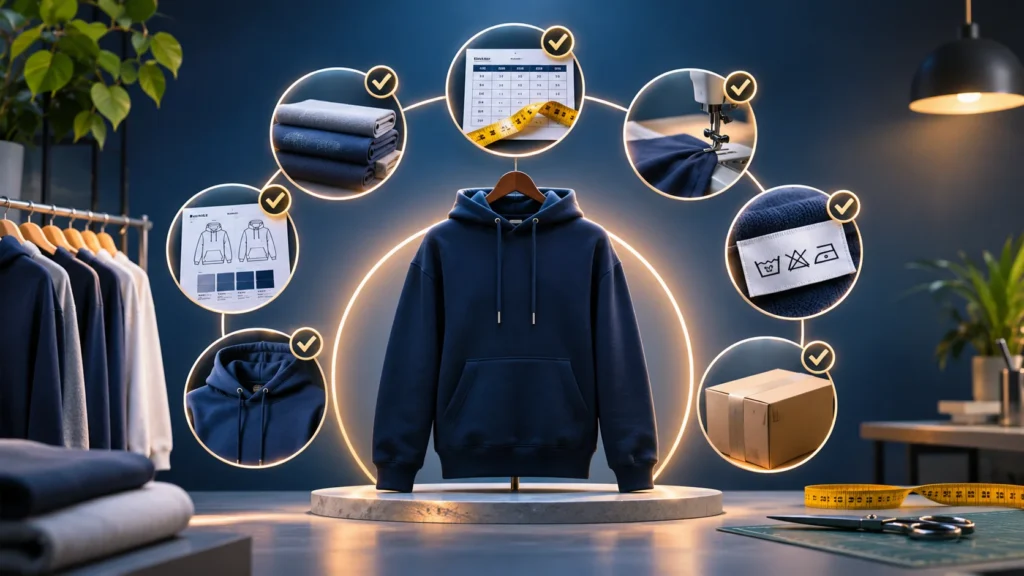
Before a first production run, check that the sample, the spec and the approvals are fixed, because those three things cannot be changed cheaply once cutting starts. Think of the moment your sample is approved and your factory asks to start bulk. From that point the fabric is cut, the trims are ordered and the line is set, so a gap in the sample or the spec is repeated in every unit. Pre-production sampling closes most of those gaps, but seven checks cover the rest, in the order they come up before bulk starts: the sample, the size set, the tech pack, the fabric, the trims and labels, the inspection plan and the dates.
Start with the pre-production sample, usually called the PP sample or PPS. Our sampling page says the PPS “is built using the exact bulk fabric, the exact custom hardware, and the exact industrial sewing machines that will be used for the final run.” That is the test to put to any factory. Was your sample sewn on the line that will make your order, in the materials that will go into it, or somewhere else with substitutes?
Other samples do different jobs. A muslin draft tests the base geometry, and a fit sample tests how the measurements sit on a fit model, so neither shows that the production line can build the design. Our sampling page says the PP sample “tests the factory floor’s capability to execute the tech pack”. Once you approve it, the page says it becomes the “Golden Sample”, the physical reference the bulk run is judged against.
Record the approval as one of three outcomes, with one named owner. Approve means the sample becomes the benchmark for bulk. Approve with conditions means it passes with named corrections, and those corrections must appear on the bulk garment before the run goes on. Reject means no bulk is cut until a new PP sample is approved. Write the outcome, the date and the signer’s name and role on one line, because a verbal yes gives a later dispute nothing to check against.
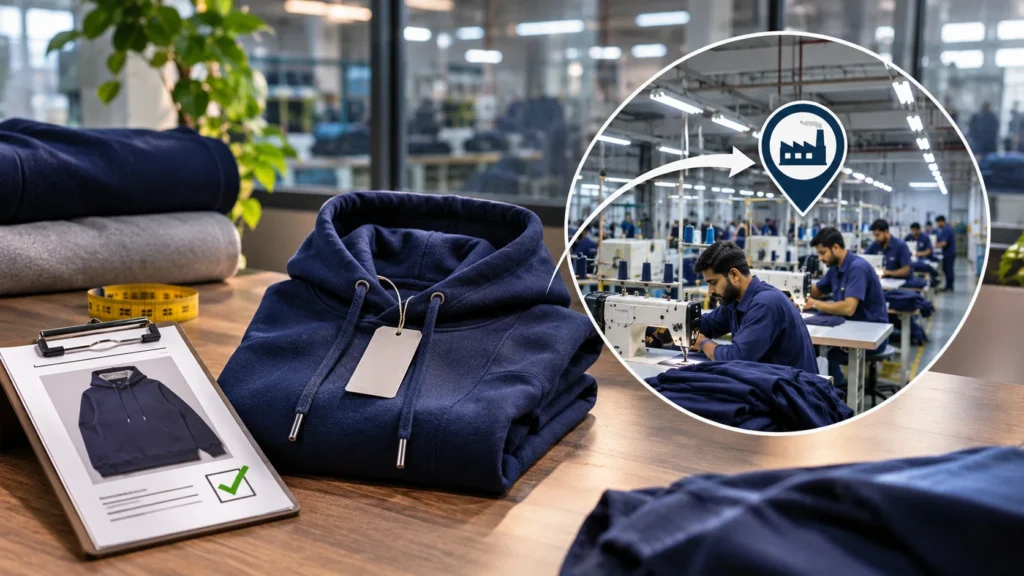
Approving one size does not prove the rest of the run. Our sampling page says a size set, which is a physical sample of every single size in your matrix such as XS, M and XXL, is made before bulk grading is final. Grade errors tend to show at the smallest and largest sizes, because that is where each measurement has moved furthest from the base size, so measure the ends as carefully as the middle.
Measure against the spec sheet, not a generic size chart. For each point of measure, write three numbers: the target, the tolerance and the actual reading. A record with those three values shows where a size drifts, while a single pass or fail mark does not. If grade rules are new to you, our pattern grading guide explains how one base pattern becomes a full size run.
Agree the tolerance for each point of measure before the size set is measured, not after. A chest measurement and a sleeve length do not need the same allowance, so one tolerance written for the whole garment can pass pieces that are wrong in the places that matter. Ask the factory to measure the same points on every size, using the same method, so the readings can be compared across the run.
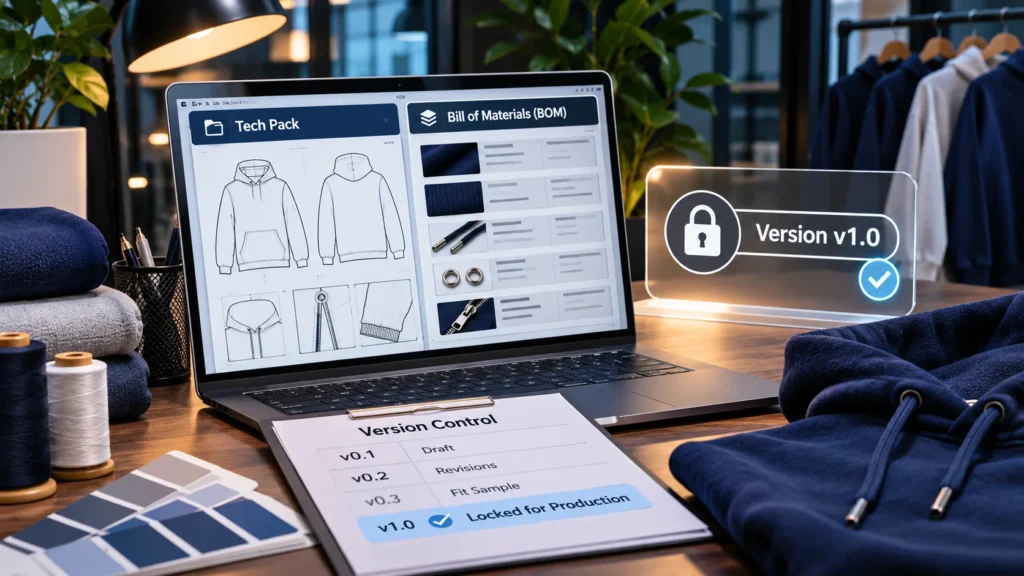
A factory cannot sample or price what is not written down. Our sampling page says sample makers need a tech pack with construction callouts, stitch types and exact points of measure (POM), plus production-ready digital CAD files in DXF or ASTM format. Our tech pack guide lists every component a factory needs, so use it as the checklist for what goes into your pack.
Give the pack a version number and a date, and ask the factory to confirm in writing which version it is building from before any fabric is ordered. Any fit comment or trim change that comes later gets a new version number and a short note on what changed, so the sample and the bulk run are always checked against the same document.
Check the bill of materials line by line against the pack. Every fabric, lining, thread, trim and label needs a supplier reference, a quantity and a colour reference where colour matters. Where the two documents disagree, the sample will show the factory’s choice rather than yours, so reconcile them before anything is cut.
Fabric is the first item that can be wrong before any garment is made. Confirm that your bulk fabric is in stock, or know its lead time, before you agree a start date. Our sampling page says the fit sample is cut from your actual bulk fabric, so a fabric that is still being made delays the sample as well as the bulk run.
Agree the colour standard in writing before the first lab dip is made. Name the physical reference, the light you will judge under and the person who signs. Then approve the dip against that standard under that light, and keep the approved swatch with the spec, because it is the reference the bulk fabric will be judged against.
Shrinkage is hard to correct once the fabric is cut, so settle it first. Our sampling page says that on prototypes, “We document the exact shrinkage percentages in both the warp and weft directions.” Ask for the length and width results separately, and ask which wash and dry method produced them. A result only means something against the care label you will print, so check that the two match before you approve the fabric.
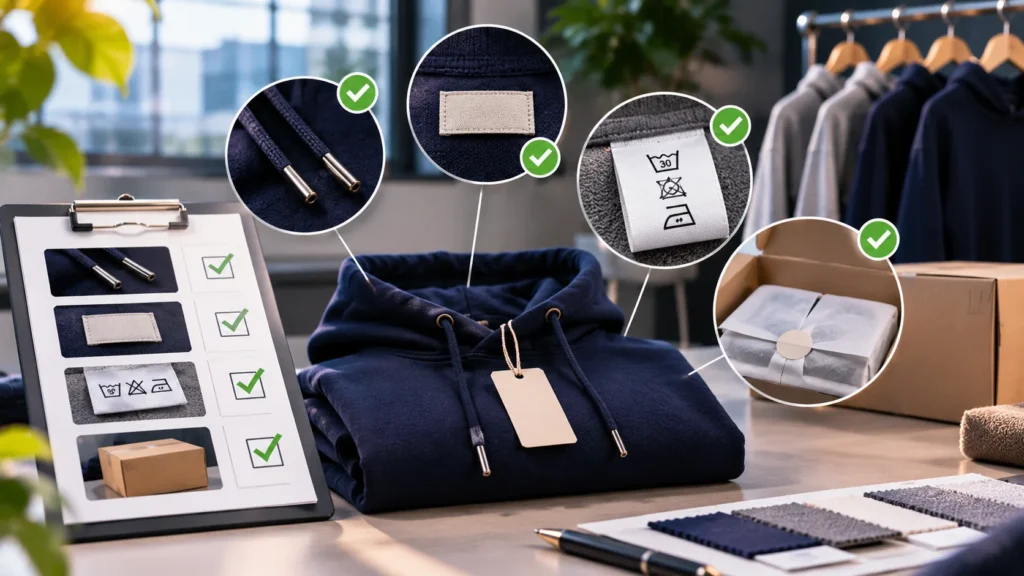
Labels are easy to leave until the end, so settle them on the sample. The US care labelling rule in 16 CFR 423.1 defines a care label as “a permanent label or tag, containing regular care information and instructions”, one that stays legible for the useful life of the product. Check the wording and the fibre content on the sample you approve, not on a proof you receive afterwards.
If you sell in the EU, Regulation (EU) No 1007/2011 is the EU rule on “textile fibre names and related labelling and marking of the fibre composition of textile products”, so check your fibre names against it before the labels are made. Our custom clothing labels page lists the details a care tag carries, including fibre content, country of origin and wash and care instructions, which makes a useful checklist for your own tags.
Packaging is the last approval, and it moves the calendar when it is late. Our custom packaging service page says garments leave our loading dock individually folded, protected in branded polybags and stickered with inventory barcodes, ready to be scanned into a 3PL warehouse. Approve the bag, the barcode and the carton on the sample, and ask who applies the barcodes and size stickers, so the warehouse can sort stock without opening bags.
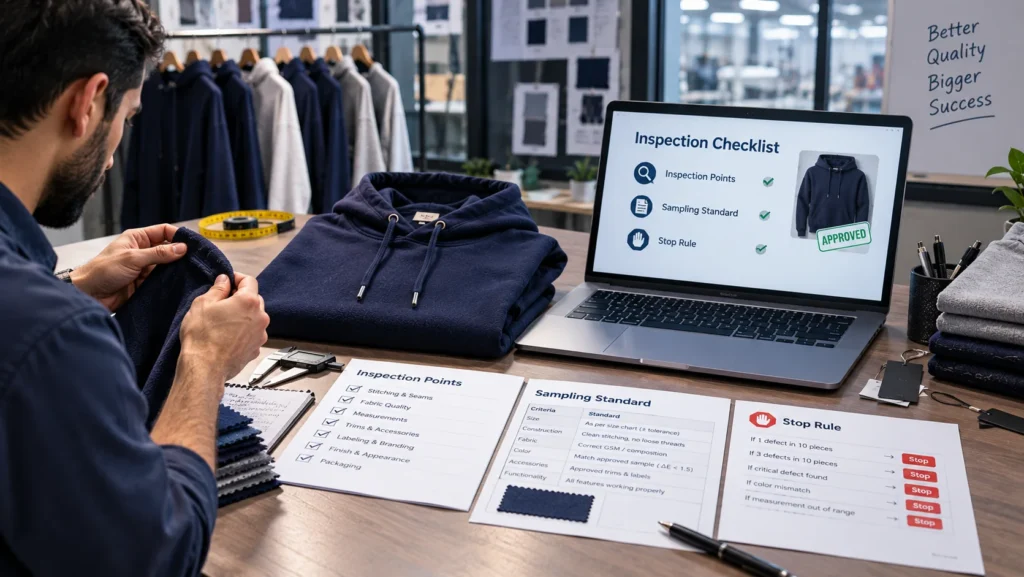
Name three inspection points in writing before production starts: pre-production, in-line and final. Our quality control and inspection page describes two of them in practice. An in-line check is where “a QA manager walks the active sewing line” every two hours and pulls garments straight out of the operators’ hands. The final check is a Final Random Inspection (FRI) of garments once they are packed into their polybags. Ask which check covers which defect, and who on your side reviews the result.
The sampling standard is easy to leave vague. ISO 2859-1 is the international standard for sampling by attributes, and it uses AQL to set sample sizes and the thresholds for accepting or rejecting a lot. AQL stands for acceptance quality limit, the figure the plan is built around. Ask the factory which plan it uses, and write the lot size, the sample size and the defect classes into your inspection terms. Our quality control forms guide sorts defects into critical, major and minor, and shows how those fields sit on a form.
Agree the stop rule before the run starts, not during a failed check. A stop rule says what happens when a check fails and what happens to the garments made since the last good check. Our quality control page gives an example: “If a sewing machine is dropping stitches, the entire production line is halted instantly”, and “the operator must correct the last batch of garments before they are allowed to resume sewing.” Ask for the same rule at the top of production check, which our sampling page describes as “the first actual garment pulled directly off the active bulk production line”.
Agree what happens to failed garments too. Our quality control page says garments with minor or major defects are routed to a dedicated rework line, so ask whether rework is included in your price and in your lead time.
Put the calendar on the same page as the terms, so nobody reads one without the other. Sampling takes 12 days, and once the sample is approved, bulk production takes 18 days and shipping takes 6 days. Write those stages into the purchase order as dates, and add the time your fabric and trims need to arrive, because a calendar that leaves that out runs late.
Write the quantity by design and by colour, and ask whether the order includes spare units for rework. Spare units are a decision, not a default, so make that call on paper before the fabric is ordered, because a batch that fails inspection needs replacements from somewhere.
Write the payment schedule and any deposit into the order. Ask in writing whether any sample cost is credited against the bulk invoice, and on what terms, so the answer is recorded rather than assumed. A promise made on a call is hard to enforce once a deposit has been paid.
Freight needs the same care. Incoterms 2020 entered into force on 1 January 2020 and set out eleven three-letter trade terms. The term on your PO sets the delivery point, and the delivery point divides costs and risk between seller and buyer, so name the term and the place it refers to in the order.
Use the table to check each sign-off, who signs it and when. The roles are a suggested split for a brand, not a rule from a standard or a Rijiz requirement, so adjust them to fit your team.
|
Item
|
Who signs (suggested)
|
When it must be signed
|
|---|---|---|
|
Pre-production sample
|
Brand owner or product lead
|
Before bulk fabric is cut
|
|
Size set
|
Technical designer or product lead
|
Before bulk grading is final
|
|
Tech pack and bill of materials
|
Brand owner, with the factory's written acknowledgement
|
Before any fabric is ordered
|
|
Fabric, colour and shrinkage results
|
Person who owns the colour decision
|
Before the roll is cut
|
|
Labels and packaging
|
Brand compliance or product lead
|
Before labels and bags are ordered
|
|
Inspection plan and stop rule
|
Brand QA lead and factory QA manager
|
Before the first run starts
|
|
Purchase order with dates and terms
|
Brand owner
|
Before the factory starts cutting
|
Repeat orders follow the same rule, and a repeat does not skip the sample. Our MOQ page says that for a design built from your own spec, “every order still goes through a physical sample before bulk starts”. Our minimum is 30 pieces per design, and the same checklist applies whether the design is new or a repeat.
The checks above follow our own process, so you can hold us to each one. We build the pre-production sample on the line that will make your order, and it becomes the Golden Sample only once you approve it. We make a size set before bulk grading is final, and our in-line checks and stop rule apply to your run too. Before a shipment is released to the freight forwarder, we send you a digital inspection report.
We hold ISO 9001 certification, and our guarantee is a full refund or a free remake if the order does not match what was agreed.
To start, read our clothing sample maker page for the sampling stages, then send your tech pack, bill of materials and points of measure. We build the first sample from those same documents, so the sample you approve is the one the line is set to make.
No. A fit sample checks how the measurements and construction sit on a fit model. Our sampling page says the pre-production sample is built with the exact bulk fabric, hardware and sewing machines for the final run, and once you approve it, it becomes the Golden Sample.
The pre-production sample is the approved benchmark made before bulk starts, and the top of production sample is a garment pulled from the live bulk line once sewing has begun. Our sampling page describes the TOP sample as the first actual garment pulled directly off the active bulk production line, so it checks that the run matches the approved sample. Agree in writing what happens if the TOP sample does not match.
No. Photos cannot show the stitching, the fit or the hand feel of the garment that will ship. Our sampling page describes the TOP sample as a physical garment pulled off the bulk line and says we overnight that unit to you, so ask for that unit before you approve the run.
The brand owner or product lead should sign it, because that person owns the design decision and can defend it later. Write the name, role and date on the approval record. A factory should not be the only party that approves its own sample, so keep a signature from your side on every approval.
It means the sample passes with named corrections that must be visible on the bulk garment before the run continues. Give each condition an owner and a check point, such as the first in-line check or the TOP sample. A condition that is not written down is one the factory cannot be held to.
Yes, for any label the sample must show, because the PP sample is the benchmark the finished garment is judged against. The US rule in 16 CFR 423.1 defines a care label as a permanent label or tag with regular care information and instructions, so the care wording on the approved sample should match the final label. Check fibre names against the rules in each market where you sell.
The count depends on how new the construction is and how many fixes each round needs. Our clothing sample maker page says brands go through 5 to 7 rounds of sampling before a bulk run on average, and that a new or unusual construction benefits from the muslin stage. Ask the factory for its planned round count in writing before you start.
Bulk production takes 18 days and shipping takes 6 days once the sample is approved, which is 24 days before any allowance for fabric, trims or other delays. The bulk calendar cannot start until the bulk fabric and trims are in hand, so add their lead time on top.
The approved pre-production sample, the size set results, the tech pack at a named version, the bill of materials with trims and labels, and the purchase order with dates and payment terms should all be signed first. Those are the documents a later dispute is settled against, so keep one approved copy of each. The table in the body sets out who signs each one.
* * *

FOUNDER & CEO AT RIJIZ