


US, UK and EU clothing sizes differ because each market uses its own size system, and the standards checked for this guide describe body measurements rather than a number that converts one market to another. Picture your first EU wholesale buyer asking for EN size labels on a US-sized order. Before you answer, you need one base size that the chart and the labels can both point to, and that starts with pattern making and grading. For the step-by-step, read pattern grading explained. This guide covers what each market expects, where the published figures disagree, and what to send your factory before anything is cut.
In the US, a garment often carries a letter size such as S, M or L on the label, and many charts pair that letter with a number. Sizes vary between brands, because each brand sets its own chart, so a size M from one label can measure differently from a size M from another. One US body-measurement reference for women’s clothing is ASTM D5585-21, an active standard for adult female misses sizes 00 to 20. Its scope says the figures can be used as a baseline in designing apparel, so treat it as a design reference, not as the chart on your label.
Vanity sizing is the practice of setting a size number to flatter the wearer rather than to match the measurements. Retail guides warn about it, which is why a number on its own is a weak spec. Put the measurements on the chart and let the number follow from them.
Men’s charts work the same way: a published body-measurement table is a starting point for a men’s clothing size chart, not the chart itself. Our garment spec sheet guide explains why those tables are a reference, not a fit target.
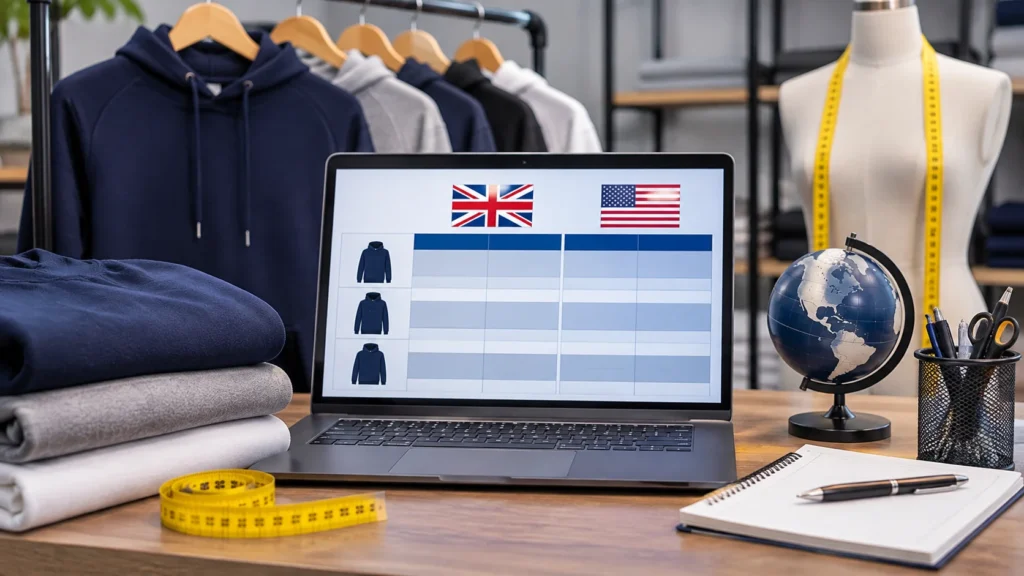
A US to UK clothing size conversion is usually quoted as a quick rule, and many retail guides give one. That rule is a rule of thumb from retailers, not a standard. The standards checked for this guide do not set a conversion between US and UK numbers, so treat any converted figure as a starting point and check it against your buyer’s UK size chart. The UK to US sizes question works the same way.
On the standards side, BS EN ISO 8559-2:2025 was published on 30 September 2025 and is listed as current. It specifies primary and secondary dimensions for specified garment types, based on body dimensions, and BSI recommends this version for organisations operating in or with the UK. If a UK buyer asks which dimensions your chart must show, this is the reference to check first.
Children’s ranges need the same care. Ask your buyer whether their children’s sizes are set by age or by height before you grade the run.
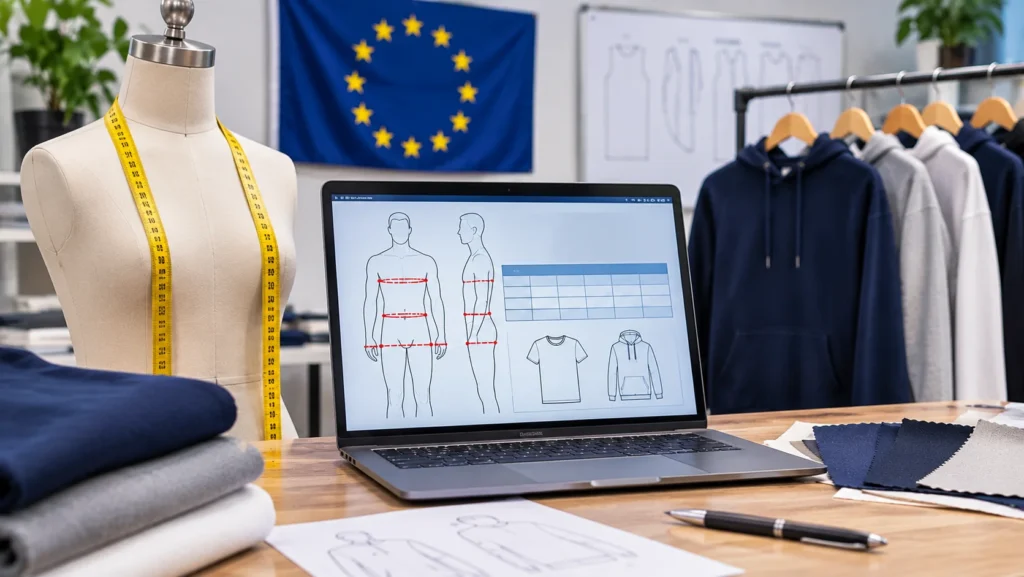
The European sizing standard is EN 13402, and its part 3 covers size labelling based on body measurements. BSI publishes that part as BS EN 13402-3:2017, identical to the European text, with a publication date of 31 October 2017 and a status of current. BSI describes it as “a flexible sizing system based on body dimensions and the related size labelling information for consumers, using a standard pictogram”. The 2017 edition superseded the 2013 edition and moved all its tables into an annex, grouped as men, women, children, head hand and foot, and letter size, so check the annex in the copy you buy.
BSI notes that “across Europe, several different systems are used for the size designation and labelling of clothes”, and the standard aims to harmonise and simplify that labelling. The page says its values “are provided for reference purposes as examples of best practice” and were adjusted with reference to sizing surveys in seven European countries.
Whether a size label is compulsory is a separate question. The BSI page does not say, and no source checked for this guide settles it for every EU country, so do not describe the label as compulsory or optional. Check the labelling rules for your product in each market before you print.
Women’s conversions are where guides disagree. Figures you will see quoted for a US to EU clothing size conversion range from US plus 30 to US plus 32, and the sources disagree, so no single number is safe to print on a chart. Those figures are retailer conventions, not standards, and the same caution applies to an EU to UK clothing size conversion. Follow the European size chart your buyer signs off, not a converted number from a guide.
A single size run can end up in Canada or Australia as easily as in the EU or US. Canada’s textile labelling requirements say the Textile Labelling Act does not require garments to conform to specific size dimensions or size codes, but if you print a size dimension, it must be accurate. For Australia, ask the buyer which number scale their customers expect, because we found no official source to confirm one.
Ask the buyer in each market for the chart they expect, then send the same measured garment points to all of them. A chart converted from another market’s table carries forward any error in that table, while a chart measured on the garment does not depend on a conversion.

The table below sets out how each market sets its size and what to send your factory for it. A row marked not confirmed is one this guide could not verify. It is not an international size conversion chart.
|
Market
|
How the size is set
|
What to send your factory
|
|---|---|---|
|
US
|
Letters such as S, M and L, plus numeric charts. ASTM D5585-21 is a body-measurement baseline for design.
|
Your measured chart in centimetres and inches, and the chart your US buyer uses
|
|
UK
|
BS EN 13402-3:2017 is the current British text, identical to the European standard.
|
The number system your UK buyer wants on the label, and a measured chart
|
|
EU
|
Body-based labelling under EN 13402-3:2017, with a standard pictogram. National practice varies.
|
A measured chart and the label wording your buyer asks for
|
|
Canada
|
Not required by the Textile Labelling Act, but any size dimension you show must be accurate.
|
The chart your Canadian buyer uses, checked before printing
|
|
Australia
|
Not confirmed in this guide. Retail guides say the UK scale is common, which this guide did not verify.
|
The chart your Australian buyer uses, checked before printing
|
|
Your store chart
|
Your own measured chart, showing the garment rather than the body.
|
Measured points per size from your tech pack, in centimetres and inches
|
The table has no conversion numbers on purpose. The conversions in retail guides disagree, and no standard checked for this guide sets one, so the chart your buyer signs off is the reference.
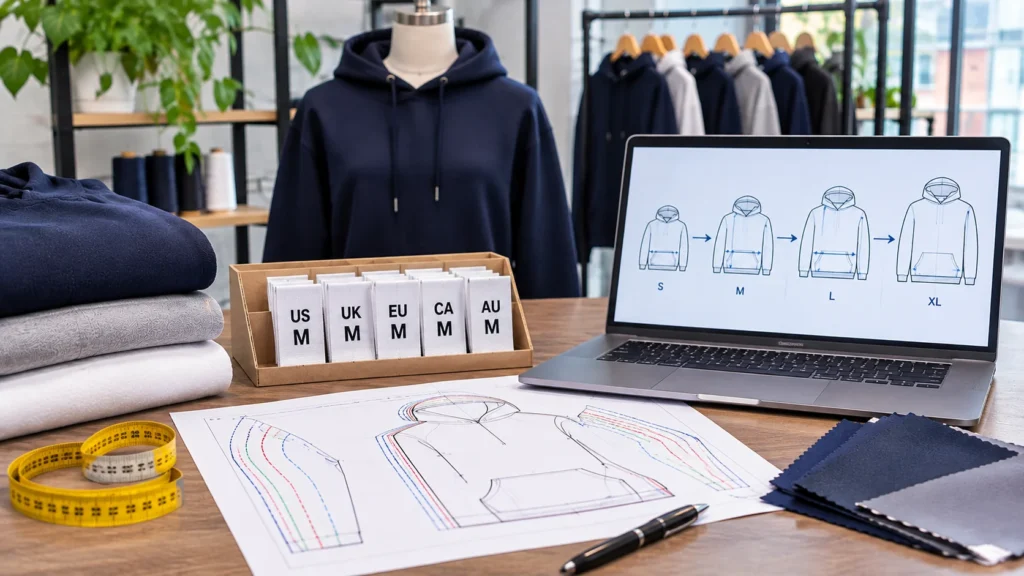
One woven logo can serve several markets if the size is shown on a separate tag. Our custom clothing labels page describes the method: “we sew a tiny, separate “Size Pip” (a small tag simply reading S, M, L) directly under the main woven label.” The page says this cuts label cost by standardising the main logo run, which matters when one design goes to several markets.
The pip does not solve the chart. An M pip has to match the M row of your chart, or the label and the chart describe two different garments. Three checks keep them aligned.
Keep one base size. Every market’s chart should come from the same graded run, so the sizes match across markets.
Match each pip to its chart row. Check that every pip reads the same size as its row before you approve the sample.
Set the pip wording early. Agree the pip wording with the tech pack, so it is fixed before the labels are made.
A store chart should describe the garment, not the body. Use the points of measure in your tech pack as the rows of the chart, and fill each size from a measured garment. For how body measurements are defined, our body measurements guide covers ISO 8559-1 and the terms behind it.
Measure in centimetres and publish centimetres first, with inches beside each figure. A buyer reads the unit their own system uses, and a chart in one unit only makes them convert the numbers before they can check them. Name each point the way your tech pack does, such as bust measurement, waist measurement, hip measurement or chest measurement, so the buyer reads the same word on both documents.
Retail guides warn about vanity sizing, so a label number can be a weak guide to fit. A women’s clothing size chart built from measured garments tells the buyer what the garment measures, whatever the label number says.
One size run may need a chart for each market you sell into, and every chart should trace back to the same graded base. Our tech pack design page puts the grading step this way: “We establish mathematical grading rules across your entire size run (XS to XXL).”
Our MOQ post says that when a design is built from your own spec, “every order still goes through a physical sample before bulk starts.” We run at MOQ 30 per design. Sampling takes 12 days, bulk production takes 18 days and shipping takes 6 days. We hold ISO 9001 certification and are REX registered, and if the order does not match what was agreed, you get a full refund or a free remake.
To see how a sample is checked before bulk, start with our apparel prototyping and sampling service, and send the chart for each market you sell into.
No. The standards checked for this guide describe body measurements and labelling systems, not a single size number that converts between markets. Each brand and retailer sets its own chart, so the chart your buyer signs off is the reference.
Show both, with centimetres first and inches beside each figure. A buyer who reads only one unit should not have to convert the numbers before checking them.
Retail guides quote a rule of US plus 30 in some places and US plus 32 in others, and the sources disagree. No standard checked for this guide sets that rule, so it is a retailer convention rather than a fact. Use the chart your EU buyer signs off, not a converted number from a guide.
This guide cannot confirm that, because the BSI page checked does not say whether EN 13402-3:2017 is compulsory. The page describes a body-based sizing system with a standard pictogram. Check the labelling rules for your product in each market before you print.
A body-based label gives the body measurement range a garment is built for, while a letter like M is a size name printed on the label. The 2017 edition of EN 13402-3 keeps its letter size tables in an annex, so check that annex in your copy. Ask your buyer which system their label needs before the labels are ordered.
One base pattern can serve every market, because the pattern sets the garment shape and the market sets the label and the chart. You will need chart and label wording for each buyer, but not a separate pattern for each market. Keep one measured spec as the source for all of them.
A size pip is a small tag, such as one reading S, M or L, sewn directly under the main woven logo label. A brand uses one when a single logo label should serve every size, instead of weaving a separate logo label for each size. Confirm the wording and placement with your label supplier before you order.
There is no reliable rule that European sizes run smaller. Some retail guides say European cuts run smaller, while others say US brands may run larger, and fit depends on the brand. Measure the garment and compare it with your buyer's chart.
Measure a real garment in that size and compare its points with the converted row, instead of trusting the converted number. Retail conversions are conventions, so the measured garment is the check that counts. Ask your buyer to sign off the chart before the labels or the run go ahead.

FOUNDER & CEO AT RIJIZ