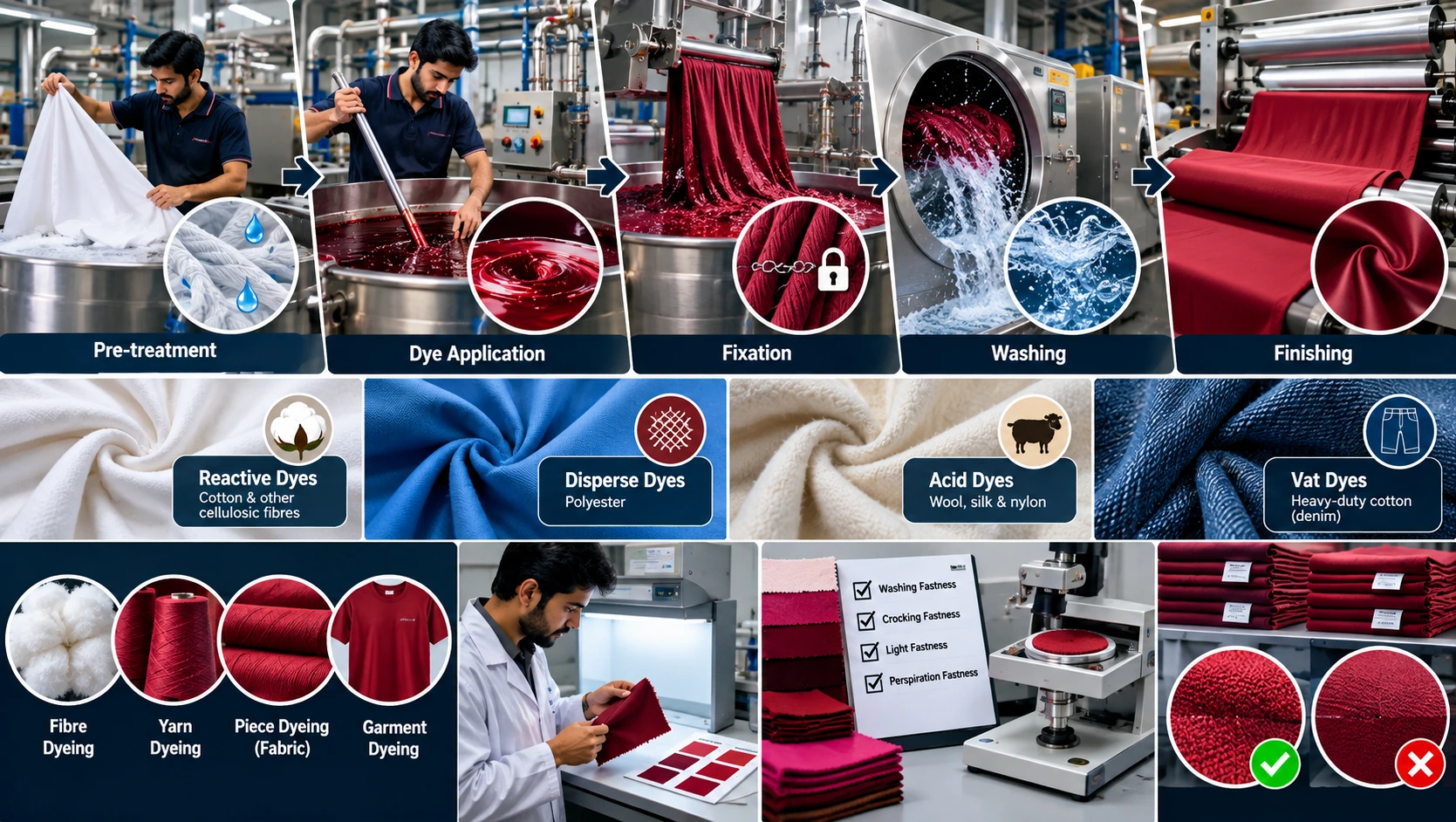

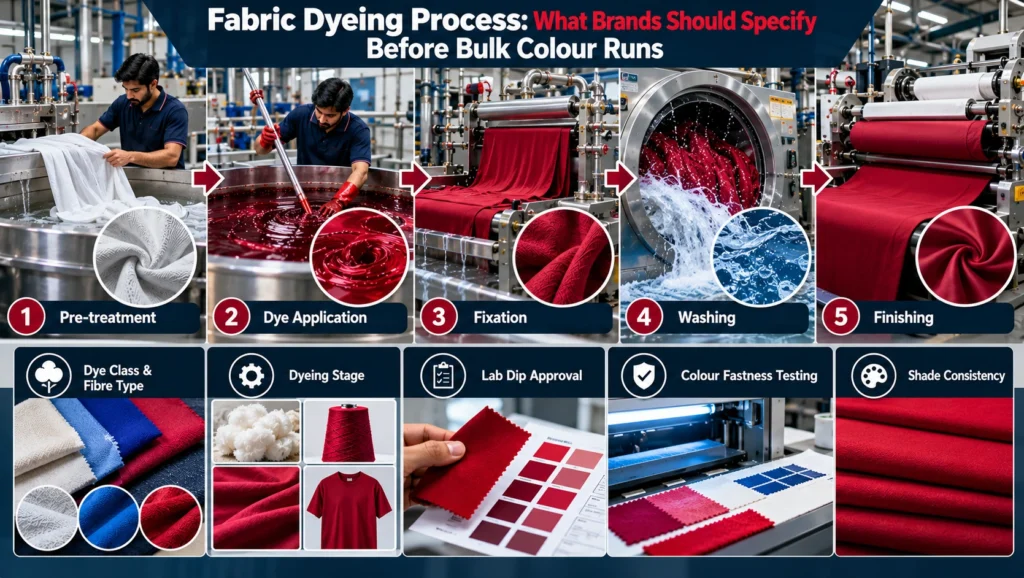
The fabric dyeing process is the sequence of steps a mill uses to get colour into a textile and lock it there so it survives washing, sunlight, and handling. It is rarely a single action. A fabric usually moves through pre-treatment (removing natural waxes, oils, and sizing so the fibre can actually absorb dye evenly), dye application (getting the colourant into contact with the fibre under the right temperature and pH), fixation (bonding the dye to the fibre so it stops moving), and washing and finishing (clearing off anything that did not bond, then setting the fabric’s final width and hand feel).
For a brand sourcing fabric rather than running the dye house itself, the practical question is not how each of those steps works chemically. It is what to ask for and check at each handoff: which dye class the fibre calls for, which production stage the colour is being applied at, what a lab dip approval actually proves, and which fastness numbers belong on a spec sheet. Our own fabric sourcing service exists specifically to manage that handoff, and the sections below work through what a buyer needs to know before signing off on a colour.
This guide focuses on colour, not construction. If the question is how the base fabric itself gets built (fibre through to finished cloth), that is a separate process covered in our companion guide to how fabric is made, which this post does not duplicate.
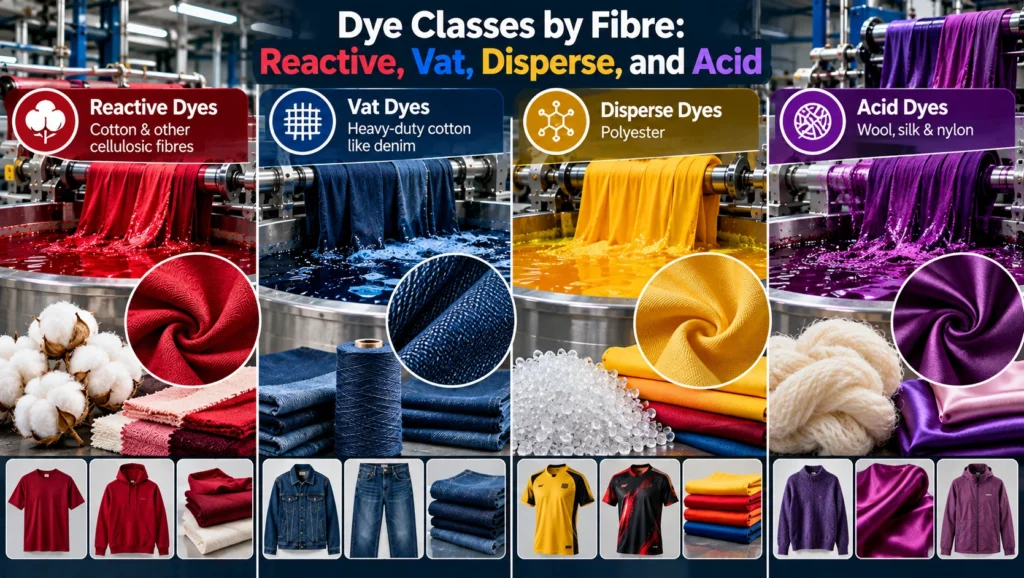
Dye selection is not a style choice, it is a chemistry match. Every dye class bonds with a specific type of fibre molecule, and pairing the wrong dye with the wrong fibre produces dull colour, poor wash fastness, or no colour uptake at all.
Reactive dyes are the standard for cellulosic fibres: cotton, linen, modal, and viscose. They form a genuine chemical bond with the cellulose in the fibre, which is why reactive-dyed cotton generally holds up well to repeated washing. This is the dye class behind most everyday cotton knitwear and wovens.
Vat dyes are built for heavy-duty cotton applications where wash and light fastness matter more than cost. Indigo, the dye behind denim, is a vat dye. Vat dyes need a reduction step (converting the dye into a water-soluble form before it can penetrate the fibre, then oxidising it back afterward) which adds process time but delivers durability that holds up to industrial laundering and repeated heavy wear.
Disperse dyes are the only practical option for polyester and other synthetic fibres, because those fibres are hydrophobic and reject water-based dye chemistry outright. Disperse dyeing relies on heat to carry the dye into the fibre structure rather than a water-soluble bond, which is why polyester dyeing runs at meaningfully higher temperatures than cotton dyeing. This is the same dye chemistry behind sublimation printing on polyester, covered in more depth in our guide to all-over print production, since sublimation is essentially disperse dye applied through heat transfer rather than a dye bath.
Acid dyes work on protein fibres (wool, silk) and on nylon, using an acidic dye bath to help the dye attach to the fibre. They produce vivid, saturated colour and are common on performance nylon and wool-blend goods.
A blended fabric, cotton-polyester for instance, complicates all of this, because each fibre in the blend needs its own compatible dye class applied under conditions that do not damage the other fibre. That is one reason a blend often costs more to dye evenly than a single-fibre fabric, and it is worth asking directly how a mill handles a specific blend rather than assuming one dye bath covers both fibres equally.
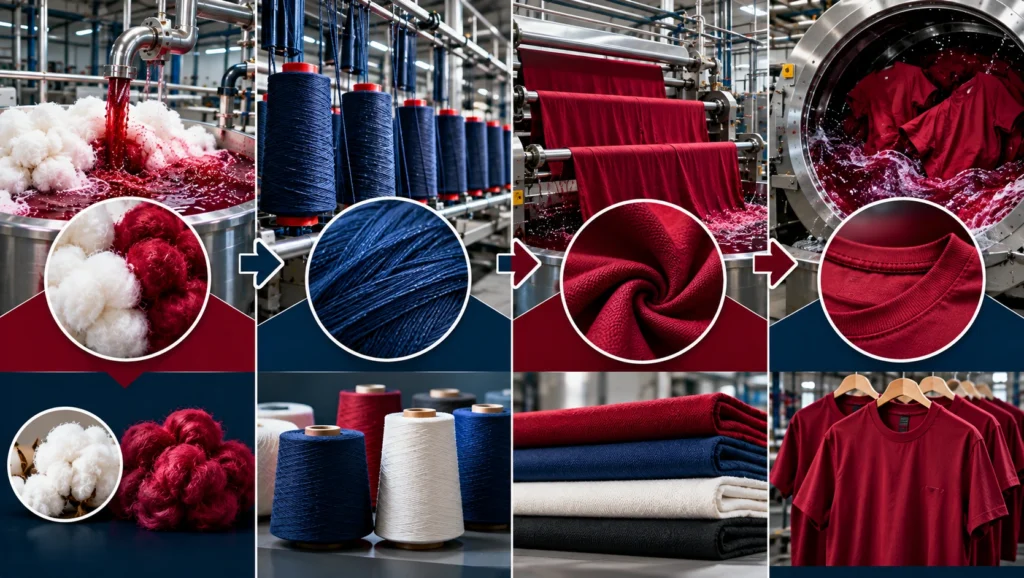
Colour can be applied at four different points in production, and which stage a mill uses changes what a brand should expect on consistency, shrinkage, and lead time.
Fibre (stock) dyeing colours loose fibre before it is spun into yarn. It produces very even, deep colour and is common for heathered or melange effects where different-coloured fibres are blended together before spinning. It is the least common stage for a typical apparel order because it has to be planned before spinning even starts.
Yarn dyeing colours the yarn itself before weaving or knitting. This is how stripes, checks, and structural colour patterns like denim’s warp-dyed yarn get built into the fabric rather than printed on top of it. Colour goes to the core of the yarn, which generally gives strong, even fastness, but it locks the colour decision in earlier and usually carries a higher minimum than dyeing finished fabric.
Piece (fabric) dyeing colours the finished woven or knitted fabric after it comes off the loom or knitting machine, while it is still greige (raw and undyed). This is the most common approach for solid colours because a mill can hold undyed greige fabric in stock and dye it to order as colours are confirmed, which shortens lead time and lowers the minimum compared to yarn dyeing.
Garment dyeing colours the finished, already-sewn garment. It is what gives a piece that soft, washed, slightly irregular look brands sometimes want deliberately. The tradeoffs are real: garment dyeing introduces its own shrinkage that has to be accounted for at the pattern stage (since the garment is dyed and washed after it is already cut and sewn to size), and trims, labels, and thread can pick up dye differently than the main fabric, which needs to be planned for rather than discovered on the first finished batch.
Knowing which stage a quote is actually using matters because it changes what “the same colour” means on a reorder. A piece-dyed reorder is checking a new fabric batch against an approved standard. A garment-dyed reorder is checking a new batch of finished, washed garments, where shrinkage and trim colour add extra variables beyond the dye recipe itself.
Before a mill commits to dyeing hundreds of metres (or hundreds of kilograms) of fabric, it dyes a small sample first, called a lab dip, using the exact recipe intended for the bulk run. On our own fabric sourcing process, that lab dip is a physical swatch, not a digital preview: we dye a roughly 5×5 inch piece of the actual raw fabric using a small set of chemical variations, ship those physical swatches to the buyer, and only proceed to bulk dyeing once one is approved.
The light source matters here more than most buyers expect. A colour can look like an acceptable match under one light and visibly different under another, a phenomenon called metamerism, so lab dip approval should happen under a standardised light source (daylight-equivalent, commonly referred to as D65) rather than under office fluorescents, a phone screen, or whatever light happens to be in the room. Comparing a lab dip against a Pantone TCX or TPX code, or against a physical reference swatch the brand provides, is the standard way to remove ambiguity from what “matches” actually means before bulk dyeing begins.
This step is also where a custom colour’s minimum order quantity gets locked in, and it is worth being precise about which minimum is which. A custom Dye-to-Match colour run typically requires 300 to 500 kilograms of fabric per colourway, which is a mill-level, fabric-specific minimum tied to filling a dye vat at a viable volume, not the same thing as an order-quantity minimum for a finished design. Our own garment MOQ is 30 pieces per design; the fabric-level dyeing minimum sits upstream of that and applies specifically to commissioning a brand-new custom colour, while a design pulling from an existing stock colour is not held to it. This is a direct consequence of the dye-lot economics covered in more depth in our guide to MOQ in apparel manufacturing: a dye vat has to be filled to a minimum volume to be worth running at all, and that minimum does not shrink because the order is small.
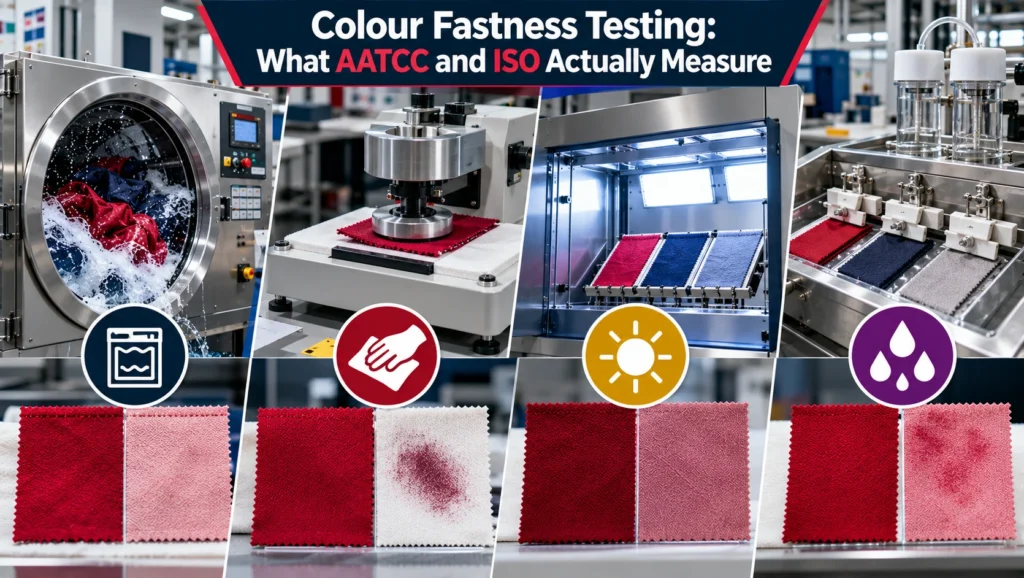
Colour fastness is not a subjective impression, it is a tested, graded property with published methods behind it. Two standards bodies cover most of what a tech pack should reference: AATCC in the US and ISO internationally, and the two publish broadly equivalent test methods under different numbering systems. AATCC maintains a full numbered index of its test methods, including specific methods for colourfastness to crocking, perspiration, light, and laundering. ISO 105-C06 covers colour fastness to domestic and commercial laundering specifically, under the ISO 105 series maintained by ISO/TC 38, the technical committee responsible for textile and colorant testing.
The four fastness categories that matter most for apparel:
-Wash fastness: resistance to fading or bleeding during laundering, tested under standardised detergent, temperature, and agitation conditions.
-Light fastness: resistance to fading from sunlight or artificial light exposure over time.
-Rubbing (crocking) fastness: resistance to colour transferring onto another surface when rubbed, tested wet and dry, since indigo and some dark shades are more prone to crocking than lighter colours.
-Perspiration fastness: resistance to fading or staining from contact with sweat, relevant for close-to-body garments like activewear and underlayers.
A tech pack that just says “good colourfastness required” gives a mill nothing to test against. Naming the specific method (for example, wash fastness to ISO 105-C06 or AATCC 61) and the minimum acceptable grade gives the mill and any inspection team a number to hold the fabric to, rather than a subjective standard that gets argued about after the goods are already cut.
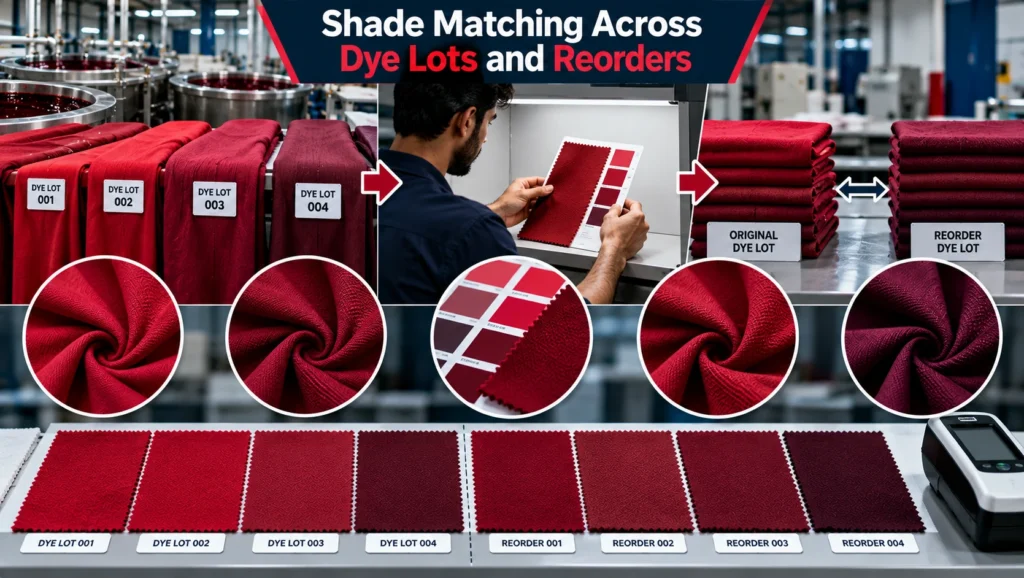
A dye lot is one batch of fabric dyed together under one set of conditions. Even with an identical recipe on paper, a second dye lot can come out slightly different from the first, because small variations in water, fibre batch, or machine conditions all affect how a dye takes to a fibre. This is exactly why a reorder six months after a first production run is not automatically a guaranteed colour match: the new batch is a new dye lot, checked against the original approved standard, not assumed to match it.
Two things reduce the risk on a reorder. First, keeping the original lab dip, the approved physical swatch, on file as the reference standard rather than relying on a photo or a description of the colour. Second, having the fabric supplier document the exact dye recipe and process conditions from the first run, since a documented recipe gives the mill something concrete to reproduce rather than a colour to re-guess from scratch.
For piece-dyed fabric ordered in more than one colourway (three colours on the same style, for instance), each colourway is effectively its own dyeing decision with its own lot, which is part of why per-colour minimums exist in the first place. Bundling colours under the assumption that one dye lot can quietly cover several shades is a common way a shade-mismatch dispute starts.
Most tech packs specify a colour name and not much else, which leaves a mill guessing at exactly the details that cause disputes later. A colour spec that actually holds a mill accountable should include:
-A colour standard, not just a name. A Pantone TCX or TPX code, or a physical swatch, removes the ambiguity that a colour name like “navy” or “sand” leaves wide open.
-The dye class or fibre-appropriate method, if the brand has a preference (reactive on cotton, disperse on polyester, and so on), especially on a blended fabric where more than one approach is possible.
-The light source for lab dip approval, so metamerism does not slip through, since a colour approved under one light and shipped under another can look like two different products.
-A named fastness requirement, with the specific test method and minimum grade (for example, crocking fastness to AATCC 8 at a stated grade), not a general “must be colourfast” instruction.
-A shrinkage tolerance figure. On our own process, a bulk fabric sample is cut, washed, and dried under controlled conditions and measured against a stated tolerance, typically in the 3 to 5% range, before a roll is accepted for cutting.
-Whether the order needs dye-lot consistency across multiple rolls or production runs, and how the supplier documents that (spectrophotometer readings, retained physical standards, or both), particularly relevant for a large order split across more than one dye lot.
None of these additions make a tech pack longer for its own sake. Each one closes a specific gap that otherwise gets discovered after the fabric is already cut, which is the most expensive point to discover it.
This is the part that is ours specifically, not general dyeing theory. Every custom colour that comes through our fabric sourcing service follows the same sequence before it reaches bulk production. A brand provides a Pantone TCX code or a physical swatch, and we formulate a Dye-to-Match chemical recipe against that standard rather than an approximate colour match. We dye a small lab dip swatch, roughly 5×5 inches, using a short set of chemical variations, and ship those physical swatches for approval under a standardised light box before a single roll of bulk fabric gets dyed.
Once a lab dip is approved, bulk dyeing does not skip straight to the cutting floor either. We cut a sample square from the bulk fabric, run it through shrinkage and skewing testing under industrial wash and dry conditions, and check it against a stated tolerance before the roll is accepted. We also test colourfastness through a crocking check, rubbing the dyed fabric against a white cloth under wet and dry conditions, and send the fabric back to the dye house if the colour transfers. A custom Dye-to-Match colourway typically needs a 300 to 500 kilogram minimum to run at all, which reflects the same dye-lot economics covered above, not an arbitrary cutoff.
If a design needs a colour built from scratch rather than pulled from a mill’s existing stock program, that lab dip and testing sequence is the part that protects a brand from a shade surprise on the first bulk shipment. If you are working out what a specific colour and fibre combination needs, get in touch and we will walk through the lab dip and testing steps for your exact fabric.
It is the sequence a mill uses to add and permanently fix colour onto a textile: pre-treatment to prepare the fibre, dye application under controlled temperature and pH, fixation to bond the dye to the fibre, and washing and finishing to clear unfixed dye and set the fabric's final hand and width.
Each bonds with a different fibre type. Reactive dyes suit cellulosic fibres like cotton and linen. Vat dyes, including indigo, suit heavy-duty cotton applications like denim. Disperse dyes are the only practical option for polyester and other synthetic fibres, since those fibres reject water-based dye chemistry. Acid dyes suit protein fibres like wool and silk, and nylon.
They are four different points in production where colour gets applied. Fibre dyeing colours loose fibre before spinning. Yarn dyeing colours yarn before weaving or knitting, used for stripes and structural colour. Piece dyeing colours finished fabric, the most common approach for solid colours. Garment dyeing colours the sewn garment itself, producing a softer, washed look but adding its own shrinkage and trim-colour variables.
A small dyed swatch, made using the exact recipe intended for bulk production, used to approve a colour before committing to dyeing the full order. On our process it is a physical 5x5 inch fabric swatch checked under a standardised light box, not a digital preview.
Because of metamerism: two colours can appear to match under one light source and look different under another. Approving a lab dip under a standardised, daylight-equivalent light source (commonly D65) avoids a mismatch that only becomes visible once the fabric reaches a different lighting environment.
How well a dyed fabric resists fading or colour transfer under specific stresses: washing, light exposure, rubbing (crocking), and perspiration. AATCC and ISO both publish numbered test methods for each category, and a tech pack should name the specific method and required grade rather than asking for generic "good" fastness.
Small variations in water, fibre batch, or machine conditions between one dyeing run and the next can shift the final shade slightly, even with an identical recipe on paper. This is why a reorder should be checked against the original approved lab dip standard, not assumed to match by default.
A Pantone TCX or TPX code or physical swatch, the dye class if relevant to the fibre, the light source for lab dip approval, a named fastness test and grade, a shrinkage tolerance figure, and how dye-lot consistency will be documented across multiple rolls or production runs.
Yes, and it has to be planned for at the pattern stage. Because garment dyeing happens after the piece is already cut and sewn, the wash-and-dye step can shrink the finished garment, which is a different risk than piece-dyed fabric, where shrinkage is measured and accounted for before cutting even starts.
A custom Dye-to-Match colourway on our fabric sourcing process typically requires 300 to 500 kilograms of fabric per colourway. That is a mill-level fabric minimum, separate from our garment MOQ of 30 pieces per design: it reflects the dye-lot economics of running a vat at a viable volume, not an arbitrary limit, and smaller batches of existing stock fabric can usually be sourced without triggering that minimum.
Yes. Each fibre in a blend needs a compatible dye class applied under conditions that do not damage the other fibre, which generally makes even, consistent colour harder to achieve on a blend than on a single-fibre fabric and is worth discussing directly with a supplier before locking in a fabric choice.
* * *

FOUNDER & CEO AT RIJIZ