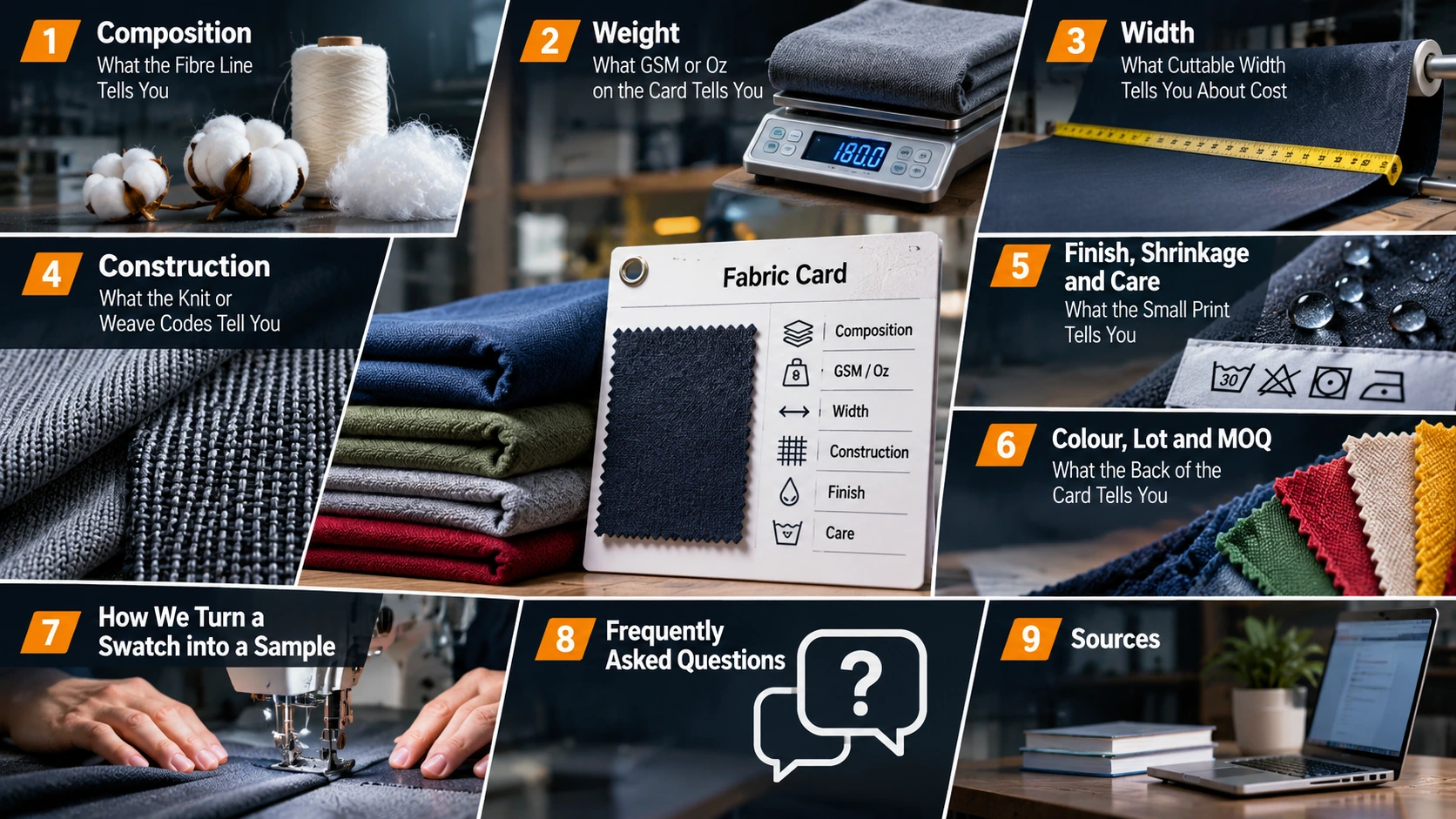

Read a fabric swatch card one field at a time, and ask what each field measures, which test sits behind it and which part of the fabric it covers. Picture three mills sending swatch cards for the same cotton blend knit. One gives weight in grams, one in ounces, and the third gives no weight at all, so the three cards cannot be compared yet. If you would rather hand that comparison to us, our fabric sourcing for your collection service feeds our own cut and sew floors. This guide goes field by field, so you know what to ask before you approve a sample.
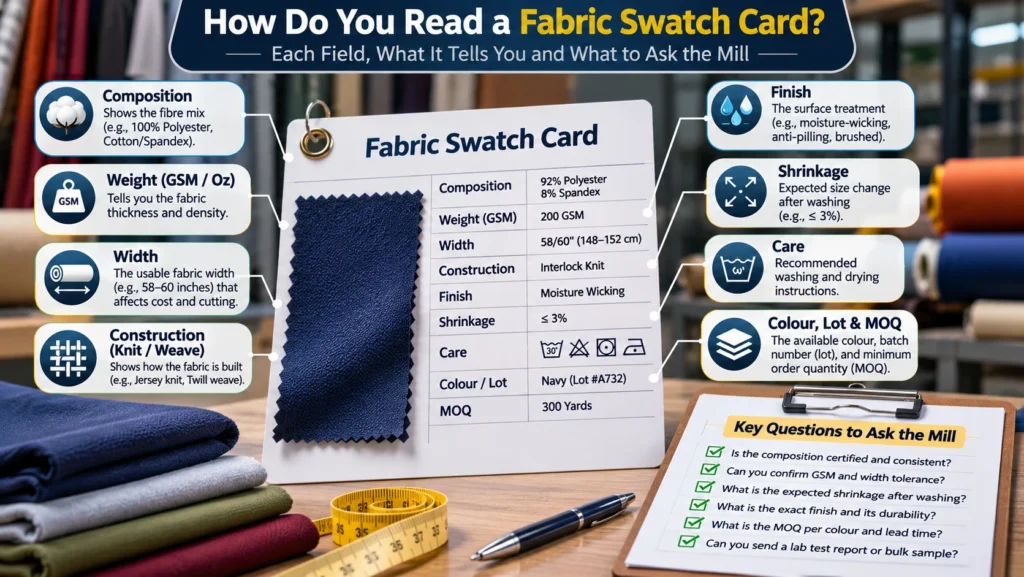
Composition is the fibre line, and in the United States it is the field with a legal rule attached. The Federal Trade Commission rule on swatches says a swatch used to promote or effect a sale must show its fibre contents, unless an exemption applies. The exemptions include a swatch under 2 square inches (12.9 square centimetres) where the information appears on accompanying promotional material, so read the card for what it must show and ask for any missing line in writing. 16 CFR 303.21 sets out the rule.
Read the names with the percentages. A card that says 95 percent cotton and 5 percent spandex describes two fibres and their shares, and the smaller share is usually the stretch fibre. In US law, spandex is a defined generic name: 16 CFR 303.7 describes it as a fibre made from a long chain polymer that is at least 85 percent segmented polyurethane. The same section defines polyester, so a card that names a fibre is making a claim you can check against that definition.
This guide checks only the US definitions. If you sell in another market, or your card says elastane, confirm the naming rule there before you print a label, because this guide does not confirm that elastane and spandex share one definition.
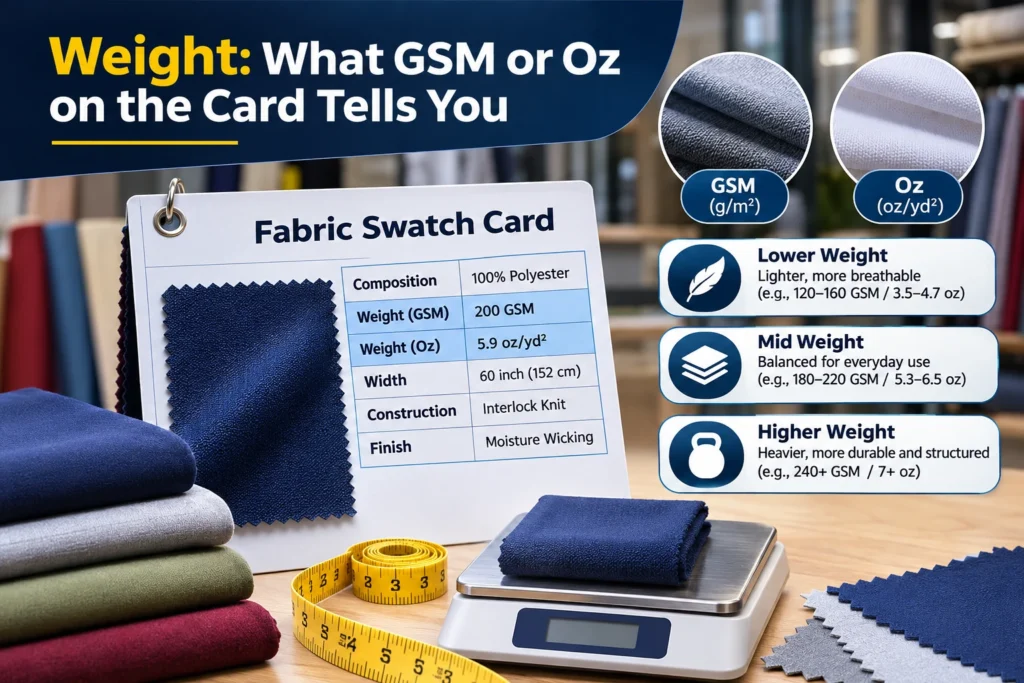
Weight comes second, and its unit needs care. GSM is grams per square metre, the mass of one square metre of fabric, and some cards print ounces per square yard instead. The unit only changes how the number is written, so the test behind the figure matters more than the unit. Our 400 GSM hoodie guide covers the GSM maths and our weight bands, so this section stays with the card.
The test is what makes a weight figure usable. ASTM D3776 is the test method for mass per unit area, which the standard calls fabric weight, and it applies to most fabrics. It has four options. Option C uses a small swatch sent to a laboratory, and the standard says those results apply to that sample and not necessarily to the lot it came from. Option A covers a full piece, roll, bolt or cut, and the standard says it may be used for acceptance testing of commercial shipments.
Ask which test sits behind the number. Was the figure taken from a full roll or from a swatch? If it came from a swatch, it describes that sample, and the bulk roll may weigh differently. Write the test option on your spec and keep the weighed sample as your reference.
A weight figure does not describe hand feel by itself. Read it with the construction and finish fields below, because two knits at the same weight can feel different.
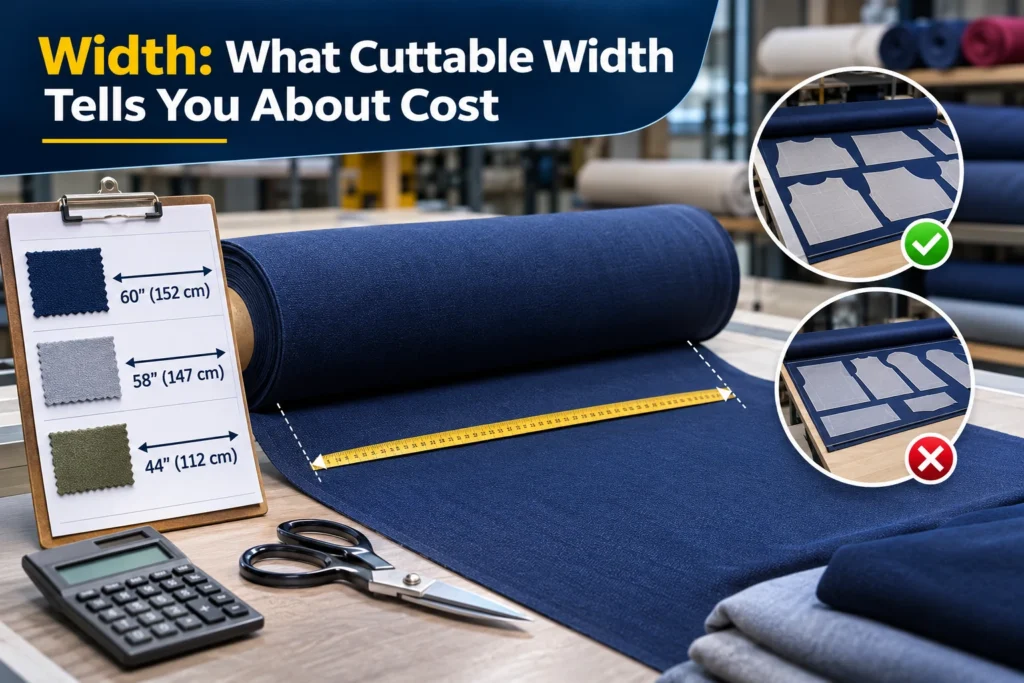
Width decides how many panels fit across a roll, so a misread width changes how much fabric each garment uses. ASTM D3774 is the test method for width, and its scope covers the width of woven or knitted fabric, usable width, or both. The selvage is the finished edge along each side of the roll, and unless the spec says otherwise, the standard includes selvages in the measurement when they are present.
Check two things before you cost the width. First, is the figure full width or usable width? Second, does it count the selvages? A width that includes the selvages can be wider than the part you can cut, so ask the mill to label the figure rather than estimate it from the roll.
Buyers also say cuttable width. That is not the term the width standard uses, so ask the mill to confirm which measurement it means before you compare two quotes, and which method produced the card’s figure. Fewer panels fit across a narrower usable width, which is why width belongs in your cost check and not only in your fit check.
Construction tells you how the fabric is built, and it changes stretch and fraying more than the fibre name does. The card should say whether the fabric is knit or woven, because a woven fabric holds a crease and a knit stretches with the body. Hoodie cards often name French terry or fleece, and our French terry vs fleece guide explains that the two can share one knit, with napping as the finish that separates them.
If the card shows a yarn count, name the system behind it. Some systems give a bigger number for a thicker yarn, and the cotton count system works the other way. Our guide to how fabric is made explains each system, so this section does not repeat them, but a count without its system cannot be compared with another mill’s count.
Treat a construction code as a question. A woven card may give a pair of numbers, such as 76 x 68, with no label. Read it as a question for the mill, and ask which number is which, because a code you cannot label cannot be checked against your sample.
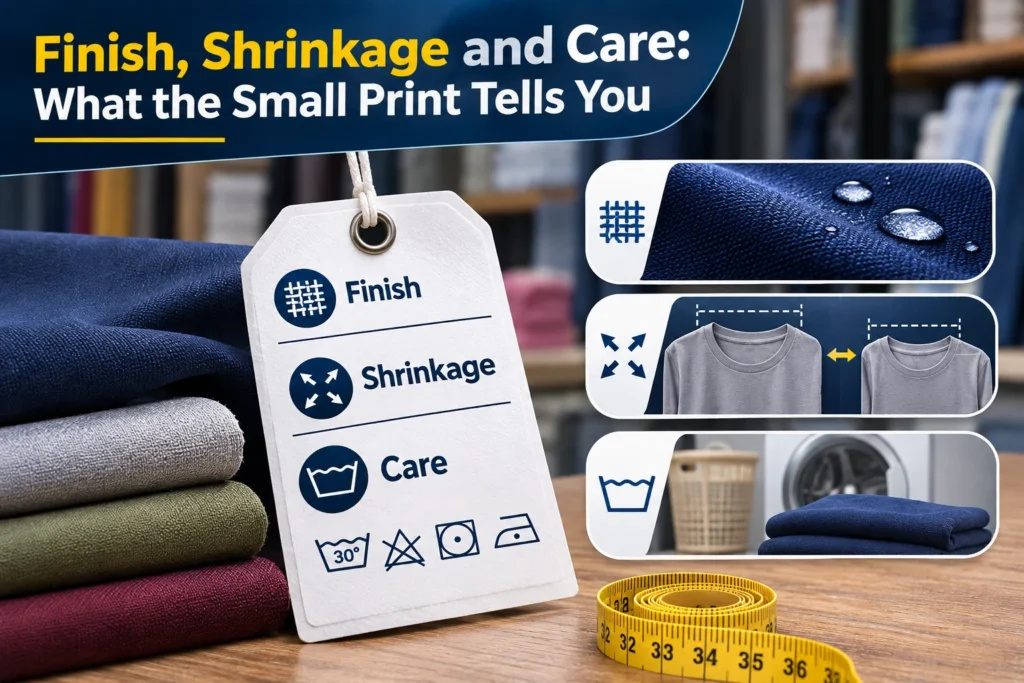
Finish names the surface treatment on the fabric, such as a silicone wash for softness or an enzyme wash to clear loose surface fibres. A finish name only helps if the card says whether the finish is expected to last through washing. Ask for the exact finish and the wash test behind it, because a term such as “soft finish” does not tell a mill which treatment to apply.
Shrinkage needs its own line, with warp and weft reported separately and the wash and dry method named. Warp is the lengthwise yarn and weft is the crosswise yarn, so the two results show change in each direction. Our fabric sourcing page describes its own check: a 50 by 50 centimetre square, washed and dried, measured in the warp and weft directions, against a tolerance it gives as typically 3 to 5 percent. Treat that as one company’s tolerance and not a figure to copy. Agree your own number with the mill, write the test method beside it, and settle it before bulk, because a result you learn after cutting cannot change the fabric you have already cut.
Copy the care line with its conditions. Put the care instructions from the card into your spec, and check that the wash and dry conditions match the ones the shrinkage test used. A care label that promises a gentler wash than the test used is a claim you cannot back.
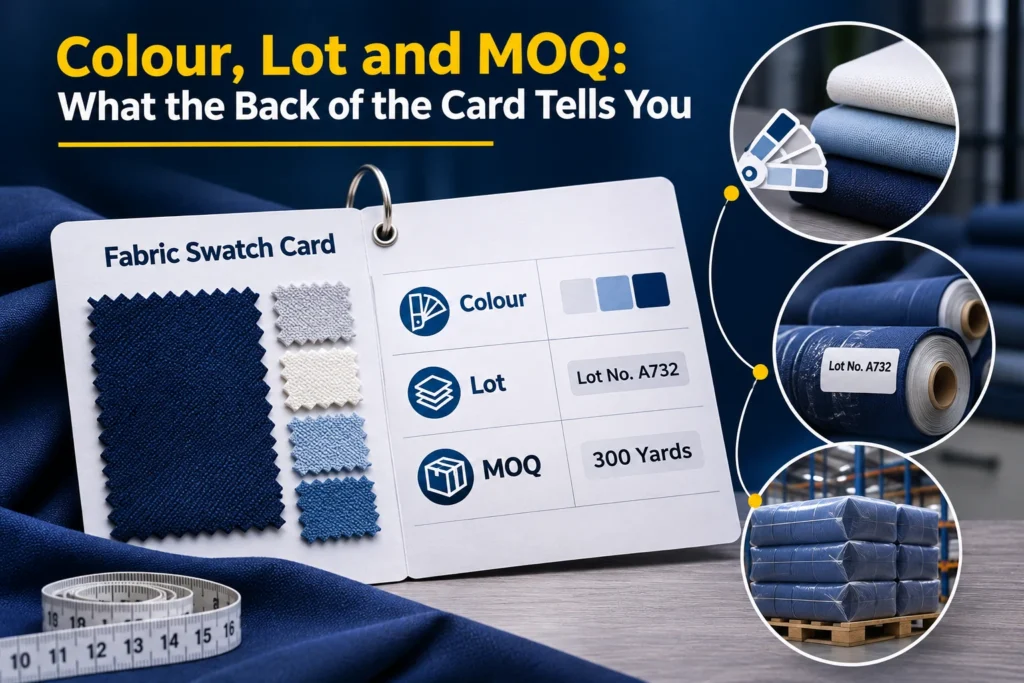
On many cards, the back holds the fields that decide whether a repeat order matches and how much fabric you must buy. Colour comes first. A colour code tells you which shade the mill is matching to, but a screen shows colour under its own display settings, so judge the physical swatch under the light you agreed with the mill. A colourway is one colour version of the same fabric, and a dye lot is one batch dyed in a single run, so a card that names a dye lot still needs a rule for how a repeat is matched to it.
The minimums come next. A fabric minimum per colourway is set at mill level, so it is a different number from your garment minimum, and the card should state its unit. Ask for the price unit too, because a price per metre and a price per kilogram cannot be compared without a conversion you agree in writing.
Table 1 sets each back-of-card and construction field against the question to send the mill.
|
Card field
|
What it tells you
|
Question to ask the mill
|
|---|---|---|
|
Composition (fibre %)
|
The fibre mix and the names used for each fibre
|
Are the fibre percentages tested or declared, and do the names match the US generic definitions?
|
|
GSM or oz
|
Mass per unit area, and whether a full roll or a swatch was weighed
|
Was the weight taken from a full roll or a swatch, and under which test option?
|
|
Width
|
Full or usable width, and whether selvages are counted
|
Is this full width or usable width, and are the selvages included in the figure?
|
|
Construction code
|
Build and density, and the yarn count system
|
Which number is which, and which yarn count system is used?
|
|
Shrinkage (warp and weft)
|
Dimensional change after a stated wash and dry
|
Which wash and dry method was used, and what are the warp and weft results?
|
|
Colour code and swatch version
|
The shade being matched and the card's edition
|
Is this the current version, and which colour reference is the shade matched to?
|
|
Dye lot and fabric minimum per colourway (mill level)
|
Whether a repeat will match, and the smallest fabric run, which our fabric sourcing page puts at 300 to 500 kilograms for a custom dye run
|
What is the fabric minimum per colourway in kilograms, and how is dye lot matched on a repeat?
|
Ask for all seven answers in writing before you approve a sample, and keep them with the card. Copy them into your garment spec sheet, so the fabric lines sit next to the measurements they depend on.
Once the card is read and the fabric is chosen, the fabric moves into sampling. Our apparel prototyping and sampling page says the fit sample is cut from your actual bulk fabric, and the pre-production sample uses the exact bulk fabric, custom hardware and sewing machines for the final run. That is why each card field you settle here matters at sampling, because the sample is built from the fabric the card describes.
We do not operate as a standalone fabric wholesaler. We source fabric to feed our own cut and sew floors, and we hold ISO 9001 certification. Our minimum is 30 pieces per design. Sampling takes 12 days, bulk production takes 18 days and shipping takes 6 days, so you settle the fabric questions before bulk, not after it.
If you still need the measurement and material lines, our tech pack design service drafts them, and its bill of materials lists the main fabric GSM. Bring the card and a finished tech pack to start sampling, so the first sample is built from the fabric you chose. If the order does not match what was agreed, you get a full refund or a free remake.
Not by default. ASTM D3776 says that a small swatch result applies to that sample and not necessarily to the lot it came from. Ask the mill which test option was used and whether the figure came from a full roll or a swatch before you treat it as the bulk weight.
By default, yes. ASTM D3774 says that unless otherwise specified, measurements include the selvages when present, but a mill can quote a figure on a different basis. Ask the mill to state whether the width excludes the selvages before you plan how much you can cut from each roll.
ASTM D3774 covers the width of woven or knitted fabric, usable width, or both, so the card should say which measure its figure shows. Ask the mill to define the figure in writing. If you plan to cut close to the edges, ask for both numbers.
In the United States, yes, when the swatch is used to promote or effect a sale. 16 CFR 303.21 requires the fibre content to appear on the swatch, with exemptions such as swatches under 2 square inches where the information appears on accompanying promotional material. Check the rules in each market where you sell, because this answer covers the US rule only.
This guide cannot confirm that they are the same, because it checks only the US definition of spandex. Under 16 CFR 303.7, spandex is a fibre made from a long chain polymer that is at least 85 percent segmented polyurethane. Confirm the naming rule in your own market before you use elastane on a card or a label.
Yes, in the United States. Under 16 CFR 303.7, polyester is a manufactured fibre whose fibre-forming substance is at least 85 percent by weight of an ester of a substituted aromatic carboxylic acid. A card that names polyester is therefore making a claim about the fibre's chemistry, not only its feel.
A swatch version number is best read as the card's edition label, and this guide found no standard that defines it. Ask the mill which version is current and write that number on your spec next to the card's other fields. A version number lets you check the card you hold against the one the mill quotes from.
On its own it is a pair of numbers with no label, so read it as a question for the mill. Ask which number is the thread count in each direction and which, if any, is the yarn count, because you cannot assume the order. Get the labels in writing before you compare two constructions.
Not reliably. A screen shows colour under its own display settings and the lighting in the photo, not the fabric under the light you will approve it in. Judge colour from the physical swatch under the agreed light, and keep the approved swatch as the reference.

FOUNDER & CEO AT RIJIZ