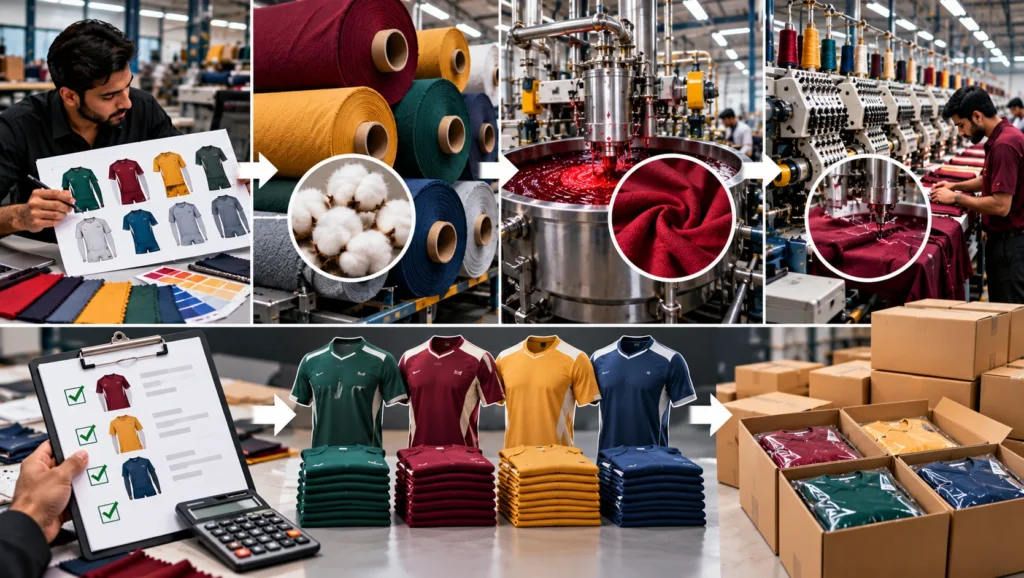
MOQ stands for minimum order quantity, and the meaning founders usually get told (the smallest number of units a factory will produce in a single run) is correct as far as it goes. What that definition leaves out is the part that actually matters when you’re planning a launch: MOQ is quoted per design, and almost always per colour within that design, not as one total number you can divide however you like across your whole range.
That distinction is exactly where a private label build and a fully custom build diverge, which is covered in more depth in our guide to private label vs OEM manufacturing. A private label order pulling from a factory’s existing blank inventory sidesteps most of the minimums below. A fully custom build inherits every one of them. Either way, the number a factory quotes you first is rarely the whole story, and this guide works through what actually sets that number and what you can do about it.
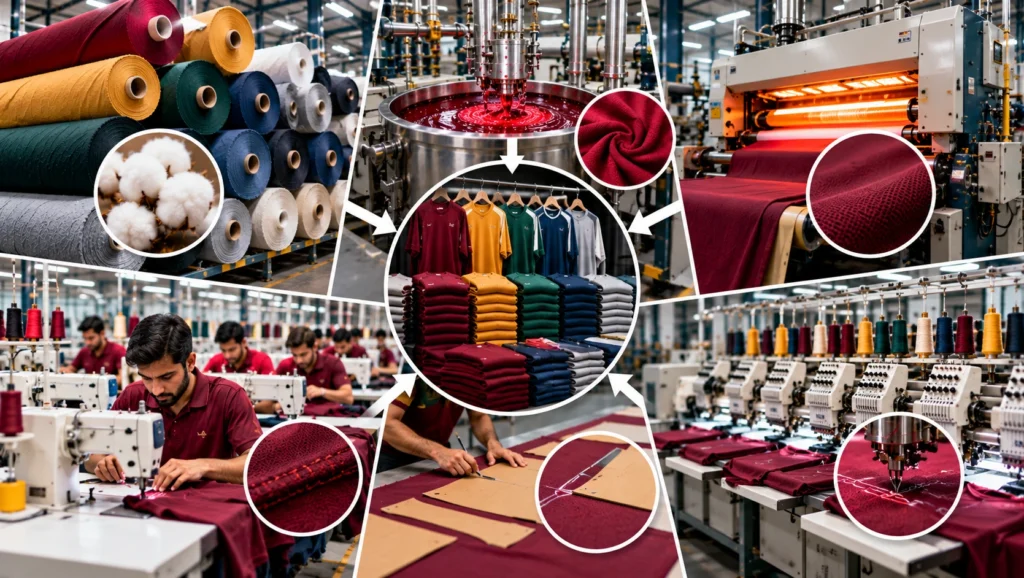
An MOQ isn’t an arbitrary gate a factory invented to filter out small buyers. It’s the point below which a production run stops covering its own fixed costs, and three of those costs show up on nearly every order.
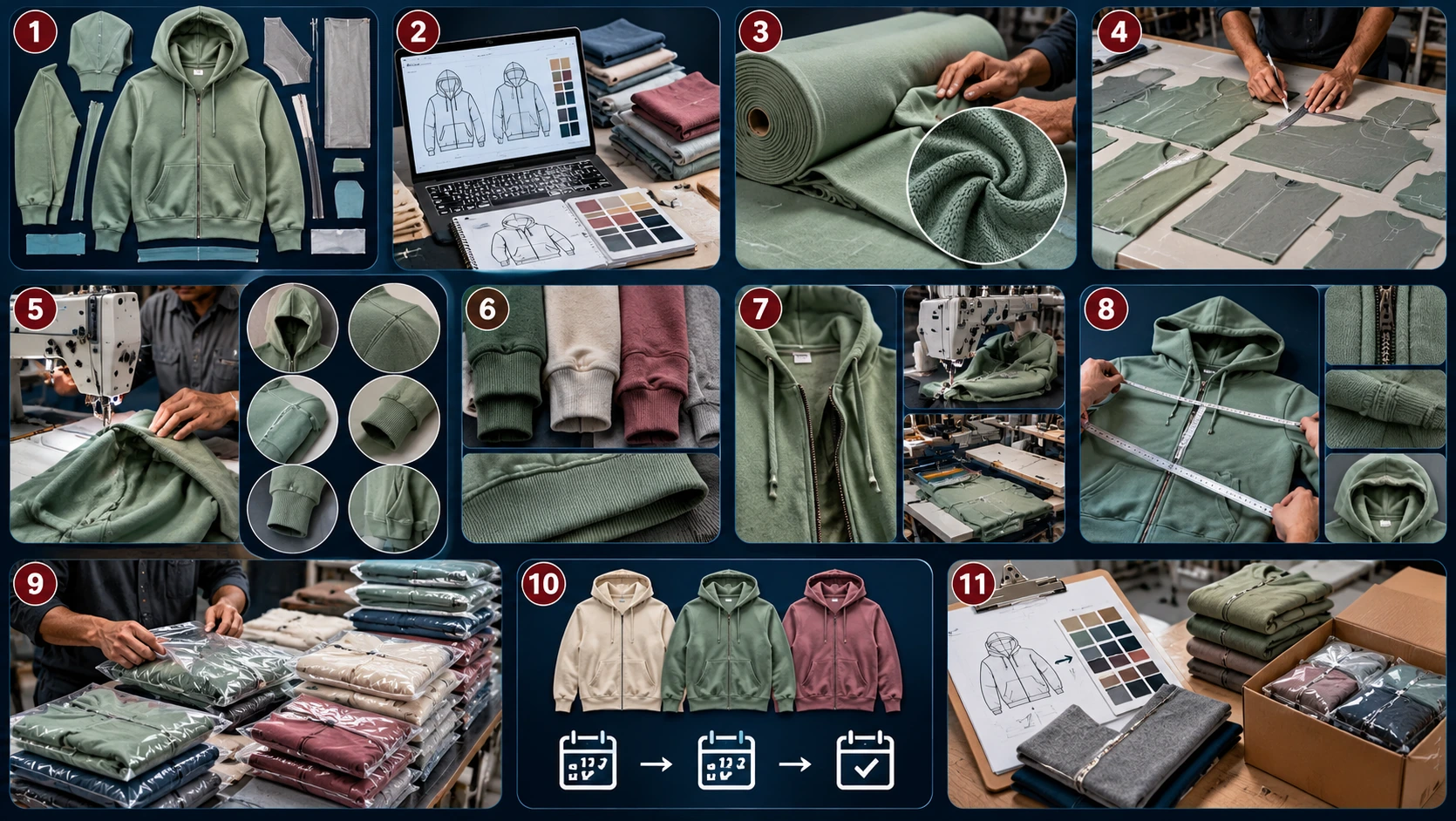
Fabric roll and dye lot minimums. Fabric mills sell in rolls, not by the metre a garment actually needs, and a custom colour usually means a minimum dye lot: enough fabric dyed in one batch to hold a consistent shade across the whole run. Dyeing is a batch process with real, testable variation between one lot and the next. ASTM’s differential dyeing test method for cotton exists specifically because fibre batches don’t all take dye the same way, which is part of why a mill won’t split a dye lot down to a handful of garments’ worth of yardage: the smaller the batch, the harder it is to guarantee the shade matches from the first metre to the last. This isn’t a small-order inconvenience a mill could easily wave away either. Cotton Incorporated’s technical bulletin on small lot dyeing notes that even a “small” commercial dye lot commonly runs in the range of 1,000 to 1,500 yards, since cutting a lot much smaller than that drives the cleanup and changeover time per yard up sharply and makes the run inefficient for the mill to justify at any price.
Setup cost on the line. Cutting a marker, calibrating machines for a specific fabric and stitch type, and getting an operator up to speed on a new construction all take roughly the same amount of time whether the run is 30 units or 3,000. Those fixed costs get divided across however many units come off the line, and a very small run divides them across too few pieces to keep the per-unit price sane. This is standard operations-management economics, not something specific to apparel: fixed costs spread over more units lower the average cost per unit, and the same mechanism explains why manufacturers of any product run in batches rather than one at a time.
Marker efficiency. A marker is the layout of every pattern piece arranged across the width of a fabric roll to use as much of it as possible before cutting. A larger run gives a factory room to plan that layout properly and waste less fabric per garment. A very small run often can’t justify the same planning time, so more fabric gets wasted per unit, which pushes the price up further and gives the factory another reason to hold a minimum in place.
None of these three costs disappear because a brand is new or small. They’re the same costs whether the buyer is a first-time founder or a returning wholesale account, which is why MOQ reads as inflexible even when a factory would genuinely like to take a smaller order.
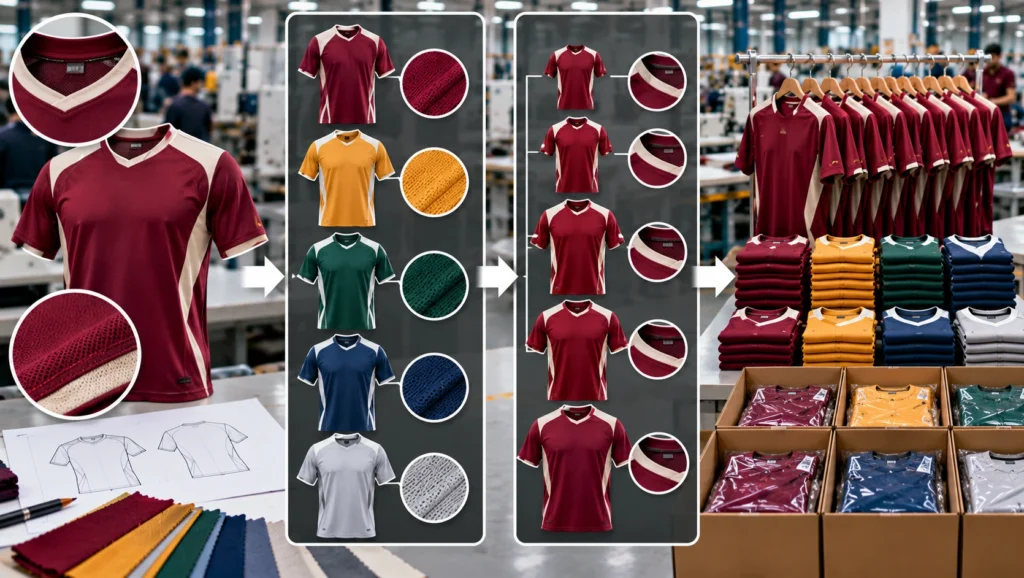
When a factory says “MOQ 100,” the number that matters is what it’s counting. Three layers usually apply, and confusing them is the single most common reason a brand’s first order comes in bigger, or more expensive, than expected.
Per design. This is the baseline: the minimum units required for one specific style, regardless of anything else. A tee and a hoodie are two different designs even if they share a fabric, so each one typically carries its own MOQ.
Per colour. Within a design, a factory usually needs a minimum quantity for each colourway before it’s worth setting up a dye lot or a print run for it. A design offered in three colours can end up needing three times the base MOQ, not the base MOQ split three ways, because each colour is its own dyeing or printing decision underneath the same pattern.
Per size. Less commonly quoted as a hard minimum on its own, but it still shapes an order in practice: a size run has to be spread across a reasonable curve (more mid sizes, fewer extremes) rather than concentrated at one end, or the factory’s cutting and grading work doesn’t line up cleanly with what actually gets produced.
The honest answer to how these three layers interact for any specific factory is that it varies, and asking directly which layer a quoted number is counting (design, colour, or size) is worth doing before assuming a “MOQ 50” quote means 50 total units of whatever you want.
It’s tempting to treat MOQ as one number set by the factory. In practice it’s the higher of two separate numbers, and the factory’s own quote is often not the real ceiling.
Factory MOQ is what the garment maker needs to justify setting up a line for your design: covering the marker, machine calibration, and operator time discussed above. Fabric MOQ sits one level upstream, at the mill that supplies the raw material. If a design needs a stock fabric the factory already holds in inventory, the fabric side of the equation barely matters. If it needs a custom colour, a specific GSM the mill doesn’t keep on hand, or a blend that isn’t part of the mill’s standard offering, the mill’s own dye-lot or roll minimum becomes the real floor, and it can sit well above what the factory itself would otherwise be comfortable running.
This is the mechanism behind a pattern that surprises a lot of first-time founders: two designs quoted at the “same” MOQ from the same factory can end up needing genuinely different order sizes once fabric is locked in, because one used a colour already sitting in the mill’s stock program and the other needed something custom-dyed from zero. Asking specifically whether a quoted MOQ is bound by the factory’s line setup or by a fabric mill’s dye lot is the fastest way to find out which lever is actually worth pulling.
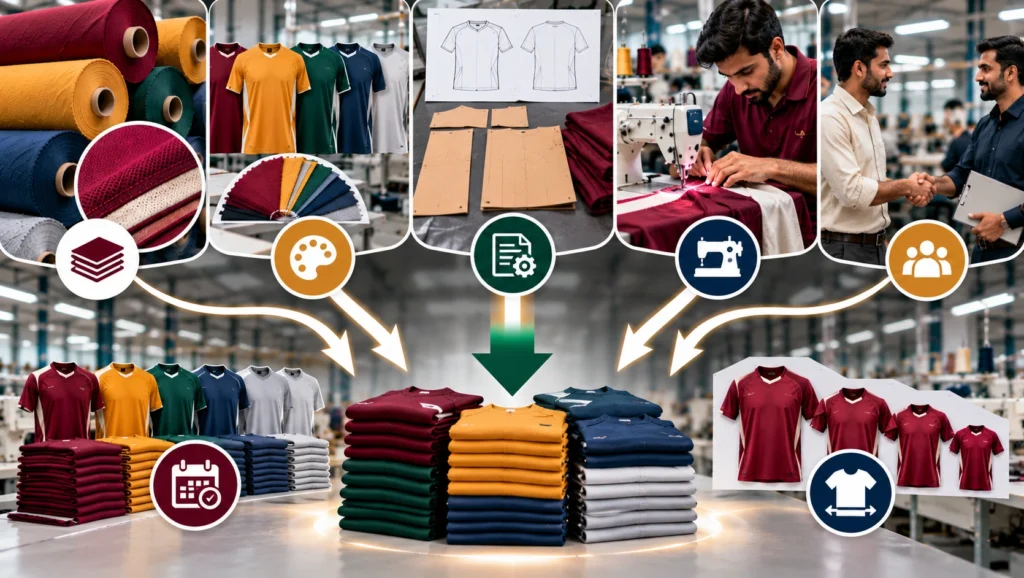
Some levers move a real MOQ meaningfully. Others just move the conversation without changing the underlying cost. Worth knowing which is which before a negotiation starts.
Stock fabric instead of custom. If a design can work in a colour and weight the mill already holds, the dye-lot minimum discussed above mostly disappears. This is usually the single biggest lever available, because it removes an entire upstream constraint rather than trimming around the edges of one.
Fewer styles, deeper per style. Spreading a limited budget across five designs means hitting five separate per-design minimums. Concentrating the same budget on two designs means clearing two minimums with more room in each, which is why most sourcing guidance points toward a narrower first collection rather than a wide, thin one.
Simpler construction. Fewer panels, fewer trims, and standard stitch types mean less line setup time to amortise, which gives a factory more room to accept a smaller run without the per-unit price becoming unworkable.
A committed reorder. A factory allocating capacity cares about the relationship, not just the first order. A written commitment to a second order within a defined window is a real, concrete thing a factory can plan around, and it’s a different offer than simply asking for a lower number with nothing behind it.
What doesn’t move: a mill’s dye-lot minimum on a genuinely custom, one-off colour, and a factory’s basic line setup cost on a fully custom pattern built from a tech pack. Those are fixed technical and cost realities, not negotiating positions, and pushing on them without changing what’s actually being asked for tends to go nowhere.
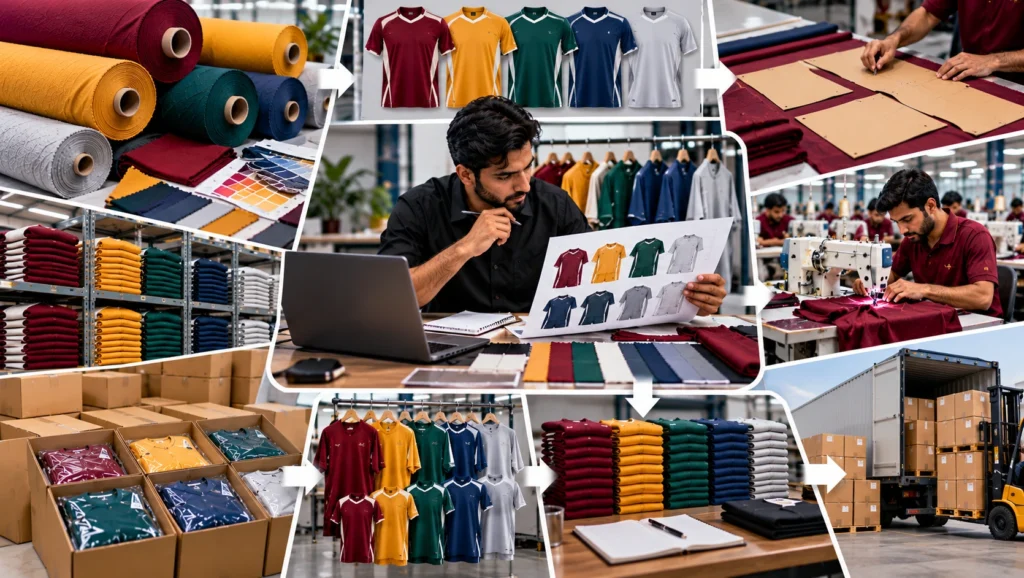
Sometimes the honest answer is that a quoted MOQ genuinely fits a brand’s plan, and the better move is working within it rather than trying to talk it down.
Combine colours under one style rather than splitting a budget across several unrelated designs. If the per-design minimum is the binding number, putting more of a limited order into one well-chosen design clears it faster than spreading thin.
Treat the first run as a validated test, not a full range. A single design at MOQ, sold through before a second one gets committed, tells you more about real demand than five thin designs that all miss reorder territory.
Start with private label on a proven base and save a fully custom build for the design that’s already shown it sells. This is the same sequencing covered in our guide to private label versus OEM manufacturing: validate on an existing base first, then invest the development and fabric-minimum cost in the style worth building from scratch.
None of this makes a real minimum smaller. It changes what gets built against that minimum, which for a first order is usually the more useful problem to solve.
A quoted number only becomes useful once it’s treated as a planning constraint rather than a line item to work around later. Knowing the real MOQ, and which of the layers above is setting it, changes three decisions before a single sample gets cut.
How many designs launch first. If the binding number is per design, a founder planning a ten-style debut collection against a limited budget is really planning ten separate minimums to clear, not one. Most brands that launch successfully start with two or three designs precisely because that’s what a realistic first budget can clear at a workable per-unit cost, not because a smaller range is inherently more fashionable.
Which colours actually ship. Per-colour minimums mean every additional colourway is close to a second commitment, not a free variation on the first. A founder choosing between five colours “to see what sells” and two colours “we can actually reorder confidently” is choosing between two very different cash and inventory positions, not just two different creative directions.
When to lock the fabric. Because fabric MOQ can quietly outrank factory MOQ, the fabric decision has to happen before the design is finalised, not after. A design built around a mill’s existing stock colour clears production faster and at a lower minimum than the same design reworked later to fit a custom shade nobody flagged as a constraint at the sketch stage.
None of this is about avoiding an MOQ. It’s about designing a launch that the confirmed number can actually support, instead of finding out the gap between the plan and the number after a tech pack is already finished.
This is the part that’s ours specifically, not general sourcing theory. We run at MOQ 30 per design, and that number holds because of how the two paths through our factory actually work.
Our private label clothing service starts from garments we already hold in inventory, which sidesteps the fabric-mill dye-lot problem described above entirely: the fabric is already produced, already in stock, and your branding goes on top of it. That’s the fastest route to a low, predictable minimum, because the biggest upstream constraint on MOQ simply isn’t in play.
Where a design needs to be built from your own spec rather than an existing base, every order still goes through a physical sample before bulk starts. Our apparel prototyping and sampling process checks stitch tension, fabric yield, and grading accuracy against the tech pack before a single roll gets cut for bulk, so a spec gap gets caught on one sample rather than on 30 finished units. Sampling typically runs around 12 days and bulk production around 18 days once that sample is approved.
Because how that number applies to a specific colour and size mix depends on the design in front of us, that’s a conversation for the quoting stage rather than a general figure this guide can publish for every design. If you’re working out what a real first order looks like for your own design, get in touch and we’ll work through the actual numbers with you, not a general estimate.
MOQ stands for minimum order quantity: the smallest number of units a factory will produce in a single run. In apparel it's almost always quoted per design, and usually per colour within that design, rather than as one number you can spread however you like across a whole range.
Because a production run carries fixed costs that don't shrink with a smaller order: a fabric mill's roll or dye-lot minimum, the time to set up a cutting marker and calibrate machines, and the operator time needed to get a new construction running cleanly. Below a certain volume, those fixed costs outweigh what the run can realistically cover.
Factory MOQ is what the garment maker needs to justify setting up a line for your design. Fabric MOQ sits upstream at the mill and applies mainly to custom colours or non-stock materials, where the mill's own dye-lot or roll minimum can end up higher than what the factory itself would otherwise ask for.
It can apply to all three, and which one is binding varies by factory. Per design is the baseline minimum for a specific style. Per colour usually adds a separate minimum for each colourway within that design. Per size is less often a hard number on its own but still shapes how a size run has to be spread.
Usually not without hitting a separate per-colour minimum for each one, because each colour typically triggers its own dye lot or print setup. Some factories will combine colours if they share the exact same base fabric, which is worth asking about directly rather than assuming either way.
Not automatically. A lower minimum usually comes with a higher per-unit cost, since the fixed setup costs are spread across fewer pieces. A low MOQ reduces upfront risk and inventory exposure, which matters more for a first, unproven design than the lowest possible unit price does.
The most reliable lever is using a fabric the mill already stocks instead of a custom colour, since that removes the dye-lot minimum entirely. Simpler construction, concentrating a budget on fewer designs, and offering a committed reorder are the other real levers. A mill's fixed dye-lot minimum on a genuinely custom colour is usually not negotiable on price alone.
Most factories will either decline the order outright or offer it at a higher per-unit price to cover the setup and material costs that a full-size run would normally spread across more units. It's rarely a flat refusal without an alternative, but it's also rarely the same price you'd get at the real minimum.
Yes. More panels, trims, and specialised stitch types mean more setup time for the factory to recover, which tends to push the minimum higher. A simple design on a stock fabric generally clears the lowest achievable MOQ; a complex design in a custom fabric tends to sit at the other end.
We run at MOQ 30 per design. Our private label program starts from existing inventory, which keeps that number low by avoiding the fabric-mill dye-lot minimums that apply to a fully custom build. A fully custom design still runs through a physical sample before bulk, regardless of order size.
Before, wherever possible. Because fabric MOQ can outrank factory MOQ, locking a fabric decision without checking whether it's a stock colour or a custom one can turn a manageable minimum into a much larger one after the design is already finished.
* * *

FOUNDER & CEO AT RIJIZ