
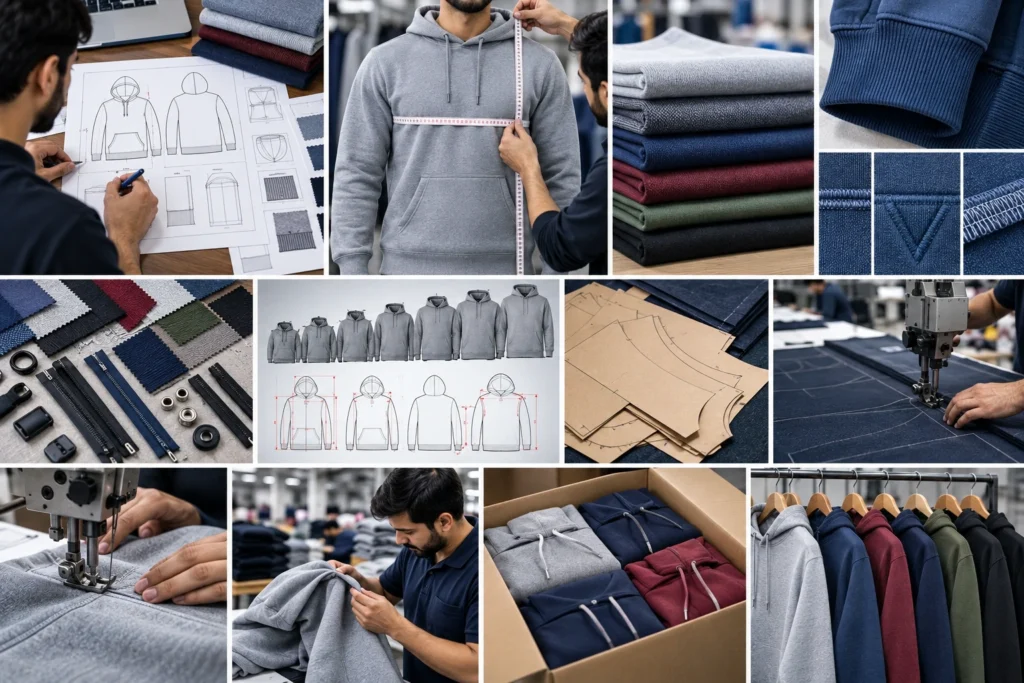
These two terms get used interchangeably often enough that the distinction is worth stating plainly. A tech pack is the complete documentation package a factory needs to build a garment: technical flat sketches, a bill of materials, construction and finishing notes, and the spec sheet itself. The spec sheet is one component of that package, specifically the measurement chart showing every point of measure, its target value per size, and its tolerance.
A brand that sends a factory “specs” without the rest of the tech pack has sent a measurement chart with no context for how those measurements connect to the actual construction. A brand that sends a full tech pack with a vague or incomplete spec sheet has documented everything except the one section a factory checks a finished garment against most directly. Both gaps cause real problems, and they’re different problems, which is why the distinction matters beyond terminology.

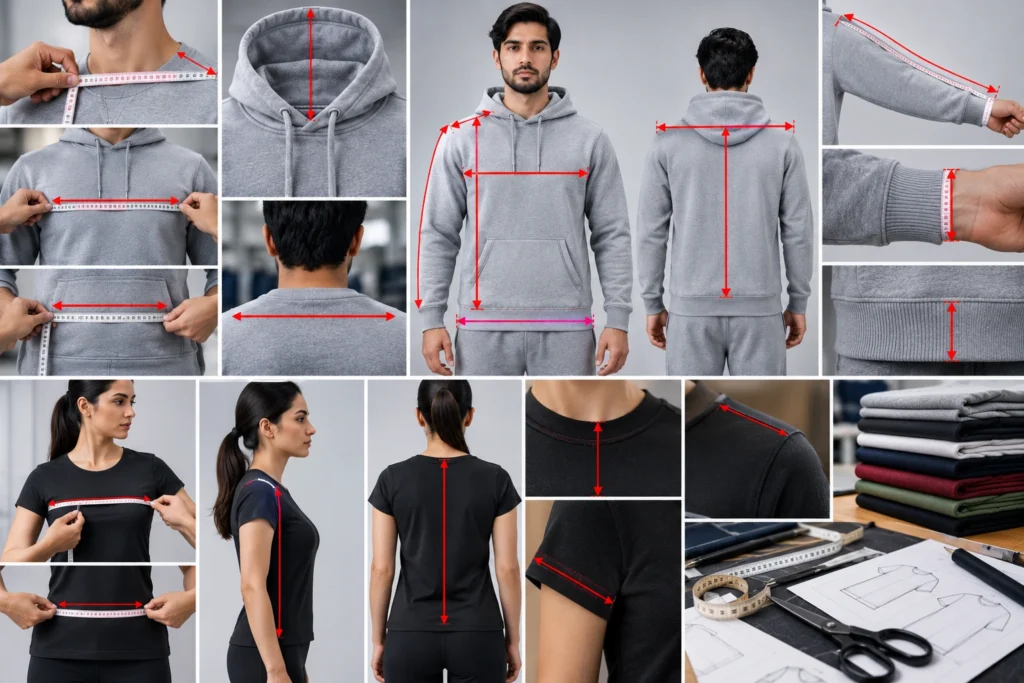
Point of measure, POM for short, is the specific, named location on a garment where a measurement gets taken, and a spec sheet is essentially a list of these, each with its own target value and tolerance. A handful of terms show up across nearly every category, worth knowing by name rather than by description alone.
Chest or bust width, measured flat, one inch below the armhole, typically doubled to reflect the full circumference.
Waist width, measured flat at the narrowest point of the garment’s waist, same doubling convention as chest.
Hip width, measured flat at the widest point below the waist, usually 7-9 inches down depending on the garment’s rise.
Shoulder width, measured from shoulder seam to shoulder seam across the back.
Sleeve length, measured from the shoulder seam to the cuff edge along the sleeve’s outer line.
Front and back rise, measured from the crotch seam to the top of the waistband, front and back separately since they’re rarely identical.
Body length, measured from the highest point of the shoulder (front) or the base of the neck (back) straight down to the hem.
Neck drop, measured from the shoulder line down to the front or back neckline edge.
None of these terms are exotic, but a spec sheet that skips naming them explicitly and just lists numbers next to a garment sketch is easy to misread, especially across a language or unit-system difference between a brand’s design team and a factory’s pattern team.
Tolerance is the acceptable range a finished measurement can fall within and still be considered correct, expressed as a plus-or-minus value per point of measure, not one blanket number for the whole garment. Larger measurements typically carry more tolerance: a chest or hip point of measure commonly allows around half an inch either way, since fabric behavior and cutting variance naturally produce more variation across a wider span. Smaller measurements need tighter tolerance: a sleeve length or neck drop off by half an inch reads as a visible fit problem in a way the same half-inch on a chest measurement usually doesn’t.
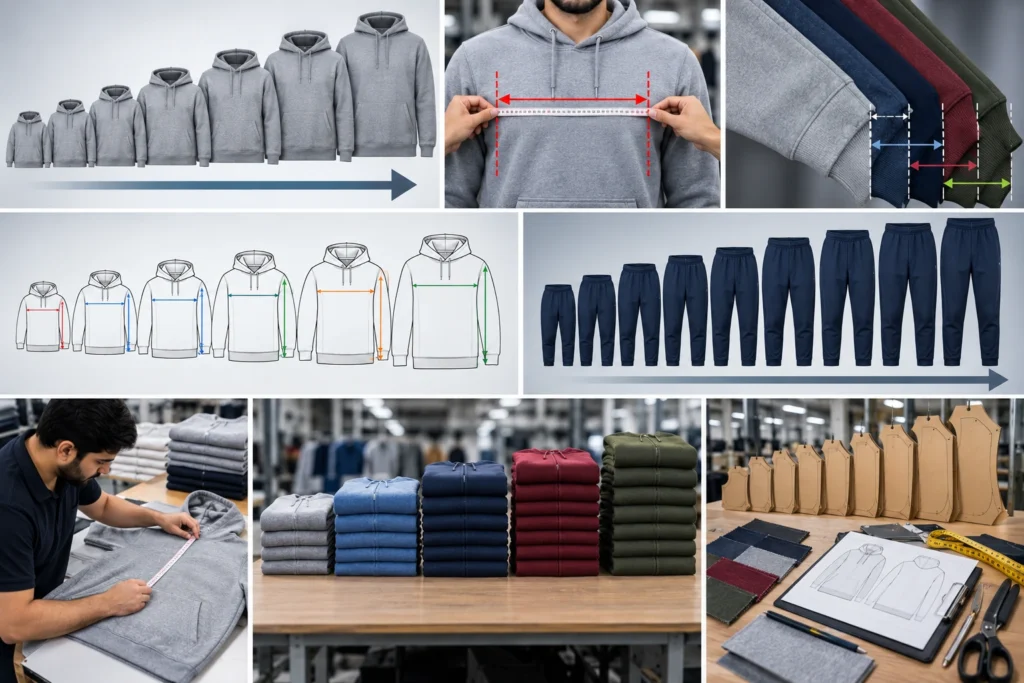
Grading takes this a step further across a size range. A base-size spec sheet gets scaled up and down to produce every other size, and the grade rule, the specific increment each point of measure changes by between sizes, needs to be explicit per POM rather than assumed uniform. A chest measurement might grow by a full inch per size while a neck drop grows by a quarter inch, and a factory working from an incomplete grade rule will default to its own assumption, which may not match what the brand actually intended.
A spec sheet with clear POM definitions, per-measurement tolerance, and explicit grade rules is the difference between a fit sample that needs one clarifying question and one that comes back wrong in a way nobody can quite explain, since the ambiguity was baked into the documentation from the start.
Apparel carries one of the highest return rates of any e-commerce category, around 25% by category according to recent industry data , well above categories like electronics or beauty. Sizing and fit issues are consistently identified as a leading cause behind that number, not shipping damage, not changed minds, but a garment that simply didn’t fit the way the customer expected based on the size listed.
This matters at the spec sheet stage specifically, before a single unit ships, because a size chart that reflects the actual, physical measurements documented on an accurate spec sheet gives a customer a real basis for choosing a size, while a size chart built on loose or inconsistent specs is asking customers to guess. Every return driven by a fit mismatch carries real cost: reverse shipping, restocking, and in many cases a garment that can’t be resold as new. A spec sheet isn’t just a factory-facing document, it’s the foundation the customer-facing size chart is built on, and errors at that foundation propagate all the way to the return rate.

Real, published reference standards for body measurements exist, and they’re worth knowing about even though they’re a starting reference point, not a substitute for a brand’s own fit model and target customer research. ASTM D6240/D6240M provides standard body measurement tables for adult men across a defined chest-size range. ASTM D6192/D6192M provides the equivalent tables for girls across a defined size range. Each of these standards is scoped to a specific demographic, not a universal one-size-fits-all reference, which is worth being precise about rather than citing “the body measurement standard” as if only one exists.
A brand using one of these standards as a starting reference still needs its own fit-sample process to confirm the spec actually matches its target customer and its own brand’s fit intent, since a published standard reflects a general population average, not any specific brand’s fitting philosophy.
No. The spec sheet is the measurement chart, one component of the tech pack. The tech pack is the complete documentation package, sketches, bill of materials, construction notes, and the spec sheet together.
A point of measure is the named, specific location on the garment (chest, sleeve length, neck drop). The measurement is the actual number recorded at that location for a given size. A spec sheet lists points of measure with their corresponding measurements and tolerances.
Because different measurements have different real-world margins for acceptable variation. A half-inch difference on a chest measurement is much less noticeable than the same half-inch on a sleeve length or neck drop, so tighter points of measure need tighter tolerance.
Not really. A standard like ASTM D6240 is a useful general reference, but it reflects a broad population average, not any specific brand's target customer or fit philosophy. A brand still needs its own fit-sample process to confirm the spec actually delivers the intended fit.
No, and assuming so is a common mistake. Different points of measure typically grow or shrink by different increments between sizes, which is why grade rules need to be specified per point of measure, not applied as one uniform scale factor.
Sizing and fit issues are consistently identified as a leading driver of apparel returns specifically, more so than damage or shipping issues, which is part of why spec sheet accuracy connects directly to return-rate economics.
It becomes easy to misread, especially across a language or measurement-unit difference between a brand's team and a factory's pattern team, increasing the risk that a fit sample comes back measuring something different than what was actually intended.
Not from scratch. A base size gets a fully specified spec sheet, and the rest of the range is produced by grading that base spec using explicit, per-point-of-measure grade rules, not by re-speccing every size independently.
* * *

FOUNDER & CEO AT RIJIZ