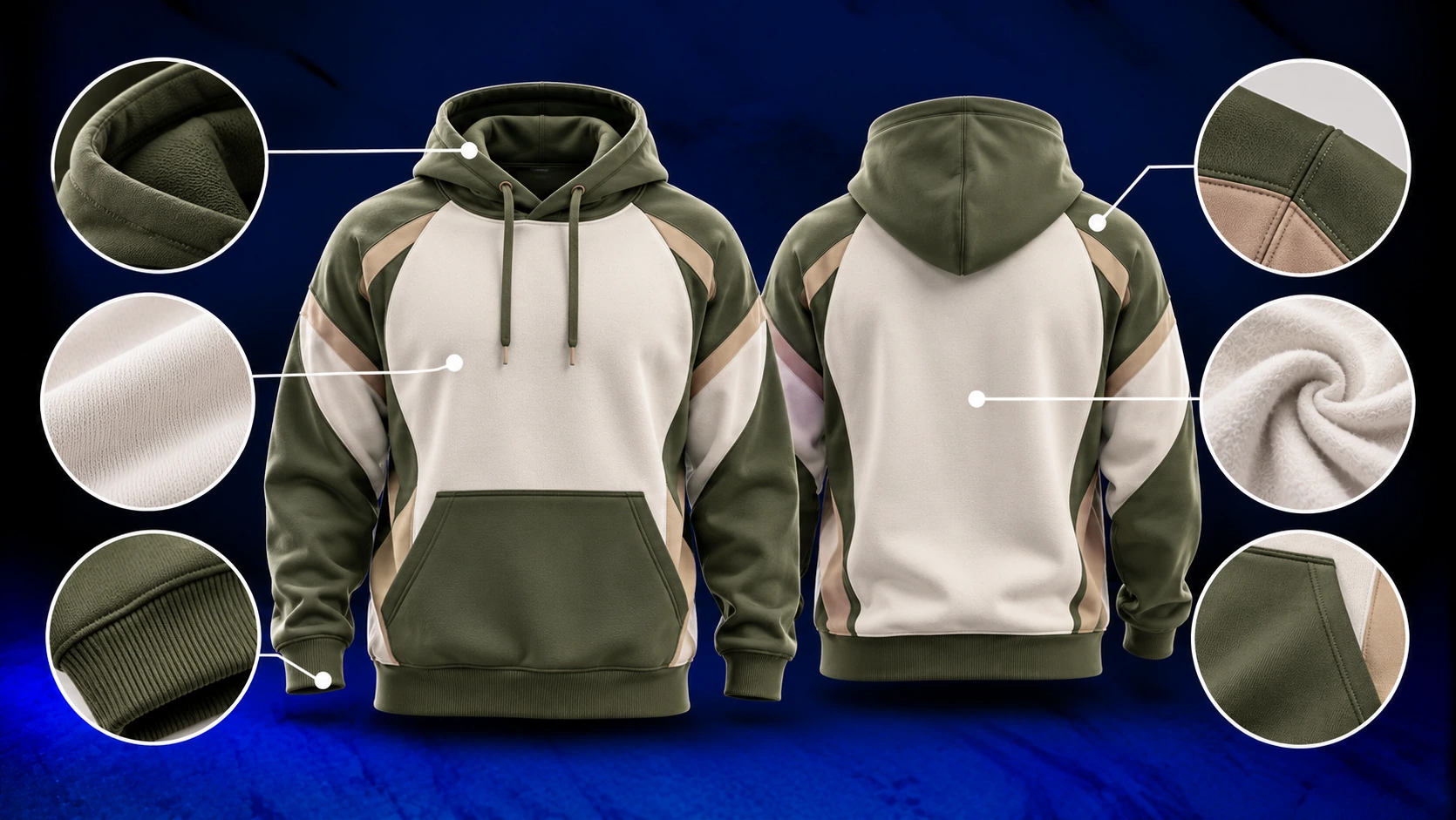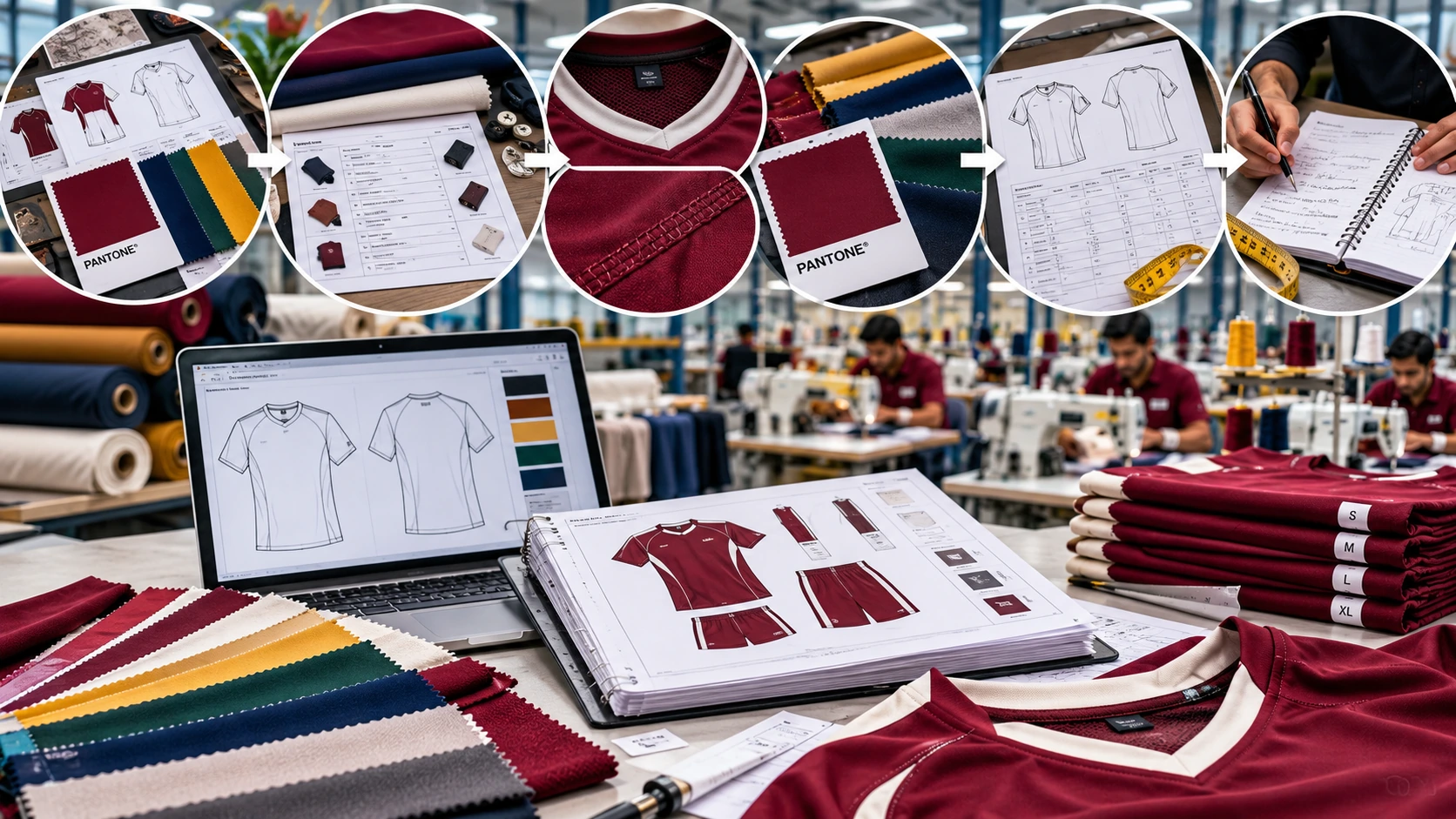

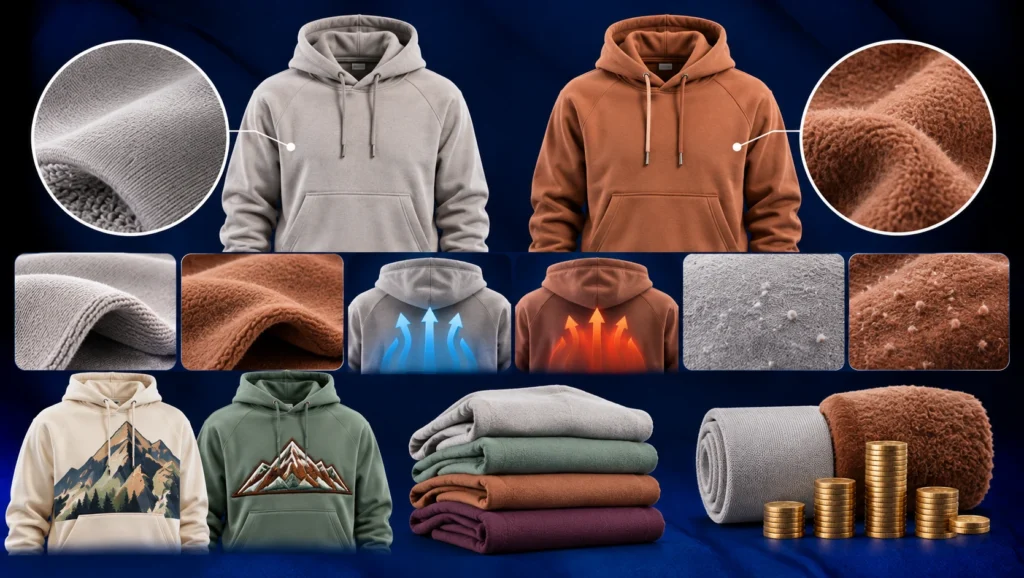
For the most common hoodie knit, yes. CottonWorks, the learning hub run by Cotton Incorporated, says that in the industry a 2-end fleece that is not napped is referred to as French terry, although it is not technically a terry, because floats and not terry sinker loops form the loops on the back. Its own words for the result are that French terry is “technically an un-napped fleece”. The face of the fabric is plain jersey. The loops are the long floats of a second yarn that runs across the back.
What turns that knit into fleece is a finishing step. CottonWorks says the brushing or napping of the interior loops is what separates a fleece from a French terry, and that the knit structure stays the same. Napping, in its mechanical finishing guide, is a process that raises the fibres on the face of a fabric by passing it over rotating rolls covered in wire points, which gives a plush pile. It adds that in a typical fleece the napped yarns are the coarser, lower twist yarns knitted as floats on the back, because lower twist lets them nap more efficiently.
There is a heavier variant. CottonWorks describes 3-end fleece as the most stable and fullest fleece, because it uses three yarns instead of two: a face or ground yarn, a tie-in yarn and a pile yarn, with the loops on the back napped. Table 1 sets the three side by side, with the rib that trims every hoodie as a fourth line, because it is a different knit again.
|
Fabric
|
How the back is made
|
Yarns in the knit
|
|---|---|---|
|
French terry
|
Float loops left unnapped
|
2-end: jersey face yarn plus a back yarn
|
|
2-end fleece
|
The same structure, with the back yarn napped
|
2-end, with coarser, lower twist back yarn
|
|
3-end fleece
|
Pile yarn napped, tie-in yarn holds it
|
3-end: ground, tie-in and pile yarn
|
|
Rib (cuffs and hem)
|
Two needle beds, same look on both sides
|
Rib knit, stretches in width
|
|
Where CottonWorks places it
|
|---|
|
Sweatshirts, sweatpants, layering; performs across all seasons
|
|
Heavier, cold-weather and active garments
|
|
Fullest, most stable fleece for extra warmth
|
|
Trims of necks, wrists and waistbands
|
The practical meaning for you: because the knit can stay the same, “terry or fleece” for a 2-end fabric is a decision about finishing, and a mill can show you both from one base. That is also why two sellers can describe the same loopback cloth with different names, a point we return to in the spec section.
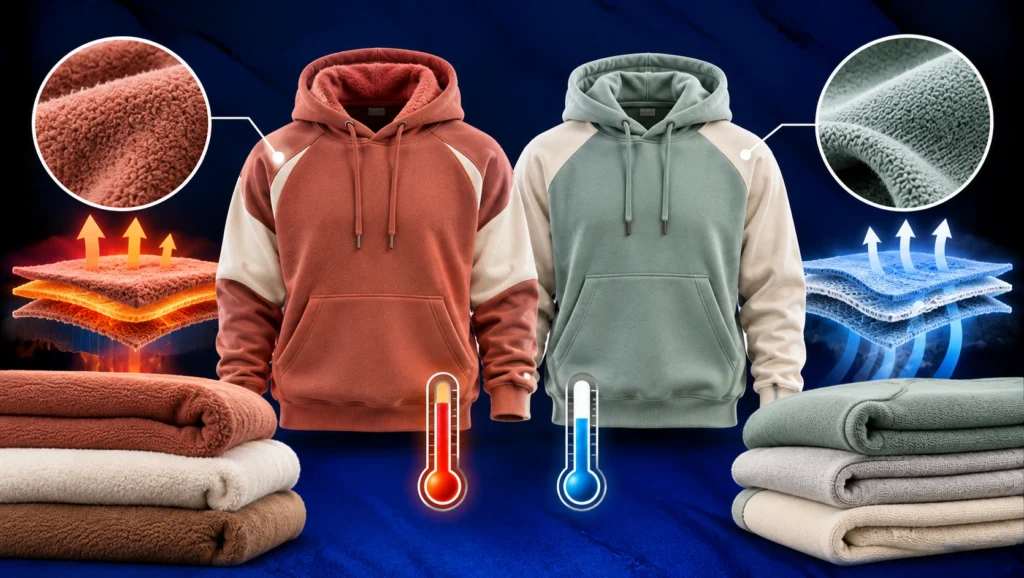
We are keeping this section qualitative on purpose. The guides we read for this post are mostly brand and seller pages, they quote warmth, wicking and absorbency in confident terms, and none of them cites a test result, so we do not repeat those claims as facts.
What can be said from the construction is this. A napped back is a raised layer of fibre, and in general terms a raised layer holds more air against the body than flat loops do, so fleece is the usual pick for cold weather. CottonWorks backs the use side of that: it says French terry performs well for all seasons because of its versatility and its lack of napping, and that fleece fabrics tend to be heavier and suit cold-weather and active garments. If your market is warm for most of the year, that points you to terry for the core line.
Two other levers move the answer more than the name does. The first is fibre. CottonWorks notes that fleece can be all cotton, a cotton and polyester blend, or all synthetic, and the same range exists for terry, so write the composition next to the construction. The second is weight. CottonWorks says French terry comes in various weights, which means a heavy terry can feel more substantial and warmer than a light fleece. Judge warmth in a sample at the weight you plan to order, using the hoodie page bands of about 350 GSM for midweight and 450 to 600 GSM for heavy, and never from the fabric name alone.
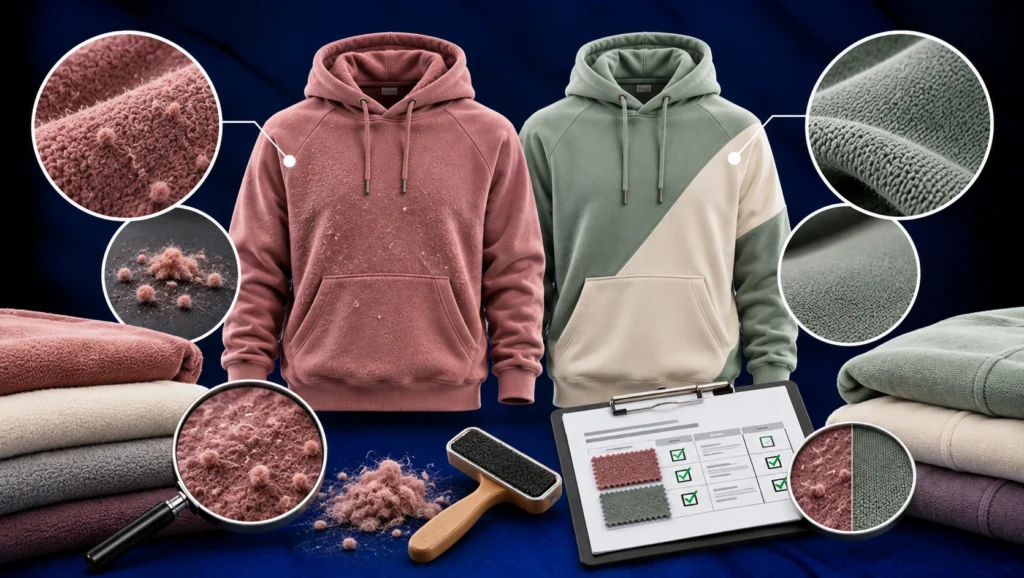
Pilling is fibre ends tangling into small balls on a surface that rubs. A napped back exists to put loose fibre ends at the surface, so the mechanism points to fleece having more to tangle than unbrushed loops. Treat that as reasoning and not as a measured result. Several guides we read say terry pills less, one says both resist pilling when made with quality yarns, and none gives a test figure. Fibre, yarn quality and finish all move the result, which is why a name cannot settle it.
The answer you can ask a mill for is a number. ISO 12945-2 specifies the modified Martindale method for determining the resistance of textile fabrics to pilling, fuzzing and matting. So the line for your supplier is a pilling rating on your own fabric, in the construction you chose, after a cycle count that you and the mill agree. We are not printing a pass mark here, because the rating you need depends on the fabric and on how the garment is worn, and the standard does not set it for you.
Where would you notice it first? Wherever the inside of the hoodie rubs, such as the lining of the hood or the inside of the sleeve. That is a question to put to the sample after a few washes, not a fact to take from a guide. Shrinkage is a separate question that depends on more than the knit name, so we leave it out of this guide.
This is where the two fabrics are closer than the guides suggest. Both are built on a jersey face, as CottonWorks describes, so the surface a print or a logo lands on is a similar kind of surface in either fabric. The difference sits behind the design.
Think about what happens at the back of the cloth. An embroidered logo pushes thread through to the inside, and that thread and any backing sit against loops on a French terry and against pile on a fleece. Heat and pressure from a transfer or a cure pass through to the same inside face. We cannot give you a measured comparison, so the sample is the test: look at the inside of the chest after decoration on each knit, and wear it against skin for an hour.
The face decides how a design is applied, and how puff print behaves on a hoodie comes down to the face plus the cure, so test any raised print on the exact knit you chose and not on a stand-in. If your decoration plan is still open, our fabric guide for streetwear covers finishing washes and fabric choice across the range, and this guide stays on the knit.
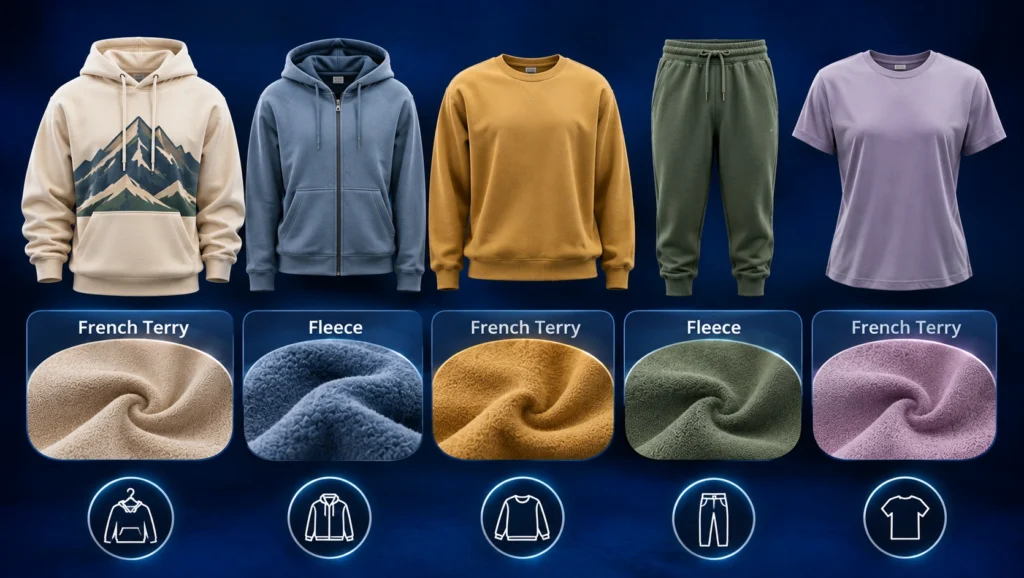
Choose from the drop, not from the fabric you like best. Table 2 turns the construction facts above into a starting point for four common situations. It is reasoning from construction and from the CottonWorks use notes, not a ranking, and each row ends in the check to run on the sample.
|
Your drop
|
Lean toward
|
Because
|
Check in the sample
|
|---|---|---|---|
|
Spring or autumn capsule
|
French terry
|
No napped back, listed by CottonWorks for all seasons
|
Hand at the weight you plan to order
|
|
Winter drop
|
Napped fleece, 2-end or 3-end
|
Raised back holds more air; 3-end is the fullest build
|
Hood and cuff feel when worn
|
|
Year-round core line
|
French terry, with fleece as a seasonal second
|
One base can cover most of the year
|
Colour match between the two knits
|
|
Layering piece
|
The thinner back in the weight band
|
A thicker back adds bulk under a jacket
|
Seam bulk at the hood join
|
The hood is the part that most often surprises a first-time buyer, because it is the one place the inside of the fabric is on show when the hood is down. A zip front also asks more of the fabric than a pullover does, since the facing sits behind the opening, and how a zip-up hoodie is built is worth reading before you pick a napped, thicker back for it.
If you are building a sweatshirt alongside the hoodie, the same choice applies to your custom sweatshirts, and one fabric decision can cover both.
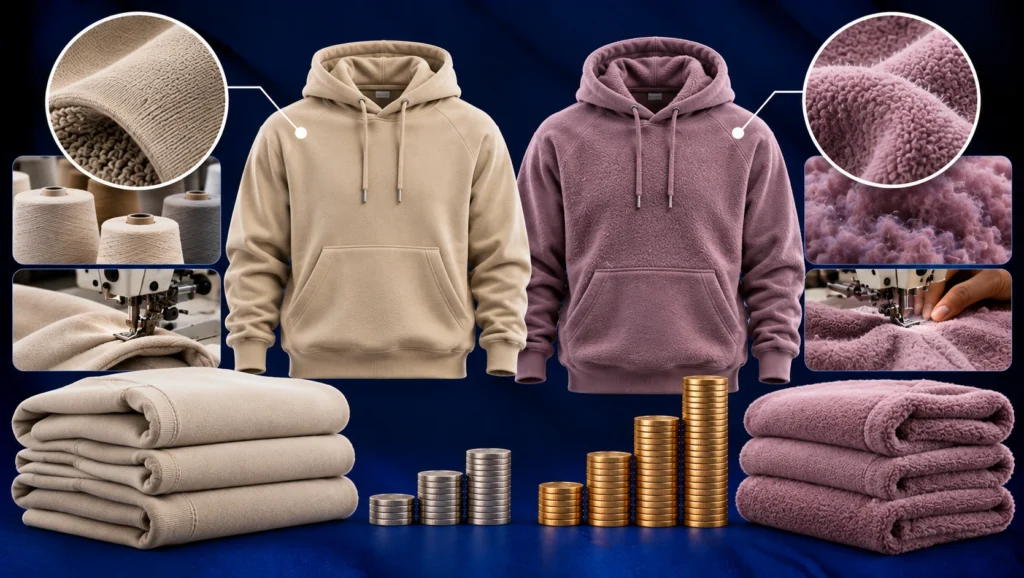
We are not quoting a gap, and you should distrust any percentage you find online, because it is one seller’s number and moves with fibre, weight and mill. What we can describe is where cost enters.
Napping is a separate finishing step, so a napped back carries an operation that an unnapped back does not. A 3-end fleece uses a third yarn, so it carries more yarn through the knit than a 2-end. Weight adds yarn to either fabric, and a heavy French terry can carry more material than a light fleece. Fibre moves the price again: an all cotton fabric and a blend are not priced alike. So the honest answer to “which costs less” is that the name does not decide it, and you only learn the number by quoting a written construction.
That is the job of our fabric sourcing service: turning a description such as “heavy and soft” into a construction, a fibre and a weight a mill can quote against. Our guide to how fabric is made walks through knitting, mechanical finishing such as brushing and napping, and the four numbers every fabric spec needs.
Names do the least work in a spec. The industry uses terry and fleece loosely, and a term like sponge fleece is a trade name we found no standard for, so a spec that says “fleece hoodie” leaves the mill guessing between at least three builds. Write these lines instead.
Construction, in plain words. For example: 2-end, unnapped loopback; 2-end, napped back; or 3-end, napped back. That single line removes the naming problem.
Fibre. The full composition, such as the percentage of cotton and of any polyester. Fibre changes feel and pilling as much as construction does.
Weight. A GSM figure for the finished fabric, in the band you chose, with the measurement method written beside it as your tech pack requires.
Finish. Whether the back is napped, and any softening or anti-pilling finish you want. Naming it matters because “soft finish” alone does not tell a mill which treatment to apply.
Pilling test. An ISO 12945-2 rating, with the cycle count and the minimum rating agreed with the mill and written beside the number.
Hood and trims. What the hood is made of and lined with, and that the cuffs and hem are a rib knit. A rib is a different structure from the body, so its fibre and colour must be matched to the body on purpose.
Care label. Five of the ten guides we read give consumer wash advice, usually cold water and low heat, and none of them cites a test behind it. Your label is a brand deliverable, so print the wash and dry conditions that the mill’s test results were run at. Heat and agitation act on loops and on a napped back in different ways, and a label that promises a gentler wash than the test used is a claim you cannot back.
Keep the approved swatch as the reference. Our tech pack guide shows where each of these lines sits on the page.
The knit, fibre and weight you list in the spec are what our team builds the sample from on our own floor. The sample takes 12 days, bulk production takes 18 days and shipping takes 6. With a minimum of 30 pieces per design, you can see the terry and the fleece as garments before either one becomes a commitment.
Not sure yet? List both knits in the brief. Our sampling service page explains how a sample is made and checked ahead of bulk, so you can press the inside face, look into the hood and sign off against your spec line. Our guarantee covers the rest: a finished order that differs from what was promised is refunded or remade at no charge.
In construction terms, nearly. CottonWorks says 2-end fleece that is not napped is referred to in the industry as French terry, so it is an unnapped fleece knit. Once the back is napped, the same structure is sold as fleece.
Sponge fleece is a trade name, and we have not found a standard that defines it, so mills and sellers use it loosely. Ask for the construction in plain terms: whether the back is unnapped loops, lightly napped or fully napped, and how many yarns the knit uses.
Fleece is generally the warmer choice, because the napped back raises fibres from the surface, and CottonWorks places fleece in cold-weather garments and French terry across all seasons. We have no test result to quote, so judge warmth on the sample at the weight and fibre you intend to order.
Napping raises fibre ends, so a napped back has more loose fibre available to tangle, but that is a mechanism and not a measured result, and pilling also depends on fibre, yarn and finish. Ask for a modified Martindale result under ISO 12945-2 on your own fabric.
A 2-end fleece uses two yarns: a jersey face yarn and a back yarn that is napped. A 3-end fleece adds a third, so it has a face or ground yarn, a tie-in yarn and a pile yarn. CottonWorks describes it as the most stable and fullest fleece and places it in cold-weather garments that need extra warmth.
Because the names describe a finish and a use, not a fixed standard. An unnapped loopback is called French terry in the industry, a napped one is called fleece, and fabrics between the two are named loosely. Put the construction in the spec so the name does not decide what you receive.
French terry is the usual starting point for mild seasons, because CottonWorks describes it as performing well across all seasons and it has no napped back. Sample your chosen fibre and weight against a lighter option before you commit, since a heavy terry can still feel warm.
The body is the terry or fleece you choose, while the cuffs and hem are a separate rib knit, which CottonWorks lists for trims at the neck, wrist and waistband. The hood is where the inside of the body fabric shows, so name the hood construction in the spec as well.
No. CottonWorks says French terry is not technically a terry, because floats rather than terry sinker loops form its loops. It is a knit with a smooth jersey face and a looped back.
* * *

FOUNDER & CEO AT RIJIZ