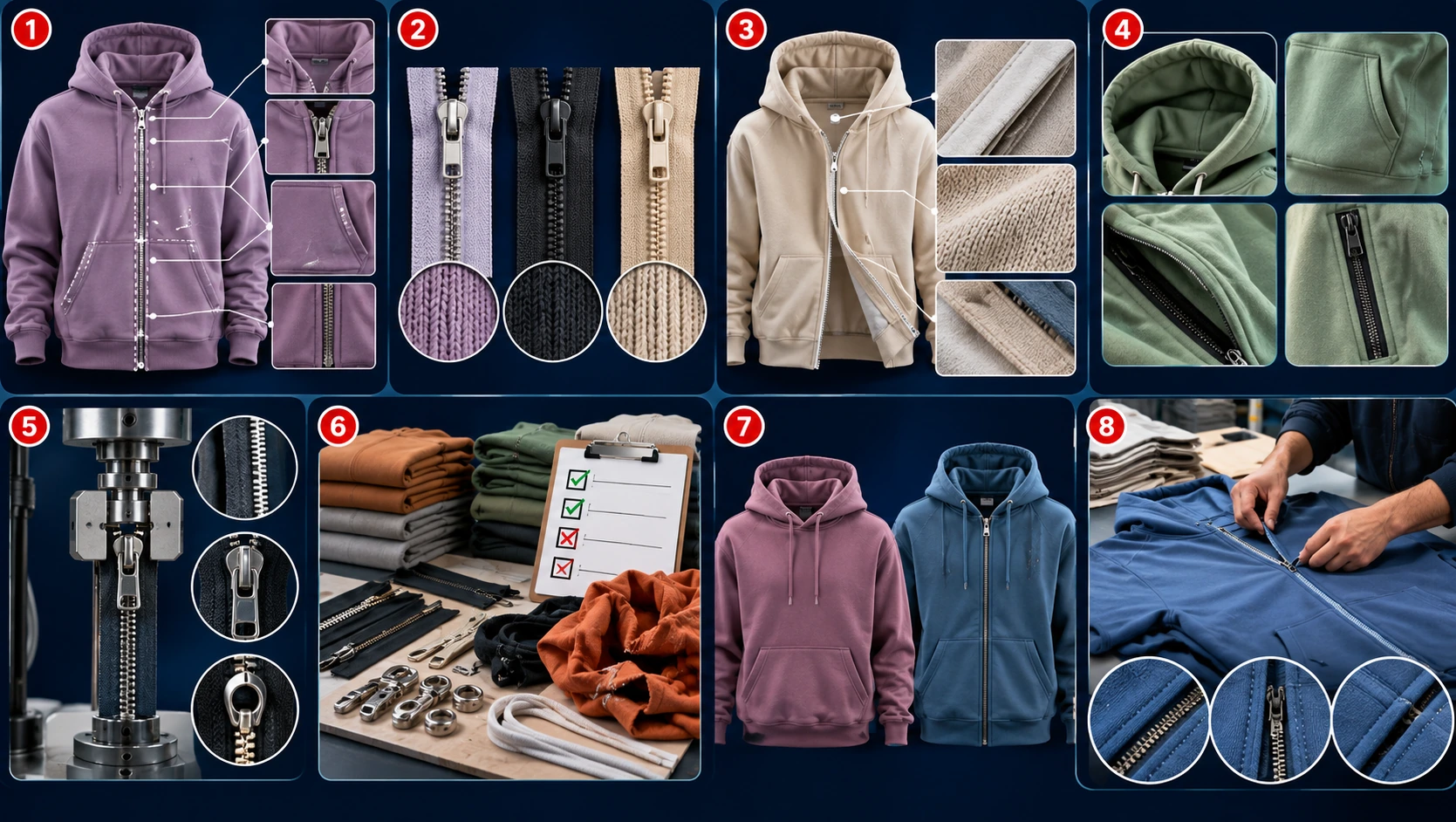

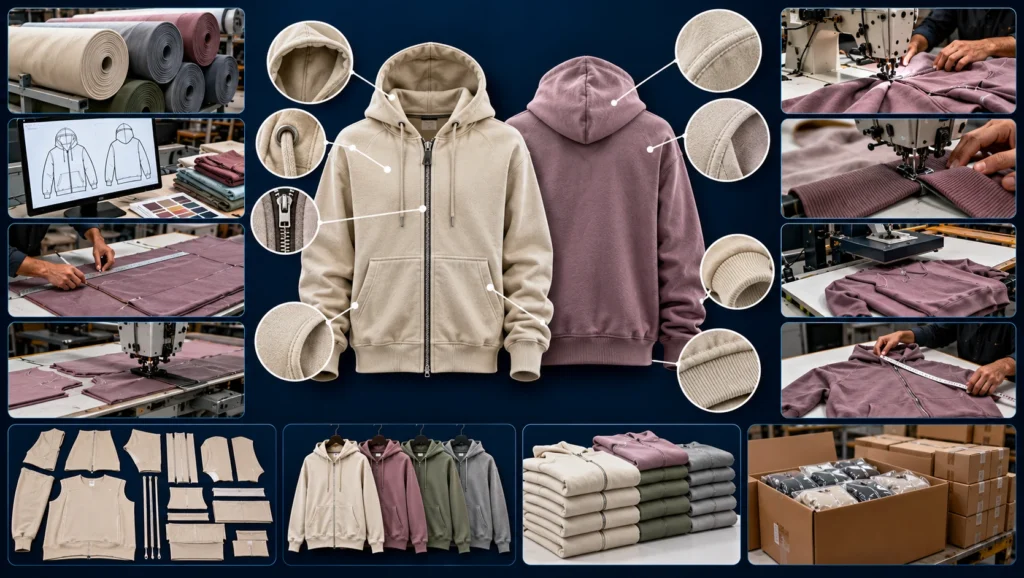
Every stage below acts on one or more of these parts, so it helps to have the words first. Table 1 lists the parts of a pullover, what each does and the term you will hear on a floor or in a tech pack. A pattern maker may use a slightly different word for the same part.
|
Part
|
What it does
|
Term you will hear
|
|---|---|---|
|
Hood
|
Covers the head and sets the shape of the neckline
|
Hood panels, with an optional lining panel
|
|
Drawcord and eyelets
|
Let the wearer close the hood opening
|
Cord, eyelet or grommet, cord channel
|
|
Neckline join
|
Attaches the hood to the body and finishes the neck
|
Neck seam, sometimes covered with tape
|
|
Body panels
|
Make the front and back of the garment
|
Front, back
|
|
Sleeves
|
Cover the arms and carry the shoulder fit
|
Sleeve, armhole or armscye
|
|
Kangaroo pocket
|
One large pouch across the lower front of a pullover
|
Pouch, kangaroo pouch
|
|
Rib cuffs
|
Close each sleeve end and hold it in place
|
Cuff, rib
|
|
Rib hem band
|
Closes the bottom edge and holds the body shape
|
Hem band, waistband
|
A zip-up adds a zipper, a facing along each front edge and side pockets in place of the single pouch; this guide stays with the pullover.
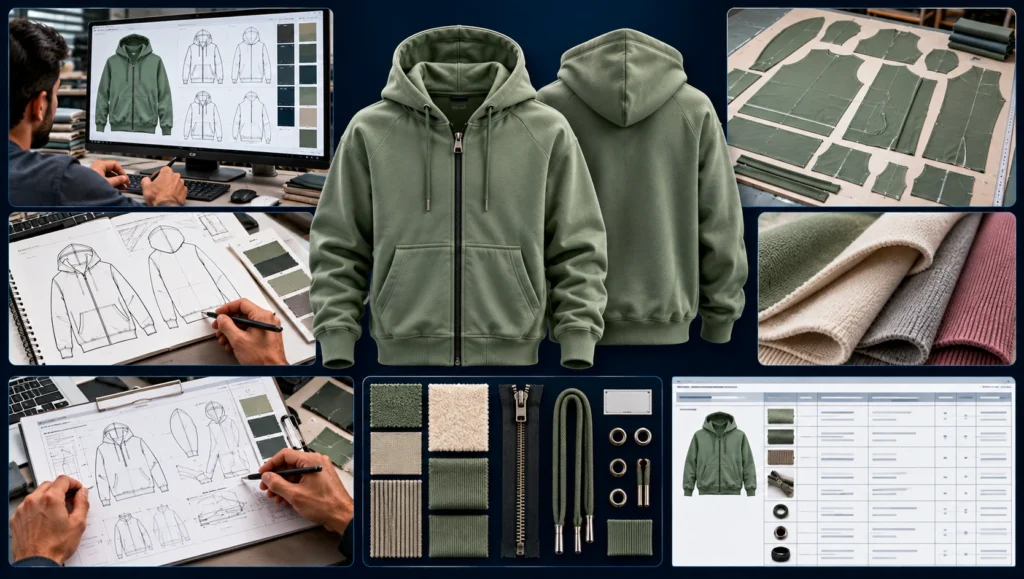
Our homepage describes the first two steps of our process plainly. In Review you send a sketch, a reference garment or a tech pack with quantity, size range, destination and target date. In Develop we confirm the specification sheet, the bill of materials, the pattern, the grade rules, the fabric, the trims, the colours and the artwork.
This comes first because everything on the floor is a copy of a decision made here. A cut panel is only as correct as its pattern, and an operator can only follow the construction the spec names. For a hoodie, write the hood style, pocket, rib, eyelets and cord into the spec, and our guide to the tech pack shows how each component is written down.
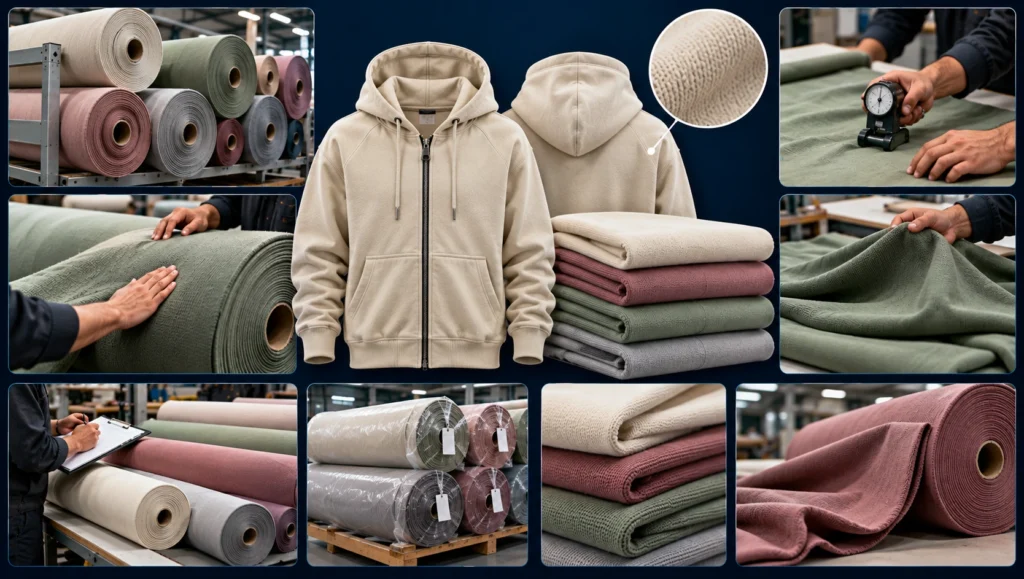
Fabric arrives on rolls, and a knit has two problems a woven does not: it hides defects in its loops, and it stretches easily. CottonWorks, the learning hub run by Cotton Incorporated, notes that knit fabrics typically are more open and loose in structure than wovens and so are subject to more instability and dimensional change.
Our quality control page describes an inbound check at this point. Technicians unroll the fabric across a backlit table, look for slubs, misweaves, dye spots and holes, and give each defect a penalty point by size, in what the page calls the 4-point system. A roll that scores too many points is classed as a lower grade and sent back to the mill. Our fabric sourcing page adds a shrinkage test on the bulk fabric: a 50 by 50 cm square is cut, marked, washed and dried, and the change is measured in the warp and weft directions. Ask which method sits behind any shrinkage figure you are quoted. AATCC Test Method 135 is a widely used reference, and it measures length and width change after home laundering across four washing temperatures, three agitation cycles and four drying procedures.
How the fabric is knitted is covered in how fabric is made, and the weight and knit choices are set out in hoodie GSM, explained, and French terry vs fleece. Resting matters because knit is held under tension on the roll. Our cut and sew page gives the reason for zero-tension spreading: if fabric is pulled tight on the table, the tension releases after cutting and the panels come out smaller than the approved pattern.
Before cutting, the pattern pieces are arranged on a marker. CottonWorks defines a marker as a stencil that shows how pattern pieces are cut from several layers of fabric, and pattern yield as the percentage of the fabric cut into pieces. A tight marker wastes less cloth, so the marker is planned per fabric width and size range, not copied from the last order.
On a hoodie, the pieces to find on the table are the front, back, two sleeves, hood panels, pouch and rib, and each size has its own set. Our cut and sew page describes our sequence. Rolls are spread in layers called plies, DXF marker files feed CNC cutting machines, and band knives handle extreme-density fabrics to prevent fraying and edge distortion. The machines also punch drill holes and V-notches into each piece, and every piece is bundled and labelled before it reaches the sewing floor. The notches tell the operator where a sleeve head, pocket or hood meets the body, which removes guesswork.
Hand cutting with shears suits a single prototype, and the cut and sew page says it is not suitable for bulk runs.
Sewing is where pieces become a garment, and the order is not arbitrary. CottonWorks says apparel manufacturing uses about 30 stitch types and about 300 types of seams, so a hoodie spec has to say which seam goes where. The sequence below is typical industry practice for a pullover, not a description of our line. The exact order varies with the style, and the approved sample decides it.
The hood is prepared first. Hood panels are joined, a lining is added if the design has one, and the eyelets and cord channel are made while the hood is still easy to handle, so an error does not mean unpicking a finished seam.
The pouch goes on the front panel early, while the front is a single flat piece, so its edges stitch cleanly and its corners can be reinforced.
Shoulders and neckline follow. Knit stretches, so a shoulder seam can be supported with a narrow tape to stop it growing as it is sewn. The hood then joins the body at the neckline.
Sleeves go in while the sides are still open. The armhole is sewn on a flat plane, which is easier and more accurate than setting a sleeve into a closed tube. Side and sleeve seams are then closed in one run.
On the machine side, our cut and sew page names overlock and coverstitch machines for seams that must stretch with the fabric, walking-foot machines that feed thick layers evenly on heavy knits, and bar-tack machines for stress points. On a hoodie, typical stress points are the pouch corners, the hood opening and the base of the side seams. Our quality control page says a QA manager pulls garments from the sewing line every two hours to check stitches per inch and bobbin thread colour, and halts the line if a machine is dropping stitches.
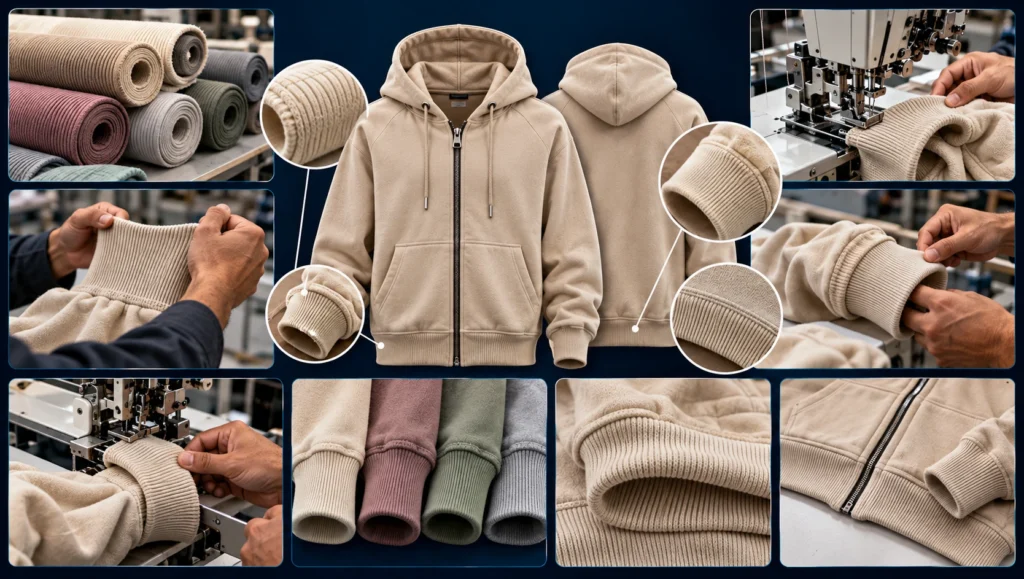
Rib is a stretchy knit cut smaller than the opening it closes. As a general rule, a cuff is stretched onto the sleeve end as it is sewn so that, once it relaxes, it grips the wrist, and the hem band works the same way. Rib usually goes on late, after the sleeve and side seams are closed, because the opening it has to match is then at its final size.
A reliable way to spread the fullness is to divide the rib and the opening into equal sections, mark them, and match the marks as the seam is sewn. That keeps the fullness even all the way round instead of bunched on one side. Ask for the rib fabric and the width of the cuff and hem band in your spec, and check on the sample that the rib recovers after stretching.
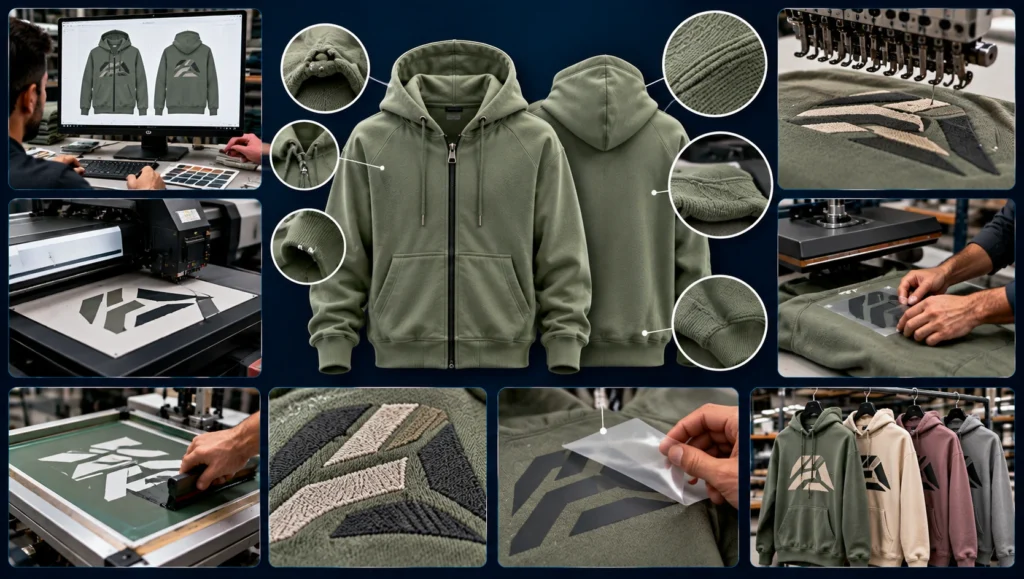
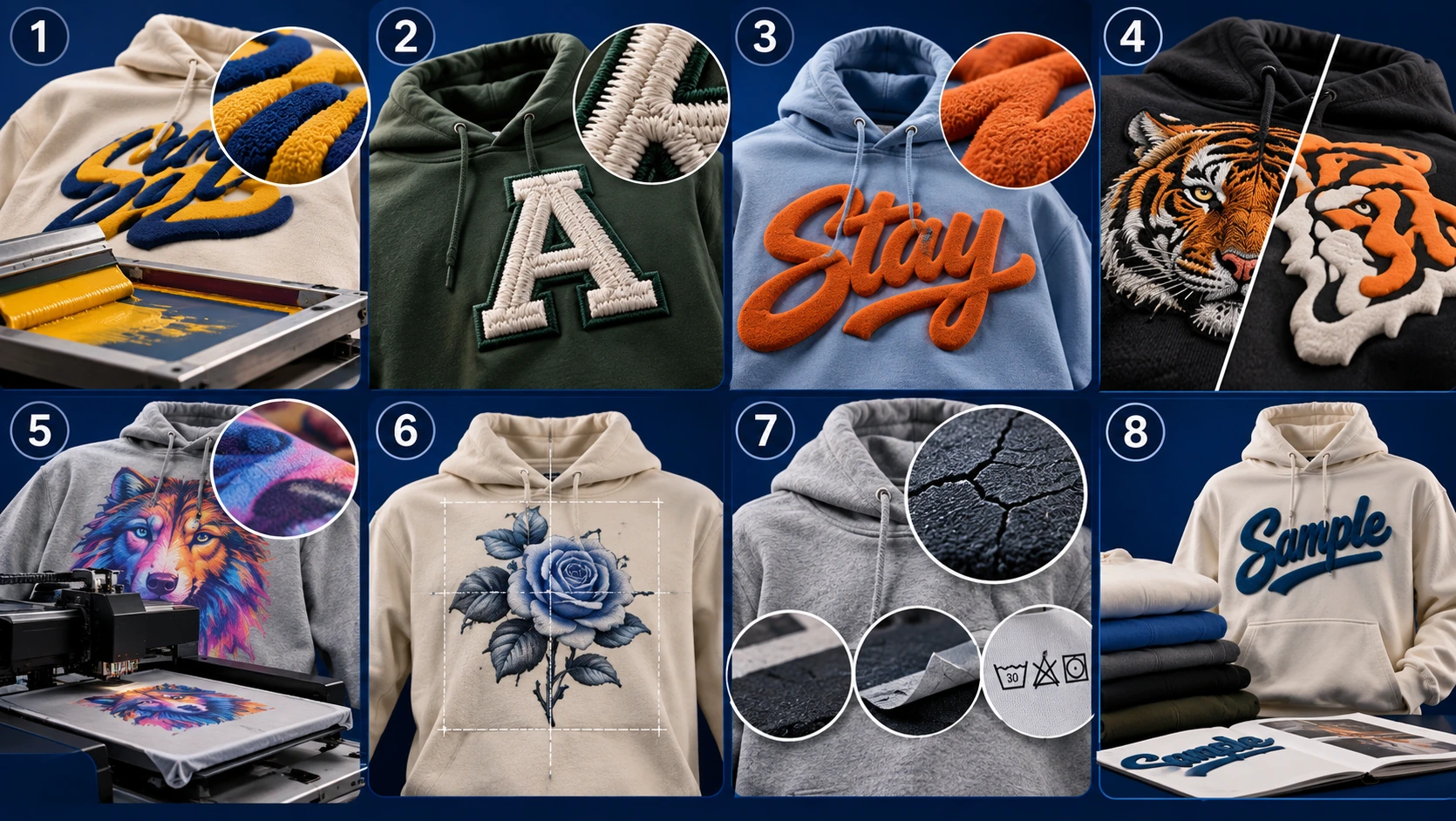
Printing and embroidery can happen at different points. Some brands print on the flat cut panel before sewing, so a graphic can cross a seam cleanly or run across the whole piece. Others decorate the finished garment, which is simpler for a chest print. Our homepage lists the Manufacture step as prepare, cut, bundle, sew, decorate and finish, and your design may still call for a different point. So ask which point your artwork needs, and confirm it on the sample, not after the bulk run starts.
Our screen printing page covers plastisol on heavy streetwear fabric. Decoration is also where placement meets construction, because a logo that lands on a seam or the pouch edge will not sit the way the mock-up did.
A sewn hoodie is not finished. Thread tails are trimmed by hand, and our cut and sew page describes pressing each garment on an ironing buck with steam so seams lie flat and minor distortion settles. Then it is measured and inspected against the reference you signed off.
Our homepage ends the process with Inspect and Dispatch: incoming-material checks, in-line inspection, final inspection, carton verification and shipment release. Our homepage FAQ says an acceptable quality limit, or AQL, belongs to an agreed sampling plan, and your quotation should state the inspection level, sample size, defect classes and acceptance limits. ISO 2859-1 is the international standard for AQL sampling schemes, and describes AQL as the maximum average percentage of defective items considered acceptable during random sampling.
Three checks matter most on a hoodie, and our quality control page describes all three. First, the final random inspection compares chest width, sleeve length and sweep to the points of measure in the spec, and a size outside tolerance counts as a defect. Second, the inspector folds the garment along its centre to check the shoulders match, because a garment cut off-grain twists after the first wash. Third, hardware such as drawstrings is pull-tested, and every sealed polybag goes through a needle detector. The page also says an independent inspector is welcome at the final random inspection. The full list is on our quality control and inspection page.
Packing is part of the build. Our cut and sew page says each garment is folded, tagged and poly-bagged to your retail specification, and can carry barcode stickers and warning labels. Our quality control page adds two carton checks: polybag barcodes are scanned to confirm they read, and each master carton is weighed against the weight calculated from the tech pack. A carton that reads light is opened and recounted before it leaves the dock. Write the folding method, label positions, polybag type and carton count into your spec.
Three windows matter to your calendar. Sampling takes 12 days, bulk production takes 18 days and shipping takes 6 days. They run in order, and your own review of the sample sits between the first two, so build that time into your drop date. We do not split the 18 days into per-stage days, because the stage mix changes with the style and the decoration.
|
Window
|
What it covers
|
Days
|
|---|---|---|
|
Sampling
|
The Sample step: prototype, fit sample, size set or pre-production sample
|
12
|
|
Bulk production
|
The Manufacture step as our homepage lists it
|
18
|
|
Shipping
|
Dispatch to your destination
|
6
|
A spec that answers questions before they are asked is the cheapest way to protect those windows.
We keep garment making in our own factory because every handover between separate suppliers is a place where a spec can be misread. The approved sample is the reference the bulk order is checked against, and our homepage says technical development, sampling, production, branding, inspection and packing follow the same approved order specification.
You do not have to commit to a large run to see this. Our minimum is 30 pieces per design, so your first order can test the sample, the fabric and the fit, not bet on a warehouse. If the finished order does not match what was promised, we refund it or remake it free of charge.
The sample is where everything above becomes visible. Our sampling service page lists the muslin draft, the fit sample, the size set and the pre-production sample, and says the pre-production sample uses the exact bulk fabric and hardware. If you are weighing the minimum, our MOQ guide explains why factories set it per design, and our cut and sew service page describes the floor that builds it. For fabric, our fabric sourcing service page describes the lab dip and testing steps before bulk. Send your sketch, reference garment or tech pack, plus the quantity, size range, destination and date, and we start at Review.
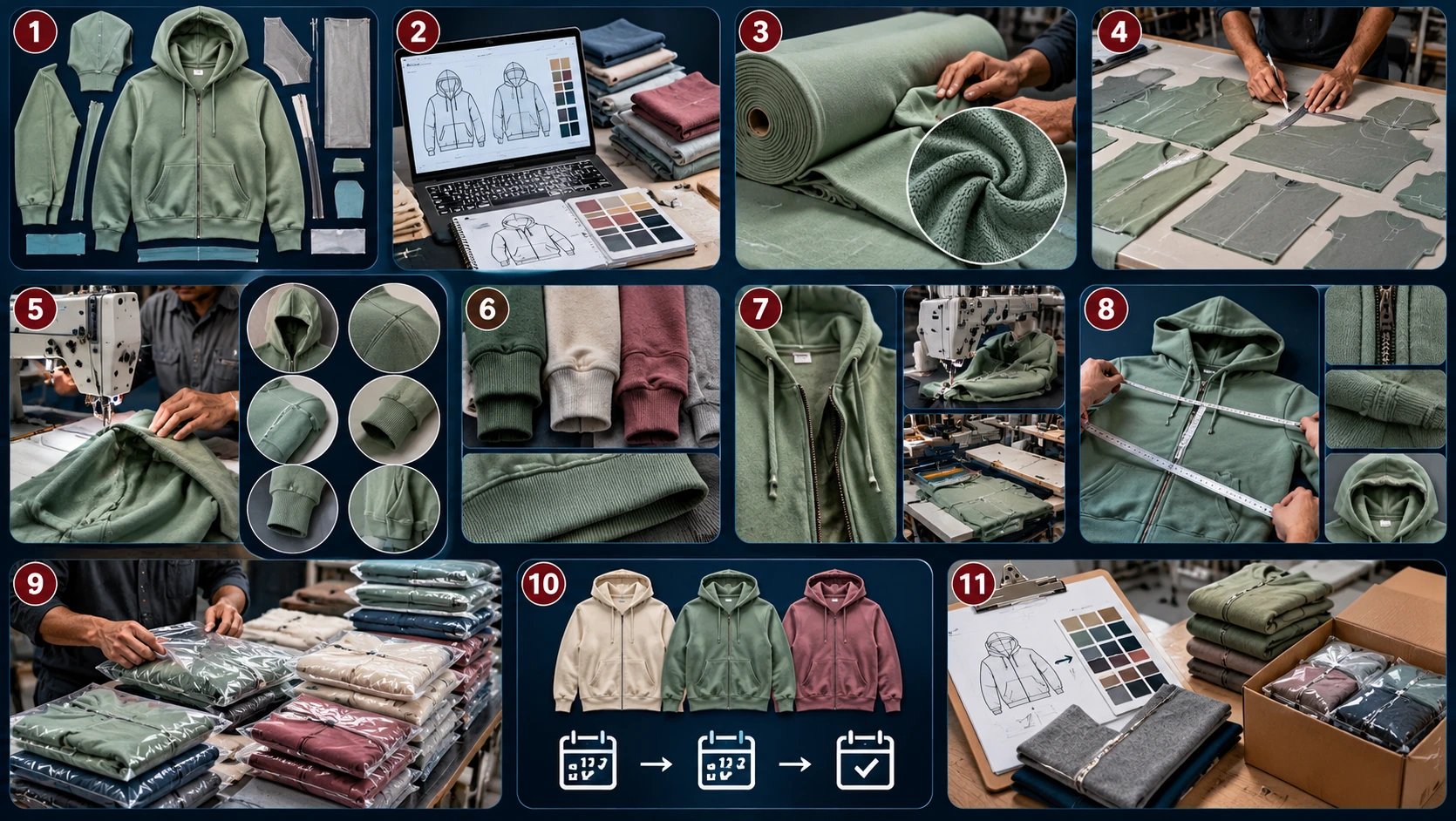
Our published process groups the work into six steps: Review, Develop, Sample, Approve, Manufacture, and Inspect and Dispatch. Inside Manufacture sit cutting, bundling, sewing, decorating and finishing, so the number of floor operations is higher and depends on the style.
The main parts of a pullover are the hood, the drawcord and eyelets, the neckline join, the front and back body panels, the sleeves, the kangaroo pocket, the rib cuffs and the rib hem band. A zip-up adds a zipper and a facing along the front edges.
It is the single large pouch across the lower front of a pullover hoodie. A zip-up usually has two pockets, one either side of the zipper, instead.
Bulk production takes 18 days and shipping takes 6 days. Sampling takes 12 days before that, and your own review time sits between sampling and bulk.
By machine for bulk. Our cut and sew page describes CNC cutting machines fed by marker files, with band knives for extreme-density fabrics. Hand cutting suits a single prototype but is not suitable for bulk runs.
Knit stretches on the roll and under tension on the cutting table. If it is cut while stretched, it settles back afterwards and the panels come out smaller than the pattern. Zero-tension spreading and a shrinkage test on the bulk fabric reduce that risk.
As a general practice, the eyelets are set into the hood panel while it is still flat and easy to handle, and the hood opening is folded to make a channel for the cord. The cord is threaded through last. The eyelet size and the cord type go in the tech pack.
As a general practice, they go on late in sewing. The rib is made smaller than the sleeve end or body opening and stretched to fit as it is sewn, so it grips once it relaxes. Marking equal sections on the rib and the opening helps spread the fullness evenly.
Our homepage says dated photos and approval records keep changes clear, and that the approved pre-production sample and revision notes become the reference for bulk. Ask for the photo points you want at the quoting stage.
* * *

FOUNDER & CEO AT RIJIZ