
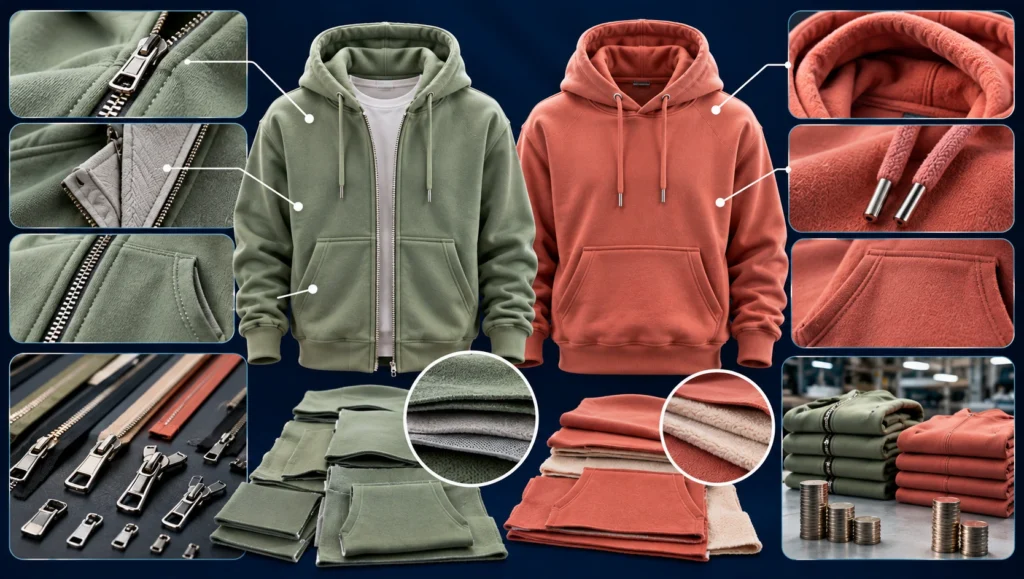
A pullover front is one piece of fabric from the neckband to the hem band. A zip-up front is two pieces that meet at a zipper, a row of interlocking teeth, called elements, mounted on tape and joined or separated by a slider. That one change reaches six parts of the garment, and Table 1 sets them side by side. The entries describe usual practice, so confirm each against your own spec.
|
Part
|
Pullover
|
Zip-up
|
|---|---|---|
|
Front opening
|
One closed panel, entered over the head
|
Two panels that meet at a zipper and open end to end
|
|
Placket or facing
|
None at the centre front
|
A facing or stabilised strip along each front edge to carry the tape
|
|
Pockets
|
Usually one kangaroo pouch across the front
|
Side-entry or zipped pockets on each side, because the centre is taken by the zipper
|
|
Neck and hood join
|
Hood edge closes round a neckline that must pass over the head
|
Hood edge usually ends at the top of the zipper, where a chin guard can sit
|
|
Hem and cuff rib
|
Hem band is typically a closed loop
|
Hem band is typically cut in two and stops at the zipper
|
|
Chest fit
|
Neck opening must pass the head, so neckline and chest ease are tied together
|
Opens fully, so chest ease is set on its own and the two edges must close without pulling
|
Each row is a place where the factory decides for you if the spec is silent. A zip front has to close across the chest without strain, so chest ease deserves its own spec line, and our guide to what body measurements are shows how a point of measure is written so the pattern maker does not guess.
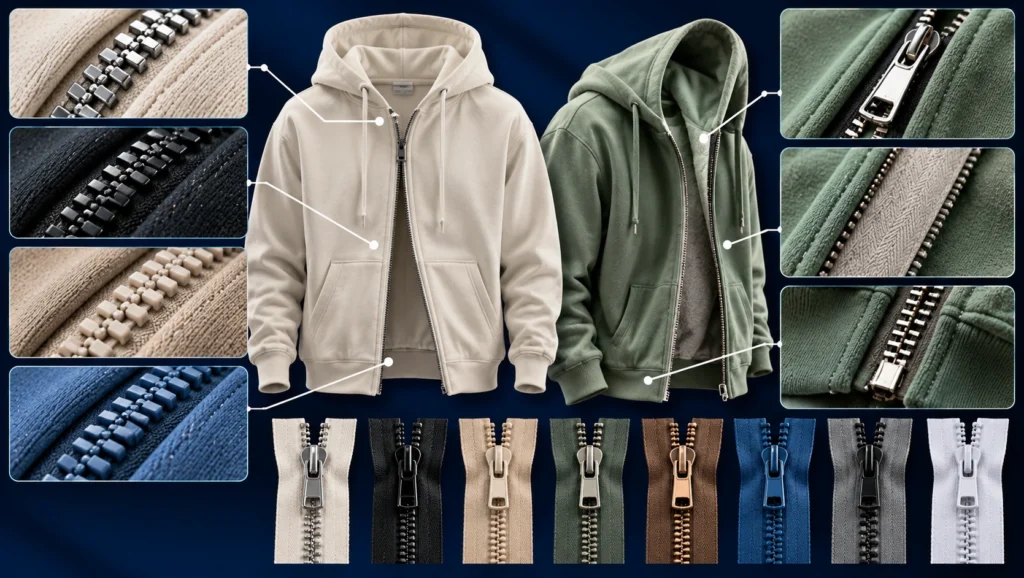
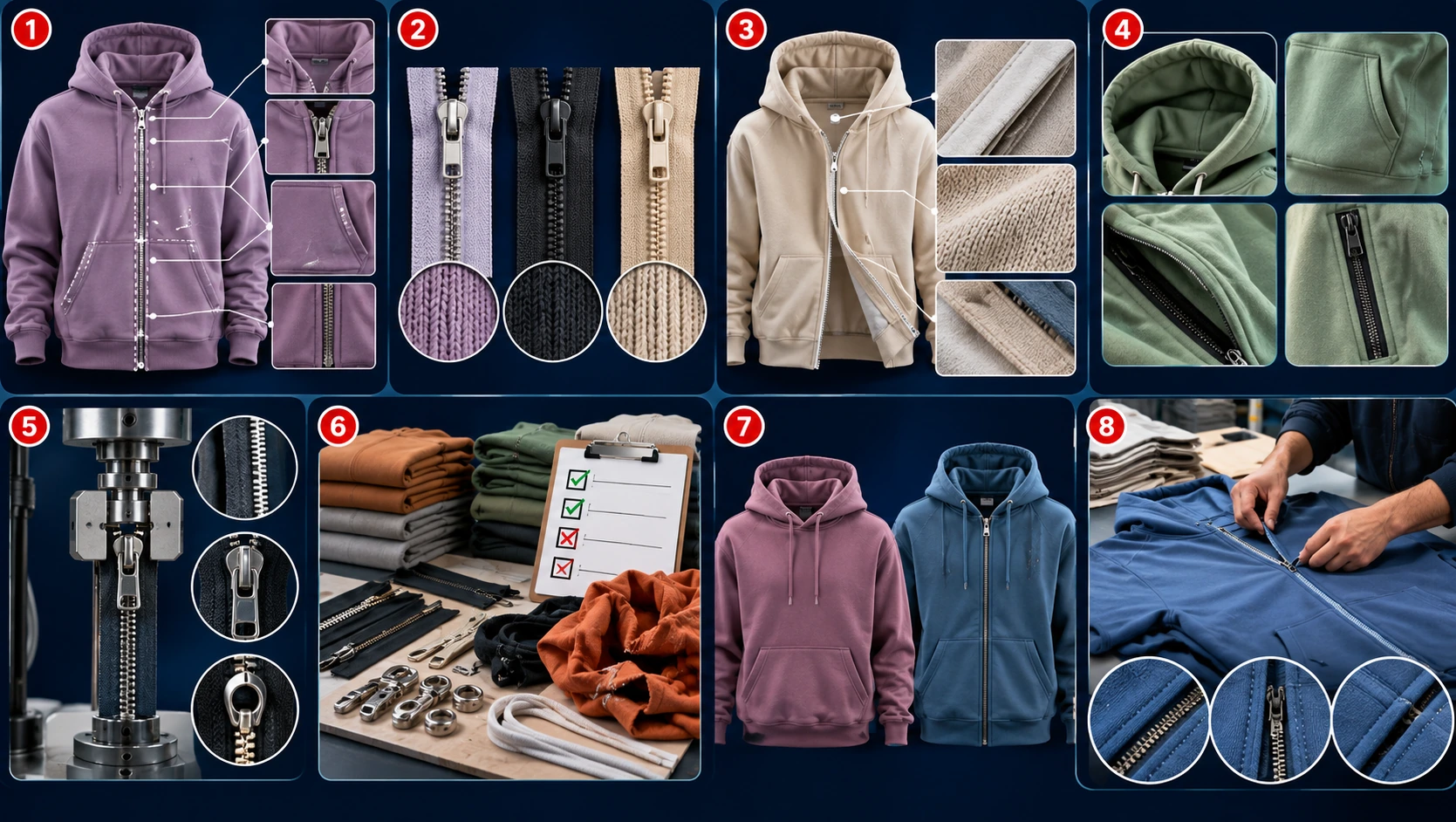
A zipper has named parts, and naming them in your tech pack removes a round of questions: top stop, slider, elements, tape and bottom stop. A hoodie front needs an open-end zipper, also written as separating, because the two sides must come fully apart. That works through an insert pin on one side and a retainer box on the other at the bottom, where a closed-end zipper has a fixed bottom stop.
The chain is the choice with the most visible effect. Table 2 describes the three usual types in general terms.
|
Chain
|
General description
|
What to check on your sample
|
|---|---|---|
|
Metal
|
Metal teeth, usually the heaviest of the three
|
How it lies against soft fleece and how the weight pulls on the front edge
|
|
Coil
|
Plastic wound into a spiral, usually the most flexible
|
Whether the front stays flexible and flat after wear and washing
|
|
Molded plastic
|
Individual plastic teeth set on the tape
|
Whether the tooth shape suits the design and the colour of the tape
|
Three more choices sit on top of the chain: the size, the slider, which may lock or not, and the tape colour. Our cut and sew service page asks the brand to list the exact zipper gauge in the bill of materials, so the spec you send is what gets sourced.
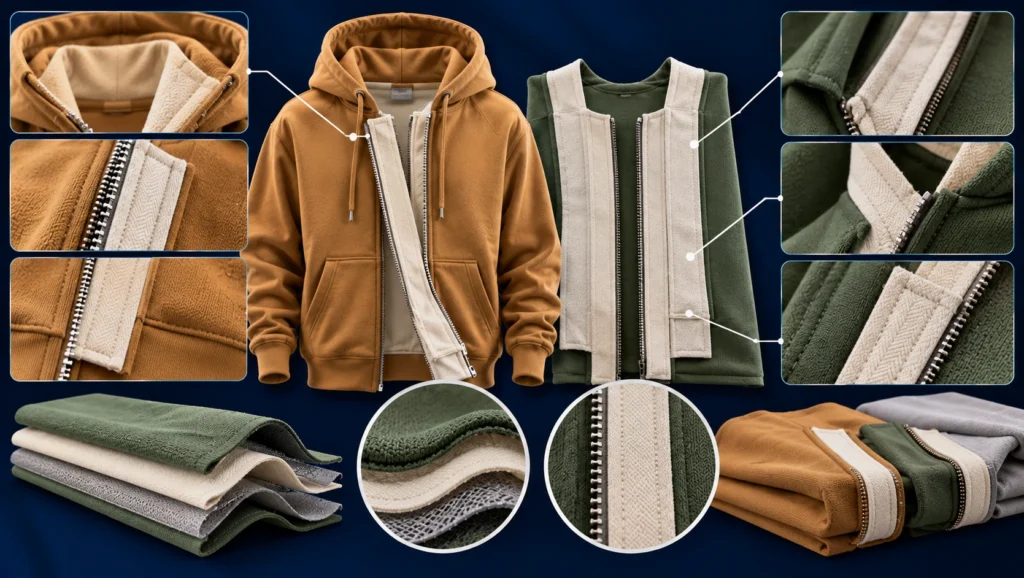
A knit stretches and zipper tape does not. When the two are sewn together with nothing between them, the machine pulls the knit, it relaxes after the seam and leaves a wave along the front. The build has three answers.
The facing or stabilised strip. A facing is a second layer of fabric folded to the inside of the front edge. A stabilising strip is a narrow tape set under the seam. Either one makes that edge behave less like a stretch knit and more like a woven. CottonWorks, the learning hub run by Cotton Incorporated, describes shaping materials as layers inside the garment shell that add stability, strength and support in key areas. A zip front is one of those areas.
The tack test. Tacking the zipper onto the fabric before sewing shows how the two stretch against each other, and a knit is where it matters most. Ask for it on your own fabric, not a spare.
Room for the slider. If the stitch runs right against the teeth, the slider can catch the adjacent fabric. Keeping the seam clear of the teeth, with a facing holding loose fabric out of the slider’s path, avoids that.
After sewing, wash behaviour decides whether the front stays flat: if the body fabric shrinks and the tape does not, the front puckers. Our apparel prototyping and sampling page names this check in the fit sample, which asks whether the zipper tape lays flat against the placket, and it describes wash testing of the prototype. The order the front is sewn in matters too, and it is covered in how hoodies are made, step by step.
A plain zip-up has one zipper. Most requests for custom zip-up hoodies add something to it, and each addition is another part that has to survive wear.
A double zipper. Two sliders on one chain let the hem open from the bottom as well as the top. The hem rib behaves differently when it can open from below, so ask for it to be sampled open and closed.
Zipper pockets. A zipped pocket is a second opening in the panel, with a pocket bag behind it. It gives a place to hold a phone, and it gives the sewing floor another stress point to reinforce. Our cut and sew page describes automated bar-tack machines that fire concentrated stitches over stress points such as pocket corners.
A chin guard or garage. A small fabric flap at the top of the zipper keeps the slider off the chin. It is one more piece to cut, place and sew.
Weight. Heavy fabric multiplies all of the above. Our cut and sew page says working with heavy French terry takes heavy-duty walking-foot machines, which feed thick layers evenly so the top layer does not bunch up. A zip front on that fabric has more layers at the seam than on a light knit.
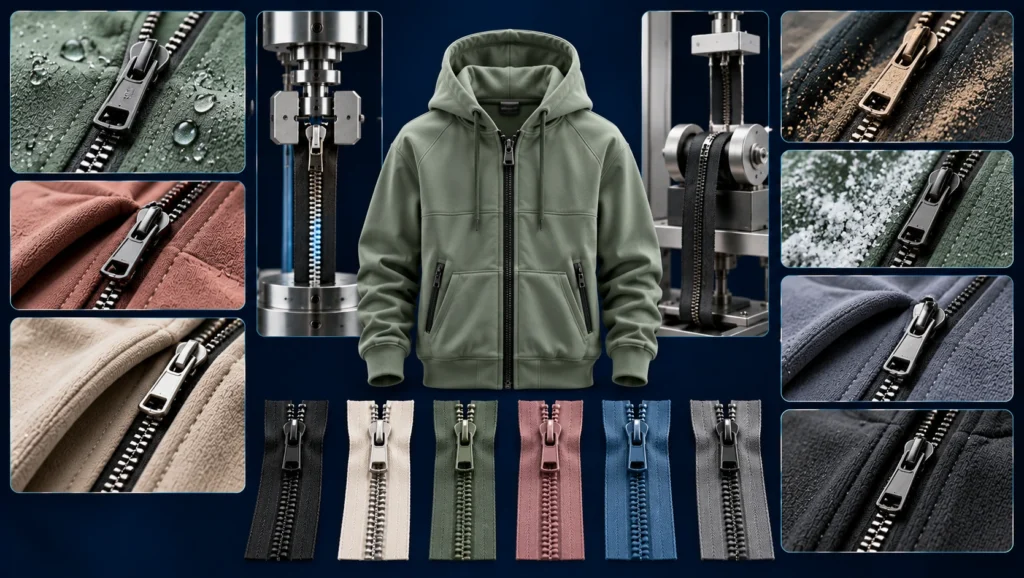
“Durable zipper” is not a specification. ASTM D2061, Standard Test Methods for Strength Tests for Zippers, lists ten test methods:
|
Test method
|
What it measures
|
|---|---|
|
Strength of chains and elements
|
How much force the chain takes before it fails
|
|
Holding strength of stops
|
Whether the top and bottom stops stay in place
|
|
Holding strength of slider lock
|
Whether the locked slider stays locked
|
|
Resistance to angular pull-off of slider pull
|
Whether the pull survives a pull from the side
|
|
Resistance to twist of pull and slider
|
Whether the pull survives twisting
|
The full list also covers holding strength of separable units, cushioned compression of sliders, slider deflection and recovery, pull-off and torsional resistance of the pull. That is the zipper tested as a part, not the front as a whole.
Two lines in the standard matter to a buyer. It says the usefulness of a zipper in service can be evaluated by these tests, and that no one test determines suitability for a specific end use. So ask a zipper supplier for results by test name, and pair them with a wear test on your sample. Three common faults map loosely onto the list: a front that bursts open can point to the separable units and slider lock, a jammed slider to a seam sitting too close to the teeth, and a missing tooth to chain strength.
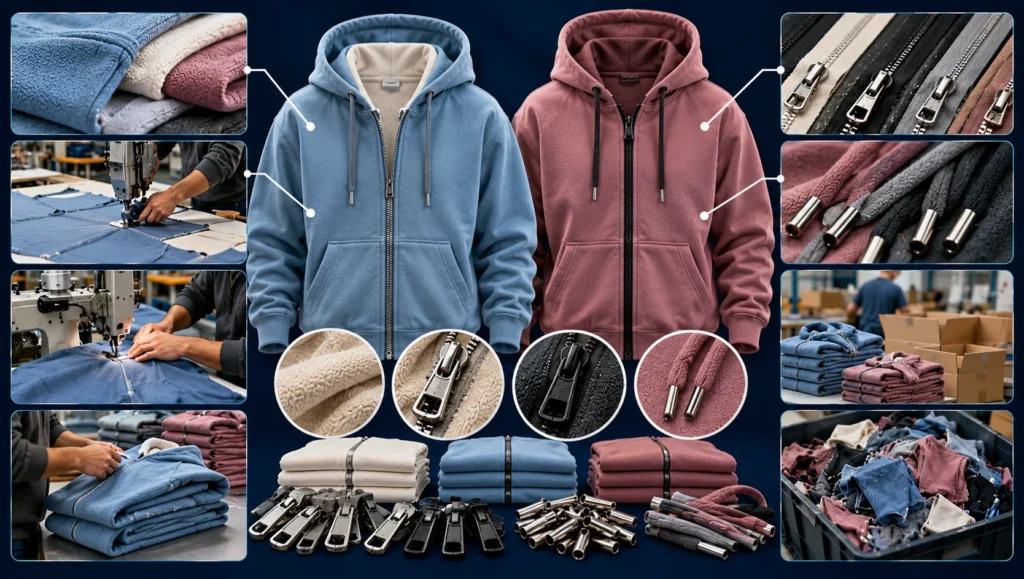
A zip-up usually quotes higher than a pullover, and the reasons are in the build, not in a mark-up. No prices are quoted here, only the drivers.
More parts and operations. A zip-up adds a chain, a slider, a pull, stops and facing or stabilising tape, and each is bought, stored, counted and checked. The tape is attached to each front edge, the facings are sewn and turned, and the front is tested open and shut. A pullover skips most of these steps, and each one is labour on every garment.
Hardware lead time. A trim that is out of stock or swapped late can hold up an order. Our tech pack guide says a zipper needs a size, material and colour, and warns about a trim swapped without a flag. Name the zipper precisely and ask to be told before any substitution.
Rework risk. A zipper fault shows only when the garment is zipped and worn, so a wave or a sticking slider is found late, and unpicking a front can cost the garment.
Fabric weight. Heavier knit slows every operation on the front. How GSM changes a hoodie sits outside this guide, but weight and zipper choice should be decided together.
Pick by your customer’s day and your own tolerance for risk. Treat what follows as reasoning from the construction, not a measured result.
A pullover has no front opening, so heat has fewer places to leave and fewer parts can snag or fail. That suits steady cold and a first drop where you want the fewest things to go wrong. A zip-up can be opened to vent, taken off without pulling over the head, and worn open as a layer. That suits changeable weather, active customers and travel.
Half-zip and quarter-zip hoodies sit between the two: most of the closed front, some venting, one shorter zipper. For a first drop of 30 pieces, a pullover has fewer parts to source and test, and a zip-up is worth the extra if your customer will use the opening. Sample one first and add the other next drop.
Whether a zip front sits flat on your fabric shows up in the sample, 12 days after you send the spec. Sampling takes 12 days, bulk production 18 and shipping 6, and our minimum is 30 pieces per design, so a fault found in the sample costs one garment, not a run. If the finished order does not match what was promised, we refund it or remake it free of charge.
Our sampling service page says the fit sample checks whether the zipper tape lays flat against the placket, that the pre-production sample uses the exact bulk fabric and exact custom hardware, and that prototypes are wash tested. Put your choice in writing: zipper chain, size, slider and tape colour, the facing or strip, the pocket type and the chin guard. If you are weighing the minimum, our MOQ guide explains why factories set it per design.
A pullover has one closed front panel that is pulled over the head. A zip-up has two front panels that meet at a zipper, so it also needs a facing or stabilised strip on each front edge, side or zipped pockets in place of a single kangaroo pouch, a hood that ends at the top of the zipper, and a hem band cut in two.
A facing or a narrow stabilising strip, set along each front edge to carry the zipper tape. Knit stretches and tape does not, so this layer stops the edge from stretching as it is sewn. The exact method is part of the spec and the sample.
None wins by default. Metal is usually the heaviest, coil the most flexible, and molded plastic sits between them in look and weight. Choose by feel on your fabric and by look, then confirm on a sample.
It adds a second slider on the chain so the hem can open from the bottom as well as the top. The hem rib and the bottom of the front are sewn around two sliders, so ask for the sample to be checked open and closed.
Knit fabric stretches and zipper tape does not. If the edge is not stabilised, the knit relaxes after sewing or shrinks in the wash and leaves a wave. A facing or stabilising strip, a tack test of the zipper on the real fabric and a wash test of the sample are the checks.
Usually yes, because a zip-up adds a zipper, stops, tape or facing and extra operations to attach and check them. We give no prices here. Our minimum is 30 pieces per design, and whether a zip and a pullover count as separate designs is confirmed at the quoting stage.
A zipped pocket is a second opening in the panel with a pocket bag behind it. State the zipper size, the opening length, the placement and the bag fabric in the tech pack. Each pocket adds a stress point, which the factory reinforces.
A half-zip runs the zipper from the neckline to about the middle of the chest, and a quarter-zip stops higher. Both keep a closed lower front, so the body is built like a pullover while the neck opening carries a shorter zipper. The facing and the hood join still need to be specified.
ASTM D2061 lists ten test methods, including strength of chains and elements, holding strength of stops and slider lock, and resistance to angular pull-off and twist of the pull. The standard says no single test decides suitability, so ask for results by test name and wear test the sample.
Choose the pullover if you want the fewest parts to source and test, and the zip-up if your customer will vent and layer. Fewer parts that can fail is a reasoned point, not a measured one. Sample your choice first, then add the other style in the next drop.
* * *

FOUNDER & CEO AT RIJIZ