
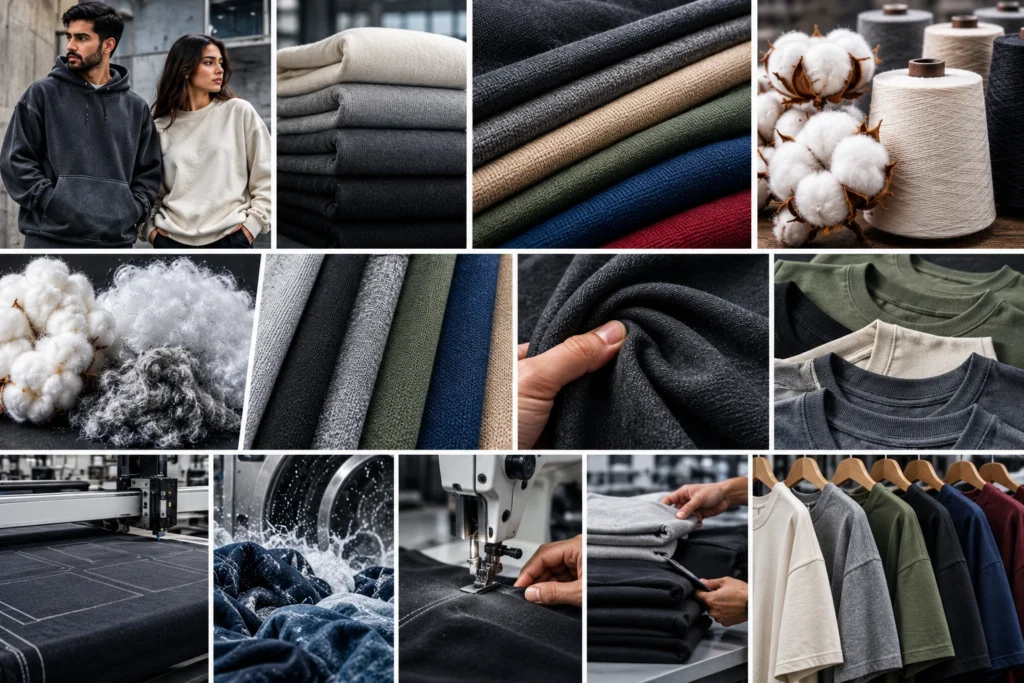
Streetwear fabric selection starts with weight, since GSM sets the floor for how a garment drapes, holds shape, and reads to a buyer before finishing ever enters the picture. Here’s the practical range, heaviest categories first, since streetwear skews heavier than most apparel this series has covered.
Heavyweight cotton jersey and French terry, 280-385 GSM, is the anchor category for premium streetwear tees and sweatshirts. This is deliberately heavier than a standard retail tee, since the extra weight is what reads as “premium” on a hanger and holds up to repeated heavy washing without going thin.
Midweight cotton fleece, 240-300 GSM, covers most hoodies and crewnecks, balancing warmth and structure against the bulk that goes with true heavyweight fleece.
Standard cotton jersey, 180-220 GSM, still shows up in streetwear for lighter-weight tees and layering pieces, though it’s increasingly the exception rather than the default in this category.
Twill and canvas, 200-320 GSM depending on application, cover workwear-adjacent streetwear pieces, cargo pants, chore jackets, and utility silhouettes that borrow structure and durability cues from actual workwear rather than fashion basics.
Fiber base matters as much as weight. Ring-spun combed cotton is the default premium standard, since combing removes short fibers before spinning, producing a smoother yarn that resists pilling and holds a cleaner surface through repeated washing better than open-end or carded, non-combed cotton.
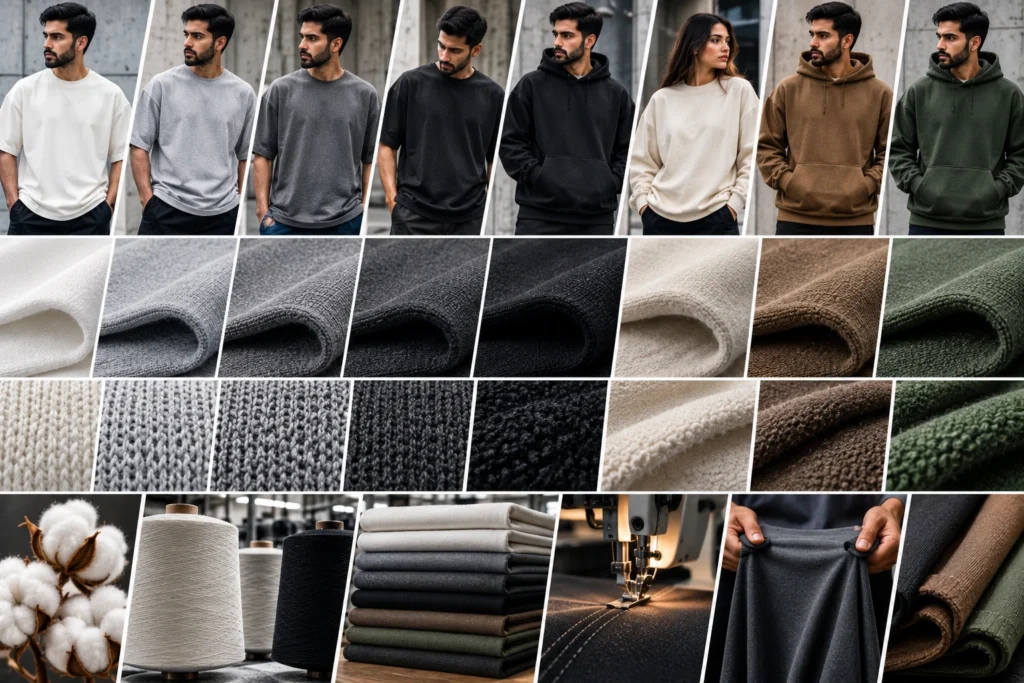
Fiber and weight set the starting point, but finishing is what actually defines a lot of streetwear’s identity, and four processes cover most of what shows up in this category.
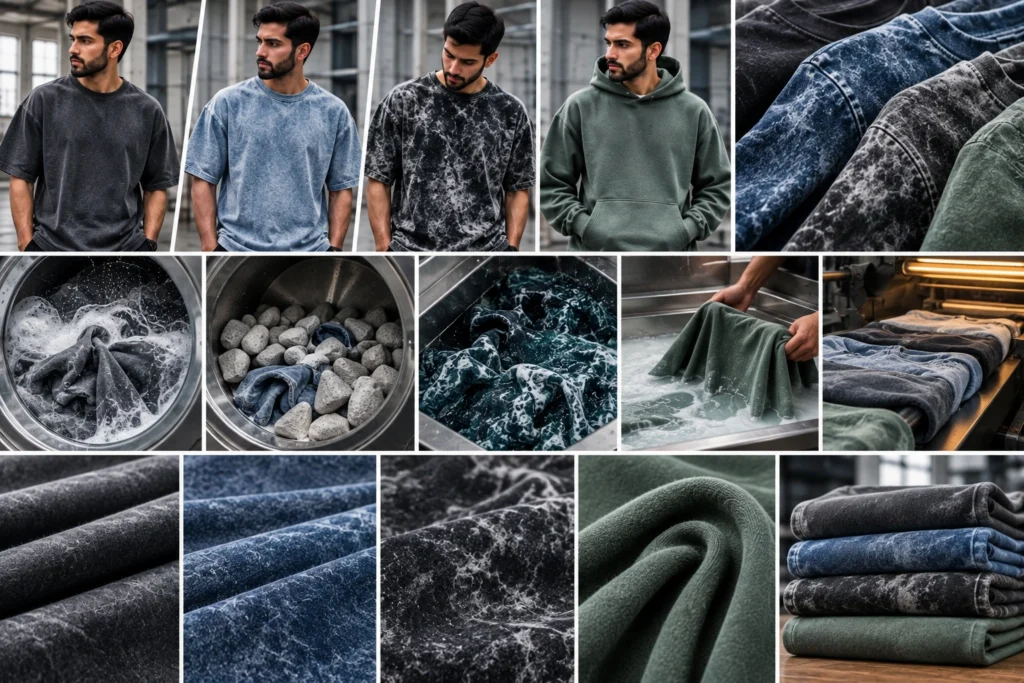
Enzyme wash (sometimes called bio wash) uses natural enzymes to break down and remove surface micro-fibers, smoothing the fabric surface and reducing fuzz and pilling. It’s the most reliable process for softening heavyweight cotton without sacrificing structure, which is why it’s the default choice for premium heavyweight basics.
Stone wash uses pumice stones tumbling inside industrial washing machines to create controlled surface abrasion, producing a faded, worn-in vintage look. It’s the process behind most distressed or vintage-look streetwear, but it comes with a real shrinkage and structure-loss tradeoff, covered with actual numbers in the next section.
Acid wash uses a chemical treatment to create high-contrast, uneven fading, the most aggressive visual effect of the four processes covered here. It delivers a distinctive look fast, but it also carries the highest risk of fiber weakening if the process isn’t tightly controlled, which is why acid-washed pieces need stricter quality control than a standard garment wash.
Silicone wash applies a silicone-based softening finish that improves smoothness and drape without the structural risk that comes with stone or acid processes. It’s frequently combined with enzyme wash, enzyme handling the fiber-level smoothing, silicone handling the surface-level softness, for what’s generally the most commercially stable result for heavyweight streetwear basics.
Garment dye and pigment dye, applied after construction rather than at the yarn or fabric stage, are worth naming separately since they interact with these wash processes rather than replacing them, producing the faded, slightly uneven tonal variation that reads as intentional on a finished streetwear piece rather than as a defect.
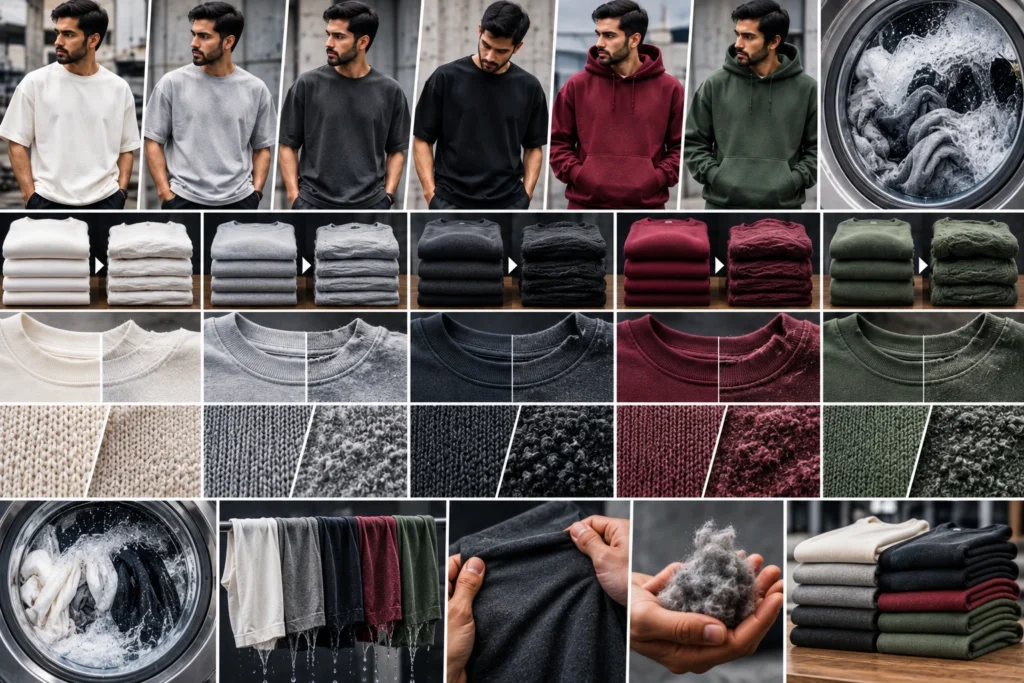
Most sourcing content describes these wash processes in the abstract without showing what actually happens at a specific fabric weight. A controlled comparison across 280, 320, and 385 GSM heavyweight cotton tees, published by manufacturer Newasia Garment , tested enzyme, stone, and acid wash across five wash-and-dry cycles to simulate real consumer wear, and it’s worth citing directly since it’s one of the few sources in this space that shows real, weight-specific outcomes rather than general claims.
At 280 GSM, stone wash produced mild abrasion and a soft vintage texture with roughly 2-3% shrinkage. At 385 GSM, the heaviest tier, stone wash produced a stronger vintage look with controlled shrinkage around 3-5%, higher than the lighter weight, since more fiber mass responds differently to the same mechanical abrasion process. Enzyme wash, across every weight tested, delivered the most consistent softness-to-structure balance, described as particularly important at 385 GSM specifically, where preserving structure while still removing stiffness is the harder finishing problem to solve. Acid wash delivered the strongest visual contrast at every weight but carried a documented risk of fiber weakening when overprocessed, a real tradeoff worth putting in front of a factory conversation rather than assuming any finish is risk-free.
This is a single manufacturer’s own published test, worth treating as one real, useful data point rather than a universal industry constant, but it’s more specific and more honest about tradeoffs than most generic “types of garment wash” content in this space, which is exactly why it’s cited here by name rather than folded into an unattributed generalization.
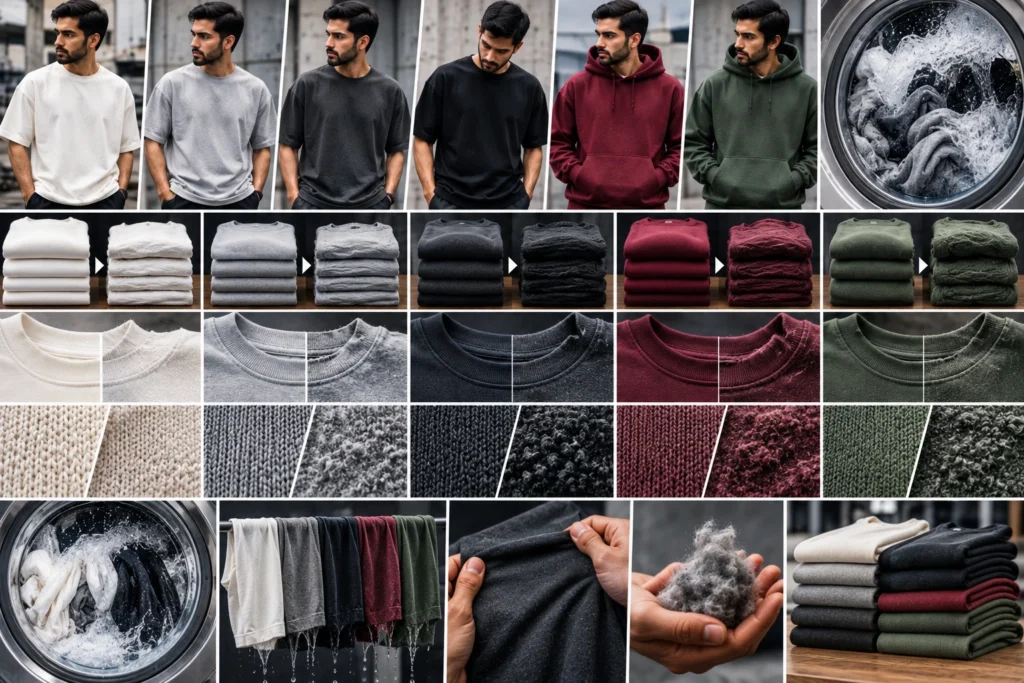
Two real AATCC test standards sit behind the claims streetwear brands make most often on a hangtag, and almost none of them cite either one by number.
AATCC 135 measures dimensional change after home laundering: bench-mark measurements are taken before and after a controlled wash-and-dry cycle to quantify exactly how much a fabric shrinks or grows. A “pre-shrunk” claim with no AATCC 135 result behind it is a marketing phrase, not a verified spec.
AATCC 61 measures colorfastness to laundering through an accelerated wash test designed to simulate the color change a fabric would show after roughly five real home or hand launderings. It’s the real standard behind a “won’t fade” or “colorfast” claim, and asking a supplier for an AATCC 61 result on a garment-dyed or overdyed piece specifically is a reasonable, specific request rather than an unusual one.
Neither test is exotic or expensive, and a factory that already runs batch-level wash testing as part of its own quality control process, the kind of process a controlled multi-weight comparison like the one above depends on, can typically provide both results without much friction.
280-385 GSM covers the range most premium streetwear brands use, with 320 GSM as a common middle ground that balances weight and drape without moving into the heaviest, stiffest tier.
In the controlled comparison above, yes, stone wash consistently showed more shrinkage than enzyme wash at every weight tested, since the mechanical abrasion process affects fiber structure more than enzyme treatment does.
Yes, and it's a common combination specifically because the two processes work on different levels: enzyme wash smooths the fiber surface, silicone wash adds a softening finish on top, together producing a more commercially stable result than either process alone.
Because it's a chemical treatment producing the most aggressive visual effect of the four, which means less margin for error. A tightly controlled process produces a striking, intentional look; an under-controlled one risks visible fiber damage.
Generally yes, since combing is an additional processing step that removes short fibers before spinning. The tradeoff is a smoother, more pill-resistant yarn, which is why premium streetwear brands specify it as a baseline standard rather than an upgrade.
Garment dye is applied after the piece is fully constructed, producing the slightly uneven, faded tonal variation associated with streetwear. Yarn or fabric dye happens earlier in the process and produces a more uniform, consistent color across the finished piece.
Not really. AATCC 135 is the actual test that quantifies dimensional change after laundering, and a specific percentage backed by that test means something a general "pre-shrunk" claim doesn't.
No. GSM is a weight spec, not a quality spec on its own. A well-finished mid-GSM fabric with proper enzyme treatment and combed cotton can outperform a poorly finished heavier fabric in actual hand feel and durability.
The accelerated test is designed to produce color change roughly equivalent to five home or hand launderings, compressed into a single controlled lab cycle rather than requiring five actual wash-and-dry rounds.
* * *

FOUNDER & CEO AT RIJIZ