
All over print, usually shortened to AOP, means a design covers the entire surface of a garment rather than sitting in one placement area. A chest logo or a back print stops at a defined boundary. An AOP hoodie’s graphic runs across the body, the sleeves, the hood, and often the cuffs and waistband, with no untouched fabric anywhere the design was meant to reach. Our own sublimation printing service exists specifically to produce that kind of full-coverage result for performance and streetwear brands.
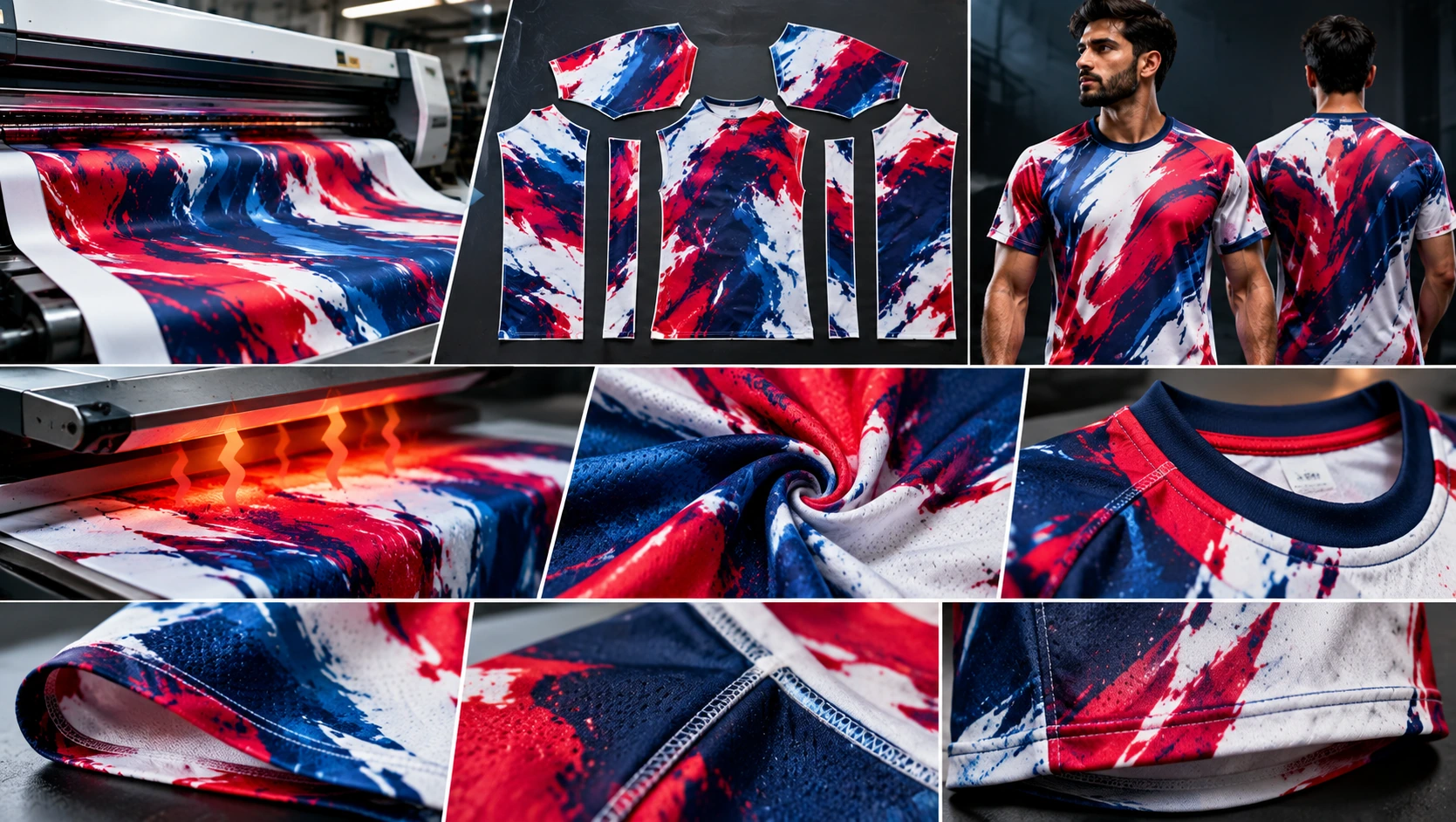
The clearest way to tell whether a garment was actually produced as AOP, rather than a large placement print that just looks like one, is to check the inside seams, the hem, and the underside of a collar. If the design continues onto those areas, the fabric was printed before the garment was assembled. If those spots are blank white, the print was applied to a garment that was already sewn, which caps how far the design can physically reach. That distinction matters more than it sounds like it should, because it determines everything else in this guide: which fabrics work, which machines apply the print, and whether the finished garment shows visible gaps at the seams.
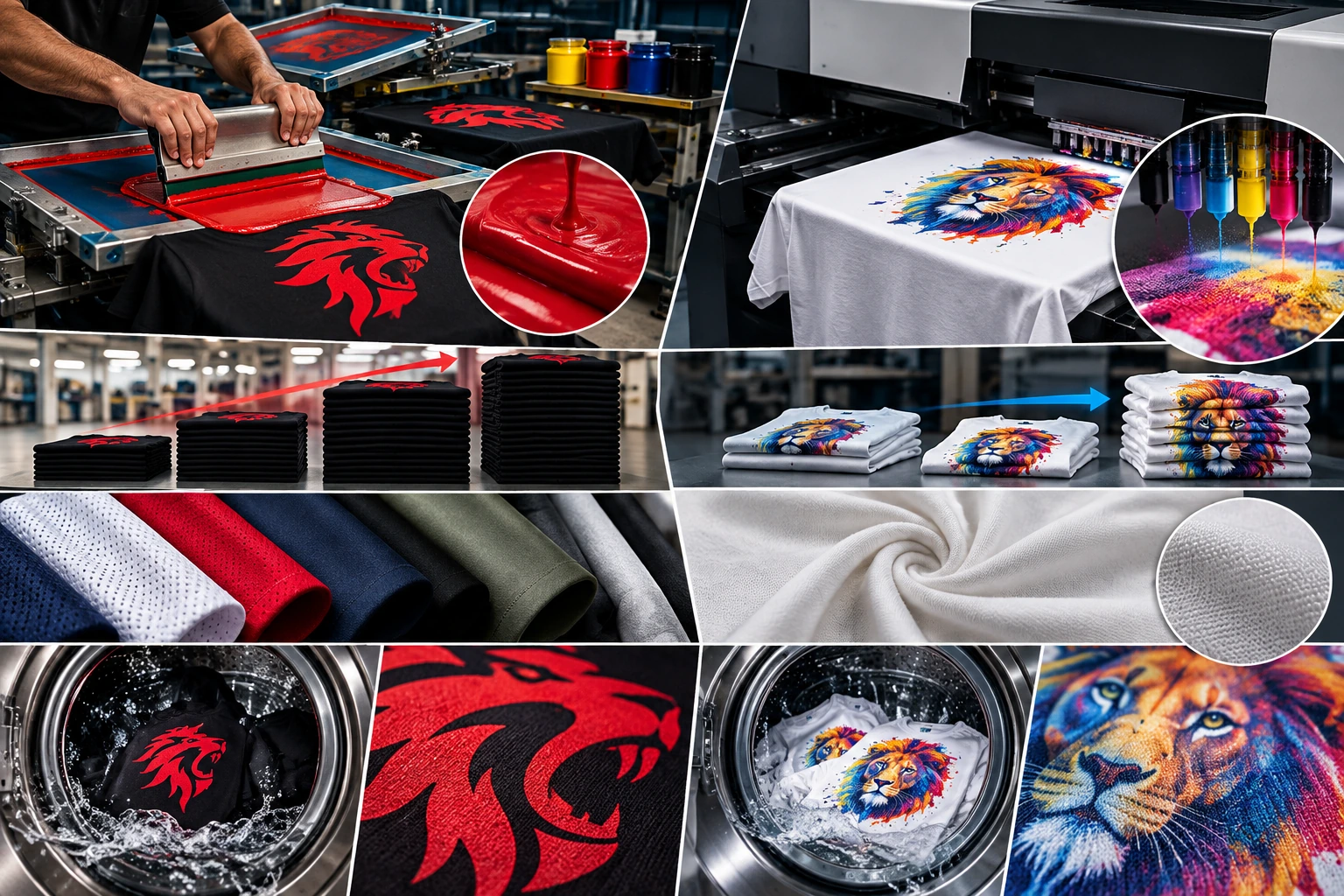
AOP is closely related to, but not identical to, screen printing and DTG , which apply ink to a defined area of a finished garment rather than covering it edge to edge. A brand deciding between a chest logo and a full-coverage design is really deciding between two different production models, not just two different looks.
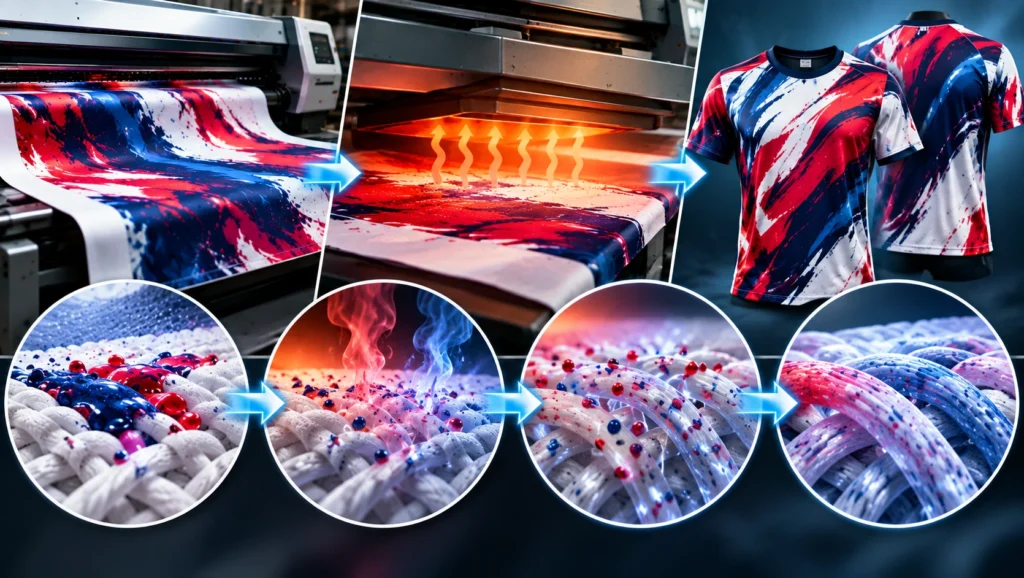
Sublimation is the printing method behind nearly every true all-over print garment on the market, and it works on a genuinely different principle than ink sitting on top of fabric. The dyes used are disperse dyes, a class of colorant built to bond with hydrophobic synthetic fiber at the molecular level rather than dissolve in water the way most textile dyes do. As described in Elsevier’s reference overview of disperse dye chemistry, these dyes are attracted to and penetrate synthetic fiber through physical forces, not a chemical reaction, which is part of why the process depends so heavily on heat rather than any wet treatment.
On our own production floor, that process runs through a heat press calibrated to 400°F (204°C). The design is first printed onto release paper using the disperse dye, then pressed against raw white polyester fabric at that temperature. The heat opens the fiber’s pores, the solid dye converts directly into a gas without passing through a liquid stage, and the gas is forced into the open pores. As the fabric cools and exits the press, the pores close back up, trapping the dye permanently inside the fiber rather than on its surface. That’s the practical reason a properly sublimated print doesn’t peel, crack, or feel like a layer on top of the shirt when you run a hand across it, the color has become part of the fiber itself.
Heat exposure of this kind has a real, testable durability property, not just a claim either side of a comparison makes. AATCC TM117 is the standardized industry test for colorfastness to dry heat, measuring how much a dyed textile’s color shifts, and how much it stains an undyed fabric held in contact with it, under controlled heat exposure. That’s the kind of test a factory should be able to point to when a brand asks how a sublimated print is expected to hold up under repeated heat exposure over the life of the garment, not just a verbal assurance.
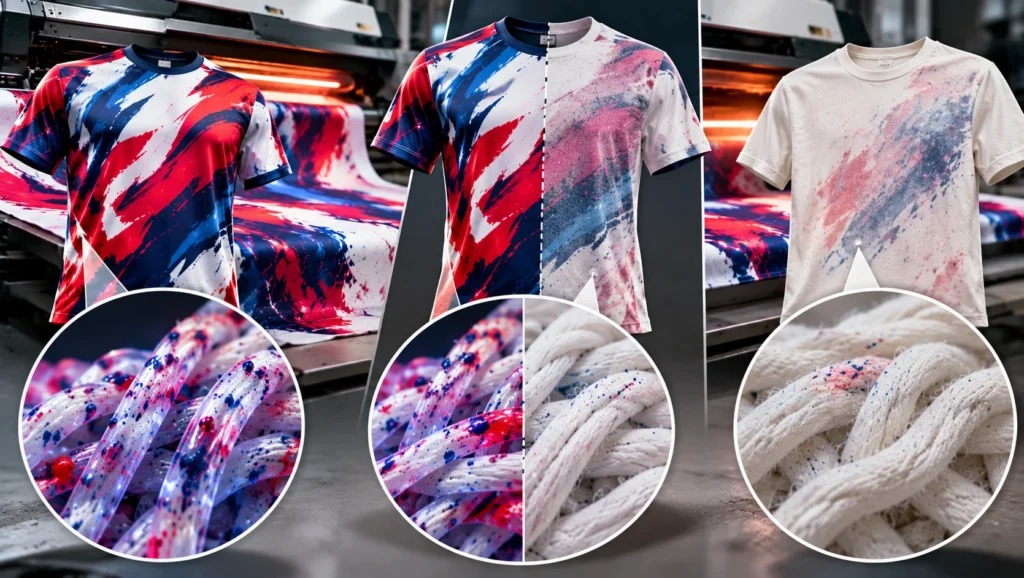
Because disperse dye only bonds to synthetic fiber, fabric composition is the single biggest variable in whether an AOP order turns out the way a brand pictured it. A 100% polyester or poly-spandex fabric gives sublimation dye a fully synthetic surface to bond with everywhere, which is why we mandate one of those two compositions whenever a brand wants deep, saturated, pitch-black color across a design.
A blended fabric, say 65% polyester and 35% cotton, complicates that picture in a specific, predictable way rather than failing outright. During the heat press, the dye bonds permanently to the polyester portion of every yarn and simply has nothing to hold onto in the cotton portion. The garment looks fully printed the moment it comes off the press, but the first wash pulls dye out of the unbonded cotton fibers, leaving behind a lighter, heathered, almost vintage-washed version of the original design. That’s not a defect exactly, it’s a predictable outcome of the fiber chemistry, and it can even be the look a brand wants for a specific collection. The problem only shows up when nobody flagged it in advance and the brand expected the same saturated color a 100% polyester swatch would have delivered.
This is why fabric sourcing and print method have to be decided together, not sequentially. A brand that locks in a poly-cotton blend for handfeel reasons before confirming the print method risks a finished run that doesn’t match its own approved artwork, through no fault of the printing itself.
The single decision that determines whether an AOP garment looks flawless or shows visible printing gaps is when the printing happens relative to the sewing. There are two paths, and they produce very different results.
The first path prints a design onto a garment that’s already been cut and sewn into its finished shape, a “blank.” Because a sewn garment is three-dimensional, with seams, folded armpits, and a collar that doesn’t sit flat, a heat press clamping down on it can’t make even contact with every part of the fabric. The gas released during sublimation can’t reach into those creases and folds, which leaves pale, untouched streaks exactly where the fabric was pinched or folded, most commonly at the armpits and around the collar. In the industry this is usually called a white crease or a ghosting effect, and it’s a structural limitation of pressing a finished 3D object, not a fixable printing mistake.
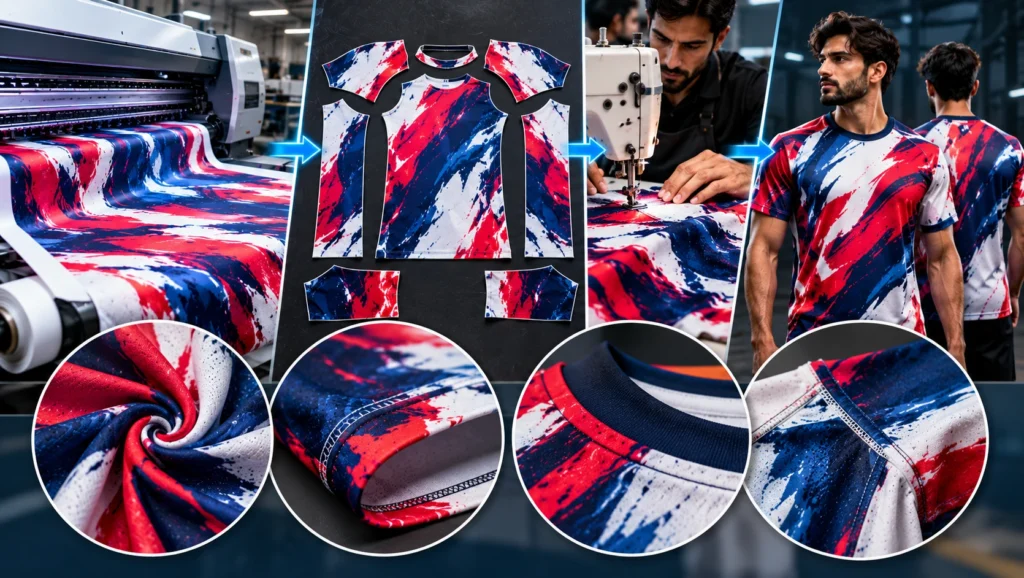
The second path, and the one our own sublimation service runs on exclusively, prints the fabric while it’s still a flat roll, before a single seam exists. Because the fabric is perfectly flat when it goes under the rotary calendering drum, the dye gas reaches 100% of the surface with no folds to hide behind. Only after the entire roll is dyed do we laser-cut the individual pattern panels and hand them to the sewing floor for assembly. This is the cut-and-sew model, and it’s the only production method that reliably delivers a true, gapless, edge-to-edge print on a finished garment.
The tradeoff is scale of equipment, not skill. Flat-bed heat presses, the kind used for a chest logo or a jersey number, are economical for a small, defined print area, which is why we route spot graphics through them. True AOP needs a rotary calendering machine, a continuous, spinning, oil-heated drum that feeds raw fabric and transfer paper together so thousands of yards can be sublimated a day without the fabric shifting or wrinkling mid-run.
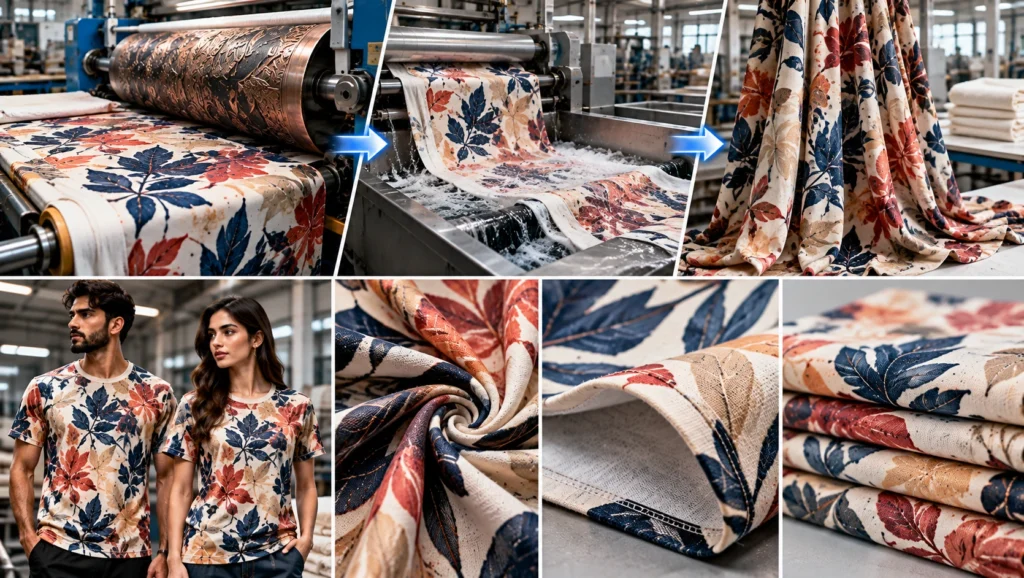
Most guides to all-over print stop at “sublimation needs polyester, so cotton is off the table.” That’s true for sublimation specifically, but it understates what’s actually possible on cotton with a different chemistry.
Reactive dye printing is a separate process built for natural and protein fibers, cotton, linen, silk, and wool among them, rather than synthetic ones. The fabric is pre-treated so the dye will bond correctly, the reactive dye is applied, and the print is then set with high-pressure steam at high heat. That steam and pre-treatment combination triggers an actual chemical reaction between the dye and the fiber, forming what’s called a covalent bond, a real chemical linkage rather than the physical trapping mechanism sublimation relies on. The fabric is then washed to remove excess dye and pre-treatment chemicals, which is a genuinely different production step than anything in a sublimation run.
The practical result is a soft, breathable, all-over printed cotton fabric with strong wash fastness, an option sublimation simply cannot deliver on a cellulose fiber. The tradeoffs are real: reactive printing is a more water- and chemical-intensive process than sublimation, and it doesn’t compress into the same fast, dry, roll-to-roll workflow. A brand that specifically wants a cotton hand feel with a bold, saturated, edge-to-edge pattern, rather than the polyester feel sublimation requires, has reactive printing as a genuine, established option, not a compromise. It’s a different fabric decision and a different production timeline from a polyester AOP run, and it’s worth asking about explicitly rather than assuming AOP automatically means polyester.
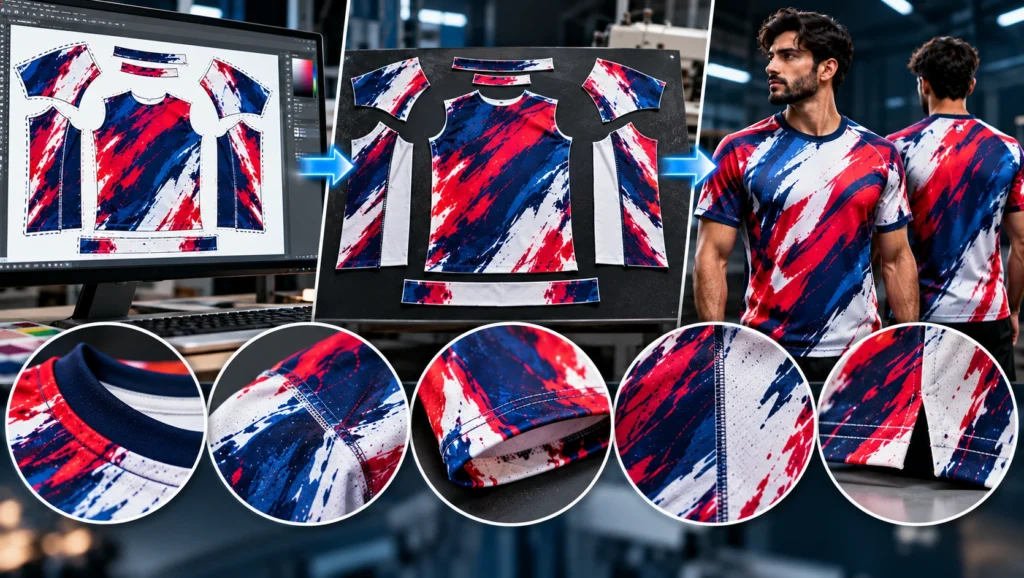
A cut-and-sew AOP file isn’t one flat image scaled to fit a garment outline. It’s a set of separate panels, front body, back body, two sleeves, a hood, cuffs, a waistband, each carrying its own section of the design, printed edge to edge with extra artwork bleeding past the panel’s actual cut line. That bleed margin exists because fabric shifts slightly during cutting and sewing, and without it, even a fraction of an inch of misalignment leaves a thin strip of unprinted white fabric showing at the seam.
Seam allowance works against the designer in the opposite direction: the strip of fabric folded inward and stitched down at every seam disappears from view entirely. A fine outline, small text, or a critical design element placed too close to a panel’s edge gets partially or fully swallowed into that fold. The practical rule is to keep anything the brand needs fully visible well clear of every panel edge, not just the outer trim line.
Perfect pattern alignment across a seam, a stripe that continues seamlessly from the front panel onto the sleeve, for example, is difficult to guarantee on a cut-and-sew garment and shouldn’t be promised as a default. Every size in a range has different panel proportions, so a match calculated for one size is very unlikely to hold for every other size in the run. Designs built from bold, large-scale, or abstract patterns tolerate this reality well. Designs that depend on exact continuity across every seam need to be flagged early, checked against a real sample, and, in some cases, redesigned around the seam rather than through it.
Sublimated color looks noticeably different on a screen, on printed transfer paper, and on the final baked fabric, because the process involves a genuine phase change rather than a direct one-to-one ink match. That gap is exactly why a strike-off exists as a mandatory step before any bulk AOP order, not an optional add-on.
On our floor, a strike-off means printing a small swatch, roughly 12 by 12 inches, of the actual approved artwork and baking it onto a sample of the exact fabric selected for the run. That physical swatch ships to the brand for a real, in-person check under normal lighting, confirming that a deep black isn’t reading as dark green and that saturated reds land on the brand’s actual guideline color rather than an approximation. Only once that physical sample is signed off does it become the binding color standard the factory produces the entire bulk run against.
This step is worth insisting on with any AOP supplier, not just trusting a digital proof or a small transfer-paper sample. Repeated laundering is also part of what a color needs to survive over the life of a garment, and AATCC TM61’s accelerated colorfastness-to-laundering test, one 45-minute cycle approximating roughly five home or commercial washes, is the kind of standardized check a factory should be able to speak to when a brand asks how a sublimated color is expected to hold up over a season of wear, not just at the point of strike-off approval.
Everything above is the general mechanics of AOP. Here’s specifically how we route a brand’s design once it lands on our floor. If a graphic is a logo, a sponsor mark, or a player number confined to one panel, it goes through a flatbed heat press as a spot sublimation job, which keeps cost down since it uses far less transfer paper per unit than a full rotary run. If the brief calls for true edge-to-edge coverage, a camouflage pattern, a galaxy print, a repeat graphic wrapping the whole garment, it goes onto our rotary calendering line, where raw polyester fabric is dyed by the roll before a single panel is cut.
Fabric sourcing happens in the same conversation as print planning, not after it, because as covered above, the fiber content decides how the finished color will actually look. Our team will steer a brand toward 100% polyester or poly-spandex when the brief calls for deep, saturated color, and will flag a poly-blend’s heathered outcome honestly rather than let a brand discover it after the fact. Every job goes through a strike-off before bulk production starts, and our quality control and inspection process checks for ghosting, color banding, and heat press consistency across the run, the same standard it applies to stitching and measurements on every other product line.
We run at MOQ 30 per design, with sampling typically around 12 days and bulk production around 18 days once a strike-off is approved. We’ve been doing this since 2016, working with brands across the EU, US, Australia, and Canada under ISO 9001 and REX certification, and if the finished order doesn’t match what was approved, that’s covered by a full refund or free remake, not a negotiation. If you’re weighing AOP against a placement print like screen printing or DTG for an upcoming collection, or you’re not sure whether your fabric choice will hold the color you want, get in touch and we’ll walk through the actual artwork and fabric with you before you commit to a production method.
AOP stands for all-over print. It means a design is printed across the entire garment, seam to seam, rather than placed in one defined area like a chest logo. The clearest way to confirm a garment is genuinely AOP is checking whether the print continues onto the inside seams and hem.
Not with sublimation, the dominant AOP method, since sublimation dye only bonds to synthetic fiber. Reactive dye printing is a separate, established process that does work on cotton and other natural fibers, using steam and a chemical bond instead of heat and a physical one, though it's a different production process with its own timeline and cost.
Sublimation dye only bonds to the polyester portion of a blended yarn. The cotton portion stays undyed and loses whatever surface color it picked up during printing after the first wash, which is what produces the heathered, lighter look on blended AOP fabric over time.
It happens when a design is pressed onto a garment that's already been cut and sewn. A finished, 3D garment has folds and seams that a flat heat press can't make full contact with, so the dye gas can't reach those spots, leaving pale, untouched streaks, most often at the armpits and collar.
Cut-and-sew prints the fabric while it's still a flat, unsewn roll, then cuts the pattern panels and sews the garment afterward, giving the dye full, even access to every part of the fabric. Printing a finished blank does the reverse, pressing a design onto an already-sewn garment, which is what creates white creases and gaps at the seams.
Not by default, and it shouldn't be promised as one. Every size in a range has different panel proportions, so a pattern match calculated for one size won't hold across the whole range. Bold, large-scale, or abstract designs tolerate this well; designs that need exact continuity across a seam should be flagged and checked against a real sample before bulk production.
On our production floor, the heat press runs at 400°F (204°C), the temperature at which polyester's fiber pores open enough for the disperse dye to convert from a solid to a gas and get forced inside before the pores close again as the fabric cools.
A strike-off is a small swatch, roughly 12 by 12 inches, printed with the approved artwork and baked onto the exact production fabric, then physically checked by the brand before bulk manufacturing starts. It exists because sublimated color looks different on a screen, on transfer paper, and on the final fabric, and it becomes the binding color standard for the entire run once approved.
Generally yes, per unit, since it requires printing, cutting, and sewing full fabric panels rather than pressing a design onto one area of an already-finished garment. Whether that's the right tradeoff depends on whether the design actually needs full coverage, our guide to screen printing versus DTG covers when a placement print is the better fit.
It depends on the product. Lighter polyester works well for performance shirts and tees, while heavier weights hold their structure better at seams and stress points on fleece or outerwear pieces. The right weight is a decision made alongside fabric composition and print method, not chosen independently of them.
* * *

FOUNDER & CEO AT RIJIZ