
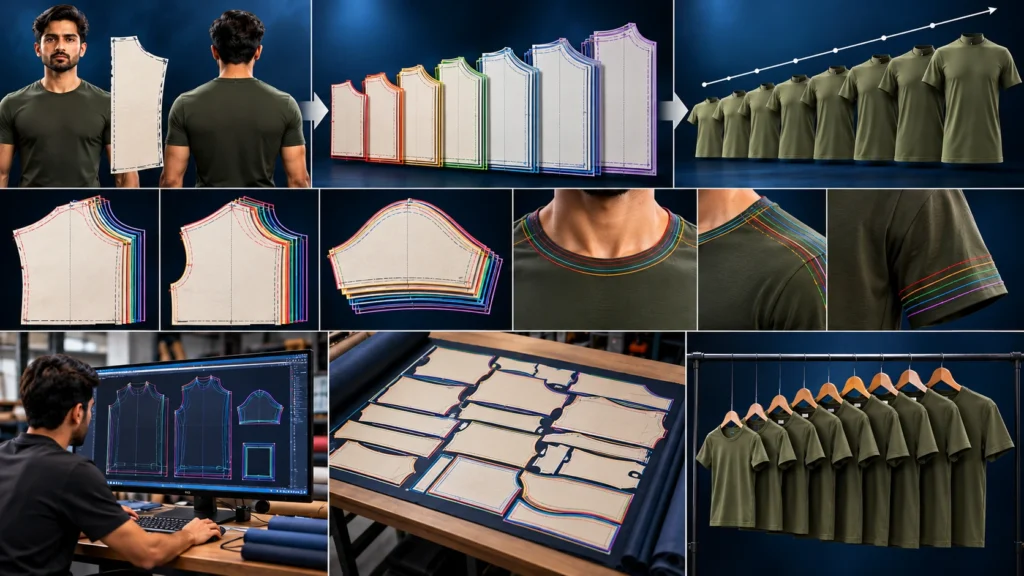
A base pattern, also called a sample size or master pattern, is the one size a design gets fit-approved on, built from the body measurements that define a base-size spec before anything else happens. Pattern grading is the process of scaling that approved base pattern up and down into every other size in the range, using a fixed set of rules, so the whole run keeps the same fit, proportion, and style details the base size was approved on.
That last part is the distinction worth holding onto: grading does not create a new shape. It changes the scale of a shape that already works. This is what separates grading from altering a pattern. An alteration changes only part of a pattern to fit one specific body, shoulder width held constant while the bust circumference moves, for example, and the result is a custom fit for one person, not a consistent size run. Grading applies a formula across the whole pattern and produces the same design at a different scale. Industry sewing references call a properly scaled grade an “even grade” for exactly this reason: every relevant measurement moves by a defined amount at once, not selectively.
There is no universal starting size. Some pattern rooms start from a small or extra-small base and grade up; others start from a middle size and grade both directions. What matters more than the starting point is that every size downstream of it traces back to the same approved base pattern, since that is what keeps a small and an extra-large from feeling like two different designs that happen to share a name.
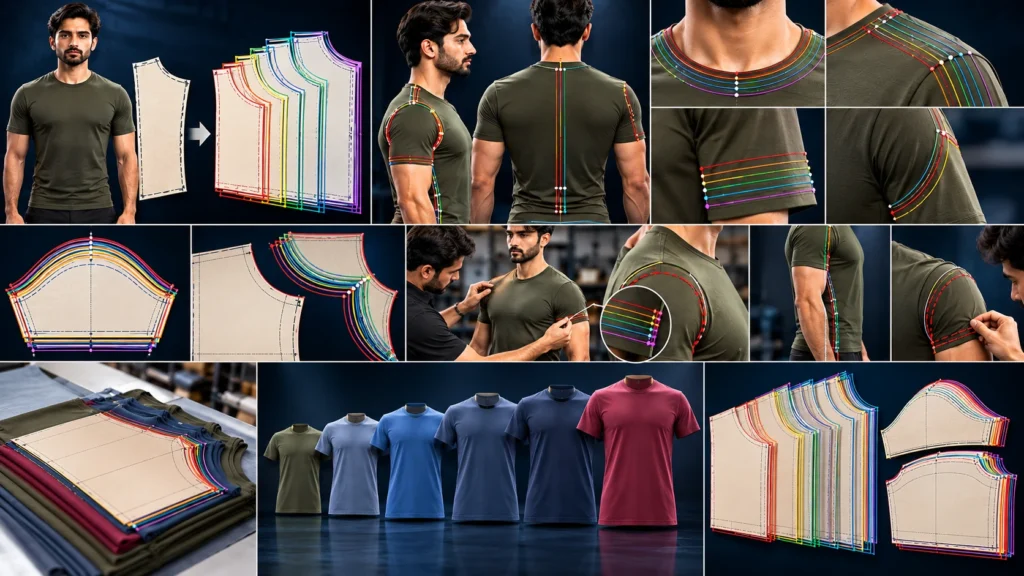
A grade rule is the specific amount a single point of measure (POM) changes between one size and the next. ASTM D5219 , the standards body’s terminology reference for body dimensions in apparel sizing, is the kind of document a grade rule ultimately traces back to: it defines the POM vocabulary (chest, waist, hip, sleeve length, and dozens more) that grade rules are written against. A grade rule library is a full set of these increments, one per POM, for a given style.
The reason a single blanket increment does not work is that different parts of a body, and therefore different parts of a pattern, do not grow at the same rate between sizes. A chest or hip point of measure might move a full inch from one size to the next, while a neck drop or a collar stand moves a fraction of that. Apply the chest increment to the neckline and the collar gapes on the larger sizes and chokes on the smaller ones, even though the chest fits perfectly at every size. This is the single most repeated technical point across pattern-grading references: grade rules are assigned per point of measure, never applied uniformly across a pattern.
It is also worth being direct about something competitor guides tend to gloss over: there is no external body that sets these increments for a brand. A “size 8 to 10” jump at one label is not the same physical increment as a “size 8 to 10” jump at another, because each brand’s base pattern measurements and grade rule conventions are its own. This is why a grade rule library, once built and fit-validated, is treated as real product IP inside a pattern room, not a generic reference chart to be copied from elsewhere.
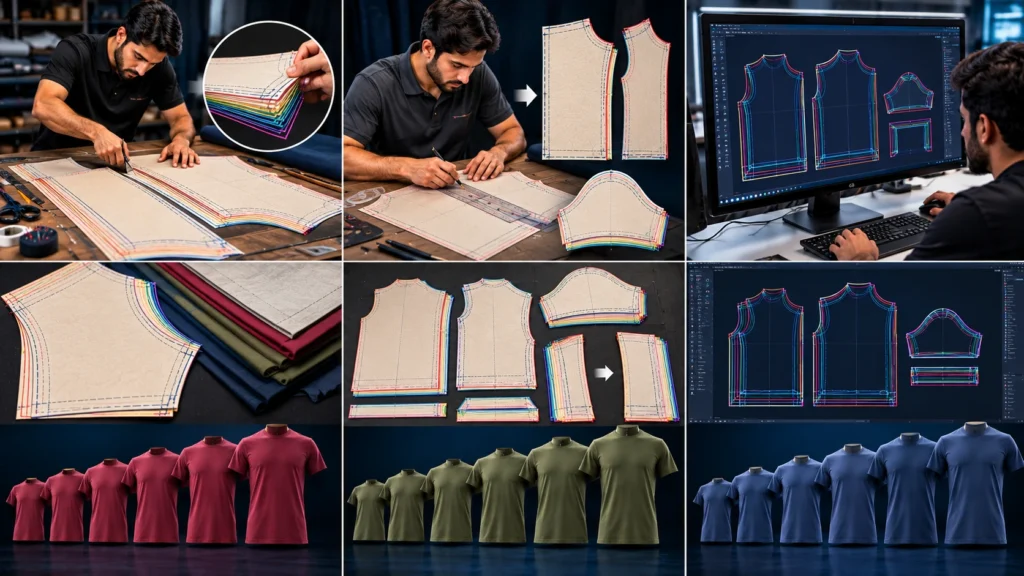
Three methods produce a graded pattern, and none of them is technically wrong, they differ in speed, consistency, and how well they survive a large size range.
Cut-and-spread is the oldest and most direct method. The base pattern is cut along defined slash lines and the pieces are physically spread apart by the grade rule’s increment to grade up, or overlapped to grade down, then the new outline is redrawn. It needs nothing more than scissors, a ruler, and a pencil, and it is genuinely the clearest way to see what grading is doing to a shape.
Pattern shifting achieves the same result without cutting the original pattern. The piece is moved a fixed measured distance and traced at its new position, which protects the master pattern from repeated cutting but takes the same care to execute accurately.
Computer grading digitizes both of the above. A grade rule is entered once per point of measure, and the CAD system generates every size in the range from that single rule set. The real advantage is not raw speed, it is that a CAD grade rule is stored, versioned, and reusable across every future style built on the same block, in a way a paper pattern’s grading history is not. For a brand producing more than a couple of collections a year at wholesale volume, this is the difference between a grade rule that can be checked and reused, and one that lives only in a pattern maker’s hands and has to be rebuilt from scratch when that person moves on.
All three methods, done correctly, produce the same graded result for a small, straightforward size jump. Where they diverge is over a wide range or a complex pattern, where a manual method is more prone to drift and a CAD system holds the original rule exactly at every size.
A break point is the place in a size range where a single grade rule stops producing a garment that still looks like the design it started from. Two of the most common are worth naming directly, since they are also the two most likely to get skipped when a brand extends a size run under time pressure.
The first is a large jump grouped into one step. Grading a size 4 straight out to a size 18 on a single rule tends to produce awkward, over-large gaps at the cut lines and a result that no longer reads as proportional. The more reliable approach is incremental grading, working through the intermediate sizes (4 to 12, then 12 to 18) rather than one large jump, which is also why grade rules themselves commonly get smaller at the low end of a range and larger toward the high end, not a flat number throughout.
The second, and the one that causes real production problems when missed, is the plus-size break point. Past roughly an extra-large, a straight-size grade rule stops describing how a larger body’s proportions actually differ, because the body does not simply scale up uniformly past that point, it changes shape. The dependable fix is not a bigger increment on the same rule, it is a new base block: bust darts repositioned, armscye curves adjusted, rise measurements extended, built and fit-tested specifically for the plus range rather than inherited from the straight-size block. A brand that treats plus sizes as “the same grade rule, just further out” is the most common reason a fit that worked cleanly through a large comes back wrong at a 2X or 3X.
Fit-testing at more than one point in the range, not just the base size, is what actually catches a break point before it reaches bulk. Testing the sample size and assuming the rest of the run holds is the single most repeated mistake behind fit complaints that surface only at the tail sizes.
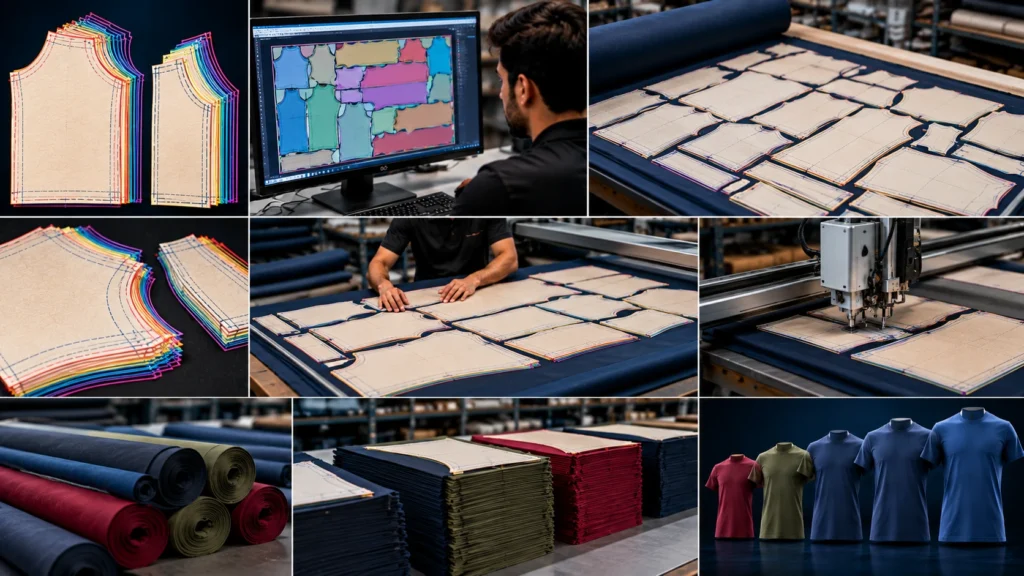
Once a pattern is graded into a full size run, every piece across every size still has to be arranged onto a layout that gets cut from a roll of fabric. That arrangement is called a marker, and “nesting” is the specific act of interlocking the graded pieces, rotating and shifting them like a puzzle, to leave as little unused fabric as possible between them.
This step is where grading stops being a pattern-room exercise and starts being a real cost line. Fabric is consistently the largest single line item in a garment’s cost breakdown, which is why a few points of marker efficiency matter more here than almost anywhere else in production. Industry benchmarking puts a marker efficiency above 80 to 85% as generally considered good , with the achievable ceiling shifting depending on pattern shapes and any placement restrictions, a striped or plaid fabric that needs pattern matching nests less efficiently than a solid, for instance.
A loosely nested marker does not fail visibly the way a bad grade rule does. Nobody notices it at the fitting. It shows up later as a fabric bill that is a few percentage points higher than it needed to be, multiplied across every unit in a bulk run, which is exactly the kind of cost that is invisible on a single garment and very visible on 5,000 of them.
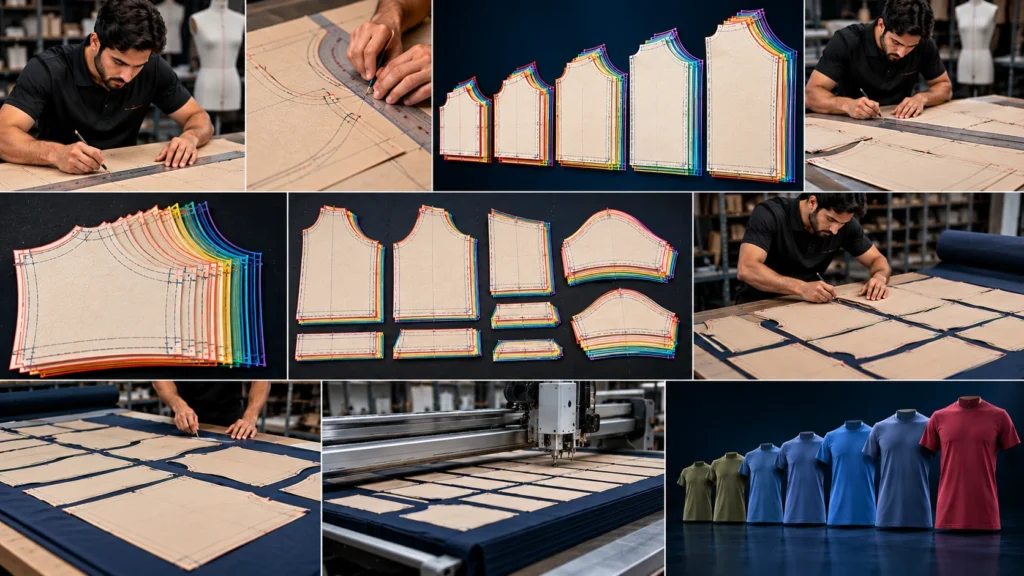
Manual grading is not obsolete, and it is worth being honest about where it still belongs. A one-off custom commission, a single sample for a pitch, or a small-batch designer working from a couture block does not need a CAD grade rule library. The grading lives on paper, the block lives with the pattern maker, and at that volume, that is a perfectly reasonable way to work.
The calculation changes the moment a brand crosses into repeatable, multi-size wholesale production. The argument for CAD grading at that point is not really about speed, plenty of experienced pattern makers can hand-grade a size run accurately. It is about what happens when that pattern maker is unavailable, or moves on, or a factory on the other side of the world needs the same grade rule applied exactly. A paper grade lives in one place. A CAD grade rule, exported in a shared format, can be checked, reused on the next style built off the same block, and handed to a different facility without anyone re-deriving it from a physical pattern. File interoperability is the practical version of this: graded digital patterns commonly export to formats like DXF, ASTM, AAMA, and PLT specifically so a factory anywhere can read the file correctly on its own cutting and plotting equipment, no matter which CAD system produced it originally.
Neither method is “more correct.” The honest dividing line is volume and how many hands the pattern needs to pass through, not a claim that one method is inherently better pattern-making than the other.
This is the part that’s ours specifically, not general pattern-grading knowledge. Once a base pattern is fit-approved, our pattern making and grading team builds the grade rule set per point of measure in CAD, using Optitex and Gerber, rather than applying one blanket increment across the pattern. Vertical growth (body length) and horizontal growth (chest, hip circumference) are graded on independent axes for exactly the reason covered above: a garment that grows correctly at the chest but drags the neckline down with it is a grading error, not a design choice.
Where a size range pushes past a standard run into plus sizes, that gets flagged as a new-base-block conversation before grading starts, not handled as a bigger version of the same rule. Once the grade set is built, marker making follows in the same CAD environment, and a well-nested marker on a straightforward style typically lands in the 80 to 88% fabric yield range, checked against the tech pack’s bill of materials before a single yard gets cut. With an approved base pattern and a clear tech pack in hand, grading and marker making for a full size run typically takes 3 to 5 business days.
None of this replaces a physical check. A graded pattern still gets plotted, cut in muslin, and validated on a sample before it goes anywhere near bulk fabric, because a mathematically correct grade rule and a garment that actually hangs right on a body are two different questions, and only one of them gets answered on a screen. If you’re working from an existing pattern or a size range that has drifted over time, our team can review the grade rule set and flag where it’s likely to break before it reaches your cutting floor, get in touch and we’ll walk through it together.
Grading applies a fixed formula across an entire pattern to produce the same design at a different, consistent scale. Altering changes only specific parts of a pattern to fit one particular body, without maintaining that same formula across the whole piece. Grading produces a size run; altering produces a custom fit for one person.
A grade rule is the specific increment assigned to one point of measure, telling a pattern how much that single measurement should grow or shrink between one size and the next. A full pattern has its own grade rule for every point of measure, not one number applied everywhere.
Because different parts of a garment do not need to change at the same rate to keep looking correct. A chest measurement commonly moves a full inch between sizes while a neck drop moves a fraction of that. Applying the chest's increment to the neckline produces gaping or choking at the sizes away from the base, even though the chest itself still fits.
No. Each brand sets its own base pattern measurements and its own grade rule library. A "size 8 to size 10" jump at one label is not necessarily the same physical increment as the same jump at another label, which is why grade rules are treated as a brand's own product data rather than a copyable universal chart.
A break point is where a single grade rule stops producing a garment that still reads as the original design, most commonly at a very large size jump graded in one step, or past a standard size range where the body's proportions stop scaling in a way the existing rule accounts for.
Not reliably. Past roughly an extra-large, bodies change shape rather than simply scaling up, so a straight-size grade rule applied further out tends to distort darts, armholes, and rise. The more dependable approach is a new base block built and fit-tested specifically for the plus range.
Nesting is arranging every graded pattern piece, across every size, onto a marker with as little unused fabric between pieces as possible. Since fabric is consistently the largest single line item in a garment's cost, a few points of marker efficiency compound into a real cost difference across a bulk cut, even though a loosely nested marker looks fine at the fitting stage.
Manual grading (cut-and-spread or pattern shifting) is fine for a single sample, a custom piece, or very low volume. Once a brand is producing multiple collections a year at wholesale scale, CAD grading becomes the more reliable choice, mainly because the grade rule is stored and reusable rather than living only with one pattern maker.
With an approved base pattern and a clear tech pack, grading a full size range and generating a production-ready marker typically takes a matter of business days in a CAD-based pattern room, not weeks, though a plus-size range that needs a new base block adds development time on top of that.
Common industry formats include DXF, ASTM, AAMA, and PLT, which exist specifically so a graded digital pattern produced in one CAD system can be read correctly by different cutting and plotting equipment at another facility.
* * *

FOUNDER & CEO AT RIJIZ