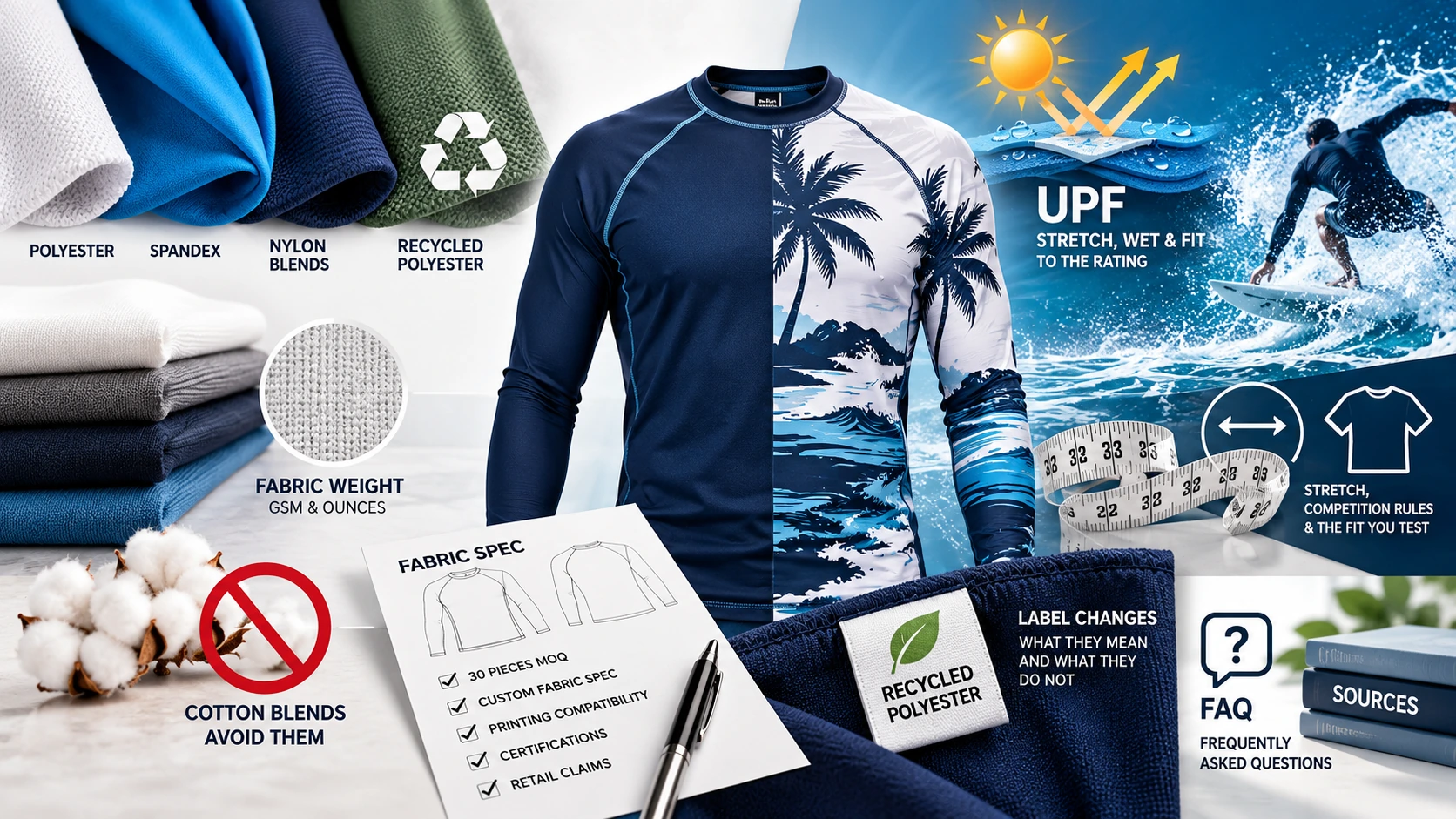

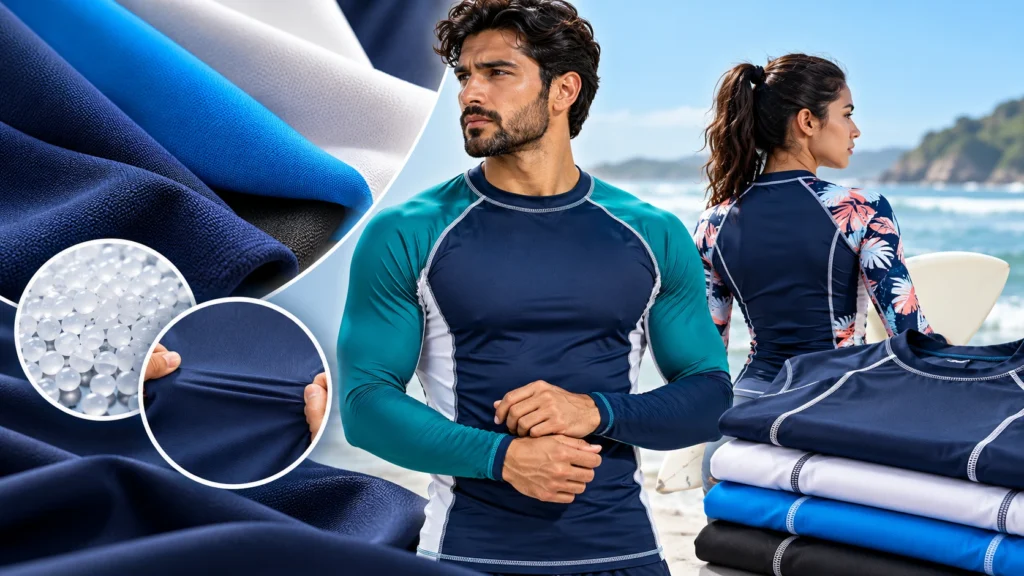
Polyester is the base to start from for a printed rashguard. Our sublimation printing service explains why: the dye needs a synthetic polymer to bind with, so the raw material is chosen during sourcing, before the print.
Table 1 lines up the common bases with the print route our service page names and what to check on a sample.
|
Base fabric
|
Print route
|
What it is good for
|
What to check
|
|---|---|---|---|
|
100% polyester
|
Dye sublimation
|
Pitch-black colour, the base our sublimation page names for it
|
Stretch and recovery on a worn sample
|
|
Poly-spandex (polyester and spandex)
|
Dye sublimation
|
Printed colour plus the stretch a grappling fit needs, named with 100% polyester for pitch-black colour
|
Spandex share and recovery on a worn sample
|
|
Nylon and spandex
|
Not named on our service page, so confirm with the factory
|
Retail claims of a softer hand and quicker drying
|
Colour and chlorine behaviour in a wash test
|
|
Recycled polyester spandex (RPET)
|
Confirm with the factory
|
Recycled content, which should be stated in writing
|
Durability and stretch, since no source here compares it
|
|
Polyester and cotton blend
|
Dye bonds only to the polyester share
|
A faded, heathered look, if that is the design
|
Fade after the first wash
|
Colour depth. Our sublimation page is specific about saturation. If you demand pitch-black colour, the sourcing team mandates 100 percent polyester or poly-spandex (Lycra) for the run, so do not assume a deep black on a blend. Put the fibre content on your tech pack in writing, so the mill knows which base it is printing on.
Claims about washing. Sellers quote wash counts and fade tests for printed rashguards. This guide does not repeat them, because none of the four sources in this guide tests a printed rashguard for durability. Ask for the test method and the sample result before you rely on any durability figure.
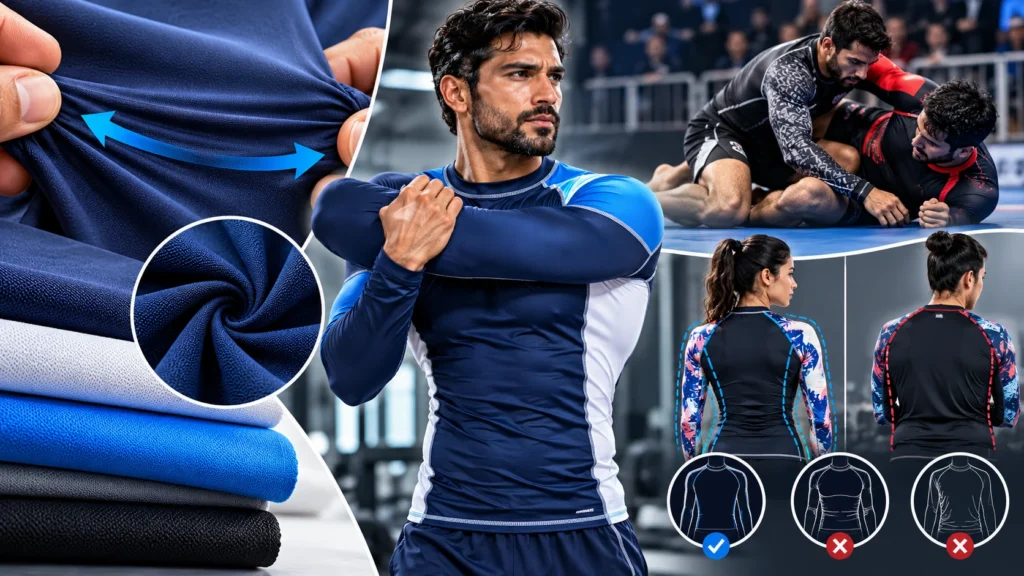
Spandex, also sold as elastane or Lycra, is the stretch fibre in a poly-spandex blend. None of the four sources in this guide sets a spandex percentage, so the share is a spec decision you test on a sample rather than copy from a number on a page.
Competition rules describe the fabric as well as the cut. The International Brazilian Jiu-Jitsu Federation uniform rules for no-gi ask for a shirt of “elastic material (skin tight)” that covers the torso to the shorts waistband, in black, white or black and white, with at least 10 percent rank colour. A shirt that is 100 percent rank colour is also allowed. That is a fabric rule, so the stretch fibre is part of compliance, not only comfort.
Mixed martial arts rules add a women’s requirement. The Association of Boxing Commissions and Combative Sports (ABC) sets it in rule 11(d) of its Unified Rules of Mixed Martial Arts: female competitors “shall wear a short sleeved (above the elbow) or sleeveless form fitting rash guard and/or sports bra(s)”, and no loose-fitting tops are allowed. The document shows an amendment dated 5 August 2026 with a requested implementation date of November 2027, so confirm which edition your event uses before you spec a women’s MMA line.
Test the stretch on a worn sample, not on a flat swatch. Move in it, pull it at the shoulders and check that it recovers, then compare the fibre ratios with the ones in our compression shorts comparison, which covers the same spandex logic for compression garments.
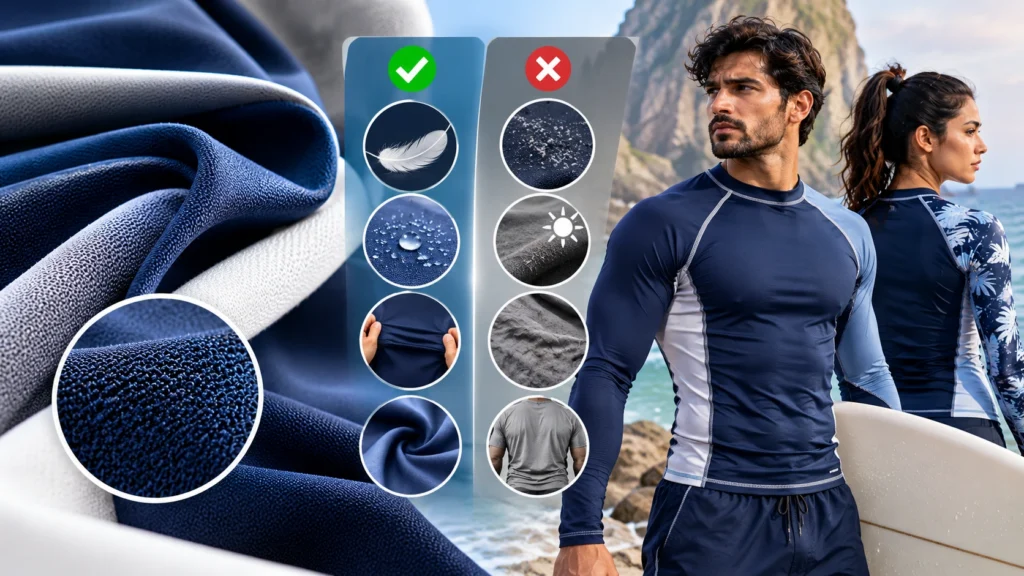
Nylon and spandex blends turn up in retail rashguards, and sellers make claims for them. Some say nylon feels softer and dries faster than polyester, while others say polyester holds colour better and resists chlorine. Those are seller claims, and the four sources this guide relies on do not test nylon against polyester, so the evidence here cannot rank the two.
If you want a nylon blend, ask the factory for a swatch in that exact blend, wash it, and compare the colour and stretch recovery with your approved sample. A retail claim tells you what the seller believes, not how your fabric will behave after a wash. That check costs one swatch and answers the question for your product rather than for a category.
Chlorine is where the fibre question meets UPF. Pool chemicals can lower a fabric’s protection, as the UPF section below explains, so a rashguard worn in pools needs that check whichever fibre it uses.
Our rashguard page lists RPET spandex blends as an option. RPET is recycled polyester, and the label tells a buyer where the fibre came from, not how it will print, stretch or wear. Our fabric sourcing service offers a feasibility review of a target blend and weight, which is the right place to ask whether a recycled blend can be knit at the weight you need.
None of the sources in this guide compares recycled and virgin polyester on durability, stretch or UPF, so this guide makes no performance claim for recycled fibre either way. Ask any supplier, including us, for two things in writing: the recycled content share and the name of the certificate behind any eco claim. A label that says recycled without those two details is a seller claim until you see the paperwork.
Weight is written two ways. GSM, grams per square metre, is the metric unit, and ounces per square yard is the imperial one. A spec that says 200 GSM and a retail page that says 5.9 oz can describe roughly the same fabric, so you need the conversion before you compare them.
The conversion is our own arithmetic, not a published standard. One ounce per square yard is about 33.9 grams per square metre, so ounces are GSM divided by 33.9. Table 2 applies that sum to five weights and rounds to one decimal place.
|
Weight (GSM)
|
Weight (oz per square yard)
|
Where a published tier sits
|
|---|---|---|
|
180
|
5.3
|
Not in a published tier we checked
|
|
200
|
5.9
|
Start of a vendor's standard tier (200 to 220 GSM)
|
|
220
|
6.5
|
Top of that standard tier
|
|
240
|
7.1
|
Start of a vendor's premium tier (240 to 260 GSM)
|
|
260
|
7.7
|
Top of that premium tier
|
Brands publish their own tiers, and these are examples rather than standards. One custom-apparel vendor lists 200 to 220 GSM as a standard rashguard tier and 240 to 260 GSM as a premium tier. We have not verified those figures, so read them as a sign of how a seller describes weight, not as a target a factory must meet.
Sample two weights before you commit, because weight changes how the fabric drapes. Write the unit on the purchase order, GSM or ounces, and the fabric state the weight was taken in, finished or washed, so the number on the sample is the number on the bulk run. For GSM by activity across other activewear, see our activewear fabric guide.
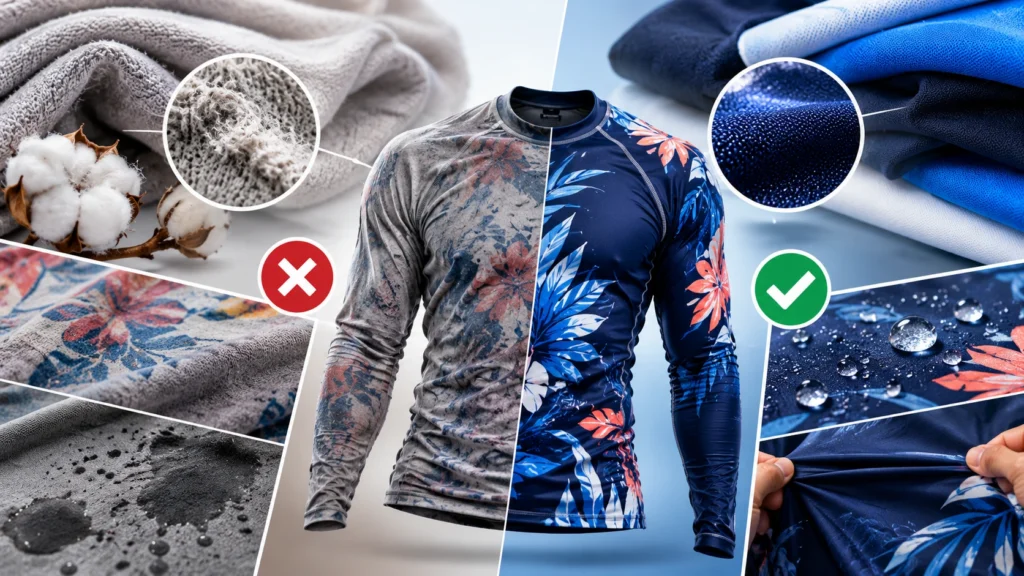
A cotton blend can look soft and natural on a spec sheet, but it is a poor base for a printed rashguard. Our all-over print guide explains why a poly-cotton blend does not sublimate the way brands expect, so this section keeps to what matters for a rashguard.
Our sublimation service page is blunt about pure cotton: “We categorically refuse to execute sublimation services on 100% cotton to protect your brand’s reputation.” On a blend, the page says the dye bonds to the polyester fibres only, so a base of 65 percent polyester and 35 percent cotton washes to a faded, heathered look. If you want that look, the blend works; if you want saturated colour, it does not.
Cotton is also weak on sun protection. The Skin Cancer Foundation’s sun-protective clothing page gives a white T-shirt a UPF of about 7, and says that when the shirt gets wet, it drops to a UPF of only 3. That is the wrong base for a sun protection claim.
If a brand still wants cotton, treat it as a handfeel decision, not a shortcut to a softer printed rashguard. Ask for a strike-off on the blend you choose and check it after a wash, because that is where a blend shows how its colour behaves.
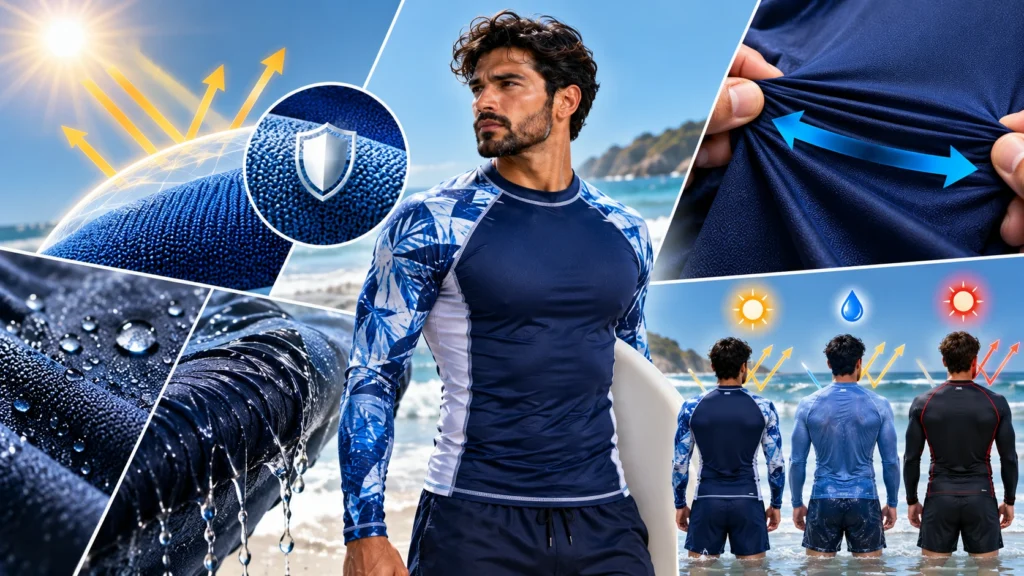
UPF stands for ultraviolet protection factor, and it is a rating for a material. The Australian Radiation Protection and Nuclear Safety Agency (ARPANSA) publishes a labelling guide for sun protective clothing that sets out three classes under the 2017 edition of AS/NZS 4399, the Australian and New Zealand standard: Minimum at UPF 15, Good at UPF 30, and Excellent at UPF 50 and 50+. The same page says Australia has since revised the standard as AS 4399:2020, while New Zealand still uses the 2017 edition, so check which edition your market applies.
The rating belongs to the material, and the garment has to earn it. The guide says a UPF rating on a clothing item “applies only to the area of skin covered”, and that stretching may lower it. ARPANSA’s test reports give the UPF of the material tested and do not assess the design or the body coverage of the product, so body coverage is a separate question for your design.
Protection drops in situations that matter for a rashguard. ARPANSA says it may become lower where the material is stretched, where it is wet, and “due to the effects of normal wear or prolonged exposure to pool chemicals”. The Skin Cancer Foundation makes the same point about fit: tight clothing can stretch and reduce the level of protection, so a tight fit is a stretch question, not a protection gain.
The Skin Cancer Foundation puts the scale in plain terms. A UPF 50 fabric blocks 98 percent of the sun’s rays and lets two percent through. The same page says dark or bright colours give better protection than lighter shades, so colour belongs on the spec next to the rating.
Table 3 sets out what lowers the rating and what to do about it on your order.
|
Factor
|
What the source says
|
What to do on your order
|
|---|---|---|
|
Stretch
|
Protection may become lower if the material is stretched (ARPANSA)
|
Test the claim on a worn sample, not a flat swatch
|
|
Wet
|
Protection may become lower if the material is wet (ARPANSA); a white T-shirt falls from UPF 7 to UPF 3 when wet (Skin Cancer Foundation)
|
Plan for less protection while wet, and say so in any claim
|
|
Pool chemicals
|
Protection may become lower through prolonged exposure to pool chemicals (ARPANSA)
|
Ask for any test result after chlorine before you make a pool claim
|
|
Close contact
|
Protection may become lower where the material sits close to the skin, such as across the shoulders if stretching occurs (ARPANSA)
|
Check shoulder and back fit on the sample
|
|
Low coverage
|
Singlets, crop tops, halter tops and briefs are excluded from UPF claims (ARPANSA)
|
Check a cropped cut against the standard before you print a claim
|
|
Whole garment
|
The rating applies to the entire item, not to individual components (ARPANSA)
|
Ask for the rating on the finished garment, not on the fabric swatch
|
A UPF number on a swatch is the start of the check, not the end. Pool use, stretch and a wet day all cut into the protection, which is why the rating belongs on your spec next to the fit and the fibre, not on a line of its own.
We make printed rashguards in our own factory, and the fabric is settled before anything is cut for bulk. We hold ISO 9001 certification. Our minimum is 30 pieces per design, so a first run can be small. Sampling takes 12 days, bulk production takes 18 days and shipping takes 6 days, so the fabric you approve in sampling is the fabric the bulk run is built on.
Every rashguard order starts with a sample you approve before bulk production begins, and we make no fabric substitutions. For a printed run, we also make a strike-off: a 12 by 12 inch swatch of your artwork, baked onto the exact fabric you chose.
If the order does not match what was agreed, you get a full refund or a free remake. Start with the fibre content and weight on your tech pack, then start apparel prototyping and sampling so you can handle the fabric before bulk. Our BJJ apparel range lists the rashguard styles we make, so you can match a fabric to a style.
Yes, the protection can drop. ARPANSA says protection may become lower where the material is wet, and the Skin Cancer Foundation says a white T-shirt drops from a UPF of about 7 to 3 when wet. Plan for less protection while the garment is wet, and ask the factory what testing sits behind any UPF claim you print.
No. The Skin Cancer Foundation says tight clothing can stretch and reduce the level of protection, because the fibres pull apart and let more UV light through. A close fit can therefore cost protection, so choose the fit for movement and test the protection on a worn sample.
The rating is measured on the material. ARPANSA says its test reports give the UPF of the materials tested, and they do not evaluate the design or the body coverage of the product. Ask for the claim on the finished garment before you print it, because the rating covers the whole item.
Yes, it can. ARPANSA lists prolonged exposure to pool chemicals as one reason protection may become lower, so a rashguard worn in pools needs that check. None of the sources here gives a figure for how much a season of chlorine lowers the rating. Ask the factory for any test result after chlorine exposure before you make a pool claim.
It means the material is in the Excellent class of the Australian and New Zealand standard, which ARPANSA lists at UPF 50 and 50+. The Skin Cancer Foundation says a UPF 50 fabric blocks 98 percent of the sun's rays and lets two percent through. The claim still depends on the skin the garment covers, because the rating applies only to the area of skin covered.
It may not. The Australian and New Zealand standard excludes singlets, crop tops, halter tops and briefs from UPF claims because they give too little body coverage, whatever the fabric rating. A cropped rashguard may fall into that group, so check the cut against the standard before you print a sun protection claim on it.
The no-gi rule asks for a shirt of elastic material, skin tight, that covers the torso to the shorts waistband. It allows black, white, or black and white, with at least 10 percent of the athlete's rank colour, and a shirt that is 100 percent rank colour is also allowed. Check the current IBJJF uniform page before you lock a colour split into a bulk order.
The sources here do not settle it, because none ranks nylon and polyester for durability. Retail guides disagree on the question, so ask the factory for swatches of both blends, wash them, and compare colour and stretch recovery against your approved sample.
The sources here do not settle it, because none compares recycled and virgin polyester on durability, stretch or UPF. Ask the supplier for test results on the exact blend and the recycled content share in writing before you assume the two perform the same.

FOUNDER & CEO AT RIJIZ