
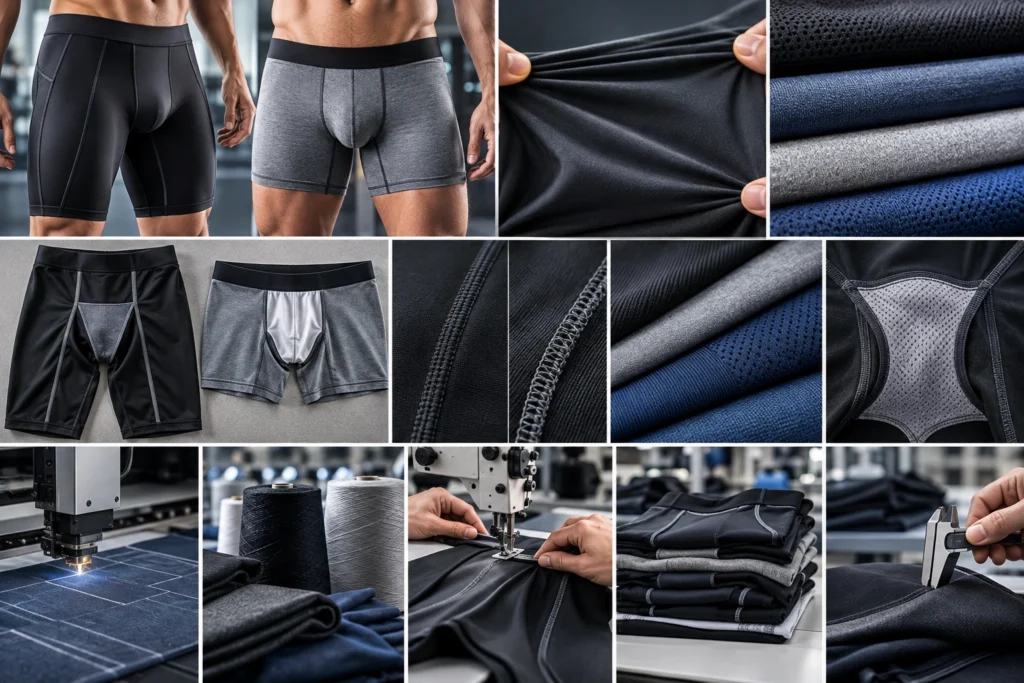
Compression shorts and boxer briefs sit next to each other in a drawer and get compared as if they’re competing for the same job. They aren’t. A compression short’s fabric is engineered to apply graduated pressure and support muscle during movement, almost always built on the synthetic fiber base (polyester and nylon account for the large majority of global fiber production, per Textile Exchange’s fiber production data ) that gives it stretch and recovery. A boxer brief’s fabric is engineered to sit comfortably against skin all day without binding, chafing, or riding. Those are two different design briefs, and the fabric spec for each one follows from the brief, not the other way around.
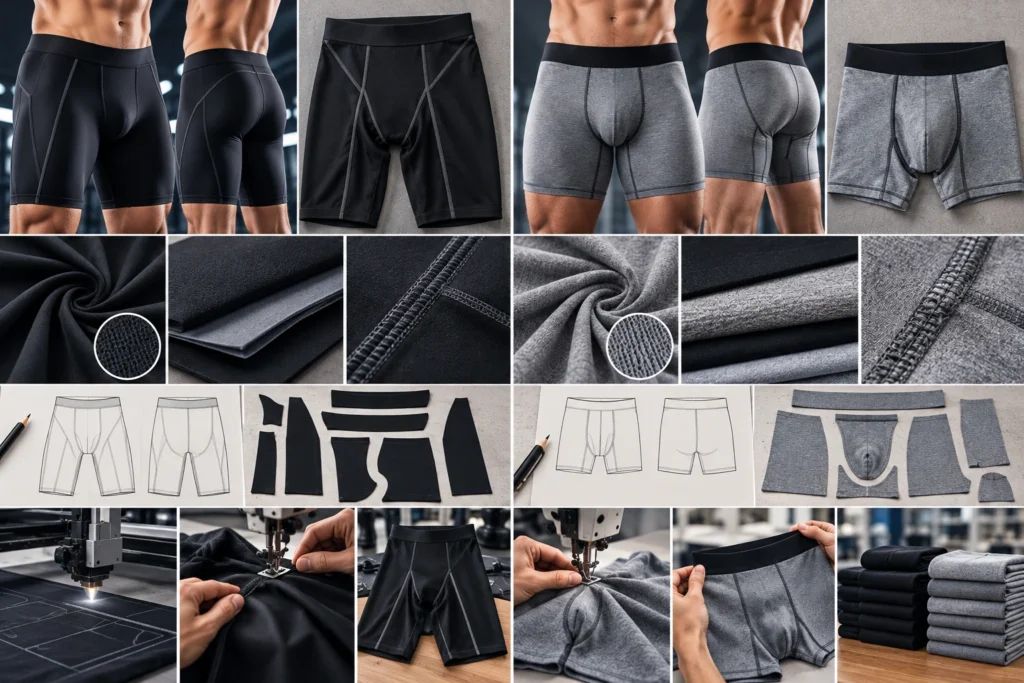
Compression shorts vs boxer briefs, at a glance
|
Spec
|
Compression shorts
|
Boxer briefs
|
|---|---|---|
|
Base fiber
|
Nylon or polyester, 75-85%
|
Cotton, modal, bamboo, or polyester microfiber
|
|
Spandex/elastane share
|
15-25%
|
Typically under 12%
|
|
Stretch type
|
True 4-way (needs 8%+ spandex)
|
2-way or light 4-way
|
|
Typical denier
|
20-70D depending on firmness
|
Not usually denier-rated (woven/knit cotton base)
|
|
Primary seam
|
Flatlock (2 or 3-thread)
|
Overlock or coverstitch
|
|
Main job
|
Muscle support, compression
|
Coverage, comfort, breathability
|
Neither garment is “better” fabric, they’re specced for different outcomes, and a brand sourcing both under one line needs separate tech packs, not one spec sheet with a note that says “same but looser.”
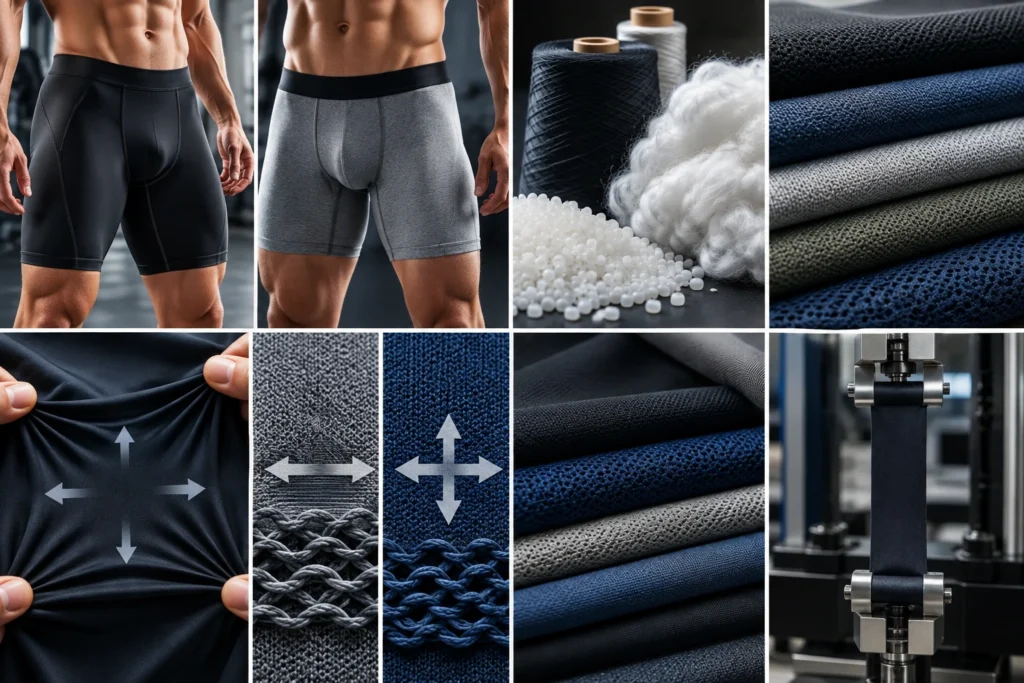
Compression fabric is nylon or polyester at 75-85% blended with 15-25% spandex, and that ratio holds across most of the categories Rijiz’s shorts manufacturing line supports, from recovery leggings to compression shorts to performance tops. The exact ratio shifts with how firm the compression needs to be: lighter support tops out around 15-20% spandex, firm compression (shaping, medical-adjacent support) runs closer to 20-25%.
Boxer briefs don’t need anywhere near that much stretch fiber, since their job is coverage, not compression. Elastane content typically sits under 12%, with the base fiber doing most of the work, whether that’s cotton, modal, bamboo, or a polyester/nylon microfiber blend chosen for softness rather than support.
There’s a real threshold that separates a fabric that stretches in two directions from one that genuinely stretches in four: roughly 8% spandex content. Below that line, a knit typically moves horizontally only. At 8% and above, it gains the vertical give that makes it move with the body instead of against it. This matters on a spec sheet because “4-way stretch” gets used as a marketing phrase more often than a verified spec, and a fabric at 5% spandex claiming 4-way stretch is making a claim the fiber content doesn’t support. ASTM D6614 , the standard test method for stretch properties using the constant-rate-of-extension (CRE) method, is the actual way to verify a stretch claim rather than take a hangtag’s word for it.
Denier measures the mass, in grams, of a 9,000-meter length of the yarn. It’s a fineness measurement, and in compression fabric it tracks closely with how firm the finished garment feels against skin.
Lower denier, in the 20-40D range, produces a lighter, closer, “second-skin” feel, common in performance tops and lighter-support shorts. Higher denier, 40-70D, produces a denser, firmer hand, used where the brief calls for more structured support, like thigh or ab compression pieces. Neither range is inherently better; a running short and a recovery short are asking the yarn to do different jobs, and the denier spec should follow from which job it is, not from whichever number happens to be in stock at the mill.
This is a spec that’s easy to leave off a tech pack because “compression fabric” sounds like one thing. It isn’t. Two fabrics can carry an identical spandex percentage and feel completely different on the body because of a 20-30D swing in the base yarn.
Seam construction is where compression shorts and boxer briefs diverge the most, and where a buyer can tell a lot about build quality just by turning the garment inside out.
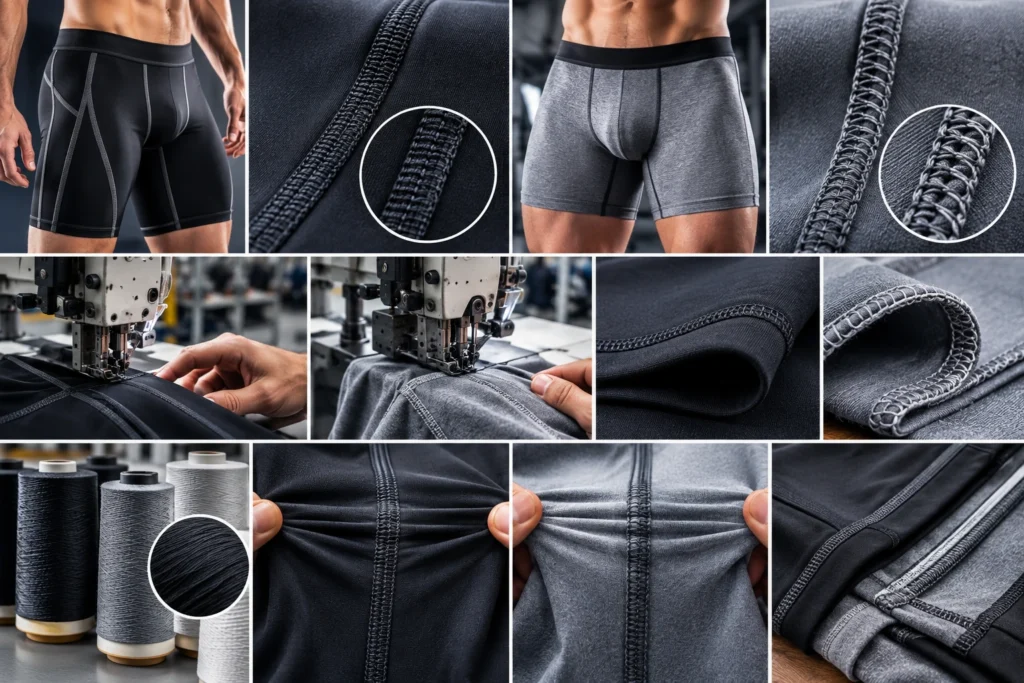
Flatlock seams sit nearly flush against the fabric, joined with either a 2-thread or 3-thread construction. 2-thread flatlock is lighter and softer, suited to base layers and lower-stress zones. 3-thread flatlock is denser and more durable, and it’s the construction used on compression leggings, running shorts, and any inner-leg or crotch seam that takes repeated friction under load. Overlock seams, by contrast, leave a raised ridge on the inside of the garment, roughly 3-7mm, which is fine for a relaxed-fit boxer brief but becomes a chafe point on a tight compression short.
The seam choice isn’t just a comfort decision, it’s a cost decision. True flatlock construction typically runs 30-50% more expensive than an overlock seam on the same garment, because it needs dedicated flat-seamer machinery and a more skilled, slower sewing operation. That premium is the actual, unglamorous reason budget compression shorts default to overlock or a shortcut sometimes called “mock flatlock” (a loose-tension overlock stitch pulled flat to imitate the look), which tends to fail under real stretch stress by separating at the seam or rupturing a single thread. Thread and yarn quality matter here too. The same open-end versus ring-spun yarn strength gap documented in woven fabric applies to sewing thread, and a mock-flatlock seam sewn with a weaker thread fails faster under the same stretch load. A tech pack that just says “flatlock seam” without specifying thread count or construction is leaving the door open for that shortcut.
Boxer briefs use overlock or coverstitch construction far more often, and that’s the correct call for the garment, not a quality compromise, since a boxer brief isn’t under the same repeated stretch load a compression short sees during actual movement.
The gusset, the panel at the crotch of both garment types, gets almost no attention on most tech packs beyond “add gusset,” and that’s usually where fit and durability complaints trace back to.
A gusset is a separate pattern piece, not a fold or a seam allowance. Boxer brief construction commonly uses a two-layer approach: an exterior gusset fabric matching the garment, and an interior gusset fabric underneath it, with the top edges sewn into the waistband either touching or overlapping by about a quarter to half an inch. Some modern patterns remove the side seam through the hip and inner thigh area specifically to cut down on chafing at exactly the point where two seams would otherwise cross.
Compression shorts carry the same gusset logic under more load, since the panel has to move through a full range of motion without bunching or pulling at the waistband seam. A gusset spec that only says “cotton lining, standard fit” tells a factory nothing about layer count, fabric weight, or waistband attachment method, and that’s usually where a fit complaint on a reorder actually originates, not in the main body fabric.

Almost every compression short on the market claims moisture-wicking performance, and almost none of them cite a test standard behind the claim. Two real ones exist, and buyers rarely ask for either by name.
AATCC 195 measures liquid moisture management: a test solution is dropped onto the fabric between sensor grids, and the test tracks wetting time, absorption rate, and how fast moisture spreads across the top and bottom surfaces, producing an Overall Moisture Management Capability (OMMC) score. It’s not suitable for high-absorbency fabrics like terry cloth, which is a useful thing to know if a supplier tries to apply it to the wrong fabric type.
AATCC 100 is the standard antimicrobial test, measuring both bacteriostatic activity (does it stop bacteria from growing) and bactericidal activity (does it actually kill bacteria already present) after 24 hours of contact between the fabric and a bacterial suspension. “Anti-odor technology” on a hangtag with no AATCC 100 result behind it is a marketing claim, not a verified one.
Neither test is exotic or expensive to request. Asking a supplier for AATCC 195 and AATCC 100 results on a compression fabric, rather than accepting “moisture-wicking, anti-odor” as a description, is the difference between a spec sheet and an adjective.
Medical compression garments are rated and certified against real standards bodies with specific mmHg targets. Athletic compression apparel, the category compression shorts sit in, largely isn’t. There’s no equivalent universal certification a brand can point to and say “this short delivers 20-30mmHg, verified.” Compression levels in athletic wear are typically supplier-stated, not third-party audited, and a buyer sourcing compression shorts should treat any specific mmHg number on a spec sheet as a supplier claim to verify through fit-and-function testing, not a certified fact the way a colorfastness rating would be.
This is worth saying plainly rather than implying more certainty than exists. It’s also, honestly, part of why the seam construction and fiber ratio specs above matter more than a compression-level number a supplier can’t actually back with a lab result, and why verifying claims through actual inspection rather than taking a supplier’s word for it is the more reliable path.
Not usually. Compression fabric's spandex share (15-25%) is built for support under movement; a boxer brief at that stretch level would feel unnecessarily tight and would cost more than the garment needs. They're specced separately for a reason.
No. Above roughly 25% spandex, fabric moves into shapewear territory, more restrictive than most athletic use calls for. The right percentage depends on the support level the garment is designed to deliver, not on maximizing the number.
Usually a spandex-content or yarn-quality issue, sometimes a seam construction shortcut like mock flatlock. Stretch recovery is a real, testable property; a supplier who can't provide any recovery data on the fabric is a flag worth acting on before a bulk order.
It depends on the base fiber. Cotton and modal manage moisture differently than polyester microfiber does, and a topical wicking finish on a natural fiber typically washes out faster (often within 20-30 cycles) than an inherent wicking property engineered into a synthetic yarn.
2-thread is lighter, softer, and suited to lower-stress areas like base layer seams. 3-thread is denser and holds up under the repeated stretch and friction a compression short's inner-leg and crotch seams see during actual movement.
Two practical checks: turn the garment inside out and feel for a flush seam rather than a ridge, and stretch the seam firmly to see whether it holds flat or starts to separate ("grin") at the stitch line.
Yes, generally in shape and panel count rather than in the basic two-layer logic, since fit needs differ by anatomy. The construction principle, a separate reinforced panel with a clearly specified layer count and attachment method, applies to both.
No, and they're often confused. Denier measures yarn fineness; GSM measures the finished fabric's weight per square meter. Two fabrics with the same denier yarn can land at different GSM depending on knit density and construction.
Spandex percentage and denier together (not just one), thread count on the flatlock seam, gusset layer count and attachment method, and any moisture-wicking or antimicrobial test results the supplier can actually provide, rather than accepting the adjectives alone.
* * *

FOUNDER & CEO AT RIJIZ