
Screen printing and DTG both put a design onto a garment, and that’s roughly where the similarity ends. They use different equipment, different ink chemistry, and different economics, and each one was genuinely built to solve a different production problem rather than compete head to head on quality. Our own screen printing service and DTG printing service both run in-house, which is a useful vantage point for this comparison: we’re not trying to sell a brand on one method over the other, we’re trying to match the method to what the order actually needs.
The short version, expanded through the rest of this guide: screen printing is a mesh-and-ink process that gets cheaper and faster per unit as volume climbs, and it’s the stronger choice for bold, simple graphics printed in bulk. DTG is a digital, print-head process with almost no setup cost, and it’s the stronger choice for full-color, detailed artwork or an order too small to justify burning a set of screens. Neither one is the “better” method in the abstract. The right one depends on the order in front of you.
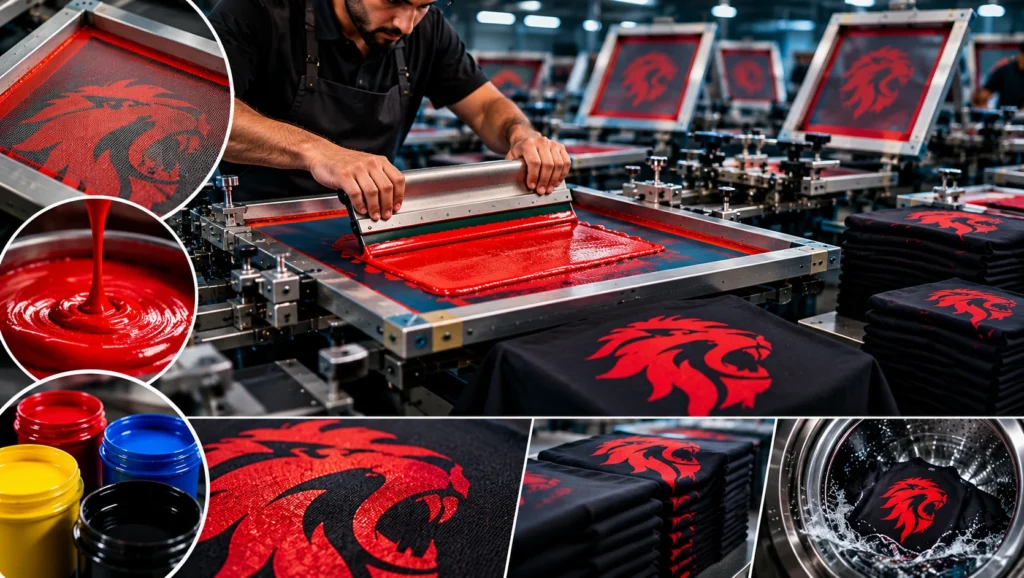
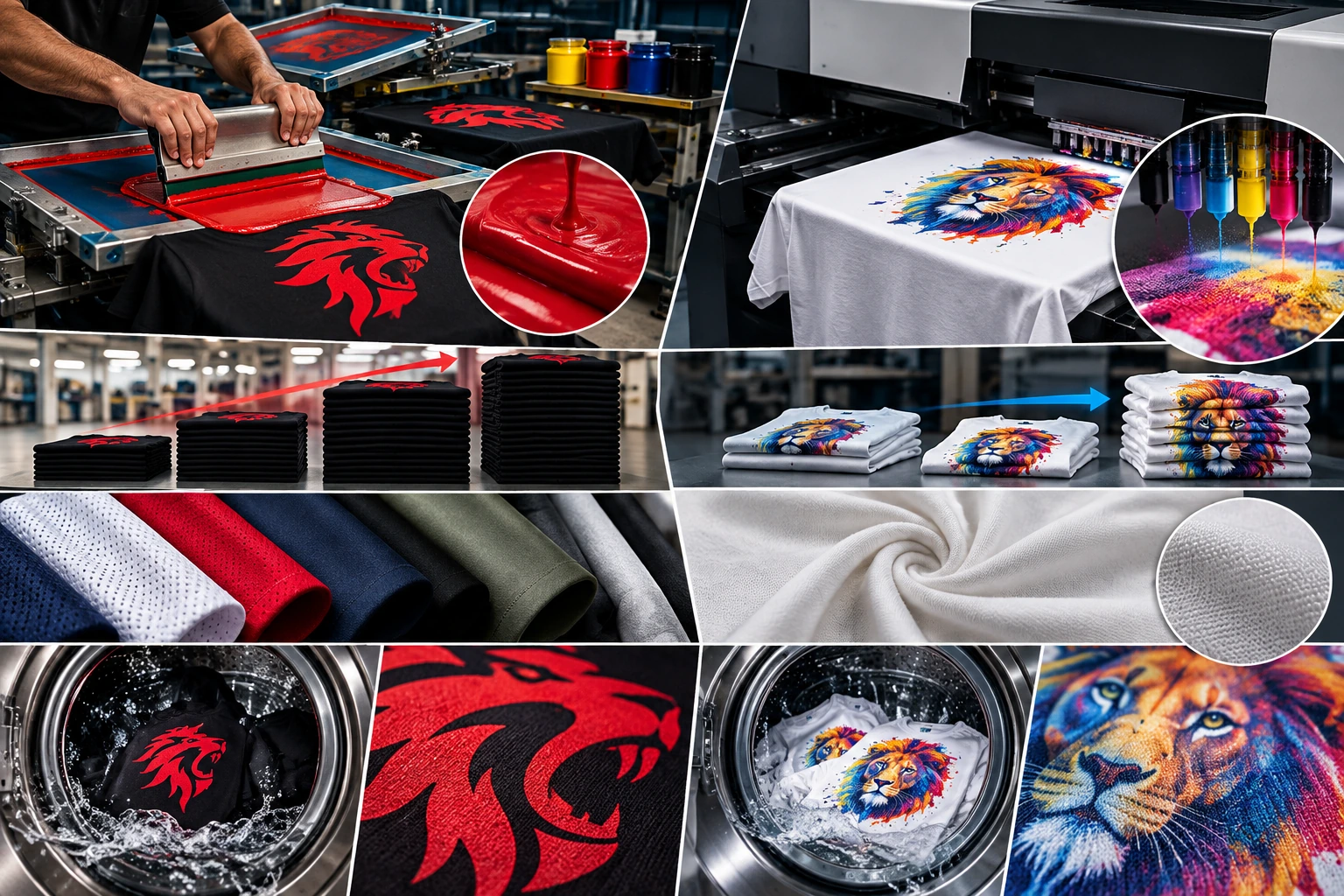
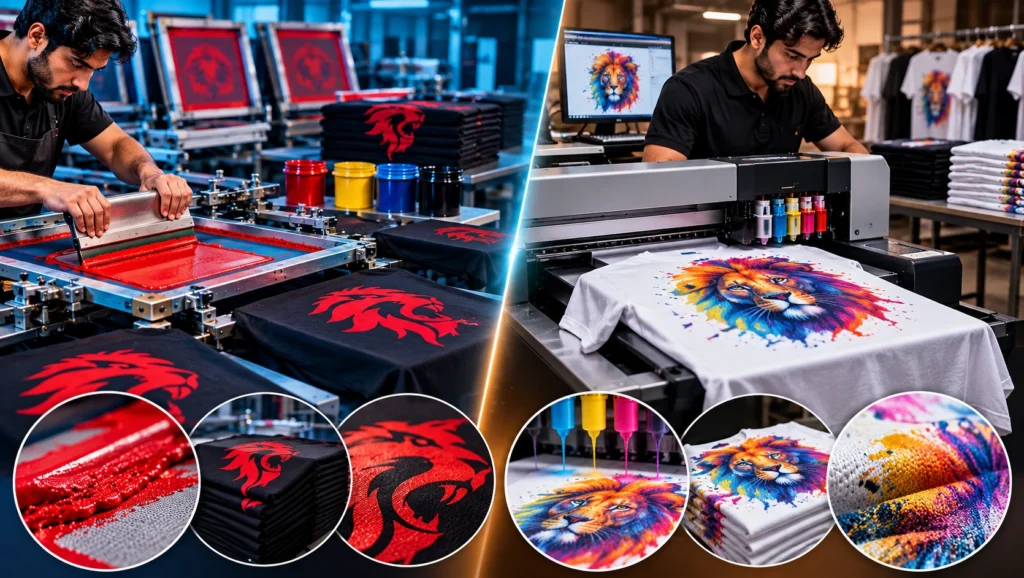
Screen printing works by stretching a fine mesh screen over a frame, blocking out everything except the design with a light-sensitive stencil, then pushing ink through the open mesh onto the garment with a squeegee. Each color in a design needs its own screen and its own pass, so a five-color graphic means five screens, aligned precisely and printed one after another.
The mesh itself does real work. A coarser, lower mesh count lets more ink through per pass, which produces the bold, opaque coverage that reads well on dark fabric. A finer, higher mesh count restricts ink to a much smaller opening, which is what lets a screen printer separate a gradient or a photographic image into the microscopic halftone dots that recreate smooth shading. Coating thicknesses in screen printing typically run far heavier than other print processes, according to the EPA’s own technical overview of the printing industry , which is exactly why screen prints read as thicker and more opaque than a digital print on the same shirt.
Ink choice matters as much as mesh. Plastisol, a thick PVC-based ink, sits on top of the fabric and delivers the highest color opacity and the most exact Pantone matching, which is why it’s the standard for streetwear, workwear, and anywhere exact brand colors matter. Water-based ink soaks into the fibers instead of sitting on top, producing a softer hand feel that suits lightweight cotton. Discharge printing goes a step further on dark garments, chemically removing the shirt’s own dye and replacing it with the ink color in the same pass, avoiding the thick base layer a standard print needs to show up on black fabric. Once ink is applied, it still has to be cured correctly, held at a specific temperature for the full thickness of the ink layer, or the print will crack and flake the first time it’s washed rather than bonding permanently to the fabric.
The setup labor is the tradeoff for all of that capability. Burning multiple screens, aligning them on a press, and mixing exact ink batches takes real time before the first shirt prints, which is why screen printing carries a minimum order quantity in most shops. Once that setup is done, though, a press can turn out a large run quickly, and the per-unit cost drops as volume rises, since the fixed setup cost gets spread across more shirts.
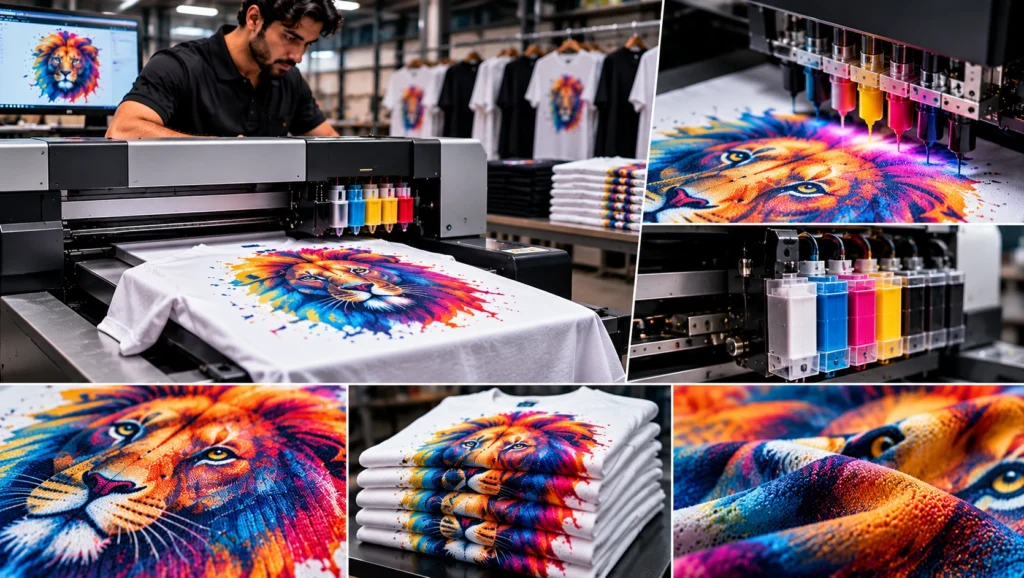
Direct-to-garment printing skips the mesh entirely. A DTG machine is closer in principle to a large, specialized inkjet printer: the garment is loaded onto a flat platen, and print heads pass over it, jetting water-based ink directly onto the fabric in a single digital pass, mixing full color as it goes rather than requiring a separate screen per hue.
That mechanism is what makes DTG strong on detail. Because color isn’t limited by how many screens a brand is willing to pay for, a DTG file can carry a full photographic gradient, a complex illustration, or dozens of blended tones without any extra setup cost per color. DTG typically requires the garment to be pre-treated before printing, a step that flattens loose surface fibers and helps the ink bond to the fabric, particularly on dark garments where a white ink underbase has to sit under the color layer to show up at all.
Fabric matters more here than it does for screen printing, because the ink itself is chemically built to bond with natural cellulose fibers. A 100% cotton or high-cotton-content garment, ideally combed and ring-spun so the surface is smooth and free of stray fibers, gives DTG ink a flat, even surface to land on. That dependency is the flip side of DTG’s flexibility: there’s no minimum order and no screen setup, but the process only works reliably on the fabric it was built for.
Before design or fabric ever enters the conversation, order volume typically narrows the choice down to one method on its own. Screen printing’s cost structure is front-loaded: screens have to be burned and aligned before a single shirt prints, so that fixed cost gets divided across the run. A small order absorbs that setup cost per unit almost entirely, which is why most screen printing shops set a minimum order quantity rather than accept a one-off. A large order spreads that same fixed cost thin, which is exactly when screen printing becomes the cheaper method per unit.
DTG inverts that curve. There’s no screen to burn and no press to align for a new design, so the cost of printing one shirt and the cost of printing the fiftieth shirt in a batch are close to identical, since each garment is printed individually regardless of how many came before it. That flat cost curve is DTG’s real advantage for a small run or a one-off sample, and it’s also DTG’s real limitation at scale, since nothing about the process gets meaningfully faster or cheaper as volume climbs the way screen printing’s setup-amortization does.
Neither curve is fixed to an exact number, since real minimums and real per-unit costs vary by factory, ink, and design complexity. What holds across the industry is the shape of both curves: screen printing rewards volume, DTG stays flat regardless of it. Our own guide to how we set minimums across our own line covers why a factory picks the number it does, which matters just as much as the print method once you’re sizing an actual order.
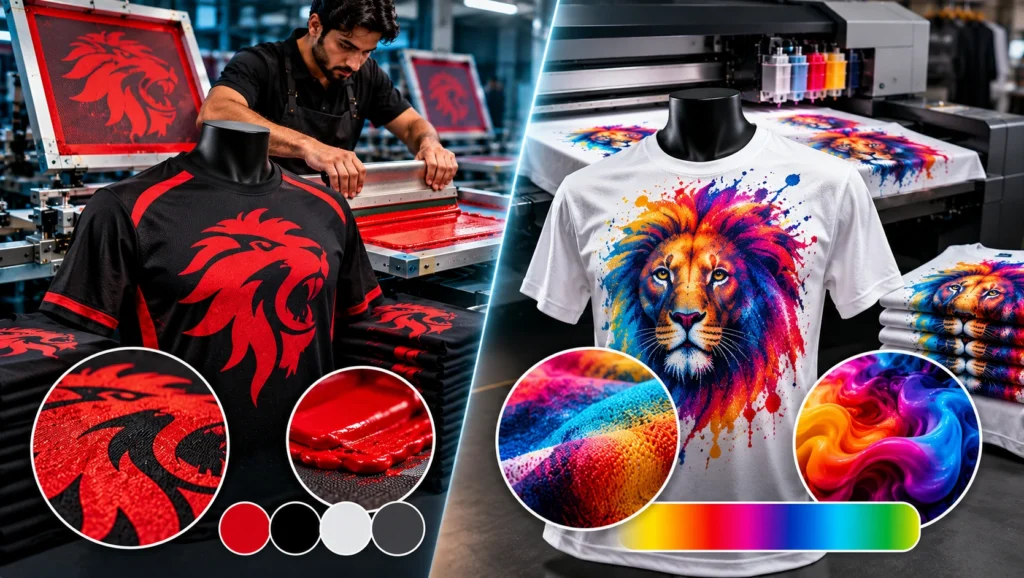
A design’s color structure points toward one method almost as strongly as volume does. A logo built from one, two, or three solid spot colors, the kind of graphic where every element is a flat, defined color with a hard edge, is exactly what screen printing was built to reproduce: crisp edges, exact Pantone matching, and strong opacity, especially on dark fabric.
A design built from gradients, photographic elements, or dozens of blended tones asks a different question. Screen printing can approximate that kind of art using halftone separation, breaking a gradient into a pattern of dots at varying density, but it takes real pre-press skill and additional screens to do it well. DTG doesn’t need that workaround, since the print head mixes full color on the fly without any per-color setup, which is why DTG tends to look effortless on exactly the kind of artwork that makes screen printing work the hardest.
Specialty finishes cut the other way. Puff ink, metallic and shimmer additives, and exact custom-mixed Pantone colors are screen printing techniques with no direct DTG equivalent, since they depend on physically mixing an additive into the ink itself before it’s pushed through a screen, not on how the color is applied to the garment.
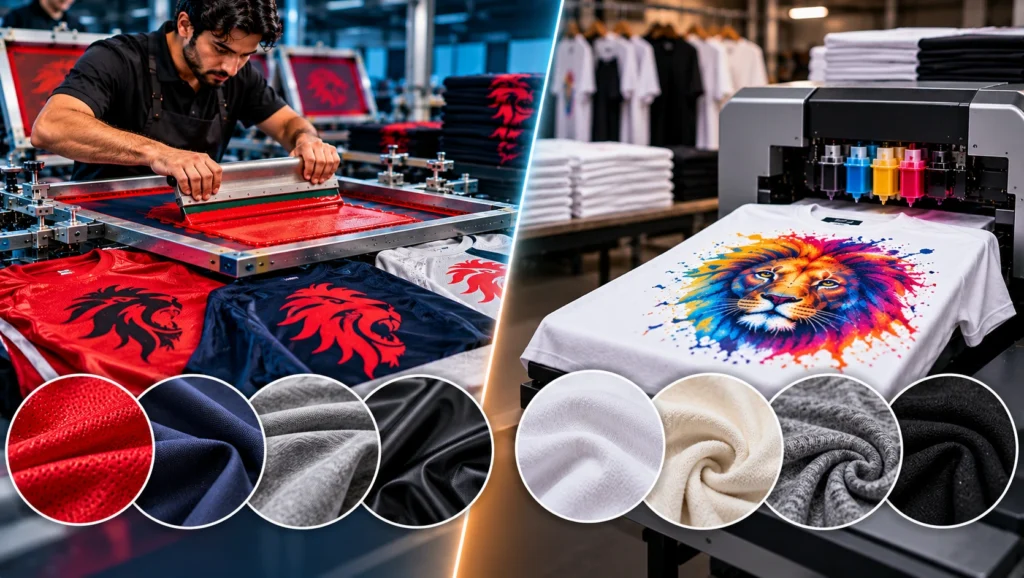
This is the constraint that rules a method out fastest, independent of anything else in this guide. DTG ink is chemically formulated to bond with natural cellulose fibers, cotton, bamboo, and hemp among them, and it does not bond reliably with synthetic fibers. A polyester athletic shirt or a heavy tri-blend printed with DTG risks ink that sits on the surface rather than bonding into it, which shows up later as bleeding during cure or flaking after the first wash.
Screen printing doesn’t carry that restriction. With the right ink formulation for the substrate, it prints across cotton, polyester, blends, and even non-apparel materials without changing its underlying process, which is part of why screen printing remains the default for performance and athletic fabric where DTG isn’t a realistic option at all.
For a brand building a mixed collection, cotton tees alongside poly-blend performance pieces, this constraint alone can mean the same design gets produced two different ways depending on which garment it’s going on, not because of a design preference but because of what the fabric will physically accept.
Every print method eventually gets judged by how it looks after repeated washing, and that’s a property with an actual test behind it, not just a claim either side makes about the other. AATCC’s Test Method 61 for colorfastness to laundering is an accelerated laundering test: a single 45-minute lab cycle is designed to approximate the color loss and surface wear a fabric would show after roughly five real hand or home washes, evaluated against a standardized reference scale.
That kind of standardized testing matters because “durable” is otherwise just an adjective. A properly cured plastisol print, cured to the correct temperature all the way through the ink layer, bonds as a distinct layer on top of the fabric and generally resists cracking through repeated wash cycles. A properly cured DTG print bonds into the fibers themselves rather than sitting on top, which gives it a softer hand feel, and it holds up well through normal wear when cured correctly, though the ink layer is thinner by nature of how it’s applied. Curing temperature is the variable that actually determines the outcome for either method: an under-cured print, screen printed or DTG, fails in the wash regardless of which process produced it. The method matters less than whether the factory running it controls that variable precisely.
There’s a labeling and compliance angle worth naming here too, separate from durability. In the US, screen-printed graphics on children’s apparel are treated as a surface coating for lead-content compliance purposes, a distinction the Consumer Product Safety Commission addresses directly in its own guidance , which is one more reason ink chemistry, not just the finished look, is worth asking a factory about before committing to a print method for kidswear or any regulated category.
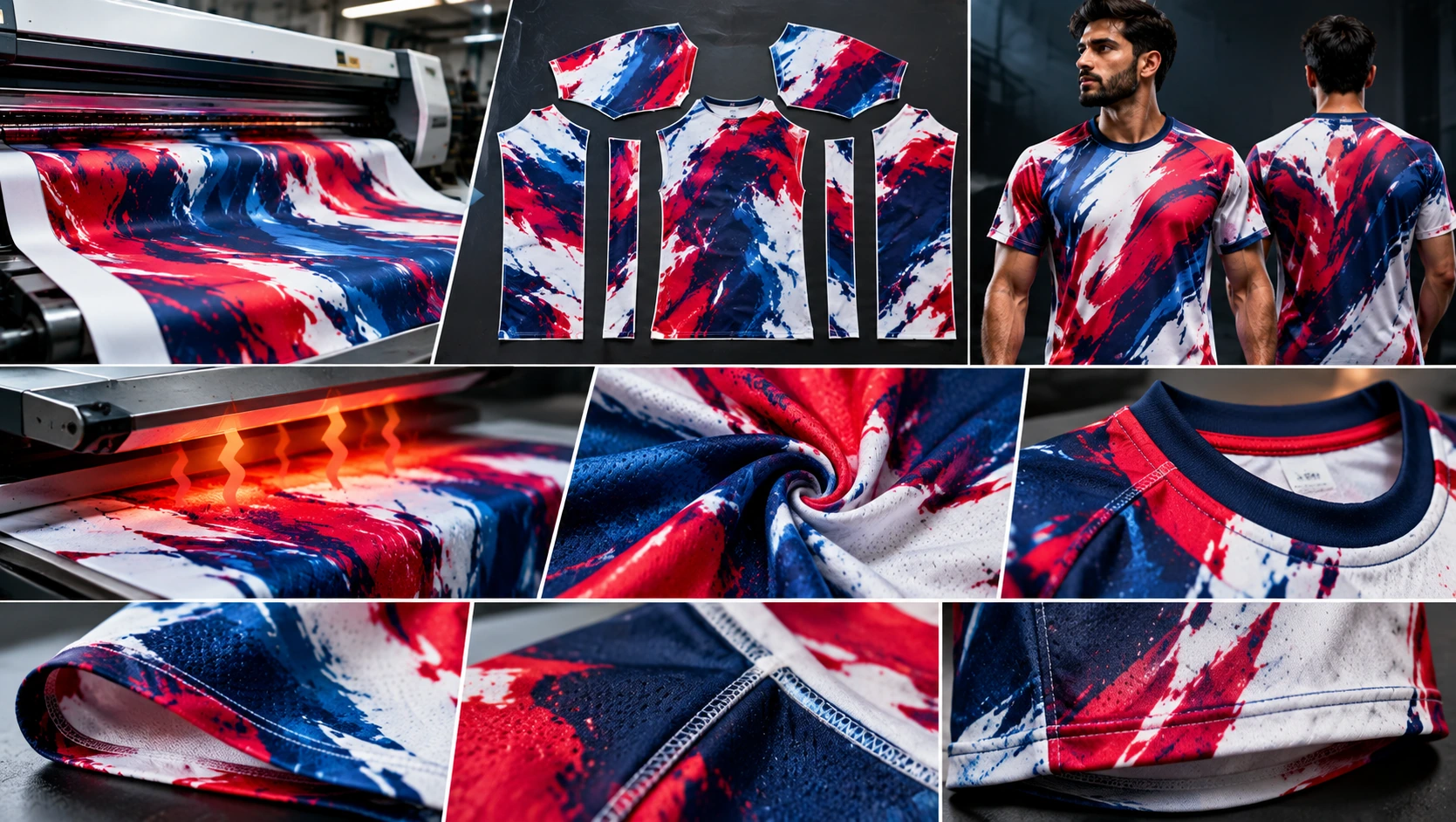
Screen printing and DTG both apply ink to the surface of a cut-and-sewn garment. All-over print, produced through sublimation, works differently at a more fundamental level: dye is printed onto transfer paper first, then heat-transferred into the fabric before the garment is even cut, so the color becomes part of the fiber itself rather than a layer applied afterward. That makes it the right tool for edge-to-edge, seam-crossing graphics that neither screen printing nor DTG can reproduce cleanly on a finished garment. Our companion guide on all-over print, planned as a follow-up to this one, covers that process and its own fabric constraints in full.
This is the part that’s ours specifically, not general printing theory. When a brand brings us a design, the first questions we ask are the same ones this guide walks through: how many pieces, how many colors, is the art built from flat spot colors or gradients, and what’s the base fabric. Bold, one-to-three-color logos on cotton or blended tees, printed at real volume, generally go through our screen printing line , where mesh count and ink formulation get matched to the specific artwork rather than defaulted to one standard setup. Full-color, detailed, or photographic artwork on a high-cotton-content garment, especially at lower quantity, generally goes through our DTG line instead, where dual-CMYK print heads and a climate-controlled production floor handle the color complexity a screen setup would struggle with.
Either path runs through the same quality checks before it ships. Our quality control and inspection process covers print adhesion and curing consistency the same way it covers stitching and measurements, because a print that looks right on day one and fails in the wash is still a quality failure, not a design problem. We run at MOQ 30 per design, with sampling typically around 12 days and bulk production around 18 days once a sample is approved, and if the finished order doesn’t match what was promised, that’s covered by a full refund or free remake, not a negotiation.
We’ve been doing this since 2016, working with brands across the EU, US, Australia, and Canada under ISO 9001 and REX certification. If you’re not sure yet which print method fits your specific design and fabric, get in touch and we’ll walk through the actual artwork with you before you commit to either one.
Screen printing pushes ink through a mesh stencil, one screen per color, and builds up opaque layers on top of the fabric. DTG sprays water-based ink directly onto the garment using a digital print head, mixing full color in a single pass with no screens involved.
It depends entirely on order size. DTG has almost no setup cost, so its per-unit price stays roughly flat regardless of quantity, which makes it cheaper for small orders. Screen printing carries upfront screen and setup costs that get spread across the run, making it cheaper per unit as volume increases.
Not reliably. DTG ink is formulated to bond with natural cellulose fibers like cotton, and it doesn't bond well with synthetic fabric. Screen printing, with the correct ink for the substrate, works across cotton, polyester, and blends without changing its underlying process.
Both can last through extensive washing if cured correctly, and both fail if they aren't. Plastisol screen prints sit as a distinct layer on the fabric and generally resist cracking when properly cured. DTG bonds into the fibers themselves, giving it a softer feel, and holds up well under normal wear when cured to the correct temperature. Curing quality, not the method itself, is usually the deciding factor.
There is. AATCC Test Method 61 is a standardized, accelerated laundering test used across the textile industry to evaluate colorfastness after repeated washing, approximating roughly five home launderings in a single lab cycle.
Screen printing requires burning and aligning a separate screen for every color before the first shirt prints, which is real labor and material cost that needs enough units to spread across. DTG has no comparable setup step, since each garment is printed individually from a digital file.
Yes, using halftone separation, which breaks a gradient into a pattern of dots at varying density to approximate smooth shading. It takes more pre-press skill and additional screens than a simple spot-color design, which is part of why highly detailed artwork often moves to DTG instead.
Not universally. Screen printing's thicker, opaque ink layers tend to give strong color pop on dark fabric without much extra work. DTG can also print well on dark garments, but it requires a white ink underbase applied first so the color layer shows up correctly, which is an extra step in the process rather than a quality limitation.
All-over print, produced through sublimation, transfers dye into the fabric before the garment is even cut, rather than applying ink to a finished, cut-and-sewn piece. That makes it suited to edge-to-edge, seam-crossing graphics that neither screen printing nor DTG can reproduce cleanly on an assembled garment.
* * *

FOUNDER & CEO AT RIJIZ