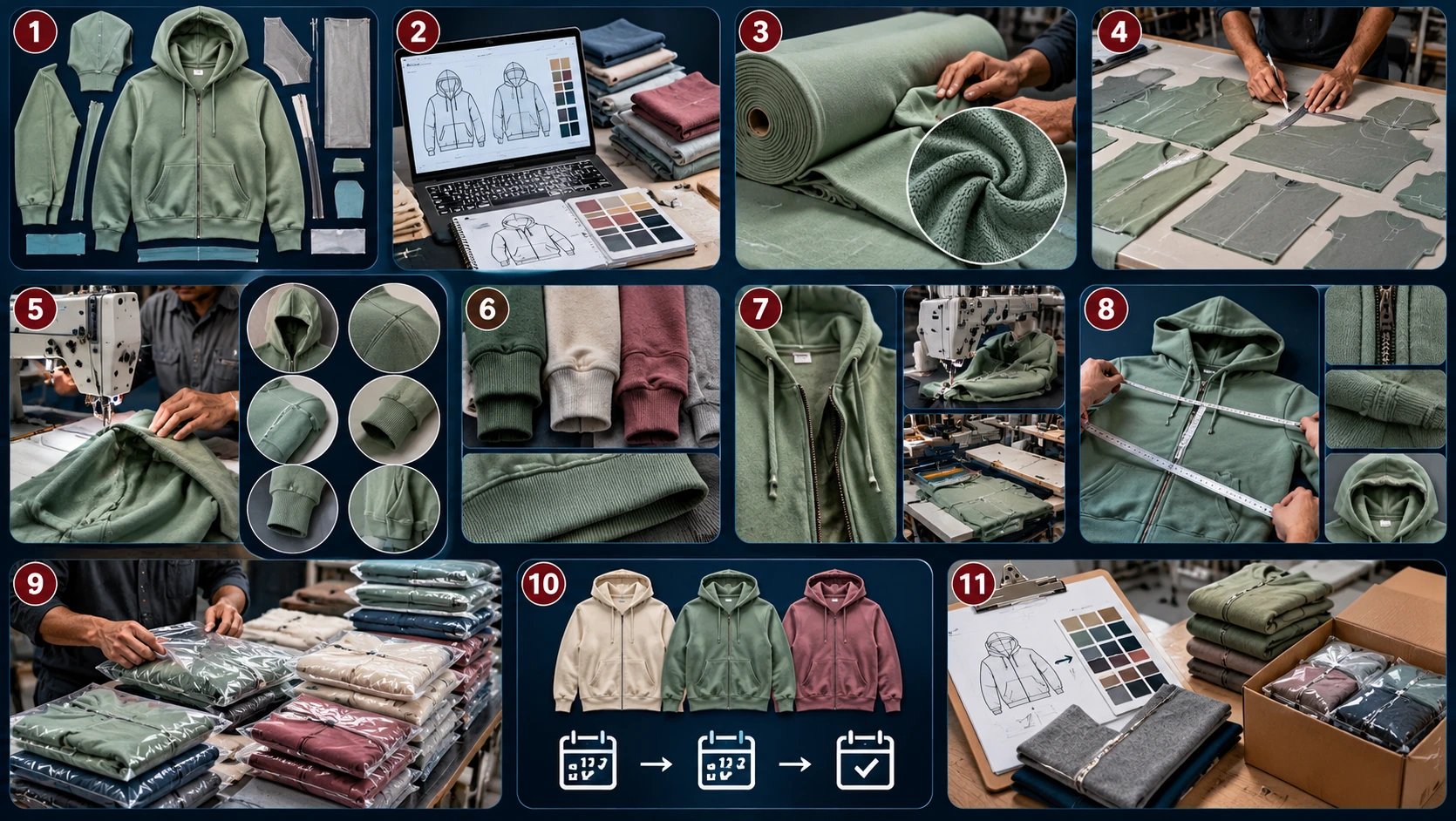

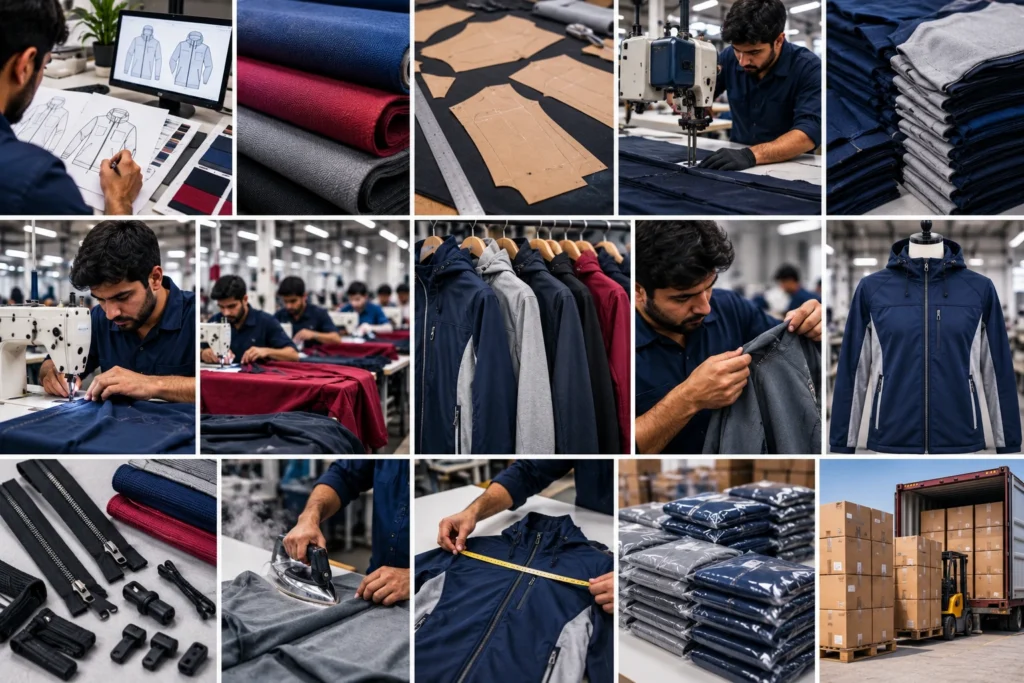
“Cut and sew manufacturing” gets used as shorthand for the entire garment production pipeline, and that shorthand hides how many distinct, skilled steps actually sit inside it. Here’s the real sequence, in order.
Design and tech pack. Every downstream stage depends on this one being complete: technical flats, a point-of-measure spec sheet, a bill of materials, and construction notes. A factory builds what’s documented, not what’s implied.
Pattern making. The first physical (or digital) pattern pieces get drafted from the tech pack, translating a flat sketch and a set of measurements into the actual shapes fabric gets cut into.
Sampling. Proto, fit, and PP samples get built and approved before bulk cutting starts, confirming the pattern, fit, and construction actually work before real yardage is committed.
Pattern grading. The approved base pattern gets scaled up and down across the brand’s full size range, a separate skilled step from pattern making itself.
Marker making. Every pattern piece, across every size in the cut order, gets laid out across the fabric’s width to minimize waste before a single layer is cut.
Cutting. Fabric gets layered (sometimes hundreds of plies deep) and cut following the marker, either by hand, band knife, or automated cutter depending on the factory’s equipment and the order’s complexity.
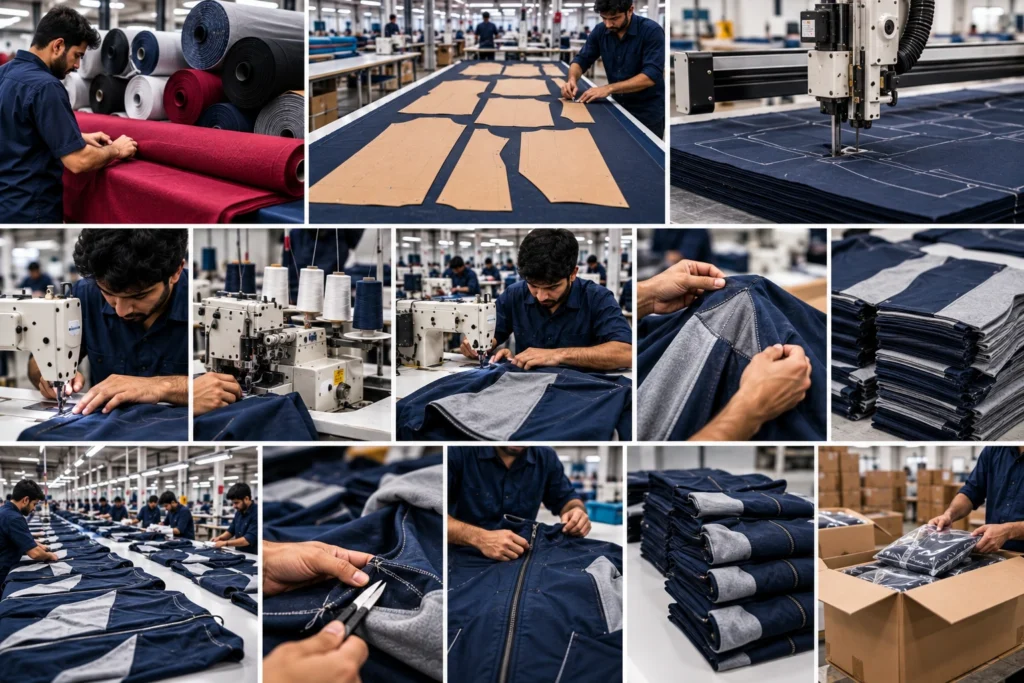
Sewing and assembly. Cut pieces move through the sewing line, assembled in a sequence specific to the garment’s construction, often across multiple specialized machine operators rather than one person building a whole garment start to finish.
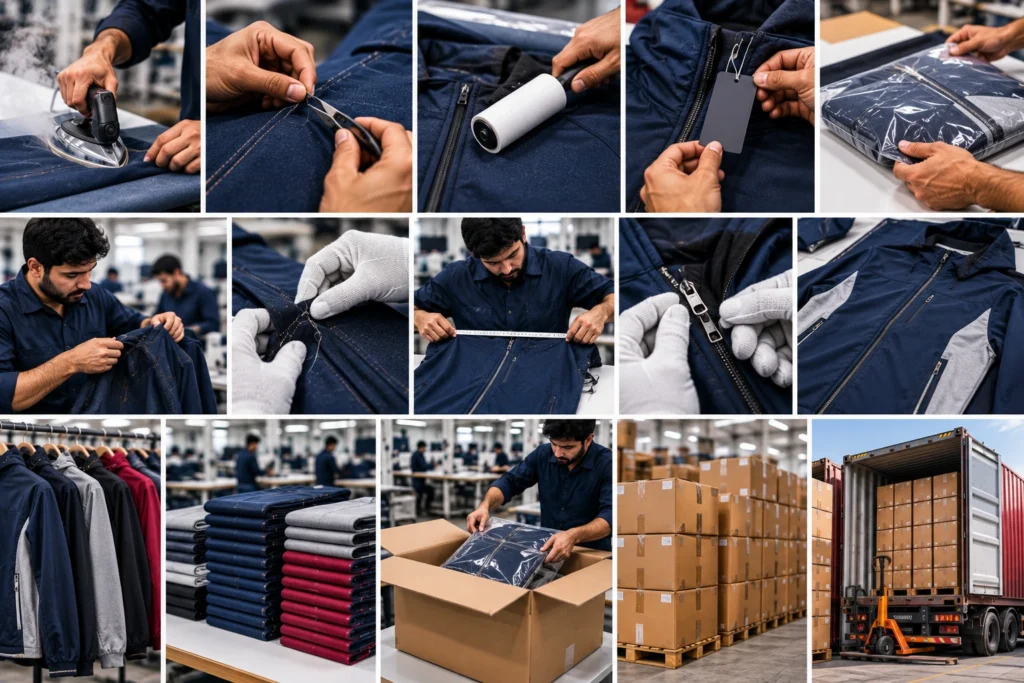
Finishing and QC. Trimming loose threads, pressing, attaching final trims and labels, and inspecting against the sealed PP sample before the garment is packed and shipped.
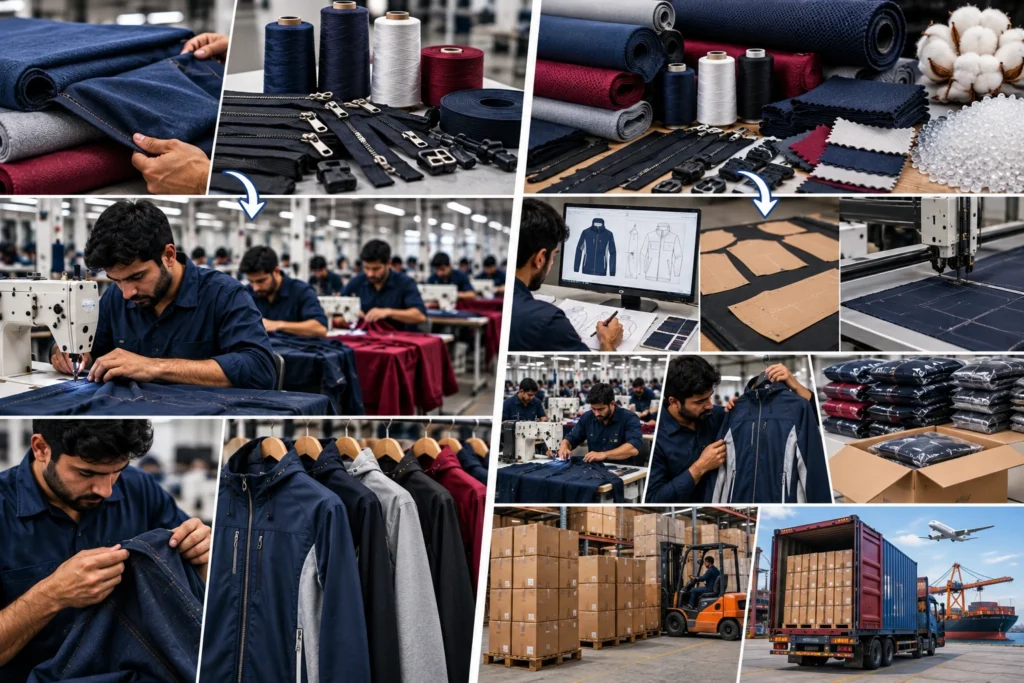
“Cut and sew manufacturer” gets requested by brands meaning two genuinely different things, and mixing them up leads to a quote that doesn’t match what the brand actually expected. CMT and FOB are the two standard terms for these models across the industry.
|
|
CMT (Cut, Make, Trim)
|
FOB / Full-Package
|
|---|---|---|
|
Who sources fabric
|
The brand
|
The factory
|
|
Who sources trims
|
The brand
|
The factory
|
|
Factory's role
|
Cutting, sewing, and trim application only
|
Sourcing, cutting, sewing, finishing, and often packaging
|
|
Brand's control over materials
|
Highest, brand picks every supplier
|
Lower, factory manages the supply chain
|
|
Typical fit for
|
Brands with existing fabric relationships or specific mill requirements
|
Brands wanting one point of accountability for cost and delivery
|
|
Pricing structure
|
Labor and trim cost only
|
A single per-unit price covering materials, labor, and overhead
|
Neither model is inherently better. CMT gives a brand maximum control over exactly which fabric and trims go into a garment, useful when a specific mill relationship or certification matters. FOB shifts sourcing responsibility to the factory in exchange for a single, simpler per-unit price and one point of accountability if something goes wrong with a component. A brand requesting a quote should specify which model they’re asking about, since a CMT quote and an FOB quote for the “same” garment can differ enormously and aren’t actually comparable numbers without knowing which one each figure represents. A factory offering both models across its manufacturing services can usually walk a brand through which one fits a given program better before a quote is even drawn up.
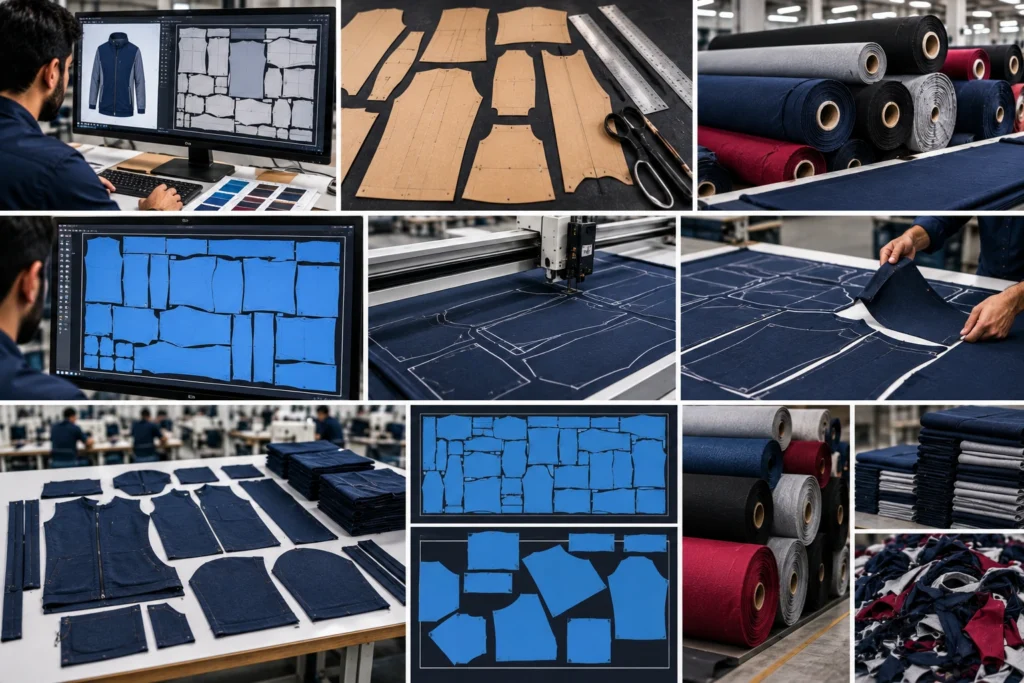
Marker making is the step most brands never see and most cost breakdowns don’t explain, and it’s one of the biggest hidden levers in a garment’s actual cost.
A marker is the layout plan: every pattern piece, in every size in the cut order, arranged across the fabric’s usable width to use as much of it as possible before a single layer gets cut. Marker efficiency is the percentage of the marker’s total area actually covered by pattern pieces, and a well-optimized marker typically lands at 82-90%. Fabric utilization is a related but distinct number, since it also accounts for end bits and end-of-roll losses that marker efficiency alone doesn’t capture, so the two figures aren’t interchangeable even though they’re often used loosely as if they were. Either way, the gap between a marker’s efficiency and 100% is real, unavoidable waste, offcuts and remnants that can’t be used for that cut order, not a rounding error or a sign of poor factory practice, it’s a structural reality of laying rectangular-ish fabric with curved, irregular pattern pieces.
This matters because fabric is usually the single largest line item in a garment’s landed cost, commonly 40-60% of total cost depending on the fabric type and construction complexity. A few percentage points of marker efficiency, multiplied across a bulk cut order, moves real money. A factory quoting an unusually low price on a garment with expensive fabric is worth a second look at how they’re managing utilization, not just at their labor rate.
Digital marker-making software has largely replaced hand-drawn markers at any factory doing meaningful volume, since software can test and compare layout permutations far faster than a person laying paper patterns by hand, but the underlying tradeoff, pattern shape versus fabric width versus waste percentage, hasn’t changed.
Grading is the process of scaling an approved base pattern (usually a middle size, like a Medium) up and down to produce every other size in the brand’s range, and it’s a distinct skilled discipline from drafting the original pattern.
A grade isn’t a simple uniform scale-up. Different points of measure grow or shrink at different rates between sizes, chest, waist, sleeve length, and rise don’t all move by the same increment step to step, and a grading error tends to show up as a specific-size fit problem rather than a whole-line issue. This is part of why a fit sample approved in one size doesn’t guarantee every size in the run fits correctly. A brand ordering a full size range should ask whether a size-set sample, not just a single middle-size fit sample, will be checked before bulk cutting.
Grade rules (the specific increment each measurement changes by, between each size) should live in the tech pack alongside the base pattern’s point-of-measure spec, not be left to the factory’s default assumptions, since default grade rules vary by factory and region and don’t automatically match a brand’s intended fit progression.
Once the marker is finalized, fabric gets spread in layers, sometimes just a few plies for a small order, sometimes hundreds deep for a large bulk run, and cut following the marker’s outline. Cutting method varies by factory and order size: hand-cutting with a straight or band knife for smaller runs or unusual fabrics, automated cutting machines for high-volume, standardized runs where precision and speed matter more.
Sewing and assembly rarely means one operator building one garment start to finish. Most cut and sew factories run a line system, where cut pieces move through a sequence of specialized operators, each handling one operation (attaching a sleeve, setting a collar, closing a side seam) repeatedly, which is faster and more consistent than a single-operator build for anything beyond very small custom orders. The sequence and machine assignment for a given garment is usually planned out before sewing starts, based on the construction notes in the tech pack.
Bottlenecks in this stage rarely trace back to sewing speed itself. They usually trace back to upstream delays, fabric or trim arriving late, an unresolved construction question that should have been settled at the tech-pack stage, or a marker that wasn’t finalized before cutting was scheduled to begin.
Finishing covers everything that happens after a garment is sewn and before it’s packed: trimming loose threads, pressing, attaching final trims and labels, and any wash or treatment specified in the tech pack. QC inspection happens throughout this stage, not just at the very end, checking the finished garment against the sealed PP sample rather than against the tech pack alone, since the sealed sample is the actual enforced benchmark by this point in the process.
AATCC , the American Association of Textile Chemists and Colorists, maintains over 200 standardized test methods covering everything from colorfastness to seam strength to dimensional stability after washing, and a factory citing a specific AATCC method by number for a QC check is giving a brand something checkable, unlike a general claim like “we do quality control.”
A brand’s own inspection, whether in-house or through dedicated quality control and inspection , at this stage is what catches a defect before it reaches a retail floor or a customer’s door rather than after, and it’s a genuinely different check than the sampling-stage approvals that happened earlier in the process.
A cut and sew manufacturer builds the garment itself from fabric and pattern pieces. A print-on-demand or decorator business starts with an already-finished blank garment and only adds print, embroidery, or another surface decoration. They're different businesses with different capabilities.
Not necessarily, and they're not directly comparable numbers on their own. CMT pricing only covers labor and trim application, so a brand also pays for fabric and trims separately, sometimes at a worse per-unit rate than a factory's own bulk sourcing would get. The real comparison has to include total landed cost, not just the quoted production fee.
It varies by order size and fabric type, from a handful of layers on a small or delicate-fabric run up to several hundred on a large, straightforward bulk order. More plies per cut is more efficient per unit but requires precise layer alignment, since an error compounds across every layer in the stack.
Because grading changes each point of measure by its own increment between sizes, not by one uniform scale factor. An incorrect grade rule on, say, the sleeve length typically shows up as a problem in the sizes furthest from the base size first, not evenly across the whole range.
The fabric utilization percentage the marker actually achieves, and confirmation that grade rules for every size in the cut order are reflected in it, not just the base size pattern.
Not automatically. Efficiency depends partly on pattern shape and fabric width, factors outside a factory's control. A brand should expect a factory to explain their utilization number and how they're trying to improve it, not assume any number below 90% means poor practice.
Finishing is the physical work: trimming, pressing, attaching trims, washing or treatment. QC is the inspection process that happens alongside and after finishing, checking the result against the sealed sample. They overlap in timing but aren't the same activity.
Yes, and it's a reasonable thing to ask for on any spec sheet where colorfastness, seam strength, or dimensional stability matters, rather than accepting a general "quality checked" claim with no specific method behind it.
There's real industry conversation about it, but reliable, specific figures on how much production has actually shifted are hard to pin down and vary widely by source, so this guide isn't going to quote a specific percentage without a defensible primary source behind it. The 8-stage process and CMT/FOB distinction above apply regardless of where the factory is located.
* * *

FOUNDER & CEO AT RIJIZ