
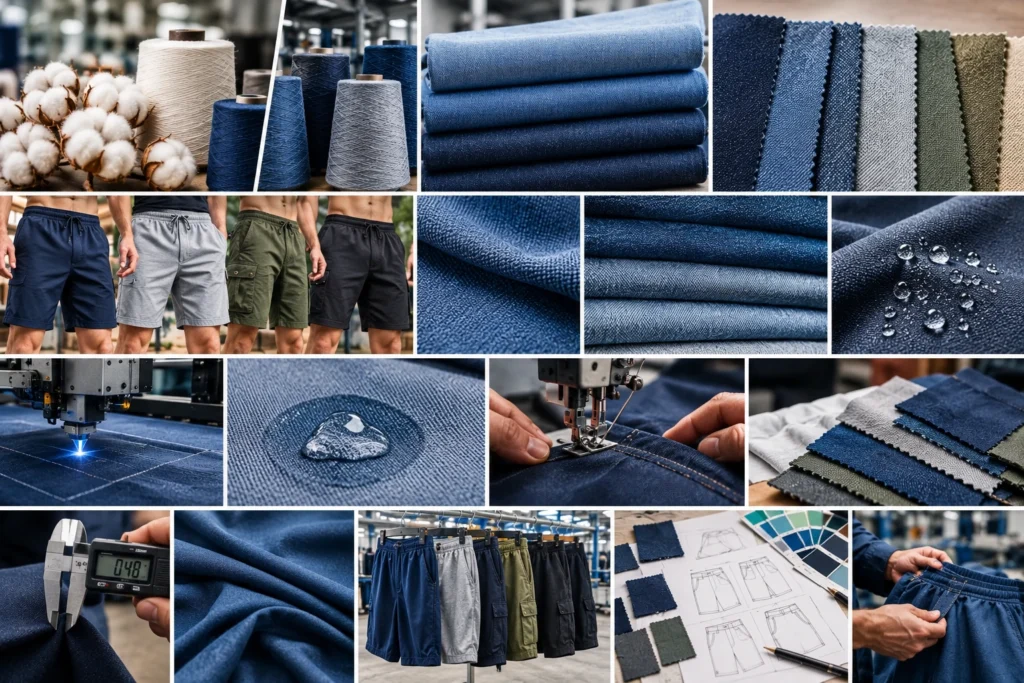
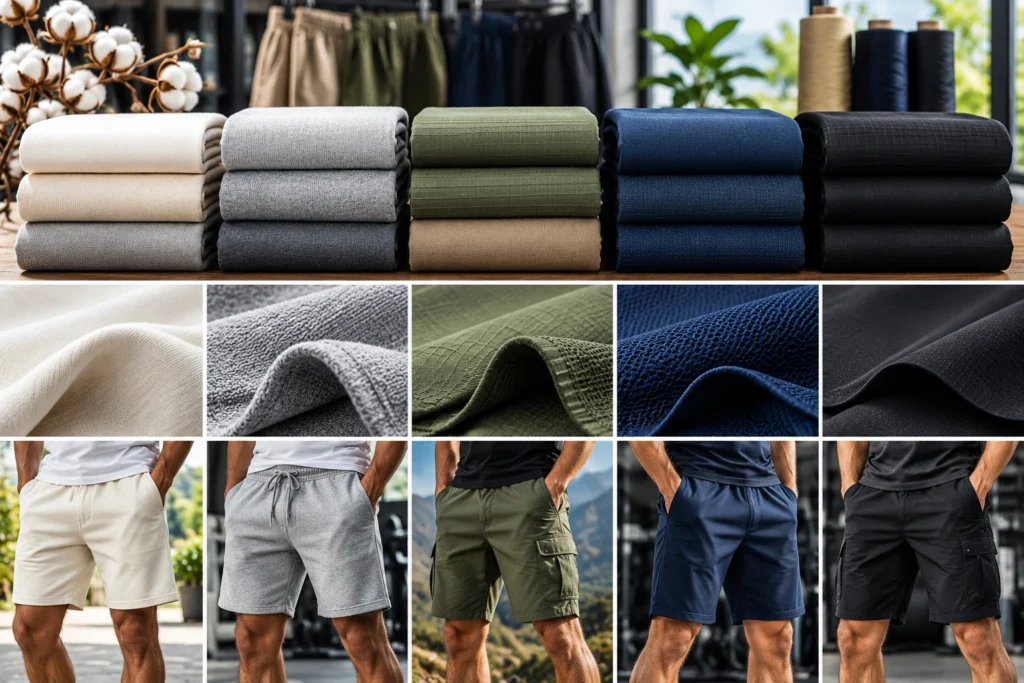
Every fabric below is a real, sourceable option for shorts production. The right one depends on what the garment is actually asked to do: move with the body during exercise, hold a crease for casual wear, resist tearing outdoors, or just feel good against skin in warm weather. GSM is the fastest way to compare weight across very different fiber types, so it’s the anchor column here.
Fabric options for shorts, by weight and use
|
Fabric
|
GSM range
|
Fabric
|
Best for
|
|---|---|---|---|
|
Lightweight cotton jersey
|
140-180
|
100% cotton or cotton-majority
|
Casual, loungewear
|
|
Performance knit (poly-spandex)
|
150-220
|
Polyester, 8-15% spandex
|
Athletic, running
|
|
Ripstop nylon (general)
|
150-200
|
Nylon
|
Outdoor, travel-weight
|
|
Nylon-spandex blend
|
180-250
|
Nylon, spandex
|
Swim-adjacent, running, outdoor
|
|
Organic cotton
|
200-260
|
100% cotton, GOTS-eligible
|
Casual, premium basics
|
|
Bamboo-cotton blend
|
180-240
|
Bamboo viscose, cotton
|
Soft-hand casual
|
|
Cotton-poly fleece blend
|
200-300+
|
Cotton-poly, 50/50 to 80/20
|
Loungewear, streetwear
|
|
French terry
|
220-280
|
Cotton or cotton-poly
|
Streetwear, mid-weight casual
|
A general framework worth keeping in mind across all of the above: 140-200 GSM reads as lightweight and breathable, 200-250 GSM as a balanced mid-weight, and 250 GSM and up as heavyweight, built for structure or warmth rather than airflow. Ripstop is the outlier that doesn’t fit neatly into that scale, since its GSM tracks with application more than with a simple light-to-heavy spectrum: as light as 40-70 GSM for packable, ultralight use, up through 150-180 GSM for everyday trekking or travel weight, 190-220 GSM for tactical or hard outdoor use, and 250 GSM or more once it’s doing workwear-level duty.
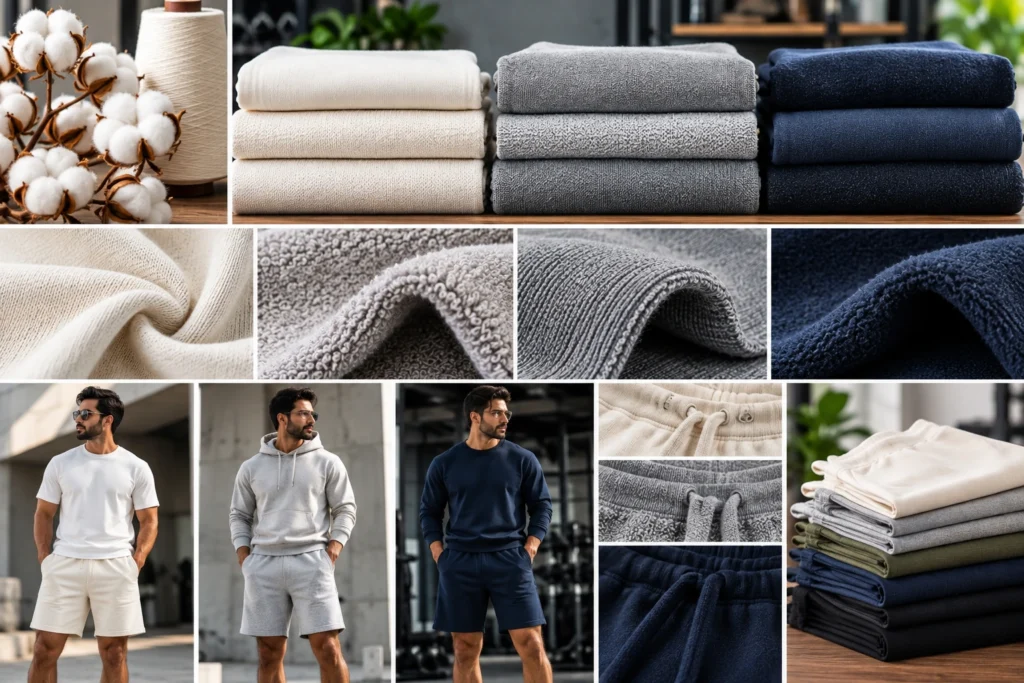
Cotton is still the default fiber for casual shorts, and for good reason: it breathes well, takes a garment dye evenly, and reads as premium at a lower cost than most technical alternatives. Lightweight cotton jersey, 140-180 GSM, is the right call for loungewear and warm-climate casual shorts where drape and softness matter more than structure.
French terry sits a step up in weight, 220-280 GSM, with a smooth outer face and a looped interior that improves both moisture absorption and insulation compared to a flat jersey knit. It’s the fabric behind most streetwear shorts and joggers, including the fleece and terry builds that run through Rijiz’s own tracksuit and streetwear programs , that need to hold a slightly more structured shape than jersey allows.
Cotton-poly fleece blends run heavier still, 200-300+ GSM, typically in ratios from 50/50 up to 80/20 cotton to polyester. The polyester share adds shape retention and faster drying; the cotton share keeps the hand feel soft. This is the fabric family for loungewear and streetwear shorts meant to hold structure through repeated washing, not for anything performance-oriented.
Organic cotton (200-260 GSM) and bamboo-cotton blends (180-240 GSM) sit in the same general weight range as standard cotton but carry different sourcing and certification implications, covered in the sustainability section below.
For athletic shorts, the fabric decision usually comes down to polyester-spandex or nylon-spandex, and the two aren’t interchangeable despite looking similar on a swatch card.
Polyester-spandex, typically 150-220 GSM, wicks moisture efficiently, resists UV fade better than nylon over time, and takes dye-sublimation printing directly, since polyester fiber accepts sublimation ink through a heat-conversion process that bonds the color into the fiber rather than sitting on top of it. It’s the more common choice when a program includes printed graphics or team branding.
Nylon-spandex, 180-250 GSM, has a softer hand feel, stronger abrasion resistance, and deeper color saturation from dyeing, which is why it shows up more often in swim-adjacent and outdoor-running shorts where surface abrasion and quick-dry performance matter more than print compatibility.
Both fiber families depend on the same spandex-percentage logic covered in this series’ compression shorts guide: below roughly 8% spandex, a knit is functionally 2-way stretch no matter what the hangtag claims; 8% and above is where genuine 4-way stretch starts.
Ripstop isn’t a fiber, it’s a weave: a reinforcement grid of thicker threads woven at regular intervals into a thinner base fabric, which stops a small tear from spreading into a large one. That structural trick is why ripstop shows up across such a wide GSM range, from ultralight packable shells down around 40-70 GSM up to tactical and workwear-grade fabric at 250 GSM and beyond.
For shorts specifically, the 150-200 GSM general-purpose band covers most outdoor, travel, and technical-casual applications: light enough to pack down, tough enough to survive abrasion against rock, gear straps, or repeated washing. Heavier ripstop, 190-220 GSM and up, moves into hardier outdoor or occupational use where tear resistance matters more than pack weight.
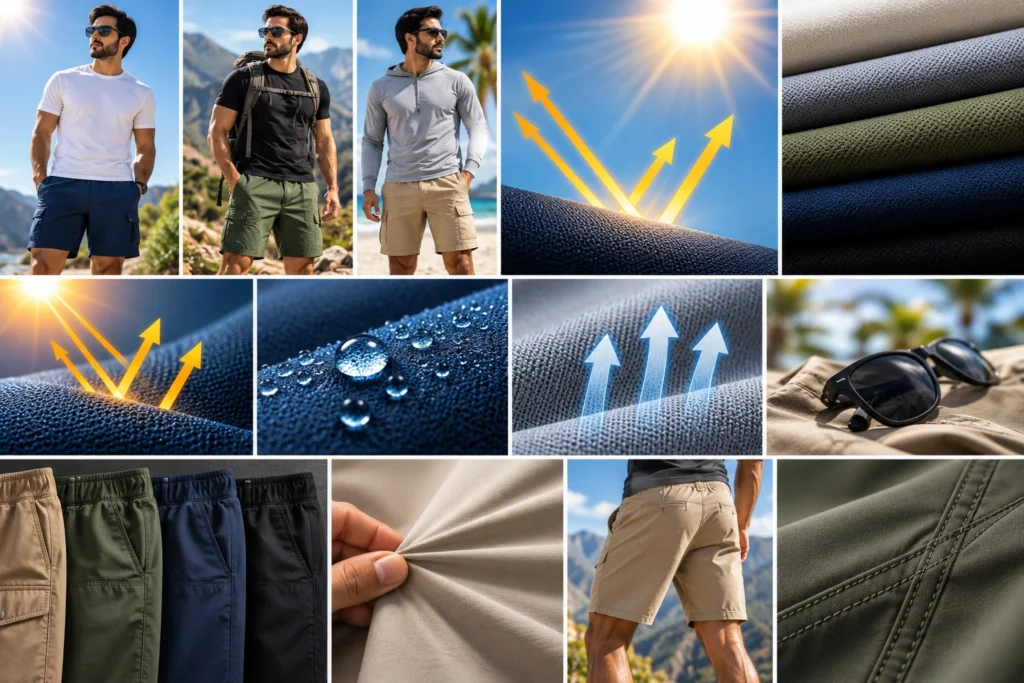
Shorts are a warm-weather, high-sun-exposure garment category, which makes UPF (Ultraviolet Protection Factor) a genuinely relevant spec, and it’s one that’s almost never mentioned on competing “best fabric for shorts” content, despite fitting this category better than most others in a manufacturer’s catalog.
UPF ratings run in bands: 15-20 rates as good (blocking roughly 93-95% of UV), 25-35 as very good (96-97%), and 40-50+ as excellent (98%+). A fabric’s UPF rating depends on fiber content, weave tightness, and even moisture state, since a wet fabric generally protects less than a dry one.
Two real testing standards govern UPF claims. AS/NZS 4399, the Australian/New Zealand standard, tests new, unstretched, dry fabric under a calibrated solar spectrum. UV Standard 801, developed by the International Testing Association for Applied UV Protection in Switzerland, tests fabric in three states, untreated, after rubbing, and after washing, including wet and stretched conditions, which generally produces lower, more conservative UPF numbers than AS/NZS 4399 because it’s testing the fabric under conditions closer to how it’s actually worn and used.
A brand sourcing shorts for a warm-climate or outdoor-adjacent market has a real reason to ask a supplier for a UPF number and the standard it was tested against , not just a “sun-safe” claim on the swing tag.
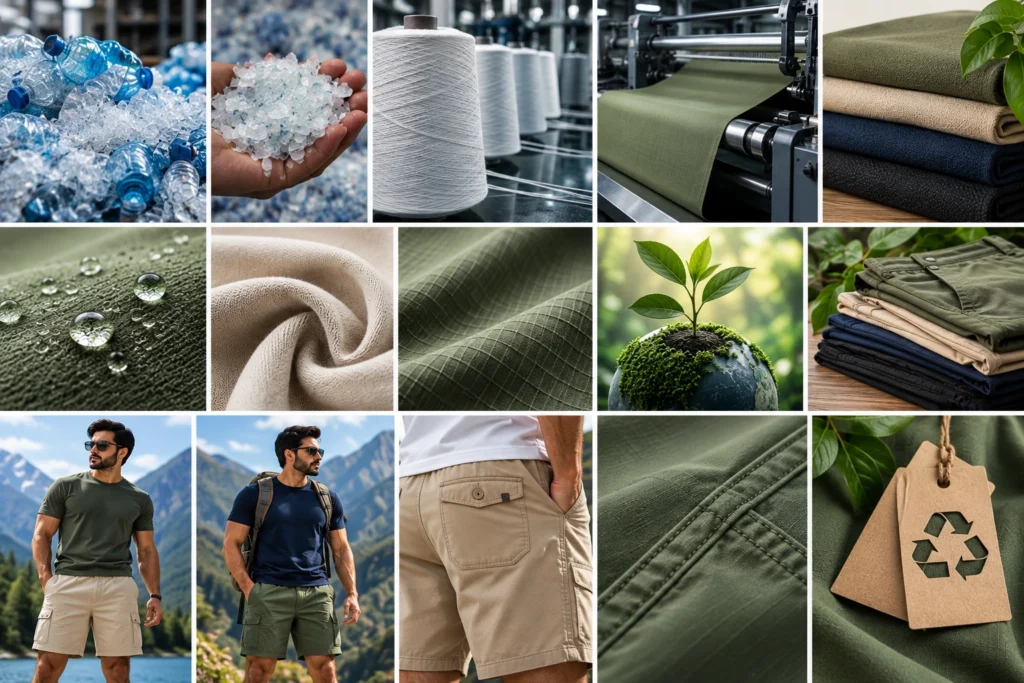
“Sustainable” and “eco-friendly” show up constantly in shorts fabric marketing with almost nothing behind them. A few real, sourced numbers are worth knowing before repeating a sustainability claim on a product page.
Global fiber production reached 132 million tonnes in 2024 , up from 125 million tonnes in 2023. Polyester alone is now 59% of total global fiber output, and 88% of that polyester is fossil-based, not recycled. Recycled polyester did grow in absolute volume, from 8.9 million tonnes in 2023 to roughly 9.3 million tonnes in 2024, but its share of the overall polyester market actually declined slightly, from 12.5% to 12%, because virgin polyester production grew even faster. Recycled polyester is also still made overwhelmingly from plastic bottles, about 98% of supply, with less than 1% of the global fiber market coming from pre- or post-consumer recycled textiles specifically, as opposed to bottles.
None of that makes recycled polyester a bad choice, it’s a real, functional option with a genuine supply chain behind it. It does mean a claim like “our shorts are made from sustainable materials” means very little without the certification behind it. The Global Recycled Standard (GRS) , managed by Textile Exchange, is the certification that actually verifies recycled content and chain of custody, and it’s worth asking a manufacturing partner for it by name rather than accepting “eco fabric” as a description.
GSM paired with fiber blend. Weight alone doesn't tell a factory how the fabric will behave; blend tells them whether it's built for stretch, structure, or breathability, and the two together are what actually determine performance.
Not necessarily. A heavier cotton-poly fleece resists pilling and holds shape well, but a well-constructed ripstop at a much lower GSM can outlast it against tearing and abrasion, because durability depends on weave structure as much as raw weight.
Rarely well. A performance knit built for moisture-wicking under movement compromises on the drape and hand feel a casual short needs, and vice versa. Brands running both categories usually need two fabric specs, not one compromise fabric.
Directly. Heavier fabric uses more raw fiber per garment, so cost tracks upward with GSM in most fiber families, though fiber type and finishing treatments can shift that relationship (a heavier basic cotton can still cost less than a lighter technical knit).
No. Ripstop describes the reinforcement weave, not the fiber. It's most common in nylon and polyester, but the grid-reinforcement technique can be applied to other synthetic and blended fabrics.
Not usually in hand feel or durability, the difference is in how the fiber was grown and processed, verified through GOTS certification. Performance-wise, organic and conventional cotton at the same GSM behave similarly.
Typically in the 180-250 GSM nylon-spandex range, since that fiber combination handles chlorine and saltwater exposure better than cotton or polyester-heavy blends, and holds shape through repeated wet-dry cycles.
No. Inherent wicking, engineered into the fiber or yarn cross-section itself, is permanent. A topical wicking finish applied after the fact typically degrades over 20-30 wash cycles. The two are not the same claim even when the hangtag language looks identical.
Because shorts are worn in exactly the conditions, warm weather, high sun exposure, direct skin coverage, where UV protection has the most real-world relevance. A jacket is rarely the garment standing between skin and midday sun the way shorts often are.
AS/NZS 4399 tests fabric new, dry, and unstretched. UV Standard 801 tests it after rubbing, washing, and while wet or stretched, conditions closer to real wear, which is why it generally produces more conservative (lower) UPF numbers for the same fabric.
Ask for the percentage. GRS certification applies at a 20% recycled-content minimum to fall under its scope at all, but the on-product GRS label requires at least 50%. "GRS-certified" alone doesn't tell a buyer which side of that line the fabric sits on.
* * *

FOUNDER & CEO AT RIJIZ