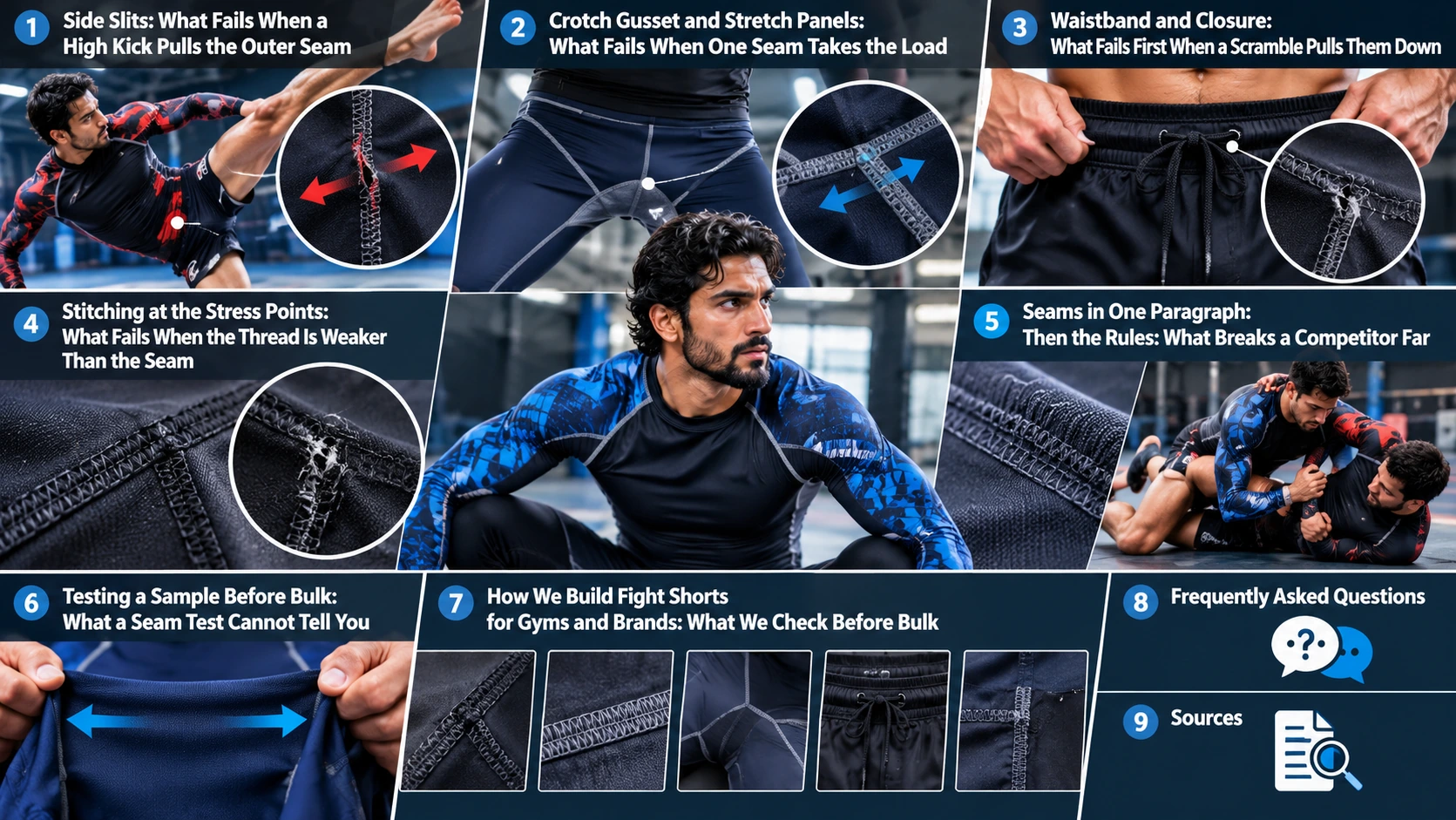

A side slit is an opening in the outer leg seam. It lets the leg lift for a kick without pulling the fabric tight across the hip, which makes it a range-of-motion feature. It does not add strength, so any strength at the slit has to come from its stitching. Opinions differ on whether a slit suits every fighter, so choose the slit length from the kicks your fighters throw in training.
The slit fails at its top. The seam ends in a corner where the fabric is pulled two ways at once, the leg lifting while the hip holds the shorts in place, so that corner takes the most load in a kick. An unreinforced top tears first because nothing spreads that load into the seam beside it. Our fight shorts page says the side slits are reinforced with bar-tack stitching to prevent tearing during high kicks, but that is a design statement with no test report behind it. Ask to see the slit top on your sample before you approve it.
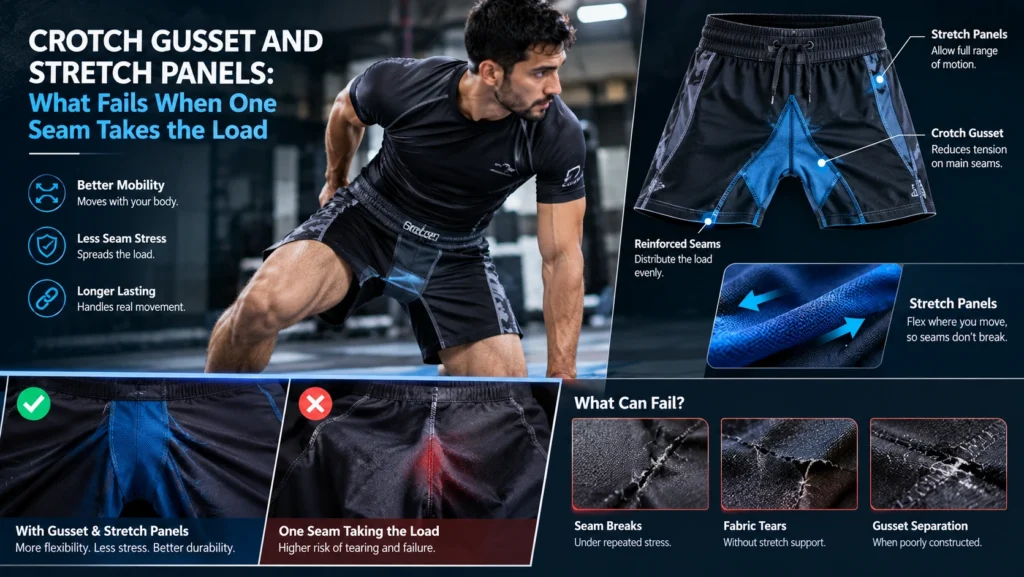
The crotch takes the load of a squat, a sprawl and a guard pull, all at the same place. A plain crotch is one seam that carries the whole load, so when that seam gives, the whole crotch goes. A gusset is an extra piece of fabric set into the crotch to split the load across more seams. A stretch panel is a knit section that moves with the hip instead of resisting it.
Our fight shorts page describes a diamond gusset with a 4-way stretch Lycra panel, which spreads stress across four seam points instead of two. It also says a triangle gusset fails during high kicks, which is the case it makes for the diamond shape. Those are design descriptions, and the page gives no test report behind either one. Ask the factory for the gusset pattern piece and count the seams that meet at each corner before you approve a sample.
|
Typical use
|
|---|
|
Shirts, dresses, warm-weather bottoms, layering pieces
|
|
Standard jeans, chinos-style pants, lighter jackets
|
|
Structured jackets, workwear, raw and selvedge denim
|
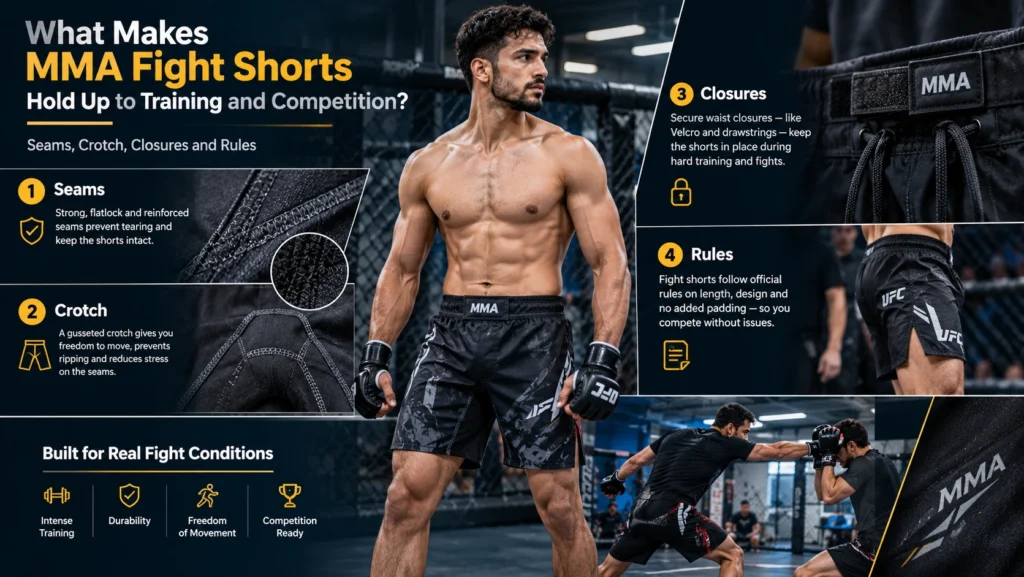
The crotch seam fails first when the gusset is missing or when its corners sit on a single line of stitching, because one seam then carries every load from the squat. Stretch matters too. A low-stretch crotch cannot move with the hip, so the seam takes force that the fabric should have absorbed.
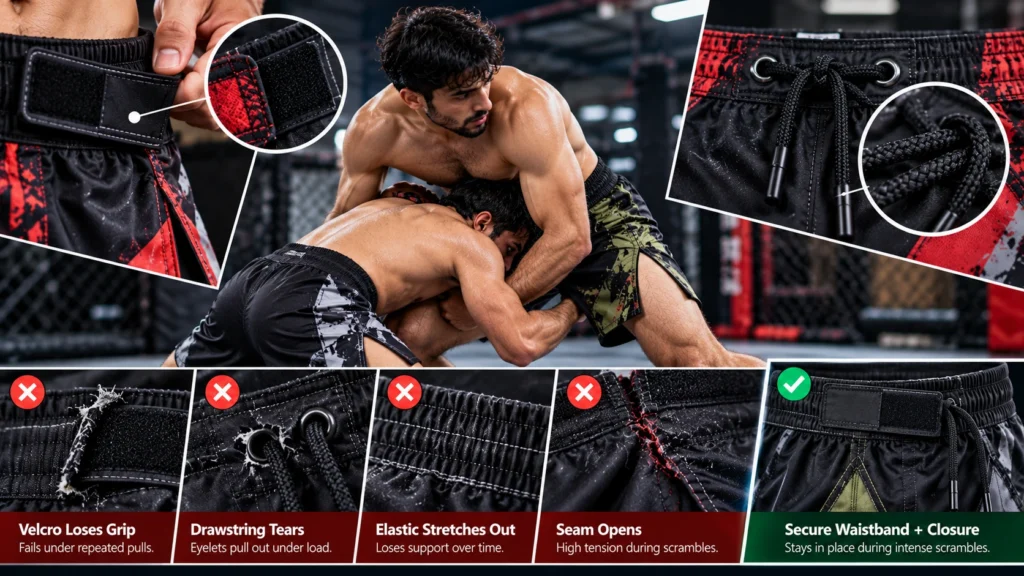
A scramble pulls on the waistband from every direction, so the closure is the part to test hardest. Competition rules decide what the closure may look like. The ABC Unified Rules say fighting shorts shall not have exposed Velcro, pockets or zippers, and the IBJJF no-gi rules ban exposed drawstrings. Between them, the two rules mean a hook-and-loop tab and a drawstring both have to be concealed.
Our fight shorts page says most MMA gyms prefer a fold-over hook-and-loop closure with a hidden internal drawstring, for maximum security during ground work without scratching opponents. That is a preference the page states, not a test result.
The closure fails first when its grip gives, because a hook-and-loop tab holds only as well as its hooks catch the loops. A closure that holds when you fasten it on a table has not yet been pulled the way a fighter pulls it. Test the sample by pulling the waistband from the sides and the back, the way a scramble does, and not only by fastening it on a table.
Stitching decides whether a seam can move with the fabric. Our cut and sew manufacturing page says a standard rigid lockstitch on four-way stretch spandex will snap the thread the moment the garment is put on. For stretch seams we use 4-thread overlock and coverstitch machines, which loop the thread so the seam stretches with the fabric. The same page says we use flatlock stitching to eliminate interior seam chafing on tight-fitting athletic wear.
Stress points need more than a stretch stitch. The same page describes automated bar-tack machines that fire concentrated zig-zag stitches over a garment’s stress points. On fight shorts, the top of the side slit and the crotch corners are the stress points to check, because the load there comes from two directions at once.
The seam fails when the thread cannot stretch with the fabric or when a corner has no reinforcement, because the load then runs into one line of thread. Ask how the line checks seams per inch. Our cut and sew page says in-line audits measure seams per inch and inspect thread tension, and you should check the stitch on your sample against the tech pack. The same page says the bill of materials must list the thread weight, so the thread belongs in the spec with the stitch.
Many fight shorts use a polyester microfibre or a polyester and spandex knit, because the polyester gives the body of the fabric and the spandex gives the stretch. Our fight shorts page describes its own build as 4-way stretch microfibre with a Lycra panel, but it gives no fibre percentage and no weight, so write both into your spec. Fabric depth belongs in our best fabrics for shorts guide. If you add mesh panels for airflow, our mesh lining guide covers how that layer is built. If you are also speccing a rashguard for the same team, the rashguard fabric choice is a separate decision.
The table compares the ABC Unified Rules of MMA with the IBJJF no-gi shorts rules.
|
Rule
|
ABC Unified Rules, section 11
|
IBJJF no-gi shorts
|
What to spec
|
|---|---|---|---|
|
Pockets
|
No exposed pockets (11(f))
|
No pockets, or pockets stitched completely shut
|
Leave pockets out of the pattern
|
|
Zippers
|
No exposed zippers (11(f))
|
No zippers, and no plastic or metal that could risk the opponent
|
No zippers on competition gear
|
|
Exposed hook-and-loop (Velcro)
|
No exposed Velcro (11(f))
|
Not named; the plastic or metal risk rule may apply
|
Conceal every hook-and-loop tab
|
|
Exposed drawstring
|
Not named
|
No exposed drawstrings
|
Keep the drawstring inside the waistband
|
|
Hem length
|
Hem may not extend below the knee (11(e))
|
At least halfway down the thigh and no longer than the knee
|
Set the hem on the pattern, not by eye
|
|
Colour
|
Fighters may wear different colour trunks (11(g))
|
Black, white, black and white, or the rank colour
|
Confirm colour with the event and your belt rank
|
The ABC text was amended on 5 August 2026 with a requested implementation date of November 2027, so check whether your event’s commission applies that version yet. Commissions can run their own versions, but the ABC text says those cannot be called the Unified Rules of MMA. Women fighters follow the same bottom-covering requirements under 11(d). IBJJF also permits compression shorts worn beneath the no-gi shorts, so no-gi compression shorts can sit under a legal outer short. A pair with a hem below the knee, or with exposed hook-and-loop, pockets or a zipper, does not meet the ABC text as written.
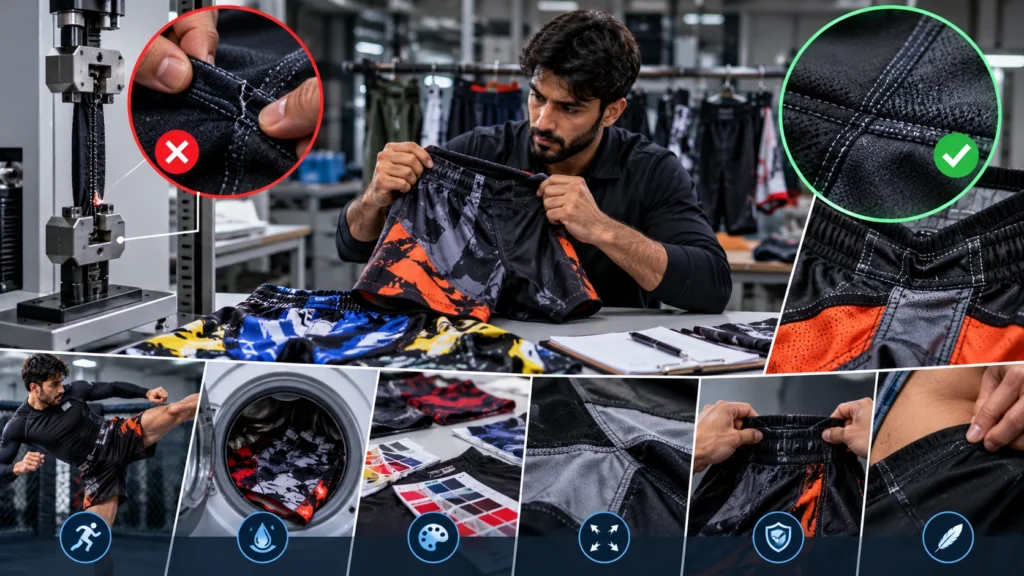
ISO 13935-1 is the strip test for seam strength. It sets a procedure for the maximum force a sewn seam takes when the force is applied across the seam. The sewn fabric may come from a sewn article or from a prepared fabric sample, as the parties agree, so ask which one your report used. The method applies to straight seams only, not curved seams, and a crotch seam is usually curved. The standard is also mainly for woven fabrics, so a knit needs the lab to confirm the method before you rely on the figure.
A seam strength result is not a wear result. CottonWorks says there are no universal standards for the durability of apparel, so the customer and the supplier have to agree on levels of satisfactory performance for each product. The same guidance says strength testing measures how a product might perform without numerous cycles of wear and care. A strip test pulls one seam once, so it cannot show how that seam holds after a season of kicks, squats and washing.
Before bulk, ask for three things: the seam method named on the report, a wash test on the prototype with length and width shrinkage recorded, and your agreed performance level written into the spec. Our quality control and inspection service checks bulk garments against the approved sample, so the spec and the sample must agree first. Our apparel prototyping page says we wash-test physical prototypes and record shrinkage in both the warp and weft directions, so ask for that record, not only the sentence.
We cut and sew fight shorts on our own production floor. Our prototyping page says the pre-production sample is built from the exact bulk fabric, hardware and sewing machines used for the run. Our cut and sew page says that before bulk production begins, you sign off on a physical Pre-Production (PP) sample. Once you approve it, it becomes the Golden Sample, and our prototyping page calls it a binding manufacturing contract. Our fight shorts page also says there are no fabric substitutions and no gusset spec changes without your written approval.
Our timeline is 12 days of sampling, 18 days of bulk production and 6 days of shipping. Our minimum is 30 pieces per design, and we are ISO 9001 certified. A full refund or a free remake is yours if the order does not match what was agreed.
Our sample makers need a finished tech pack with construction callouts, stitch types and points of measure before they start, so write the closure, the stitch types and the hem length into it. Send us that tech pack and start with the apparel prototyping and sampling stages.
A split starts at the seam where the load is higher than its stitching and fabric can carry. Kicks load the side seam, and squats, sprawls and guard pulls load the crotch, so a seam without reinforcement at its corners gives first. Check the stitch type and the stress points on the pre-production sample before you approve bulk.
A gusset spreads the crotch load across more seams, and a stretch panel lets the crotch move with the hip, so each does a different job. Our fight shorts page describes both as design features, but it gives no test report for either. Check both on the sample before you approve it.
A side slit is a mobility feature, because it lets the leg lift for a kick without pulling the fabric tight across the hip. It does not add strength on its own. The top of the slit needs reinforcement, because that corner takes the most load in a kick.
Put the sample on a fit model and pull the waistband from the sides and the back, the way a scramble does. Check that the closure stays fastened and that any hook-and-loop stays concealed. Ask for the same check on the pre-production sample, because a test on a table does not load the waistband the way a fighter does.
Under the ABC Unified Rules, fighting shorts shall not have exposed pockets, Velcro or zippers. Under IBJJF no-gi rules, pockets must be absent or stitched completely shut, and zippers are not allowed. Check the rulebook your event or federation uses, because commissions can run their own versions.
Under the ABC Unified Rules, the hem may not extend below the knee. Under IBJJF no-gi rules, the shorts must reach at least halfway down the thigh and be no longer than the knee. Set the hem length on the pattern to meet both, and check it on the sample before bulk.
No. A seam strength test pulls a seam until it breaks, and CottonWorks says strength testing is designed to show how a product might perform without numerous cycles of wear and care. Ask for the seam result and the wash result together, and treat neither one as a lifespan.
No, not for a curved crotch seam, because the standard applies to straight seams only. It is mainly written for woven fabrics but says it can apply to fabrics made by other techniques, so the lab must confirm the method is valid for your knit. Ask the lab to name the method on the report.
No universal standard does. CottonWorks says the customer and supplier need to agree on levels of satisfactory performance for each product and end use, so the wash test and the result you accept belong in your spec.
* * *

FOUNDER & CEO AT RIJIZ