
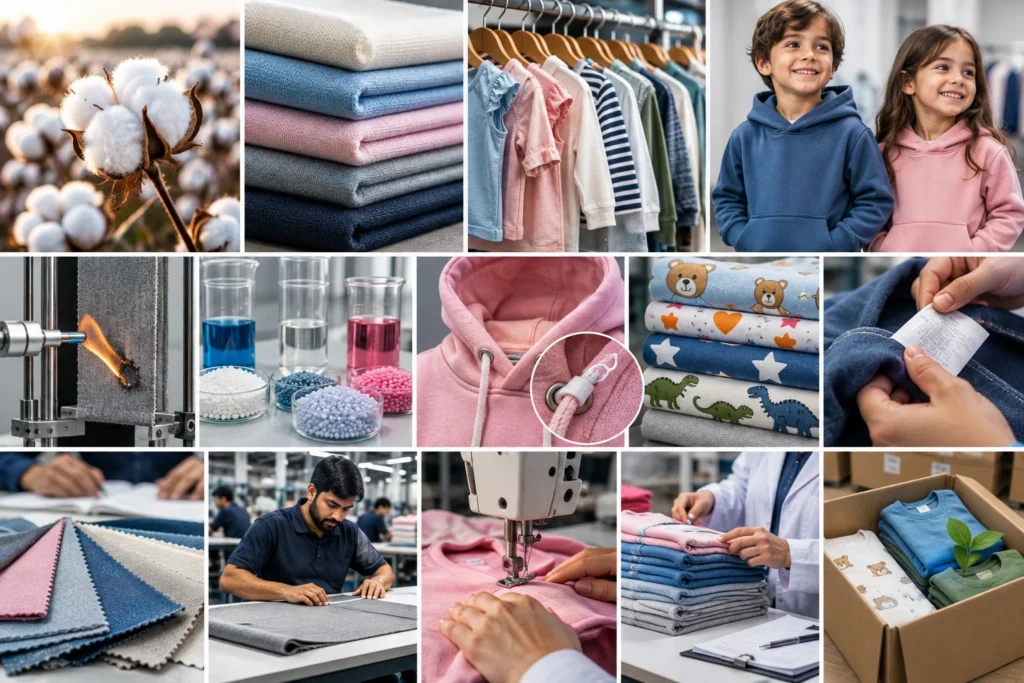
Adult apparel sourcing content can treat regulation as background context. Kidswear can’t, since several of the requirements below are legally mandatory, not optional best practices, and a garment that doesn’t meet them can’t legally enter a given market regardless of how well it’s made otherwise.
This matters at the sourcing stage specifically, before bulk production, since a factory that doesn’t build these requirements into the tech pack and pattern from the start is building toward a rework, a shipment hold, or worse, not toward a finished, sellable product.
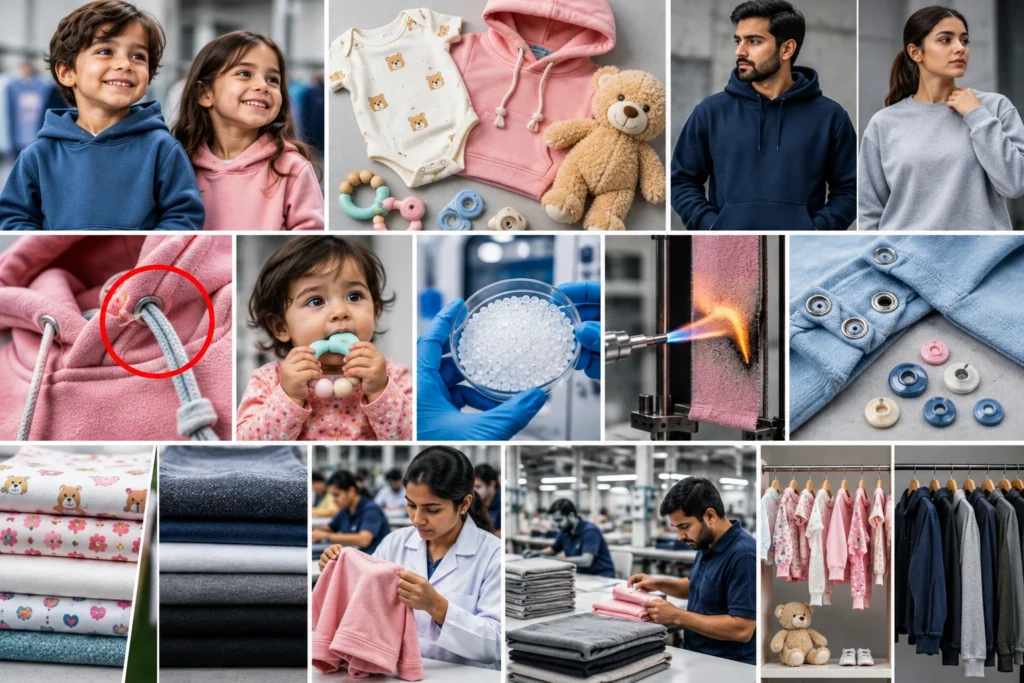
US kidswear compliance sits across several distinct CPSC regulations, each covering a different hazard category.
Flammability. The Flammable Fabrics Act , administered by CPSC and codified in 16 CFR Parts 1602 through 1632, sets mandatory flammability standards for clothing textiles broadly, with additional, stricter standards specifically for children’s sleepwear (16 CFR Parts 1615 and 1616). A kidswear brand sourcing sleepwear specifically needs to confirm which standard applies, since sleepwear-specific requirements are more stringent than the general clothing textile standard.
Drawstrings. This is one of the most specific, well-documented hazard rules in kidswear regulation. 16 CFR Part 1120 incorporates ASTM F1816-97 and classifies non-conforming drawstrings on children’s upper outerwear as a substantial product hazard. The rule is specific: drawstrings at the hood or neck are prohibited entirely on sizes 2T through 12. Drawstrings at the waist or bottom on sizes 2T through 16 are limited to 3 inches of maximum length outside the drawstring channel when the garment is fully expanded, and must be free of toggles, knots, or other attachments at the free ends. This isn’t a stylistic guideline, it followed 18 documented deaths and 38 nonfatal incidents CPSC tracked from neck and hood drawstrings between January 1985 and September 2009.
Small parts and choking hazard. Snaps, buttons, decorative appliqués, and any small attached component need to be evaluated against small-parts choking-hazard standards for the intended age range, since a component that’s perfectly fine on adult apparel can be a real hazard on a garment sized for a young child.
Phthalates. Under CPSIA, 16 CFR Part 1307 restricts eight specific phthalate compounds to a maximum of 0.1% (1,000 ppm) in accessible component parts of children’s toys and child care articles. For kidswear specifically, this matters whenever a garment includes a molded plastic component, a PVC print, a rubberized appliqué, or a plastic snap or zipper pull, not for woven or knit fabric on its own, so the relevant question for a tech pack is which components on a given garment are plastic, not whether the whole garment needs phthalate testing by default.
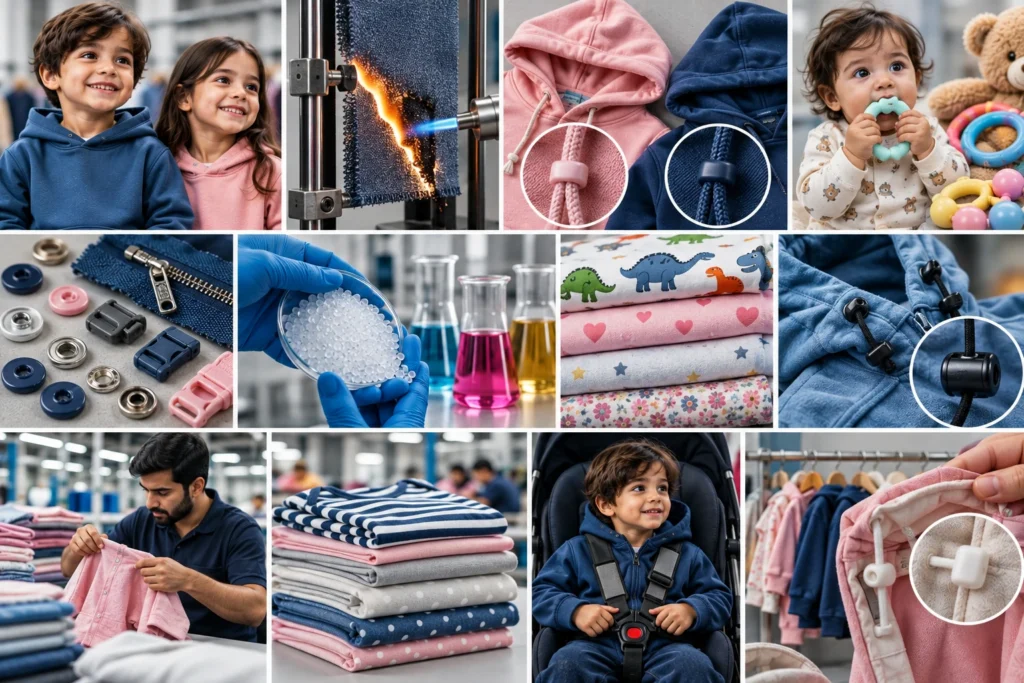
The EU regulatory picture shifted meaningfully in December 2024, and a brand sourcing for both US and EU markets needs both frameworks in view, not just one.
The General Product Safety Regulation, (EU) 2023/988 , has applied since December 13, 2024, replacing the older General Product Safety Directive (2001/95/EC). The shift from a directive to a regulation matters structurally: a directive requires each EU member state to separately transpose it into national law, which can create small inconsistencies country to country, while a regulation applies directly and uniformly across every member state without that extra translation step. GPSR covers general product safety broadly, not apparel specifically, but it’s the umbrella framework kidswear (and every other consumer product) sourced for the EU market sits under.
On drawstrings specifically, the EU has its own dedicated standard, EN 14682, covering safety requirements for cords and drawstrings on children’s clothing, broadly parallel in intent to the US’s ASTM F1816-97 but a separate standard with its own specific requirements, worth confirming independently rather than assuming US drawstring compliance automatically satisfies the EU standard.
REACH, the EU’s broader chemical-substances regulation, also applies to textiles and restricts a range of substances beyond what CPSIA covers in the US, which is part of why a brand selling into both markets needs a supplier who can speak to both compliance frameworks, not just one.
OEKO-TEX Standard 100 tests finished textile products for harmful substances against defined limit values, and Product Class I, the strictest of its four product classes, applies specifically to textiles intended for babies and small children up to 36 months. It’s a real, meaningful, independently verified certification, and it’s worth asking for by name on kidswear specifically.
It is also not a substitute for legal compliance. OEKO-TEX Standard 100 certification doesn’t automatically satisfy CPSIA’s flammability, drawstring, small-parts, or phthalate requirements in the US, and it doesn’t automatically satisfy GPSR or EN 14682 in the EU. It’s a voluntary trust signal layered on top of legal compliance, not a replacement for it, and a brand that treats an OEKO-TEX certificate as covering its legal obligations has misunderstood what the certificate actually attests to.
The practical takeaway for a tech pack: legal compliance (CPSIA in the US, GPSR and EN 14682 in the EU) is the non-negotiable baseline. OEKO-TEX Standard 100 Product Class I is a genuinely valuable, optional layer on top of that baseline, not a shortcut around it.
No. Above a certain point, added spandex increases cost and can change hand feel and durability without adding meaningful performance benefit for a given activity. Yoga and studio wear justify a higher spandex share because of the opacity-under-stretch requirement; running and team sports fabric usually don't need to go nearly as high.
No. Inherent wicking is engineered into the fiber or yarn cross-section and is permanent. A topical wicking finish is applied after the fact and typically degrades over repeated washing. The real test standard behind a genuine wicking claim, AATCC 195, is covered in more depth elsewhere in this series.
No, they're two distinct construction methods produced on different machines. A finished garment can combine panels of each (a circular-knit body with a warp-knit structured panel, for example), but a single piece of fabric is one or the other, not both.
It's widely used in activewear and generally considered safe at the low concentrations used for textile treatment, though a brand with specific safety claims to make should ask a supplier for the treatment's actual test data and compliance documentation rather than relying on general industry reputation.
Because most team programs require printed graphics, numbers, or sponsor branding, and polyester is the fiber that accepts sublimation ink directly through heat conversion. A fabric blend that isn't majority polyester won't take sublimation printing the same way, which narrows the practical fiber choice for this category specifically.
bluesign audits the manufacturing process and chemical inputs at the factory level. OEKO-TEX Standard 100 tests the finished textile itself for harmful substances. One is a process certification, the other is a finished-product certification, and they're not interchangeable.
Yes, particularly for outdoor recreation and cooler-weather training pieces, where a brushed interior face adds a soft, slightly insulating hand without the bulk of a full fleece backing. It's less common in high-intensity categories like running or HIIT, where the priority is airflow rather than warmth.
No. GSM tells you weight, not stretch percentage, knit construction, or moisture-management performance. Two fabrics at the same GSM can perform completely differently depending on fiber blend, spandex share, and whether they're circular or warp knit.
It depends on what claim the brand wants to make. A brand focused on manufacturing-process sustainability should ask about bluesign specifically; a brand focused on finished-product safety should ask about OEKO-TEX Standard 100. Some suppliers carry both, but assuming one implies the other is a mistake.
* * *

FOUNDER & CEO AT RIJIZ