
The apparel industry operates on a dangerous financial premise: sew it fast, ship it out, and pray the client doesn’t catch the mistakes. This culture of speed over precision is exactly why an entire industry of third-party auditing companies (like QIMA, SGS, and HQTS) exists. Brands are forced to pay external inspectors hundreds of dollars a day just to fly to a factory and verify that the clothes they already paid for aren’t falling apart.
You should not have to hire an external police force to manage your own manufacturer.
At Rijiz, we operate our facility under a zero-trust policy. We do not inspect garments at the end of the line; we audit them continuously at every single workstation. This document serves as our internal factory audit manual. It breaks down the mechanical stress tests, the acceptable defect mathematics, and exactly how our quality control and inspection services guarantee your bulk run matches your approved prototype perfectly.
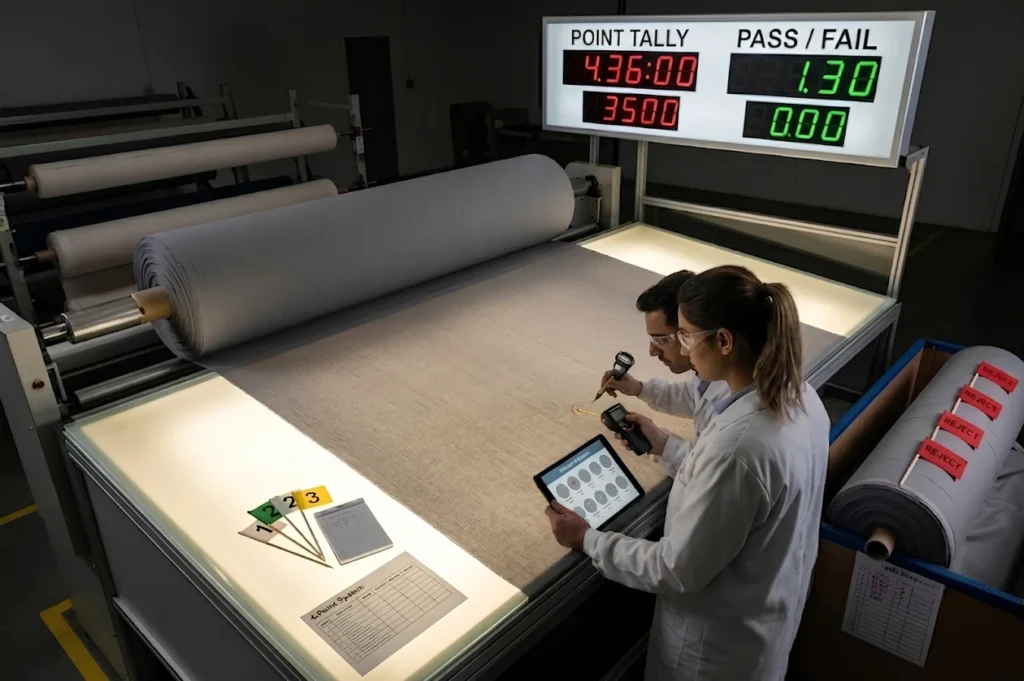
You cannot build a flawless garment out of compromised fabric. The biggest mistake a generic garment inspection company makes is waiting until the clothes are completely sewn to start checking for errors.
Before a single roll of fabric is allowed onto our cutting tables, it undergoes a grueling inbound audit known in textile engineering as the 4-Point Grading System.
Inspector’s Note: Our technicians unroll the greige or dyed fabric across massive, backlit inspection tables. As the fabric rolls over the high-intensity light, the technician visually hunts for slubs, misweaves, dye spots, and microscopic holes. Every defect is assigned a penalty point based on its physical size. If a roll of fabric accumulates more than 40 penalty points per 100 square yards, the entire roll is classified as “Grade B” and is legally rejected and returned to the textile mill.
If an overlock sewing machine has the wrong thread tension, it will pucker the fabric. If you wait until the end of the day to check the garments, you will have 500 puckered, unsellable shirts.
To prevent this, our floor managers execute rigorous In-Line Inspections. Every two hours, a QA manager walks the active sewing line and pulls garments directly out of the operators’ hands.
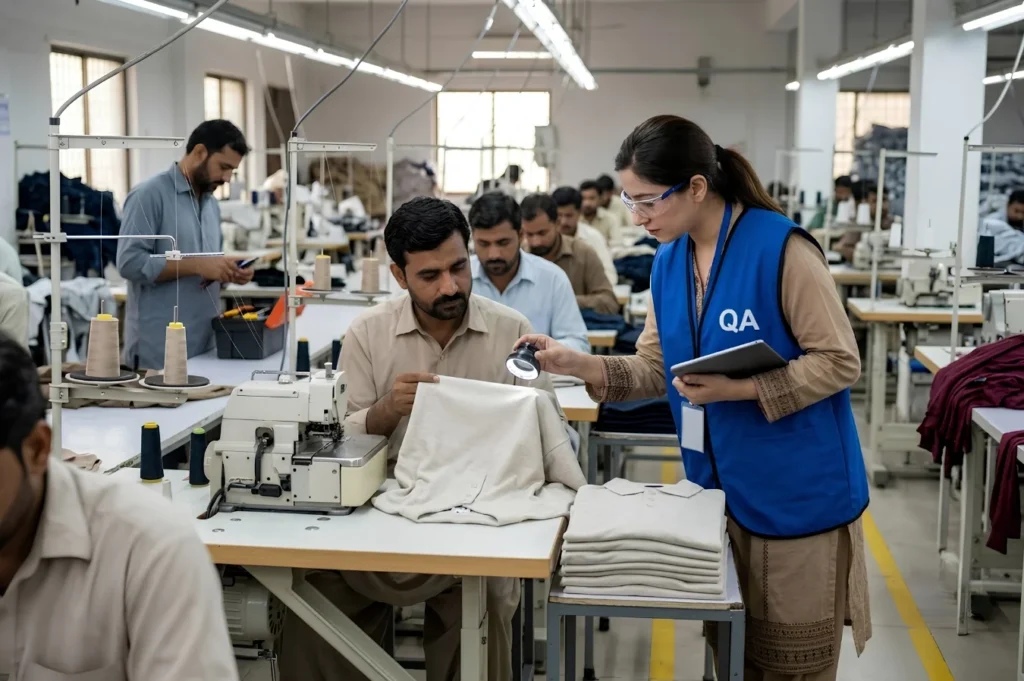
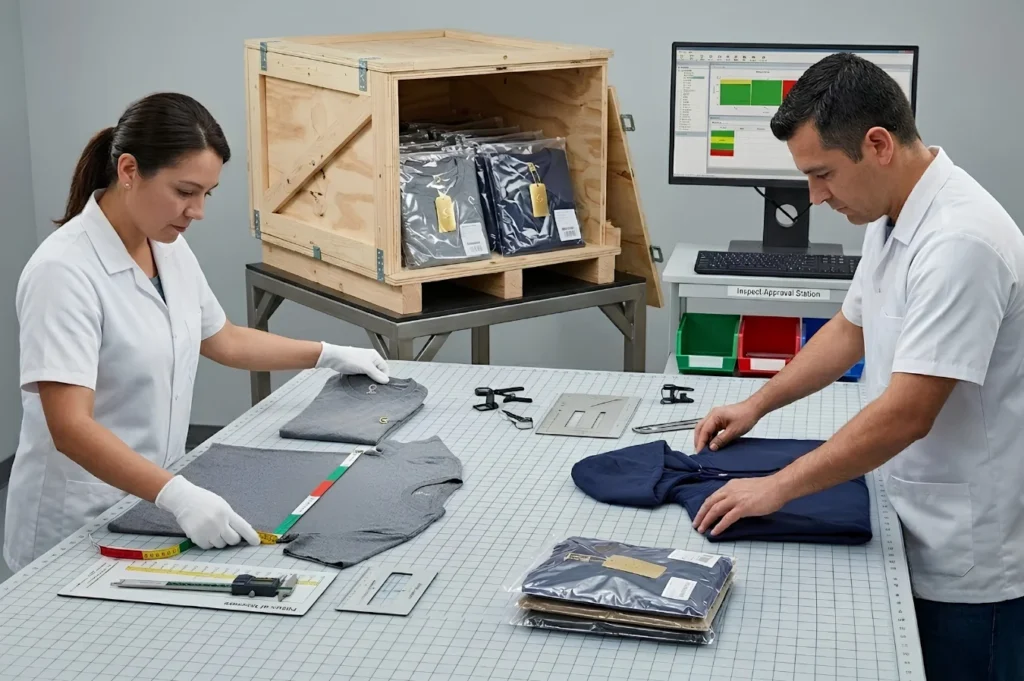
Once the garments are fully assembled, pressed, tagged, and folded into their polybags, they enter the Final Random Inspection (FRI) phase. This is the last line of defense before your inventory is loaded onto a shipping container.
Our internal auditors open random boxes from the sealed pallet. They pull out the packaged garments and subject them to a brutal, comprehensive teardown based strictly on your approved Golden Sample.
Dimensional Tolerance Verification: A size Large must measure exactly like a size Large. The inspector lays the garment completely flat and uses a specialized measuring tape to check the chest width, sleeve length, and sweep against the Points of Measure (POM) chart. If the measurement deviates beyond the allowed fraction of an inch (the tolerance), it is marked as a Major Defect.
Symmetrical Visual Alignment: The inspector folds the garment exactly in half down the center vertical axis. If the left shoulder seam does not perfectly align with the right shoulder seam, the garment was cut off-grain during the laser cutting phase. An off-grain garment will twist heavily after its first wash. It is instantly rejected.
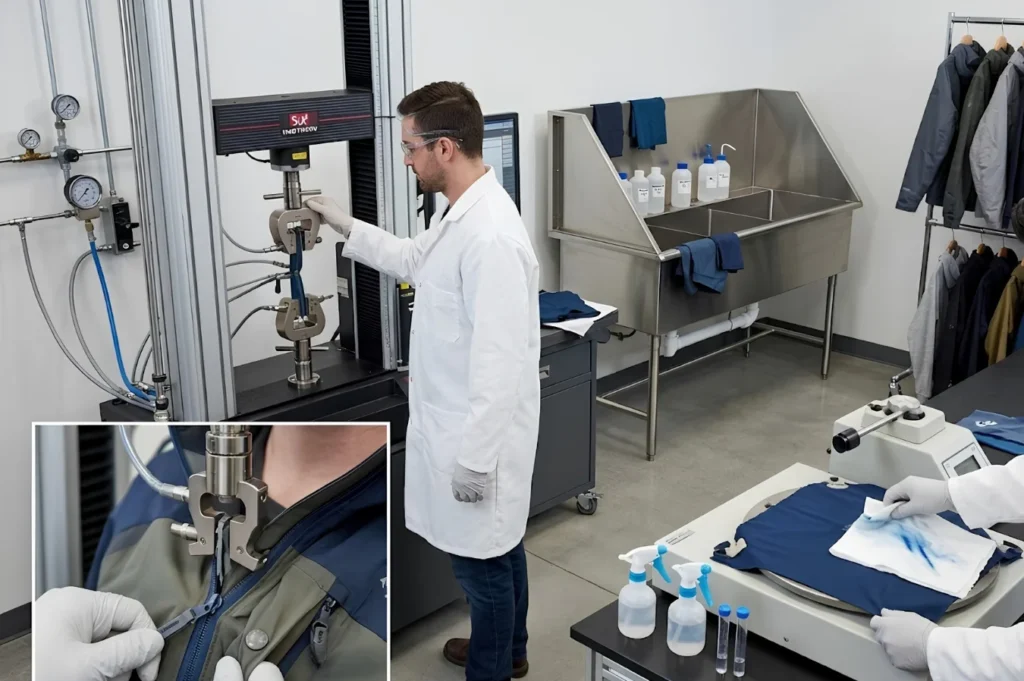
Visual checks are not enough for high-performance apparel. Certain fabrics and hardware require brutal, physical stress testing—meaning we actually try to destroy the sample garment to see where its breaking point lies.
Inspector’s Note — Hardware Pull-Tests: We do not just look at the zippers to see if they zip. Inspectors perform physical pneumatic pull-tests on all YKK hardware, snap buttons, and drawstrings. The machine pulls the hardware until it breaks to ensure it will not detach when an end-consumer violently yanks on it.
Inspector’s Note — Crocking Tests: We must verify the chemical stability of the fabric dye. We perform “crocking” tests by taking a swatch of your dyed fabric and violently rubbing it against a piece of pure white cotton, under both wet and dry conditions. If the dye bleeds onto the white cotton, the chemical fixation failed at the dye house, and the fabric is rejected.
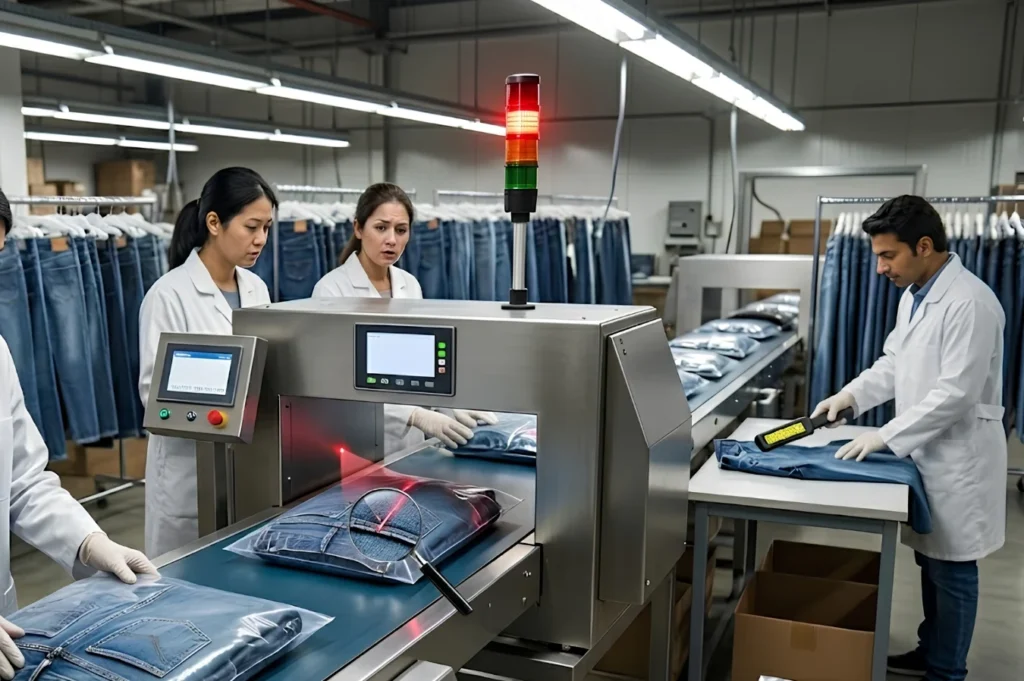
During the rapid pace of an industrial sewing line, needles frequently snap. A broken needle tip can easily become embedded inside a heavy denim seam or hidden under a pocket fold. If a consumer finds a needle in their garment, the liability to your brand is catastrophic.
Before any shipping carton leaves our facility, we pass every single sealed polybag through an industrial conveyor needle detector. If a microscopic shard of metal is trapped inside the garment, the machine halts and sounds an alarm, ensuring 100% safety compliance.
Your logistics provider (Amazon FBA or your 3PL warehouse) will penalize you heavily if your shipping boxes are labeled incorrectly or if the carton weights do not match the shipping manifest.
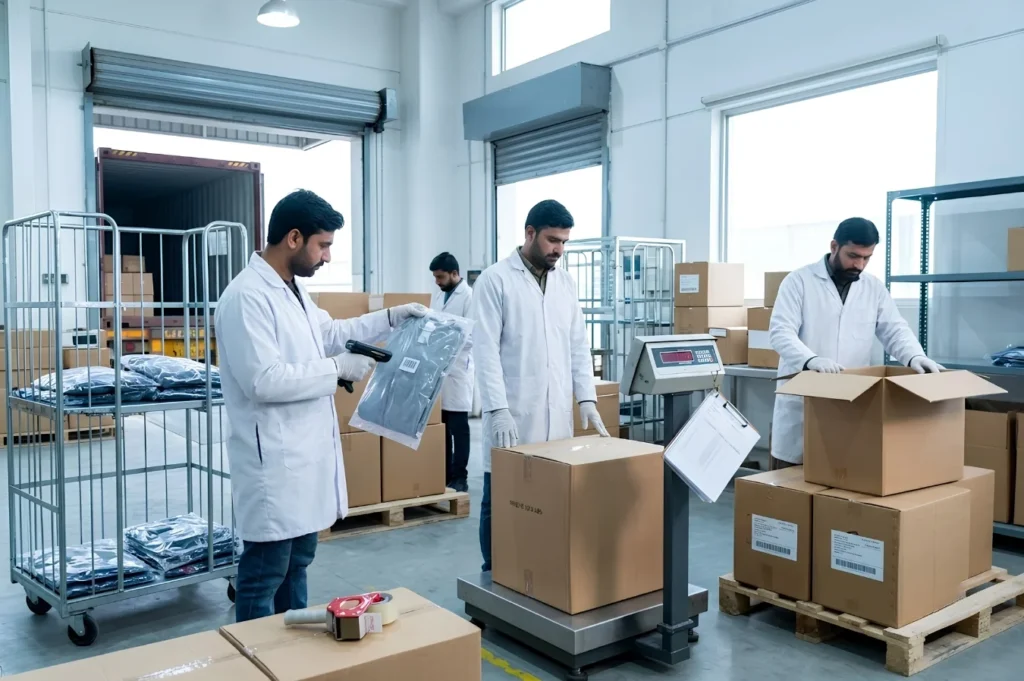
Our final factory garment inspection process extends beyond the clothes themselves into the actual logistics. We scan the UPC barcodes on your polybags to ensure they read correctly into retail systems.
We then weigh the master shipping cartons against the theoretical weight calculated in your tech pack. If a box is supposed to hold 50 shirts and weigh exactly 25 lbs, but the scale reads 22 lbs, the inspector knows immediately that the box is missing garments. The carton is opened, recounted, and corrected before it ever leaves our loading dock.
Absolutely. We operate a completely transparent factory floor. You are always welcome to hire an independent garment inspection company to conduct a Final Random Inspection (FRI) at our facility before you authorize the final payment for shipping. We welcome external audits because our internal standards are just as strict.
Garments with Minor or Major defects are routed to a dedicated rework line. If a hem is crooked, the thread is unpicked, and the hem is re-sewn perfectly by a master operator. If the garment has a Critical defect (like a burn hole or torn fabric), it is physically destroyed and replaced with a newly manufactured unit. You never pay for defective goods.
Yes. Before we release the shipment to the freight forwarder, we provide you with a comprehensive digital inspection report. This includes high-resolution photos of the garments, the AQL statistical breakdown, and the results of the hardware pull-tests, proving the batch meets your exact standard.
Do not accept a 10% defect rate as “the cost of doing business overseas.” You are losing thousands of dollars to poor tension, skipped stitches, and off-grain cutting.
Our apparel quality control services provide the strict statistical mathematics, the in-line auditing, and the brutal hardware stress tests required to ensure your inventory is completely flawless the moment you open the box.
Rijix Limited - 7 Bell Yard, London, England, WC2A 2JR
Rijiz International - Mohala Chawinda Daburji Arayian Pasrur Road Sialkot, Pakistan.
Phone : +44 7307582940 Phone : +92 336 140 8321