
Industrial Custom Embroidery Services: The Physics of Thread and Fabric
Slapping a heavy logo onto a lightweight t-shirt will completely destroy the drape of the garment. Embroidery is not a printing technique; it is a structural modification to your fabric. Every time a needle punctures a textile, it introduces kinetic tension. If that tension is not managed mathematically, the fabric will pucker, the stitches will sink, and the logo will warp after a single wash.
We provide high-volume custom embroidery services built on strict mechanical discipline. We do not just run your logo through an automated software converter. We engineer the stitch paths, calculate the exact backing required for your specific fabric GSM, and execute the run on high-torque, multi-head industrial embroidery machines.
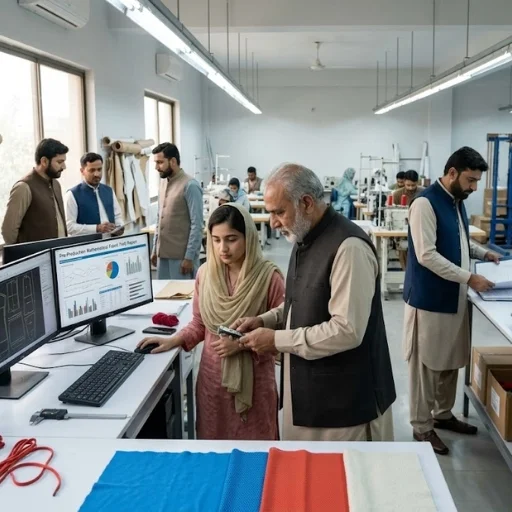
The Digitization Protocol: Translating Pixels to Stitch Paths
A JPEG image means absolutely nothing to an embroidery machine. Before a needle ever moves, your visual logo must be translated into a digital, machine-readable language (typically a DST or PES file). This process is known as digitization.
Amateur facilities use auto-digitizing software, which treats every logo the same. This results in heavy, bulky thread build-ups that snap needles and distort text.
Our commercial embroidery manufacturer team manually digitizes every file. A master digitizer plots the exact path the needle will take. They calculate the push-and-pull compensation required based on your specific fabric type. They dictate exactly where the machine should lay down a structural “underlay” stitch before applying the top satin stitch. This level of granular control ensures crisp, highly legible text,even at microscopic scale.
Core Embroidery Capabilities
Different brand aesthetics require entirely different mechanical applications. We maintain the hardware and technical expertise to execute three distinct categories of thread work.
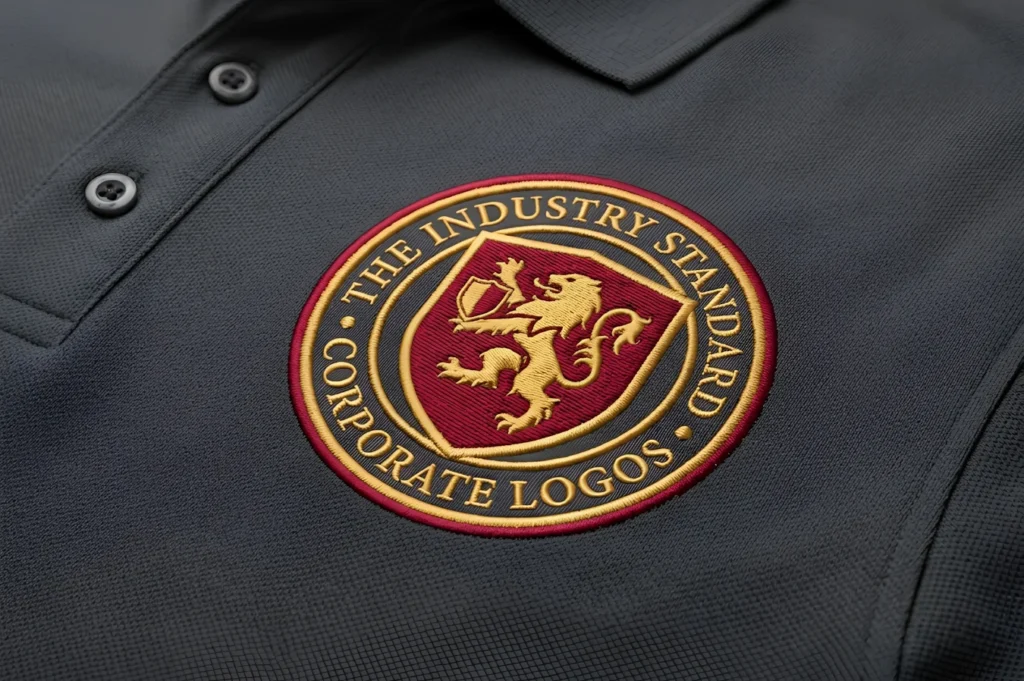
The industry standard for corporate logos, left-chest monograms, and intricate crests. The thread is stitched flat against the surface of the garment. For high-end bulk apparel embroidery, we utilize dense satin stitches for bold lettering and tatami (fill) stitches for large, solid blocks of color, ensuring zero fabric shows through the design.
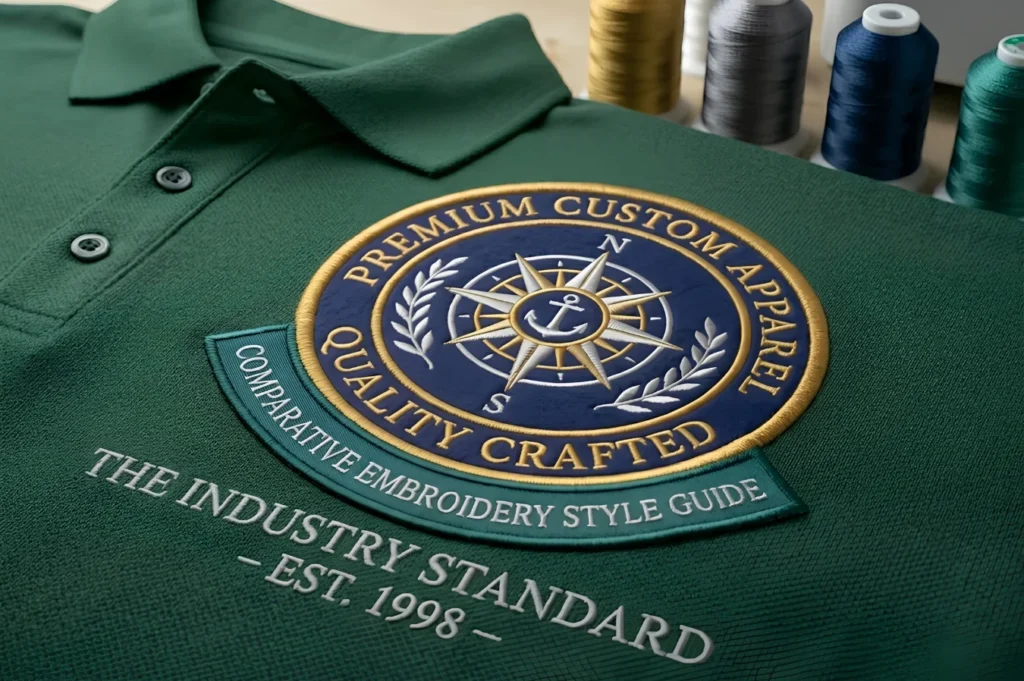
This technique is mandatory for premium streetwear snapbacks, trucker hats, and heavy hoodies. Before stitching, we lay a high-density, 3mm thick EVA foam over the fabric. The needle fires through the foam, encapsulating it completely within the thread. The result is a bold, raised, three-dimensional graphic that literally lifts off the garment.
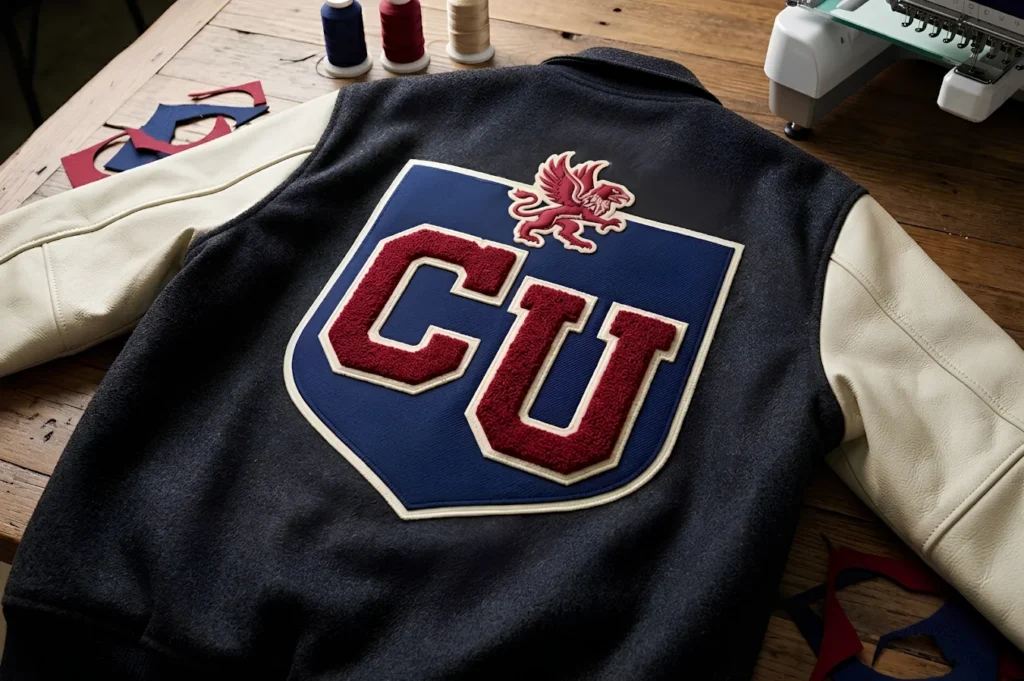
For massive back-piece logos (like varsity jackets or collegiate sweaters), covering a 14-inch area with solid thread makes the garment too heavy and rigid to wear comfortably. Instead, we use Appliqué: laser-cutting a separate piece of fabric (like felt or twill) into the shape of your logo, laying it on the garment, and securing the edges with a tight satin border stitch. We also offer looping Chenille embroidery for classic, textured varsity aesthetics.
Stabilizers and Backing Mechanics
The secret to flawless embroidery happens entirely on the inside of the garment. You cannot fire 10,000 stitches into a soft piece of cotton without reinforcing the textile first.
Depending on the stretch and GSM of your garment, our technicians apply specific industrial stabilizers (backing) to the interior of the fabric before hooping it into the machine.
Used for highly stable, heavyweight wovens (like denim or thick twill) that do not stretch. Once the embroidery is complete, the excess backing is simply torn away by hand, leaving a clean interior.
Mandatory for knits, activewear, and any fabric that stretches. This backing permanently stabilizes the fabric so the embroidery doesn't warp when the garment is pulled over a body. The excess is surgically trimmed with scissors post-production.
When embroidering high-pile fabrics like thick fleece, towels, or beanies, the stitches tend to sink into the fuzz and disappear. We lay a transparent, water-soluble film over the fabric before stitching. This keeps the thread elevated and crisp. The film dissolves instantly during the first wash.
High-Torque Multi-Head Production
As a dedicated apparel embroidery factory, we do not run single-head hobbyist machines. Bulk production requires massive scale and mechanical reliability.
We deploy industrial, 15-needle, multi-head machines (such as Tajima or Barudan equivalents). These machines allow us to embroider 20 to 30 garments simultaneously with exact mechanical synchronization. The high-torque motors are capable of driving thick metallic threads through the heavy seams of a Carhartt-style work jacket or the rigid buckram of a structured baseball cap without dropping a single stitch or breaking tension.
Thread Anatomy and Color Theory
The visual impact of your logo is dictated by the chemical makeup of the thread itself. We stock thousands of thread cones and match your exact brand guidelines using the Pantone Solid Coated (PMS) system.
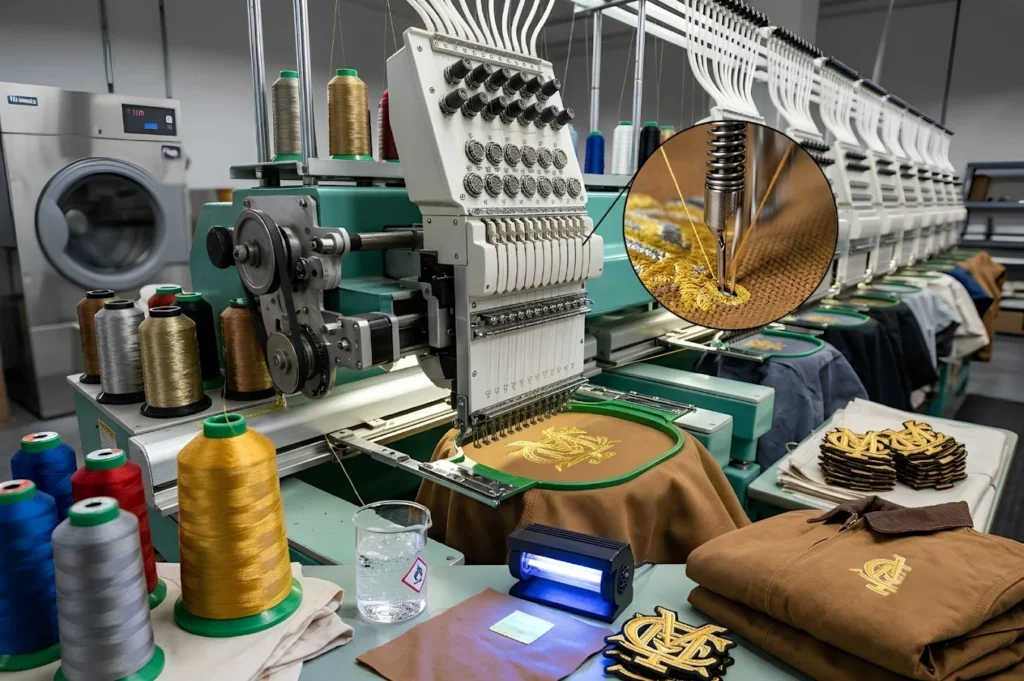
This is the workhorse of industrial embroidery. It is highly resistant to bleach, industrial washing, and UV fading. It possesses a high tensile strength, meaning it will not snap during high-speed multi-head runs, making it the default choice for heavy workwear and activewear.
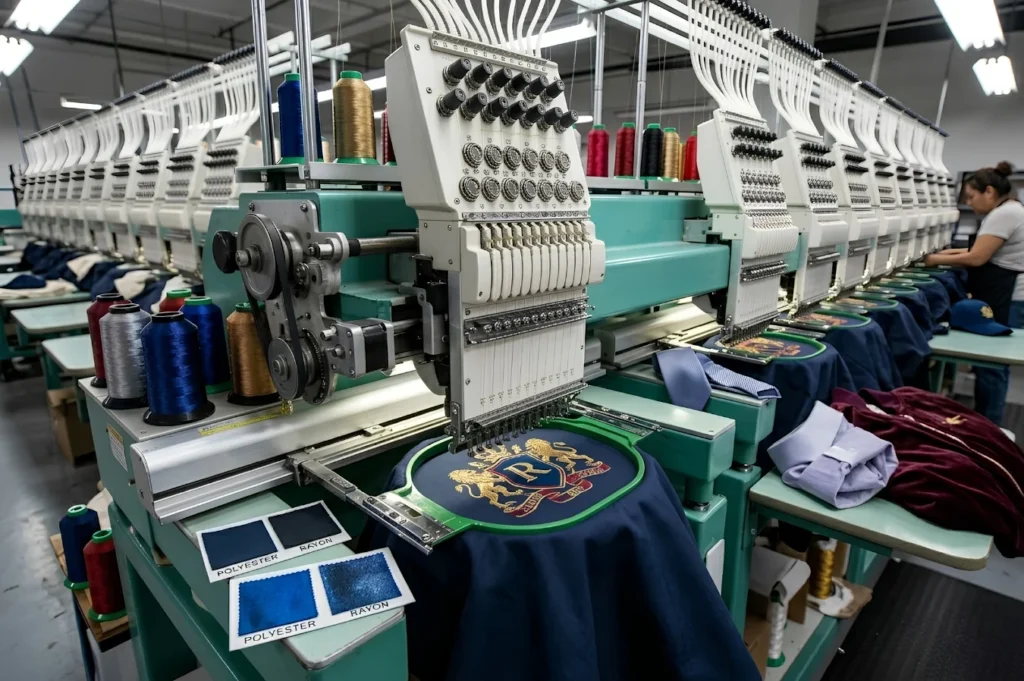
Rayon is slightly more delicate than polyester but possesses an incredibly high-sheen, glossy finish. We utilize rayon for high-end corporate apparel, luxury streetwear, and intricate crests where a premium, light-catching aesthetic is required.
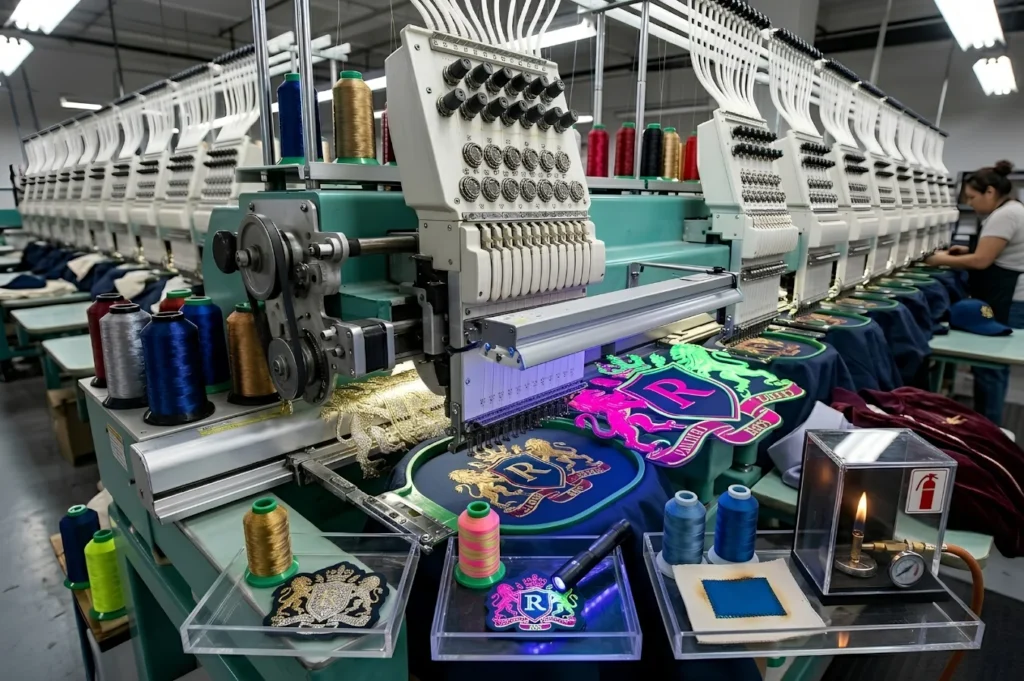
For highly specialized branding, we deploy metallic threads, neon UV-reactive threads, and fire-retardant threads (mandatory for specific industrial uniform contracts).
Understanding Contract Embroidery Economics
In the embroidery industry, pricing is not based on the number of colors in your logo; it is based strictly on “Stitch Count.”
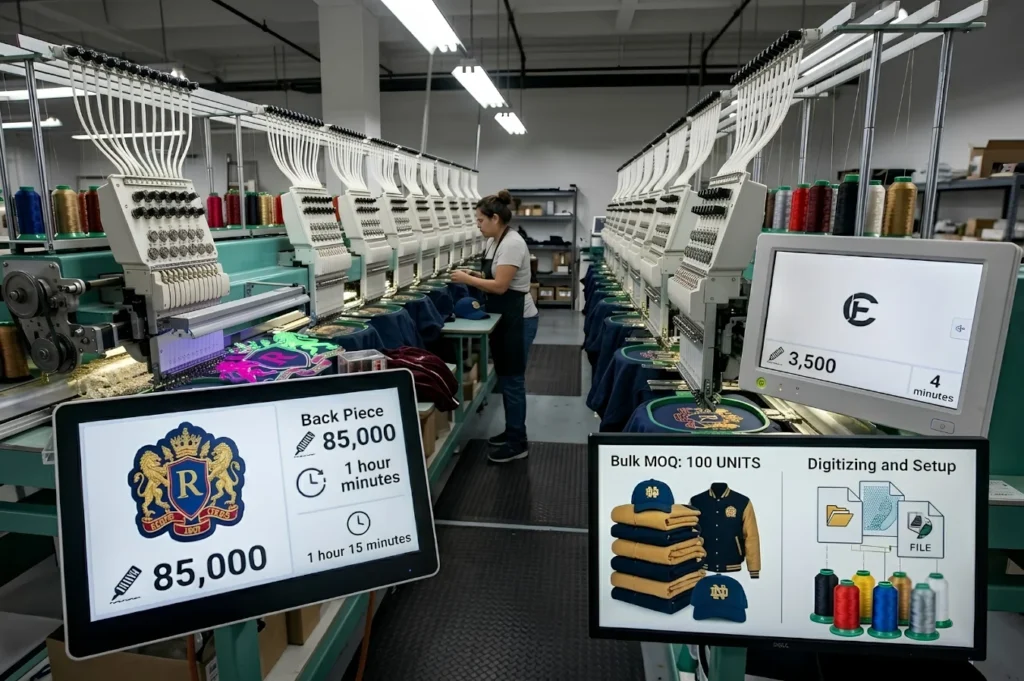
A small, minimalist left-chest logo might require 3,500 stitches and run in four minutes. A massive, fully-filled back piece might require 85,000 stitches and tie up a machine head for over an hour.
When you contract our 3D puff embroidery services or standard flat stitching, we run your digital file to calculate the exact stitch count. We then multiply that count by our bulk run rate. Because of the intensive setup required to digitize the file, hoop the garments, and thread the multi-head machines, we enforce strict Minimum Order Quantities (MOQs), typically starting at 100 units per design.
Testimonial
Posted on GoogleTrustindex verifies that the original source of the review is Google. We have worked with this supplier on the development and production of high-performance sportswear, and the experience has been very positive. We especially value their clear communication, willingness to make adjustments, and commitment to quality. They were open to technical feedback and worked closely with us to improve fabrics, finishes, and details until meeting our standards. Deadlines were met properly and the final result was professional. We definitely recommend this supplier to brands looking for a serious, long-term partnership.Posted on GoogleTrustindex verifies that the original source of the review is Google. Great productPosted on GoogleTrustindex verifies that the original source of the review is Google. Highly recommend this company for your custom clothing for your brand. One of my favorite things working with them is the constant and clear communication, and the attention to detail. Also they are very quick especially for producing high quality apparel, and provide updates and progress photos throughout the process. A+ across the board, ive recommended them to my peers in the industry and will certainly use them again.Posted on GoogleTrustindex verifies that the original source of the review is Google. Gohar was very helpful and worked with our team every step of the way. He providing useful tips and thorough inspection during the manufacturing process. The clothes were extremely high quality and all designs, embroidery, etc was perfect.Posted on GoogleTrustindex verifies that the original source of the review is Google. Excellent communication, service and products. Material is always as agreed and of top quality. Very much recommended.Posted on GoogleTrustindex verifies that the original source of the review is Google. Amazing Service, Shipping and Very Affordable Prices, Highly Recommended!Posted on GoogleTrustindex verifies that the original source of the review is Google. They are SO fast. Very good to work with and responsive. They are knowledgable about what looks good and giving you exactly what you want.Posted on GoogleTrustindex verifies that the original source of the review is Google. I have build a hand full of entrepreneurial businesses, but recently made my first venture into the sportswear sector, and decided to work with Rijiz as my first clothing manufacturer. They did an incredible job bringing my flat sketches to life, and working with me throughout the iterative design process, making small tweaks and suggestions as we moved towards the final product. Their communication was good via email, and they were supportive throughout the process, even checking in with me periodically to ask how things were going. The only hiccups were a last minute increase in the cost per unit of the product, and a slightly longer than expected lead time, but my order quantity was very small, so these problems make sense. I'm sure larger order with them take priority. Overall, they are a great company that I will continue to work with as this business grows, and I would highly recommend them!Posted on GoogleTrustindex verifies that the original source of the review is Google. Every good communication skills, always delivering and make the customer wholesome. Very very happy for the results💯💯💯Posted on GoogleTrustindex verifies that the original source of the review is Google. Great manufacturer and makes sure every detail is on point, Very satisfied with their work. What i ordered was exactly what was delivered to me, Much respect to them 🫡
Technical Embroidery FAQ
We can, but it requires careful engineering. Embroidering directly over a functional pocket sews the pocket shut. If you need a logo on a pocket, we highly recommend utilizing our Full Production Package (FPP), where we embroider the raw fabric panel before the pocket is actually sewn onto the garment.
There is a physical limit to how small thread can be manipulated. If letter heights drop below 5 millimeters (0.2 inches), the needle punctures overlap, causing the text to look muddy. Our digitizers will warn you if your text is too small and suggest thickening the font or simplifying the logo.
Yes. If you operate as a Private Label brand and want to ship us your own blank hoodies or hats, we act strictly as your contract embroidery manufacturer. We will require a physical test run of 5 units to calibrate our thread tension to your specific supplied fabric.
No. 3D puff requires firing thousands of high-density satin stitches over a 3mm foam block. A standard 150 GSM t-shirt lacks the structural integrity to support that much weight. The fabric will heavily distort and sag. 3D puff is strictly reserved for structured hats, heavyweight fleece (400+ GSM), and thick outerwear.
Ready to Execute High-Density Visual Branding?
A cheap, poorly digitized logo will ruin an otherwise perfectly manufactured garment. Do not trust your visual identity to software auto-converters and weak hobbyist machines.
Our custom embroidery services provide the industrial hardware, the mechanical backing protocols, and the expert digitization required to make your logo look unshakeably premium.
Fast & secure delivery worldwide.
Hassle-free refunds
Confidence in every purchase.
Dedicated customer assistance.
Get in touch
Rijix Limited - 7 Bell Yard, London, England, WC2A 2JR
Rijiz International - Mohala Chawinda Daburji Arayian Pasrur Road Sialkot, Pakistan.
Phone : +44 7307582940 Phone : +92 336 140 8321